F L A U N T


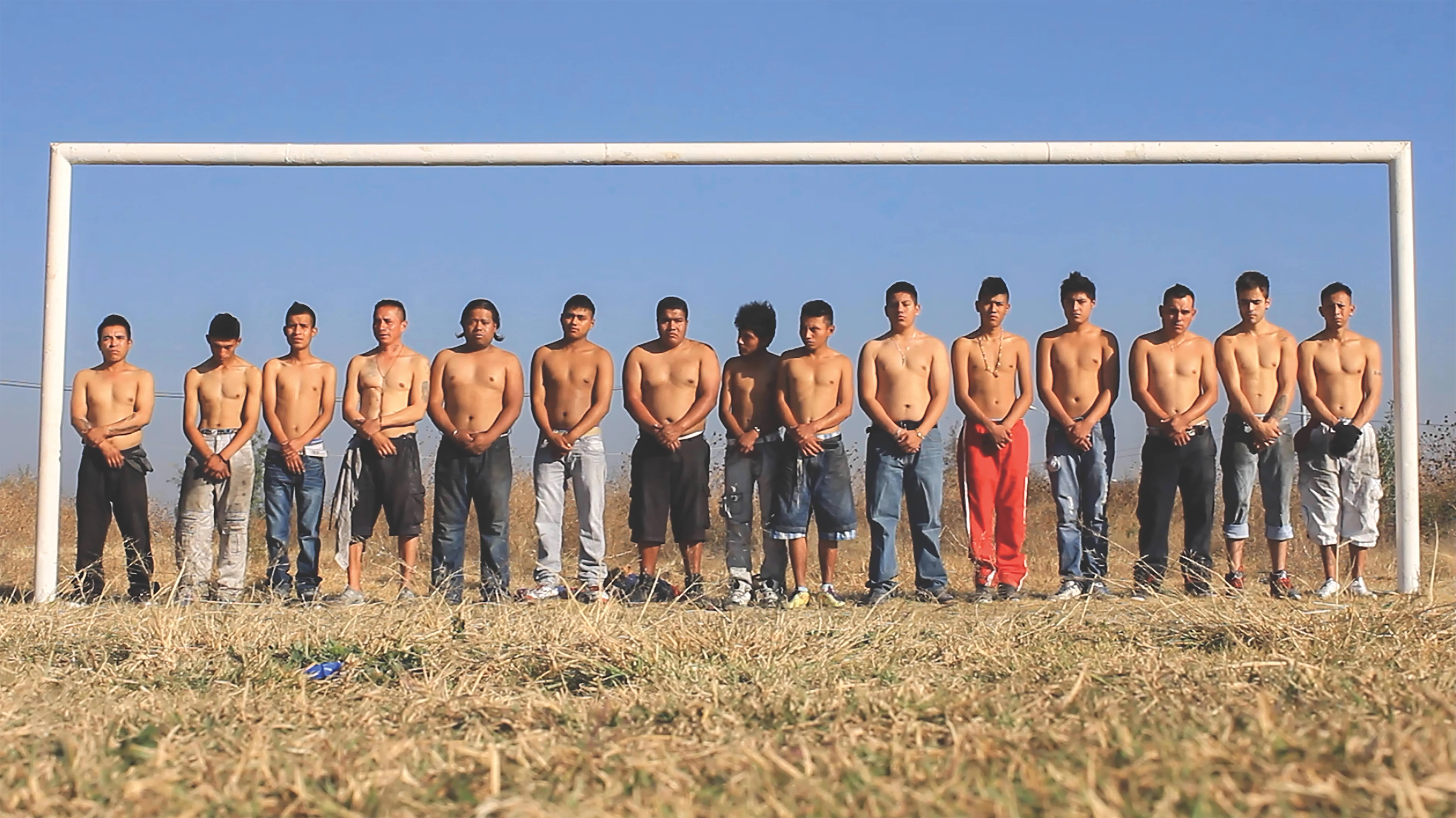
If one closes their eyes during a soccer match (unwise, given current market rates show that games are around 40 dollars per minute and even a second missed is a dollar wasted), one will still be swallowed by this great frenetic roar of pride, a sonic demonstration of a united will. All spectators are willing that little polyurethane ball to hit those players’ shoes at the right time, willing it in the right direction, and willing that the goalkeeper is distracted enough.
This shared will is so loud in fact, that the FIFA World Cup banned the use of vuvuzelas (a skinny plastic horn) in 2010 as the resulting carnal orchestra of stadiumgoers exceeded 127 decibels, or the ambient continuous sound of a gunshot. More than that, in the stands it’s this energy that enters through your ears and settles between your jaw and your tongue, that even the most blase of onlookers can’t ignore.
This summer, the 2026 FIFA World cup will kick off in Mexico City, making Estadio Azteca the first stadium to host three World Cup opening matches, previously having hosted in 1970 and 1986.
To commemorate the occasion, Museo Jumex is presenting Football & Art: A Shared Emotion, an exploration of the grounds beyond the field in an examination of the layered intersectionality that stratifies as culture develops. Curated by Mexico City-based art critic, curator, and artist, Guillermo Santamarina, the exhibition is a mediation of the human elements behind the now multinational commercial sporting juggernaut. “My work, model, and strategy began by reviewing the history of similar experiences focused on the relationship between football and art. There haven’t been many exhibitions on this topic. In fact, the most relevant ones took place in the last decade.” He says. At the same time: “I tried to find works that, in addition to their visual eloquence, were accompanied by critical thinking, paradigms where aesthetic force and sociological, historical, and gender-related approaches converge (feminism, LGBTQ+ activism, new masculinity, etc.), and potential for site-specific work, commissioning pieces that would be created from archives and related documents.”
The space will bring together over 100 works by 60 artists from around the world in a playful homage to the world’s sport. Commissioning pieces from Diego Berruecos, Iñaki Bonillas, Sofía Echeverri, and the art collective Tercerunquinto, they articulate how the sport plays within a system of representation and collective imaginaries, with consideration of their critical and political dimensions.
In our increasingly visual world, the exhibition works to shift the spectrum of object representation beyond the commercial iconography that has inundated the sport. “From the beginning of this curatorial process, I rejected the idea of an exhibition of paraphernalia, chronicles, anecdotes, or about star figures in the annals of this sport,” he comments.

“Exposure was once defined as a consequence of the application of these devices, identified from the ball, the shoes, the shirt, the goal, the field, the stands, to the sounds emitted in the games, the behavior of the fans, or all the passions that are ignited in the territories outside the stadium.”
By borrowing from experiential artifacts of soccer, the exhibition transmutes the spectacle of the sport into an intimate exploration of public and private. This topic that has been explored in depth by the art collective Tercerunquinto (composed of Gabriel Cázares and Rolando Flores), who have created an arrangement of stadium seats salvaged from the recent renovation of the Estadio Azteca stadium. Transforming the seats in “Tribunas” (2026), they have affixed steel plaques bearing the names of Mexican soccer players to the seats, sharing the memory of the storied stadium between the players and those who sat in the arenas cheering them on.
In the exhibition design, Architect Mauricio Rocha and his studio have created a spatial reinterpretation of the different elements that make up the game. “From the outset of the design process for this museum display, Mauricio Rocha, his team, and I envisioned an installation that would select and play with elements from the place where football is played and celebrated. We considered a grass pitch… but Mauricio proposed the dirt field as an unquestionable archetype associated with basic reality, the world of the precarious yet functional, and the platform of the essential popular gathering where democracy, competition, transcendence, diplomacy, legitimacy, and ritual converge.” Anchored by the dirt field, the space operates as a bridge between the global spectacle and the everyday practice of the sport with wooden locker rooms and structures specific to the game.
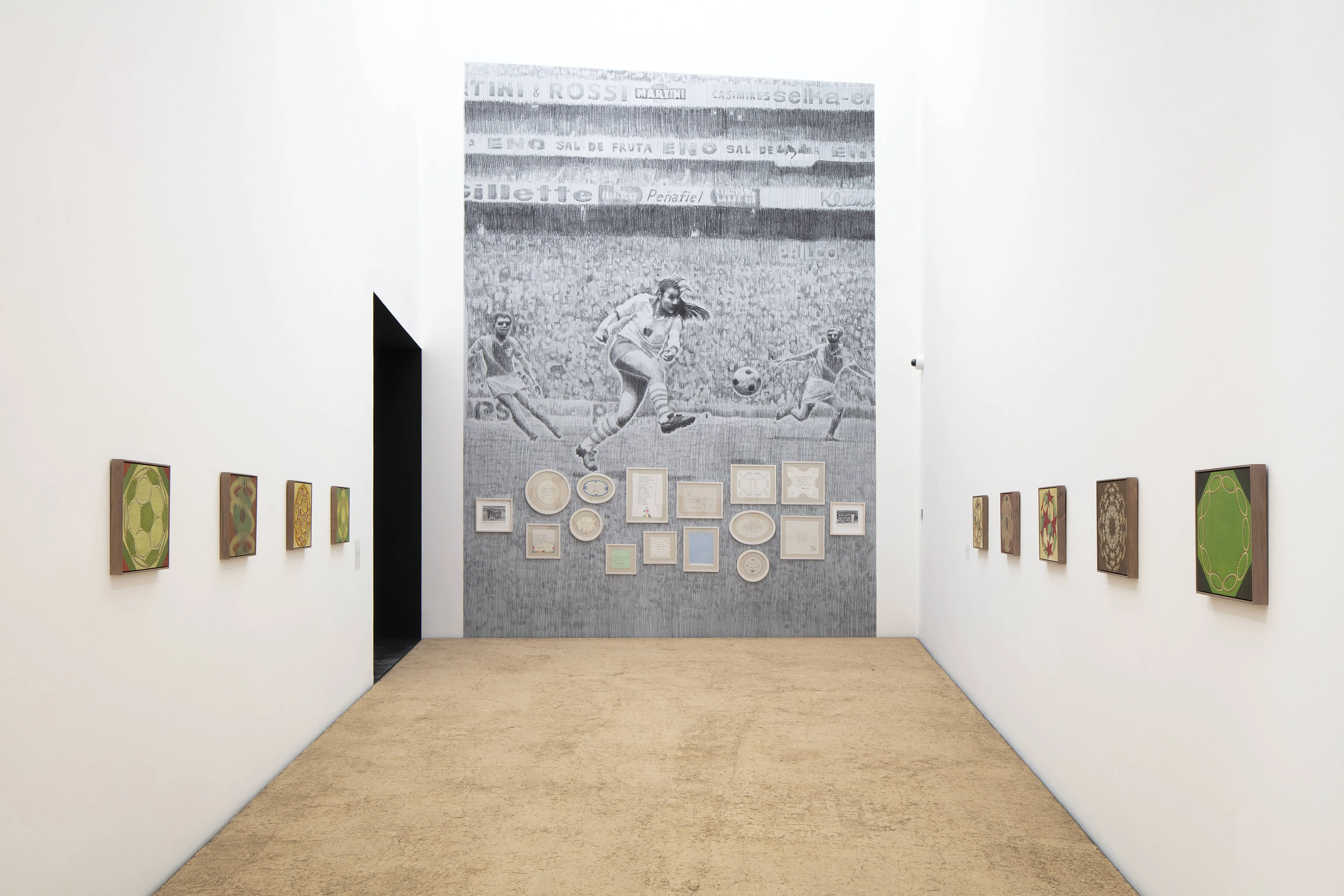
On the wooden lockers of the exhibition, conceptual artist and printmaker Iñaki Bonillas has worked with images from the Televisa Archive, spending several months looking through 35mm negatives. The selected photos paint an image of new masculinity, a sort of putting-it-all-out-there vulnerability that despite winning as a team, it’s dependent on its members to succeed.
On a large wall, “Dechado de impedimentos (Sampler of obstacles)” depicts a moment from the oft-overlooked history of women’s soccer. It’s a look into the Mexico Women’s National Team of 1971, which made it to the World Cup finals despite dealing with the hardships of maternal responsibility and gender biases. Not to be ignored in the great year of 2026, Argentinian performance artist Marta Minujín’s 1977 painting of a colossal blonde woman titled, “Mi Mundo (or My World Cup)” and works from Mexican photographer Graciela Iturbide. “It is an inevitable and necessary phenomenon in the transformation of patriarchal reality,” Santamarina comments. “It is impossible to be indifferent to its impulses and its categorical demands.”
In a world fraught with conflict, and where the real and unreal blur with the advancement of technology and the like, perhaps there is nothing more real than seeing that polyurethane ball fly across that field.
“With everything that has been happening precisely in parallel with the devastating assault on the essence of art!” From so many hostile fronts… Commodity, spectacle, mirage, agent of violation of constructive humanist culture, discriminatory mechanism (especially classist in Mexico), of anesthetization, fragmentation, and confusion of individuality…I can only tell you that I have to survive,” says Santamarina, “and that I do what I can to hold onto some gentle rope leading to the truth.”
Stay up-to-date with exclusive events and content.


