F L A U N T


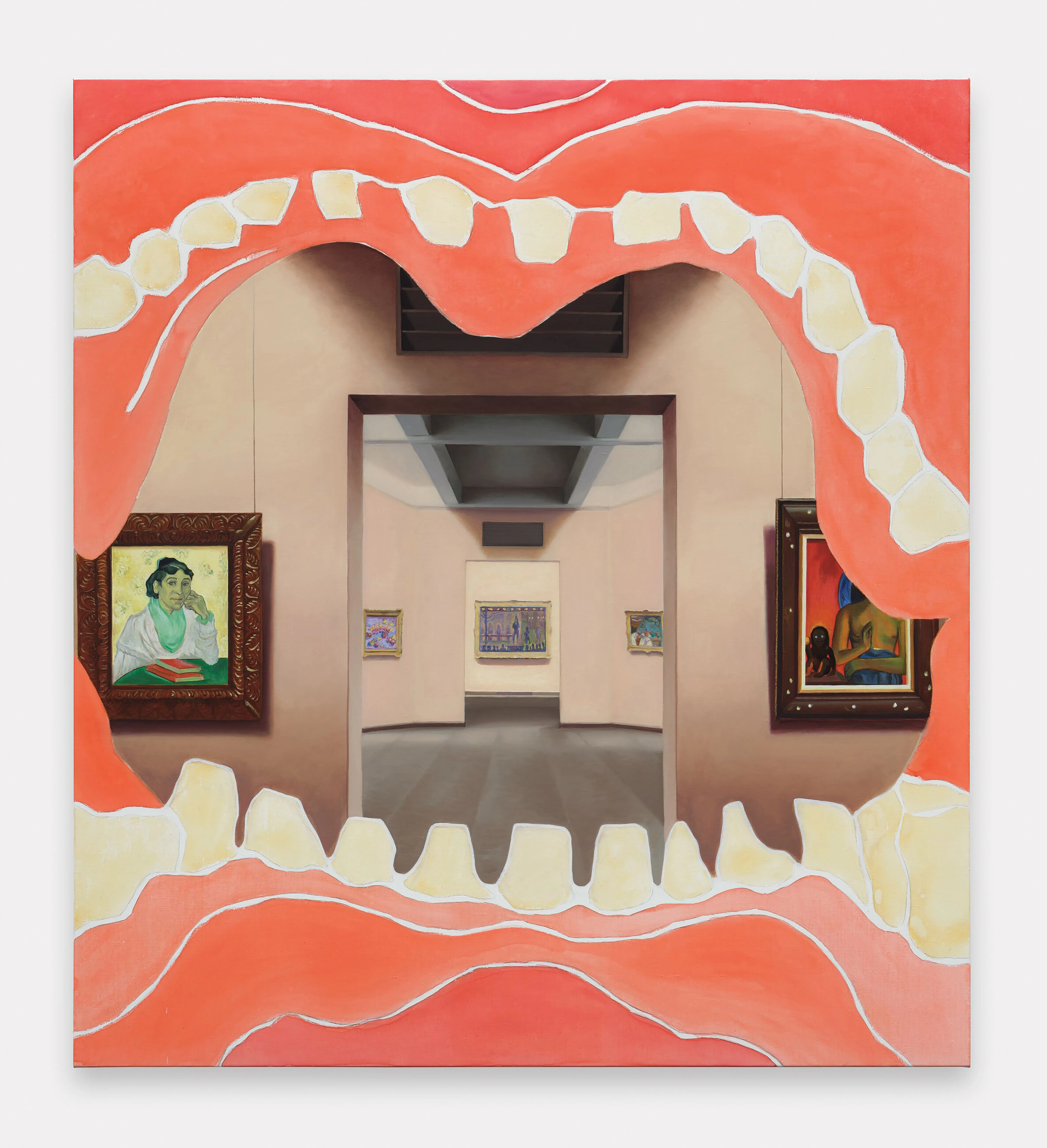
I rarely meet people who share my strange aversion to movies, but Allison Katz does. I find them too affecting; whatever is happening onscreen takes hold of me too easily, and most of the time I would rather look at reality. Katz understands this, though the one thing she does watch is tennis, and, in particular, tennis documentaries. Tennis, she tells me, is as cerebral as it is physical. You need a team, but ultimately you are out there alone. You can be winning and then lose, be losing and then win, and then begin again. Listening to her, I begin to suspect that her description of a tennis match has smuggled in a theory of painting—or, at least, a description of how she paints. The discipline is exacting, but it cannot tell you what will happen next.
Across her paintings, her writing, her recurring motifs, even the structures through which the work is encountered, she seems to return to a version of the same question: How do you create the conditions for something unexpected to happen? When I ask her this more or less point blank, Katz answers with something a teacher at a free dance class once told her: “It takes a lot of discipline to be a free spirit.” Her current solo exhibition at Hauser & Wirth in New York, Outta the Bag, seems to stage this problem from its title onward. A play on the idiomatic “letting the cat out of the bag,” with Katz’s own name tucked inside the joke, the phrase suggests a secret revealed, though it’s a secret revealed by accident.

The paintings themselves have a similar way of showing their hand without explaining themselves. When Katz shows me “P-Cock with Portrait” (2026), I ask her to walk me through it three times. The painting depicts a peacock whose great fan of a tail is also an artist’s palette, except the palette is not merely depicted: Katz used it to make the painting itself. The evidence of the painting’s making has ended up on the same surface as the finished thing. At the upper left is a one-to-one reproduction of a portrait of Katz painted when she was 23 by Susannah Phillips, for whom Katz posed during her student years in Montreal. “I learned to paint at the same time that I learned to pose,” Katz has said, “to be both the painter and the painting.” Here she is both, while the palette—the provisional evidence of labor—performs as a peacock, an old symbol of vanity, divinity, excess, and display. The secret of the painting’s making is made plain and yet still remains elusive.
The imaginary and the real, the personal and impersonal, the way one participates in some form of groupthink while still trying to find new threads and be an individual: these are tensions she has returned to throughout her practice. “I always wondered how an image could be non-narrative, but still have a story,” she tells me. Her paintings have a way of making thought feel less like a line than a field of electrical activity, allowing for associations that do not announce in advance why they belong together. She takes genres whose limits we think we know—landscapes, portraiture, still lifes—and worries at them until they begin to fuse. “Motifs are containers,” she says. “You get the balance of something impersonal in order to understand what is personal.” In Katz’s world, the personal enters the impersonal and comes out strange.
The strange part is that, for Katz, understanding what is personal seems to require becoming less attached to the self, as if painting were a strategy for loosening, if not losing entirely, her sense of it. She describes being disturbed by the conventional idea that an artist’s career should move toward some identifiable signature, as if youth were only a series of trials on the way to a style everyone can recognize. Painting, to her, offers the opposite possibility: camouflage, subversion, a way of moving horizontally rather than advancing toward a single, iconic move. If painting is meant to reflect a state or condition, she tells me, then style may be “the least truthful way of showing what painting can do.”
Here, I think, we arrive at the real problem: taste.
“Taste is really the albatross around painting’s neck,” Katz says. I think immediately of Alice Neel, who once said, “The self, we have it like an albatross around the neck.” Katz doesn’t know the line, and for a moment we are both delighted by the coincidence: she has said almost exactly the same thing, only replacing the self with taste. If the self was once the burden, perhaps now it is the obligation to know what you like, make it recognizable, and call that a self. Katz is interested in what painting might do against that closure. She recalls a line attributed to Martin Kippenberger and passed on to her by Charline von Heyl: “The best way to advance is to question your own taste.” If we are too boxed in by what we already like, what happens to the possibility that a painting might take us somewhere we did not already know we wanted to go?

Questioning your own taste, of course, requires finding ways to get around yourself. To do so, Katz works on as many as a dozen paintings at once, while also writing, drawing, thinking through titles and captions, moving between different registers so that no single painting has to bear too much weight. Even a finished painting, for Katz, remains a fragment; part of the discipline is knowing when to move beyond it. She puts it more simply: “I’m trying to stay cool with the painting. Like pretending I don’t want to go out on a date, even though I’m totally in love.” Much of her process seems designed around this kind of strategic indifference, finding ways to relax her own grip long enough for the painting to do something she could not have planned.Maybe this is why Katz resists the idea that, after enough years of working, a person finally arrives at some stable version of themselves.
With Outta the Bag now in New York and another exhibition opening in Montreal this fall, she finds herself returning to two cities that formed her at different stages of her life. I ask whether she has developed a style despite herself. Katz tells me she thinks of herself as “very episodic,” invoking a distinction in moral philosophy between people who experience their lives as a continuous narrative and those who can genuinely feel like different people from one period to the next. The narrative model has largely won out: we tend to treat coherence across time as a sign of maturity, even moral seriousness. But what if a life does not feel that way from the inside? Art-making, Katz says, has taught her that consistency takes care of itself.

Maybe this is what an episodic self looks like in paint: not an identity carried intact through time, but a frame in which distant versions of a life can suddenly find one another. In “P-Cock,” Katz at 23 reappears inside a painting made decades later. Past and present do not resolve into a story of arrival; they occupy the same surface.
“The thing about painting is that it is a frame, and so much of life just can’t be contained,” she tells me. She trusts the frame anyway. Perhaps this is the game Katz has been describing to me all along: the boundaries are fixed, but what happens inside them is not. Memory ages, degrades, returns without warning. Painting, she says, is “a little bit like a time-traveling machine.” We do not choose the image that releases something in us, what will become the Proustian madeleine, what will open the portal.
By the time we finish talking, I realize my own mind has been running loose with associations. Peacocks, tennis matches, Alice Neel. I want to understand exactly how it all fits together, and then it comes rushing back in, familiar: the agony of doubt, the sense that I will never quite capture the thing as it is. I think again about why I do not watch movies. I had told Katz that most of the time I would rather look at reality. But reality is hardly the stable alternative I had imagined. Memory changes behind our backs; the self disappears and returns somewhere else; one image opens unexpectedly onto another. There is no pristine thing to simply look at. Katz’s paintings seem to begin there, in the mess between the world and our endless appetite to make an image out of it.
Stay up-to-date with exclusive events and content.


