F L A U N T


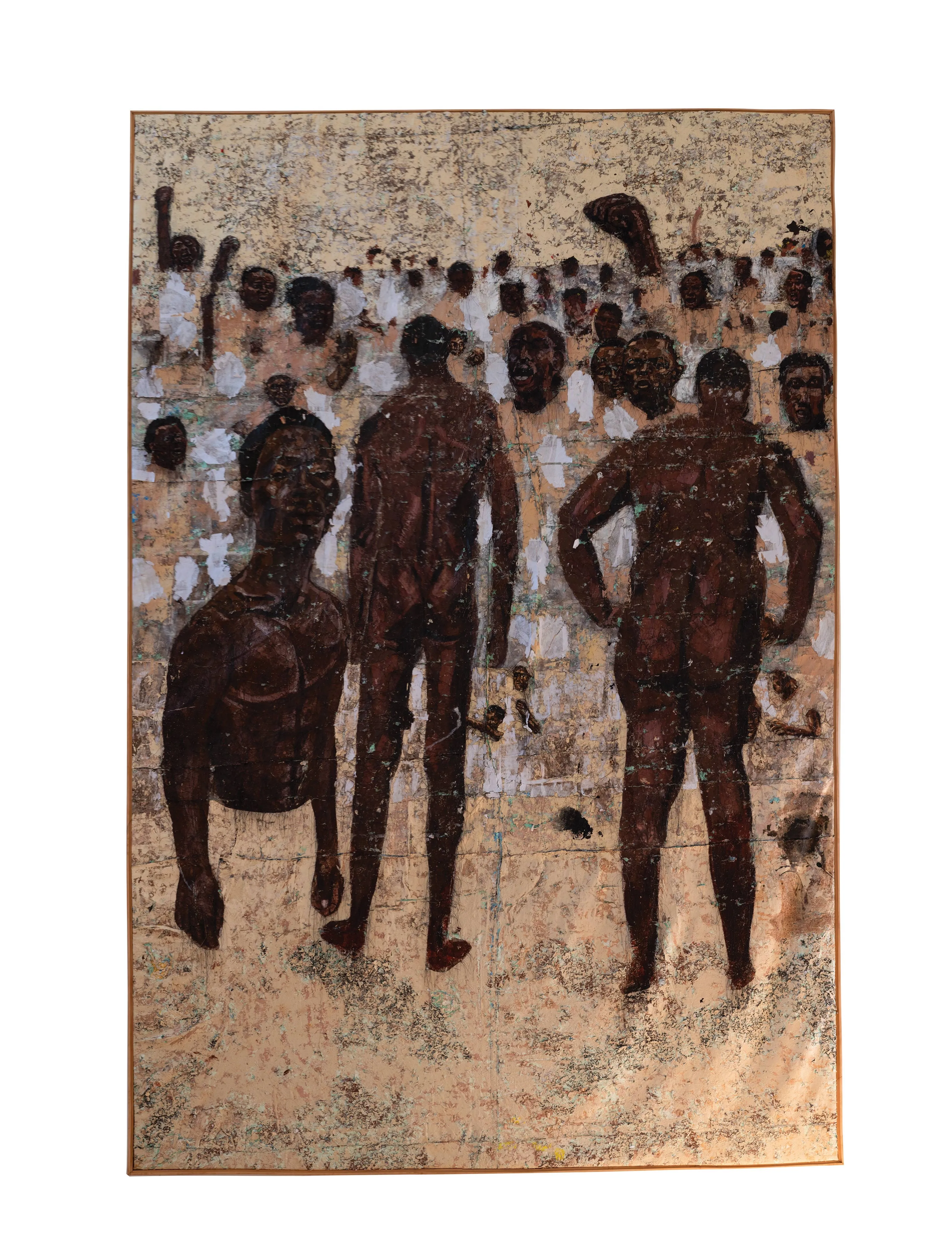
Beauty arrives first, pleasing to the eye. Then rupture. With billowing canvases stitched together with yarn and scarred by thick layers of paint; with swimmers, dancers, and lovers drifting through fields of bright canary, pink, and azure; with figures that emerge partially, like memories surviving in damaged photographs, Kaloki Nyamai paints histories that refuse stillness.
Earlier in his career, the Nairobi-based artist struggled to meld that dissonance in his work, searching for a way to capture both the depth of his country and his own fractured relationship to history and identity. Today, Nyamai creates large-scale mixed-media installations that transport viewers into immersive memoryscapes built from paint, rope, photography, fabric, and stitched surfaces. His work has been exhibited internationally at venues including James Cohan Gallery and Galerie Barbara Thumm, as well as exhibitions like Sharjah Biennial 16, Art Basel, and most recently, the 2026 Venice Biennale.
Before those opportunities, Nyamai turned to his grandmother.
Decades ago, she composed songs about the people in her village, transforming daily grievances between neighbors into performance. “People feared her,” Nyamai tells me, laughing. “And they loved her songs.” When Kenya’s first president, Jomo Kenyatta, visited her village, she sang publicly before being arrested and interrogated as a suspected political dissident. Though eventually released, she never performed publicly again.
In his own practice, Nyamai inherited that instinct toward historical record, though transformed into something more coded and indirect. “I put it in a way that you can dance,” he says, “only to know that I’m actually talking about you.”
Born in Kitui, Kenya in 1985, Nyamai began making art while trying to understand his place within a vast and fractured historical inheritance. Early charcoal drawings documented slum settlements around Nairobi, capturing fragmented scenes of daily life shaped by difficult conditions.
“My dad wanted me to be an engineer,” Nyamai recalls. Within a culture shaped by aspirations toward white-collar labor, becoming an artist felt to his father “like a suicide mission.” His mother, by contrast, responded with complete confidence. “She just thought, yeah, you’ll be okay.”
That confidence still structures the emotional architecture of Nyamai’s paintings. In “Twe eli vaa” (2023), thick fields of red and orange paint fracture open to reveal flashes of yellow beneath the surface, as though another image were pushing upward from underneath. Across the upper half of the canvas, arms, hands, and faces drift in and out of visibility, dismembered and partially obscured. In the middle, a face with an open mouth emerges more clearly than the others, though its eyes remain entirely hidden. Above it, a naked couple reclines in motion, suspended somewhere between intimacy and collapse. The uneasy fragmentation colliding with ecstatic colors leaves the viewer uneasy, wondering if it is moral to relax in culturally troubled times.
Bodies swim through cerulean expanses and recline against pink atmospheres, though figures rarely appear fully intact in Nyamai’s works. In “Twikale vaa gutavye kela kindo.2” (2023), hands and forearms emerge through layers of cracked teal paint. Two main figures lounge together, their expressions blurred almost beyond recognition. Around them, fragmented bodies dance through transferred newspaper imagery, less complete than the foreground figures. The painting is not immediately legible, so viewers must piece together emotional logic slowly. Returning to the same question: how can peaceful moments exist in larger struggles?
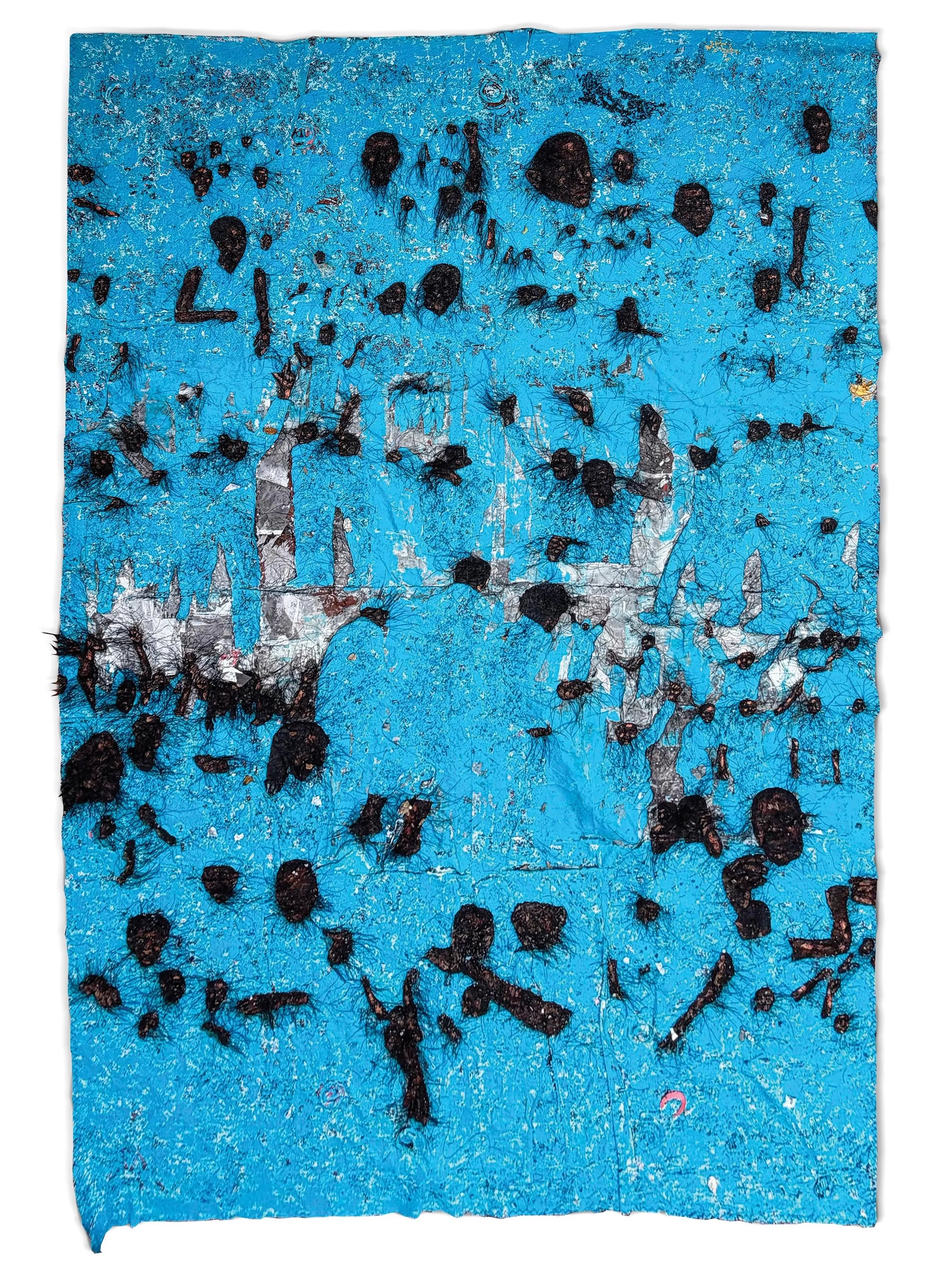
Nyamai’s surfaces carry that same instability physically. Acrylic paint cracks under pressure. Sisal rope pushes outward through the canvas. Thick stitching remains visible rather than concealed. Some works hang unstretched from the wall, sagging under their own weight like fabric or skin.
That impulse becomes literal in “Twivaa Twieli Ndokandie” (2025), where a seam physically splits the canvas into pieces. Two-thirds of the work retains the dense visual language familiar throughout Nyamai’s practice: green vegetal forms layered over fragmented figures, dark orbs hovering in the background like side profiles stamped in shadow. The remaining section exposes the reverse side of the canvas entirely, revealing intricate threading of black yarn and sisal rope usually hidden from view. The effect feels anatomical, as though the painting has been opened to expose its internal structure.
Those material decisions emerged from years of conversations with his grandmother, whom he recorded obsessively while navigating what he described as an identity crisis. He asked her about ancestors, rituals, rain, warnings, village life, and memory itself. Most of the recordings have since been lost, though one still remains with him.
“I realized that I was collecting so much information,” he shares. “And through the information I was collecting is the information that now I was able to use in my work.”
The recordings became less an archive than a methodology: a way of understanding history as unstable, emotional, and constantly rewritten through storytelling. During that same period, Nyamai began questioning the historical frameworks he had inherited through colonial education systems.
“The only history we know is the history of the Renaissance, the Italian, Spanish,” he shares. “But there’s so much history that has not been told.”
Even so, the paintings pulse with movement.
In Nyamai’s ongoing series Dining in Chaos, bodies gather around banquet tables, swim through open water, dance, flirt, lounge, and embrace within luminous fields of color. At first glance, many of the works appear celebratory. Only gradually does unease begin surfacing beneath the pleasure.
The series emerged from an image Nyamai could not stop imagining of a luxurious banquet unfolding while violence erupted beyond its borders.
“The sounds of killing became like jazz music on that table,” he says.
Inside the space of abundance, elites continued dining comfortably while catastrophe unfolded elsewhere, transformed into background noise. Nyamai expanded the metaphor outward until it could contain contemporary political violence and social numbness.
Originally, he intended to spend only one year on the series. Four years later, he remains inside it.
Each attempt to move away from the work seemed interrupted by new crises: protests, kidnappings, authoritarian policies, war. “You find your studio becomes a battleground,” he relays.
Rather than depict violence directly, Nyamai constructs what he calls “situations within situations,” or temporary spaces of softness suspended within instability. Dining expands beyond eating into a broader condition of luxury and leisure. Swimming becomes both freedom and danger. Playfulness itself appears fragile.
In “Nikwetela nginya indii” (2025), a face emerges more fully than in many of Nyamai’s earlier works. The figure stares directly outward, hair flattened and mouth unsmiling, surrounded by dense reds threaded with sisal fibers and bands of collaged newspaper clippings. Yet the image refuses stability. Along the right edge of the work, deterioration in the painted surface suggests another dissolving body, while a second expression, an open mouth contorted in pain, hides beneath the central figure’s ear. The painting reveals anguish only after the viewer has already been seduced by its color and texture.
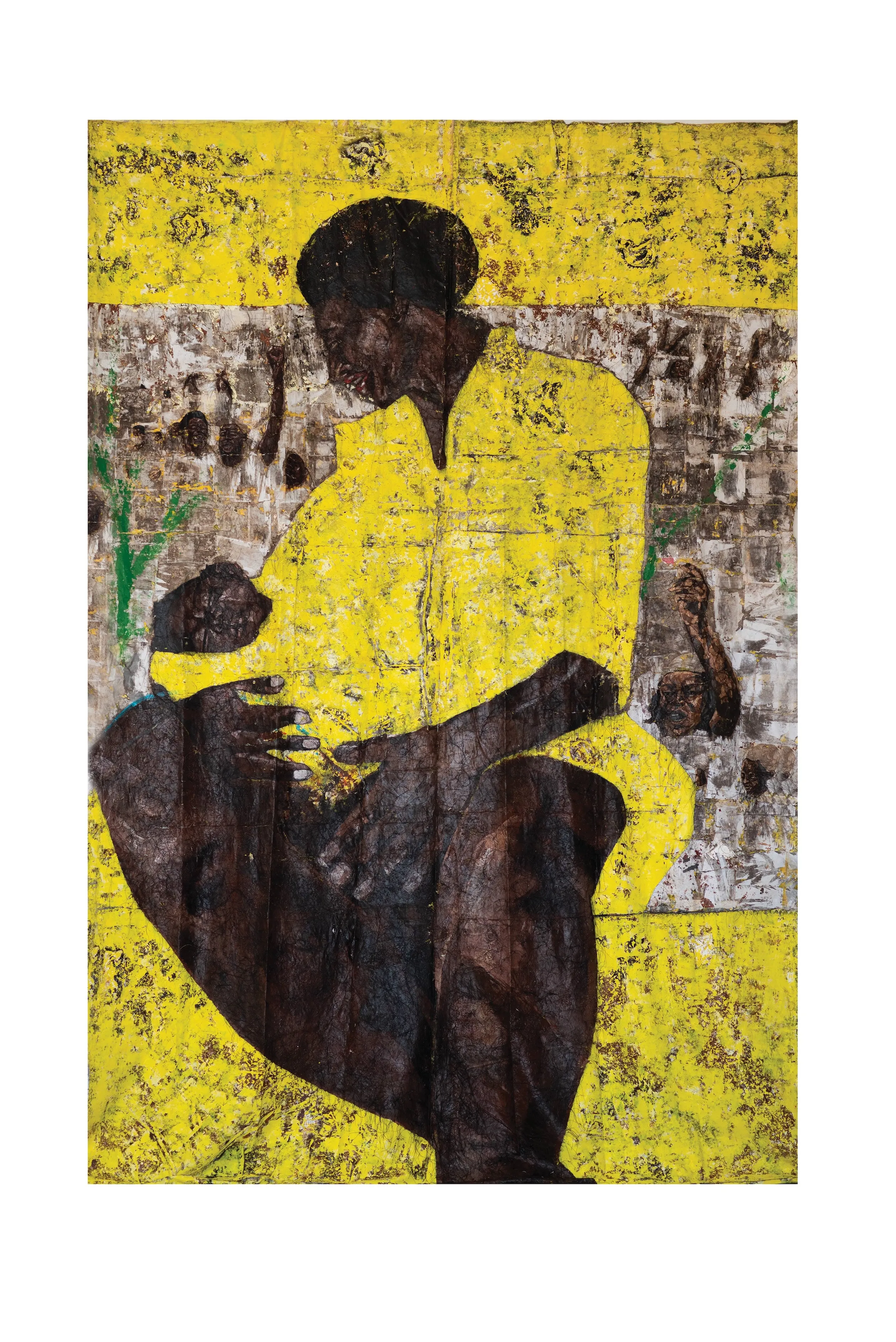
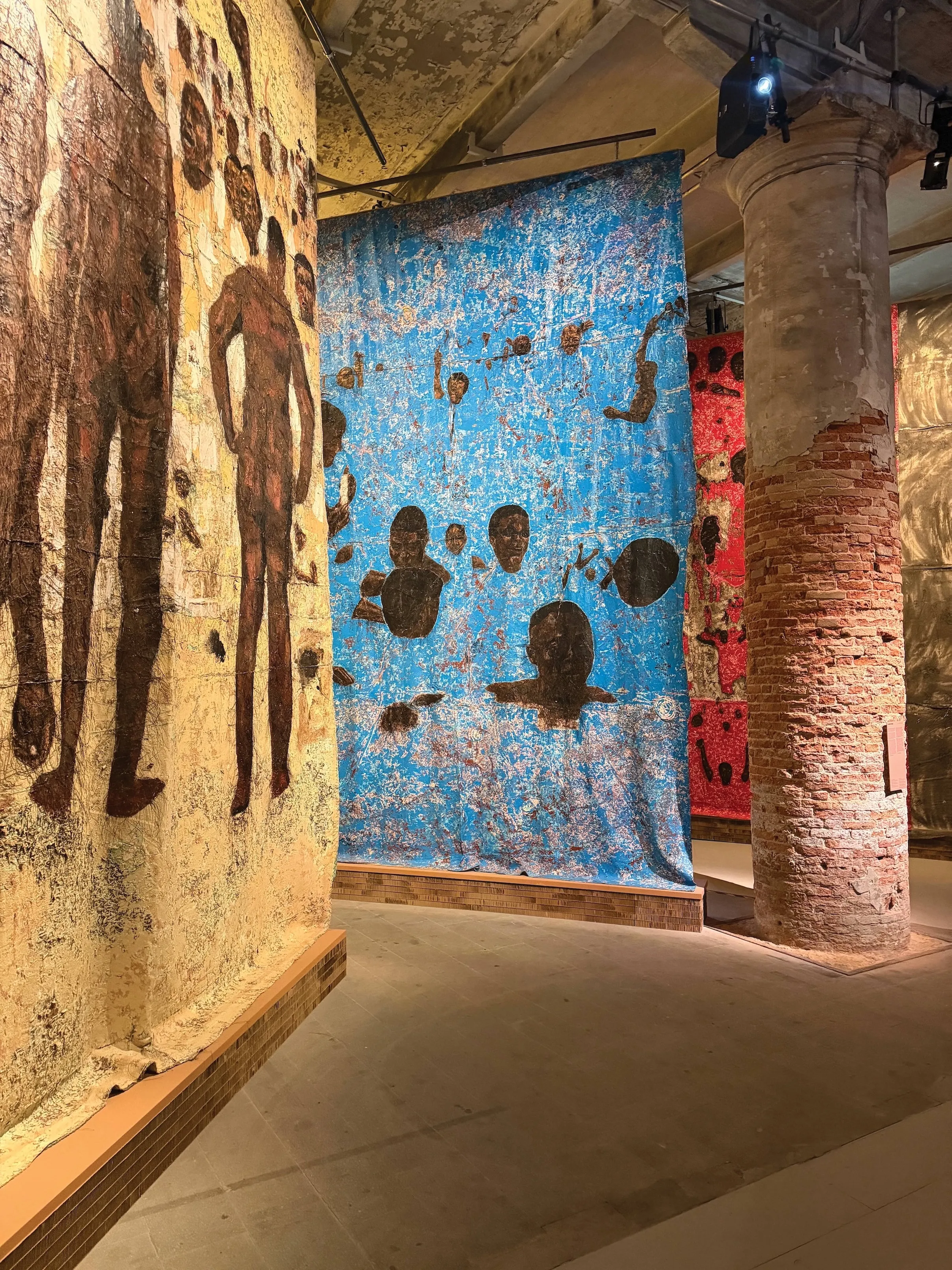
Several works shown during the 2026 Venice Biennale explored vulnerability across different stages of life. One monumental yellow painting reflects on childbirth and maternal protection, examining infancy as a terrifyingly delicate condition where survival itself feels uncertain. Another depicts young people swimming energetically through open water, their bodies suspended between freedom and risk. “The sea can take you anytime,” Nyamai says.
Even in these works, Nyamai resists singular interpretation. The paintings function less as illustrations of political ideas than as emotional environments where pleasure, grief, intimacy, and exhaustion coexist simultaneously.
That ambiguity extends into language itself. Nyamai titles many works in Kikamba rather than English despite exhibiting internationally. “Sometimes so much gets lost in translation,” he says. “The best is to give it as is.”
Still, traces of his grandmother remain embedded throughout the work. Her songs linger not only in Nyamai’s political sensibility, but in his understanding of art as something communal, coded, seductive, and dangerous.
Unlike those songs, Nyamai’s paintings rarely announce themselves directly.
Innocence arrives first.
Then guilt.
Stay up-to-date with exclusive events and content.


