F L A U N T


Alejandro Cardenas lives between Diego Velázquez and Francisco de Goya. Literally, his studio in Madrid is mere blocks away from two streets named after the pivotal 17th and 18th-century artists. He’s also a 15-minute walk to the Museo Nacional del Prado, so lunch might be found in “The Garden of Earthly Delights” (1490–1500) by Hieronymus Bosch or “The Triumph of Death” (1562) by Pieter Bruegel the Elder.
Also at the Prado is one of Velázquez’s most well-known paintings, “Las Hilanderas” (1657), or “The Spinners” (sometimes referred to as “The Fable of Arachne”). Depicting women in a Santa Isabel tapestry workshop, the work tells Ovid’s Fable of Arachne, in which a mortal weaver challenges the goddess Athena to a weaving contest, creating a tapestry of Titian’s “The Rape of Europa” (1560-62). Angered by the mortal’s skill and defiance, Athena strikes her—and subsequently transforms her into a spider.
Cardenas has always been interested in mythology. “When I was a kid, my dad would tell me the stories of the Trojan War, the Odyssey, the gods,” the Chilean-born American artist said. “It was something I grew up hearing about, and as I got older, that fascination never went away.” What interests Cardenas in particular is that mythology makes basic human stories fantastical, where “gods, mortals, and their struggles exist simultaneously in a real way.”
But fantasy is also reality. “Those power struggles between the gods and the mortals are reflected in our society and have always been a feature of humanity as long as we’ve known it, such as between corporations and the public, the rich and the working class,” Cardenas says. Which is to say, while he’s inspired by both ancient mythos and the artists who came before him, Cardenas is also concerned with the future. This is true for the works he currently has on view in ARACHNE at Almine Rech in New York City, an exhibition just as much derived from the eponymous fable as it is illustrative of a not-too-distant future wherein those same power struggles have only continued, if not worsened.
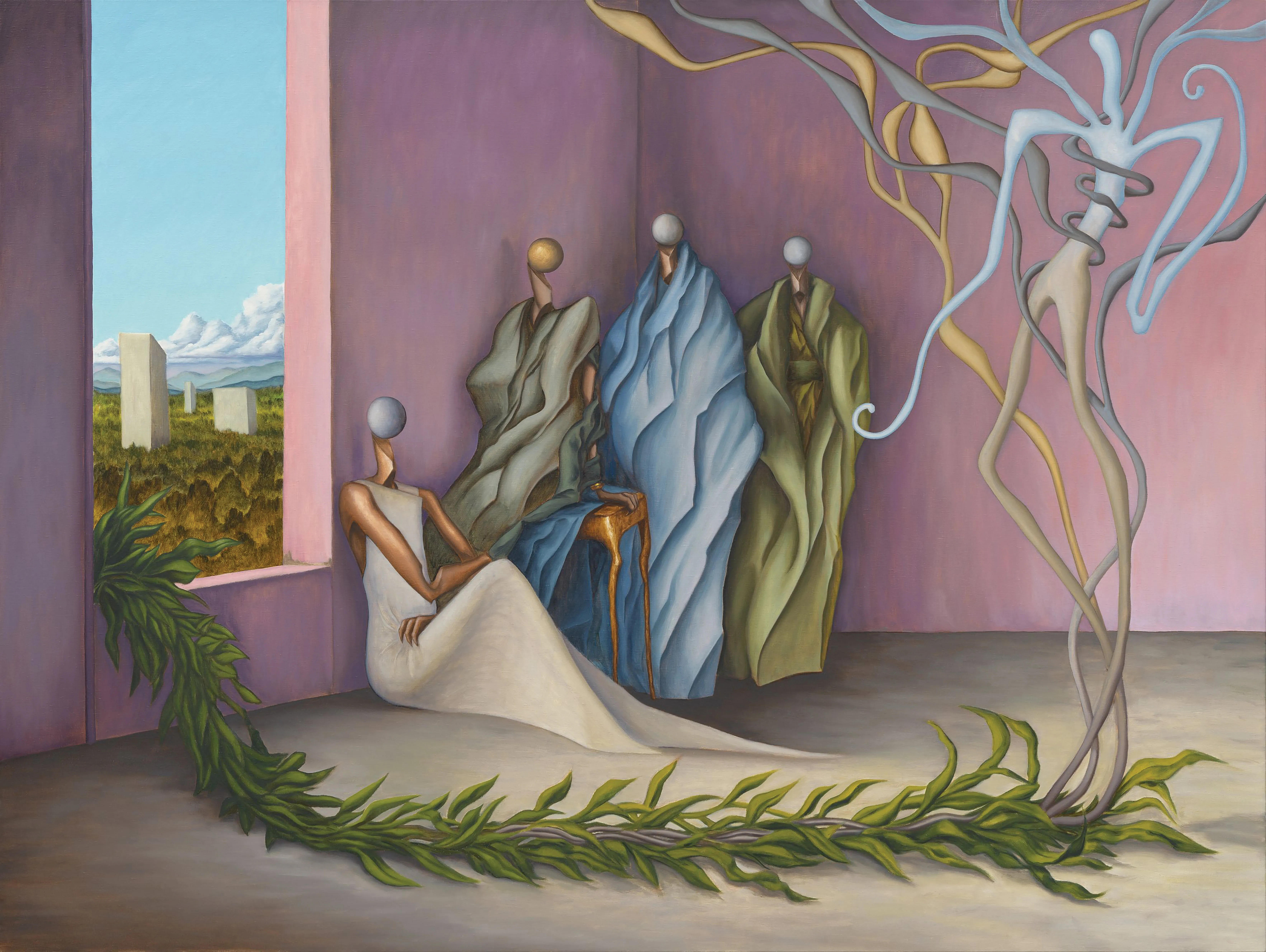
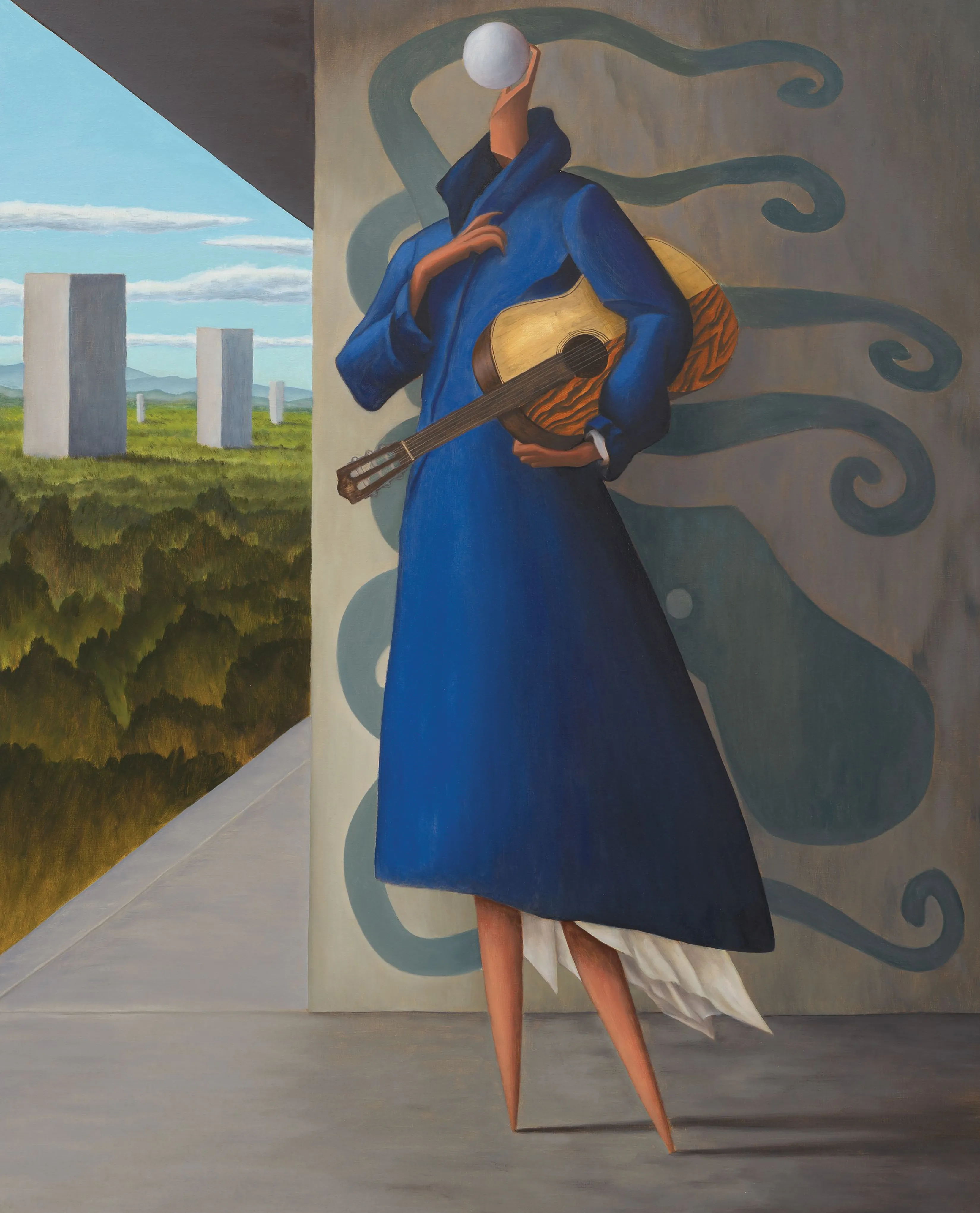
Painted with a sprawling, expressive surrealism, Cardenas’ works show humanoids engaged in human acts. Some of them play guitar, others dance in a circle. Elsewhere, a couple lounge on a chaise together, while another pair with bright orange and green bodies tenderly hold each other’s hands. Perhaps the most awe-inspiring moment is found in “Tierra Duende” (2026), which features a flamenco-dancing humanoid flanked by two guitar players. The dancer’s rich red dress sweeps through the air as she flings sashes of royal blue and crimson around in a circle.
The dancer, like all of Cardenas’ humanoids, is angular—its body lanky, its limbs slender and sharp. The figures’ heads tend to be spherical, sometimes triangular, but none of them have faces. And while they appear to live in cities with brutalist-like buildings made of sleek concrete, much of their surroundings are overgrown with greenery.
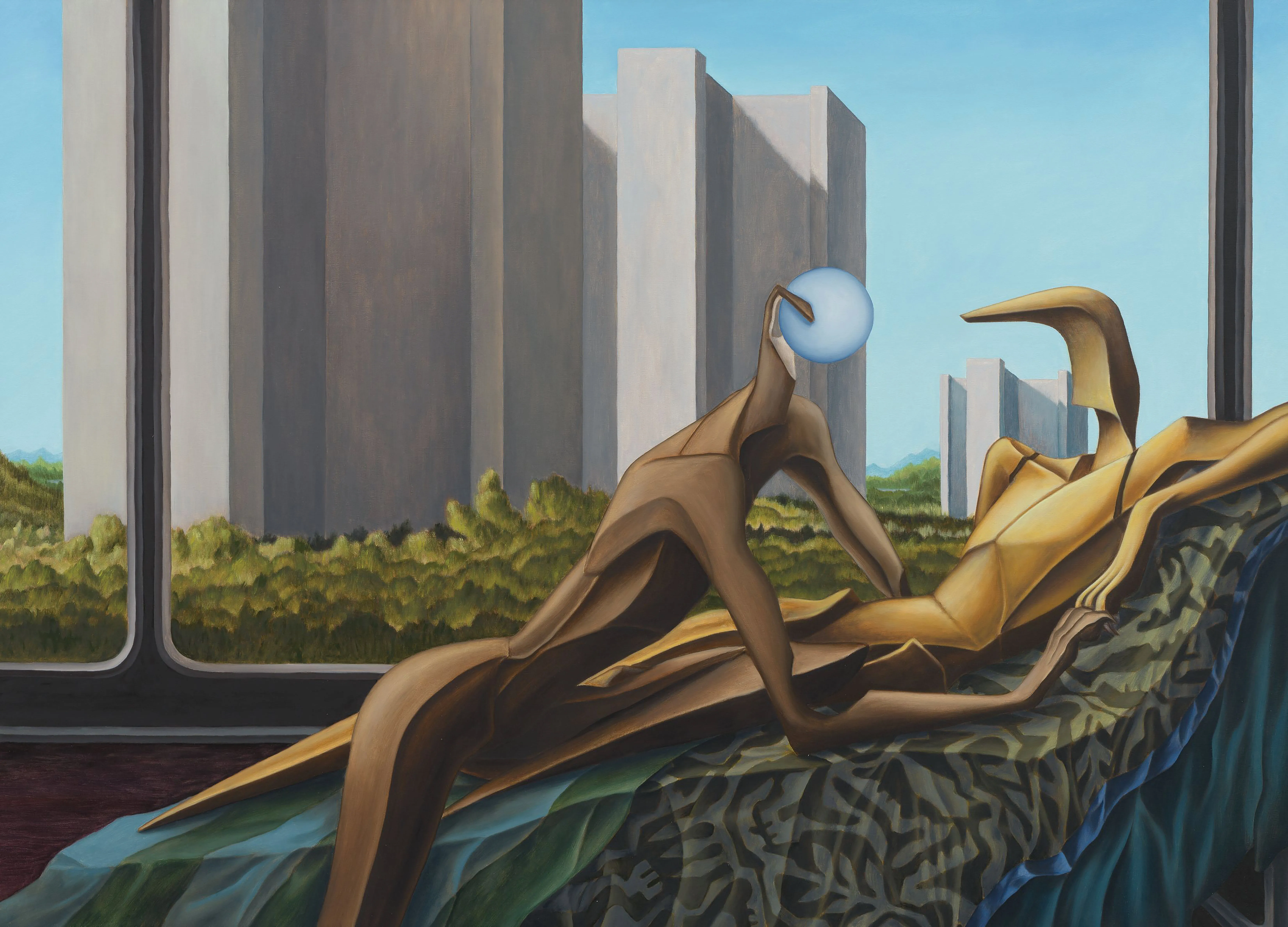
This world Cardenas has painted into reality imagines a post-human future, where “the way we exist and all the things we’ve built and that make our society have either disappeared or gone somewhere else,” he said. “In place of humans live these figures who have returned to a primal state where they don’t need jobs, bank accounts, phones. They just exist to appreciate and be in the world, doing all the things that really matter, like being together and making art,” Cardenas said. But while the figures aren’t human, they are uniquely humane in their existence, seeming to reflect the best parts of those that existed before them.
Prior to touching brush to linen to create these works, Cardenas had filled as many as seven sketchbooks with hundreds of preparatory compositions. As if referencing the show’s namesake, Cardenas spun these sketches into an expansive web of their own in the form of a meticulous graphite grid, hand-drawn directly onto the gallery’s free-standing walls. To complete the site-specific installation, he recruited artist Keith Riley, one of his oldest friends; the two worked together across five 10-hour days, photocopying sketchbook pages into an immersive mural throughout the gallery. “It felt like I was back in high school, just hanging out and making art with my friends,” Cardenas says.
This attention to the artmaking itself speaks to a dynamic Cardenas is particularly sensitive to, which is the fact that oftentimes viewers only see the finished object on the wall, thereby missing the process it took to get there. “You can spend months working on a painting, and you live an entire life over that time. Every experience I have gets put into that painting, but in the end, the viewer only sees a single image,” which they can perceive however they choose, no matter the meaning you’ve imbued it with.
To Cardenas, Velázquez’s painting of Arachne is also illustrative of this dynamic between artist, object, and audience—yet another way in which Velázquez’s painting and the myth itself work as a metaphorical through line for the show. “Arachne is punished for defying the gods. She didn’t pay Athena proper respect for her talent, even though from her point of view, she developed her talent by her own hard work,” he said. Similarly, artists and their labor are constantly devalued, whether by the ultra-wealthy, the market, or the encroaching of AI on human creativity.
To protect the physical experience that he sees as essential to artmaking, Cardenas decided to reject digital tools for this show, sketching ideas by hand and working directly on linen. “Bringing any sort of digital intervention separated me from the actual experience of making the works,” he says. “Making a painting is a very physical act. Painting takes your whole body, your whole mind.” By keeping his process analog, the works on view remain anchored in history, forging a direct kinship with the painters who once walked the streets in Madrid that now bear their namesakes. “I don’t think my experience when I paint is that different from Velázquez or any other painter,” he said. “They were existing and taking the world around them, and filtering it through their mind and their talent, and making artwork.”
In Cardenas’ “Tierra Duende,” the flamenco dancer is caught in a moment of duende, which describes an artist’s ability to fill the stage with their presence, evoking in their audience a communal feeling of thrill, awe, and emotion. Similar to painting, “flamenco is this collaborative physical act,” Cardenas says. And like a moment of duende, “a painting is a transmission. It’s literally alive with the experience of the artist”—whether that artist is Velázquez or Cardenas, whether the story being told is a fable about Arachne or the fate of our distant, or not too distant, future.
Stay up-to-date with exclusive events and content.


