F L A U N T


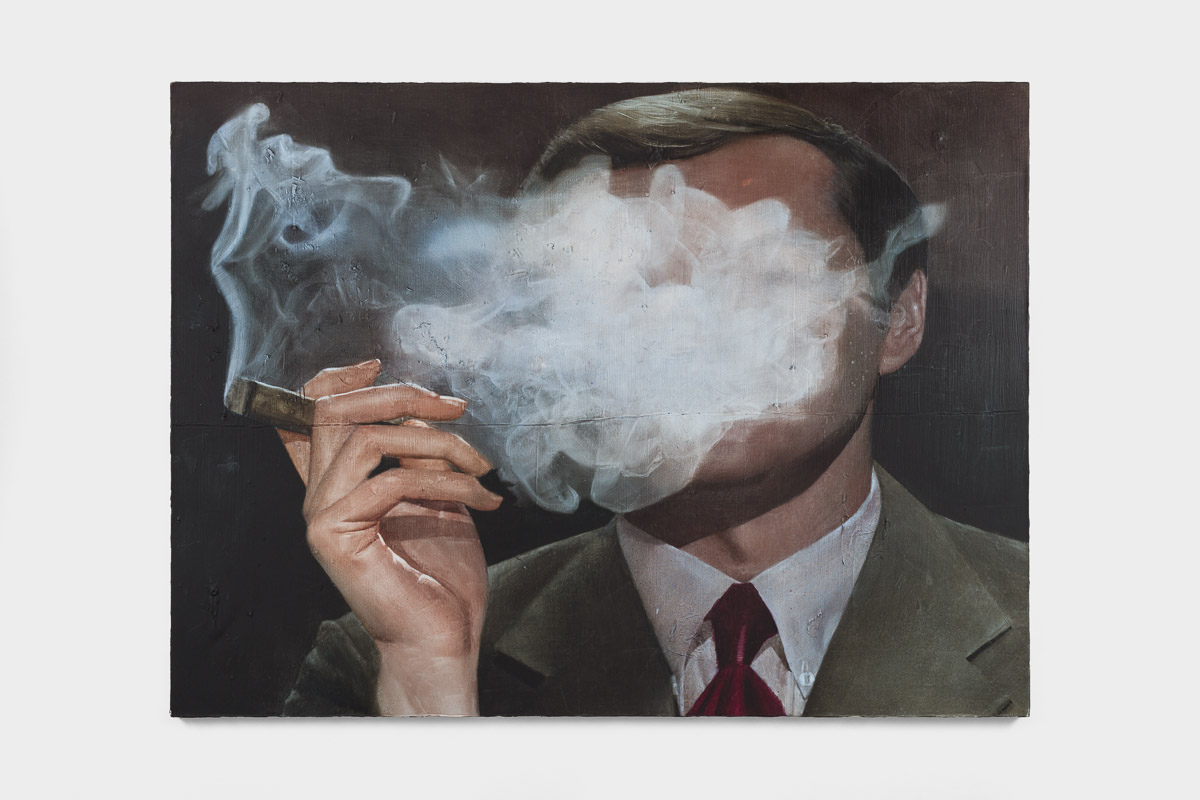
Painter Joseph Yaeger has secrets; his paintings keep them. In gently lit, tightly cropped compositions of partial face, body part, or swath of garment we are given to understand that melodrama is afoot. In a refined earthen and nitrate palette, the sounds of the pictorial space are muffled as if by velvet, and like all hushed tones, one must lean closer to hear them.
There is a choreography in Yaeger’s visions as to what is deliberately withheld, a specific kind of tension that arises when a portrait refuses to look back at the viewer with clarity. Yaeger’s exhibition, Agita, on this fall at Gladstone Gallery in New York, operates within this charged space of spycraft and psychological suspension. Known for constructing cinematic—particularly noir-inflected—and richly atmospheric tableaux that linger at the threshold between intimacy and opacity, Yaeger’s figures inhabit a world governed by dream logic and tightly guarded, seldom shared secrets.
Across these canvases, the human face is treated as an object among objects, holding neither portrait nor narration. Traditionally the anchor of empathetic identification, figures here are repeatedly veiled, obscured, and sometimes violently erased. Consider the striking composition of a figure seated with a cigar, where a dense, billowing cloud of white smoke completely replaces the visage—with echoes of Magritte, Munch, Cocteau, and Gable—reducing the man to a sharply tailored suit, a red silk tie, and a manicured hand balancing ash. It is an image of profound theatricality and mystery, a literal smokescreen that turns the casual scene into a seductive riddle. In this way, the true subject of the works is the idea of uncertainty and our taste or tolerance for it—in art, in memory, and in life.
This dynamic of concealment beckons like Salome’s veils throughout the entire exhibition, striking a series of chords that feel both timeless and uncannily attuned to the dynamics of the contemporary psyche. The work evokes a pervasive cultural climate defined by smoke, shadow, whispered words, isolated gestures, and the glamorous armor we don to navigate the emotional minefield of society. In an era saturated with performative exposure and eyeball-grabbing, Yaeger’s paintings pivot in the opposite direction, favoring the power of the unspoken, the guarded, and the muffled. The angst—or agitation, if you will—of modern existence is rendered here not through chaos, but through intense, suffocating stillness.
The technical mastery underpinning these works amplifies their psychological resonance. Working with watercolor and pigment across heavily gessoed linen and canvas, Yaeger builds surfaces that possess a rich, tactile history. The support is often scored, cracked, or etched with faint traces of studio debris, creating a subtle network of micro-fractures that mimics the craquelure of old master paintings while retaining a contemporary rawness. This material alchemy allows light to pool and refract strangely across skin and fabric, lending the scenes an eerie, cinematic illumination reminiscent of mid-century psychological thrillers or forgotten noir film reels.
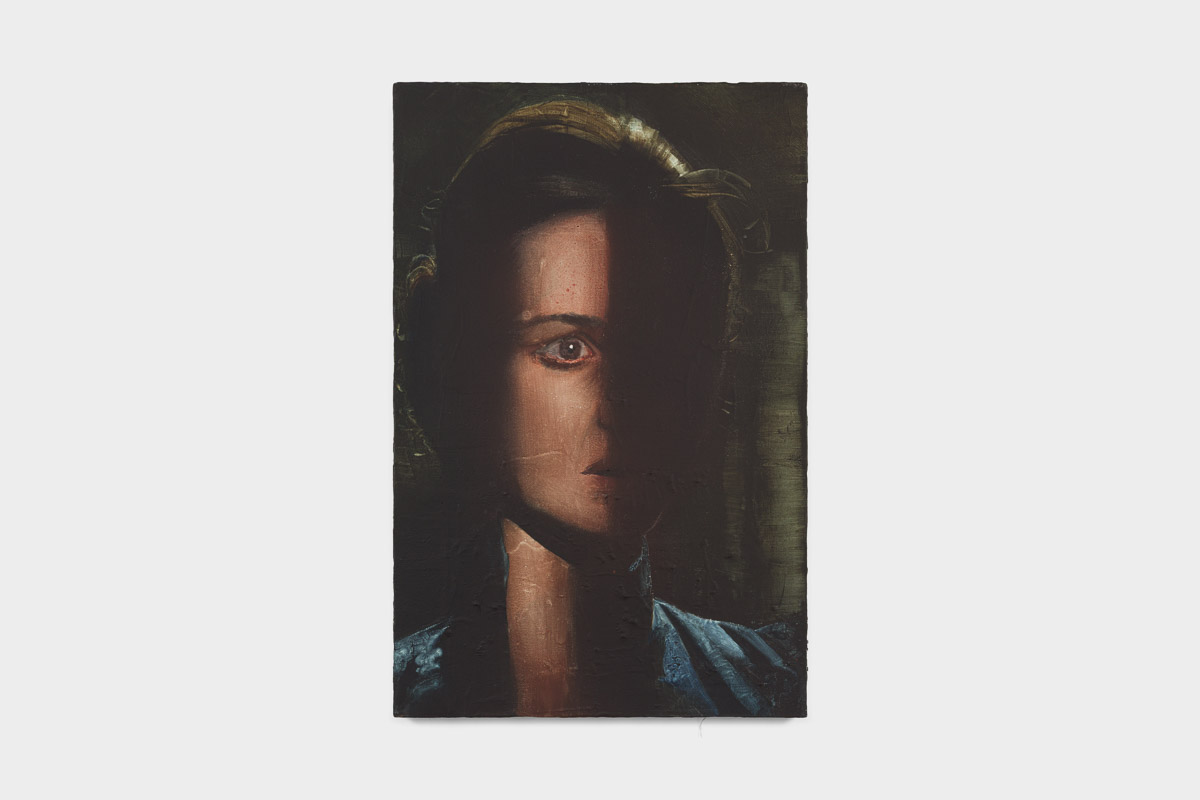
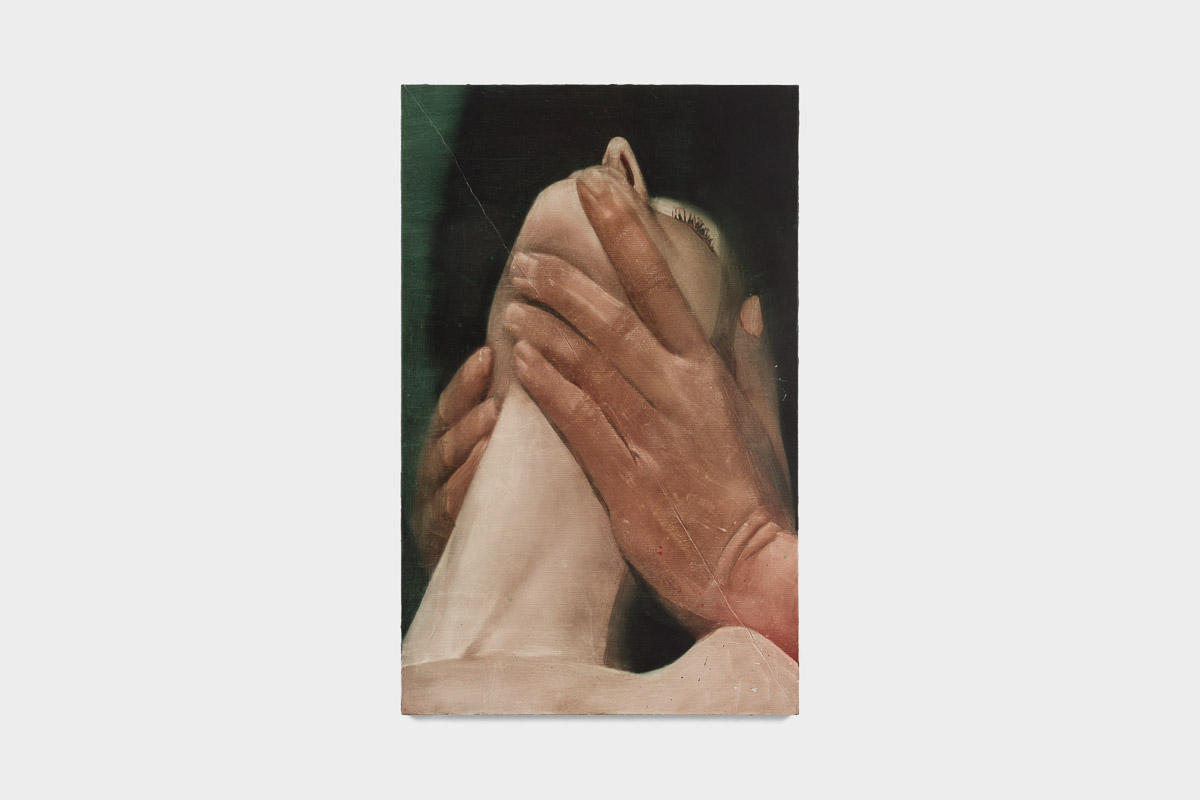
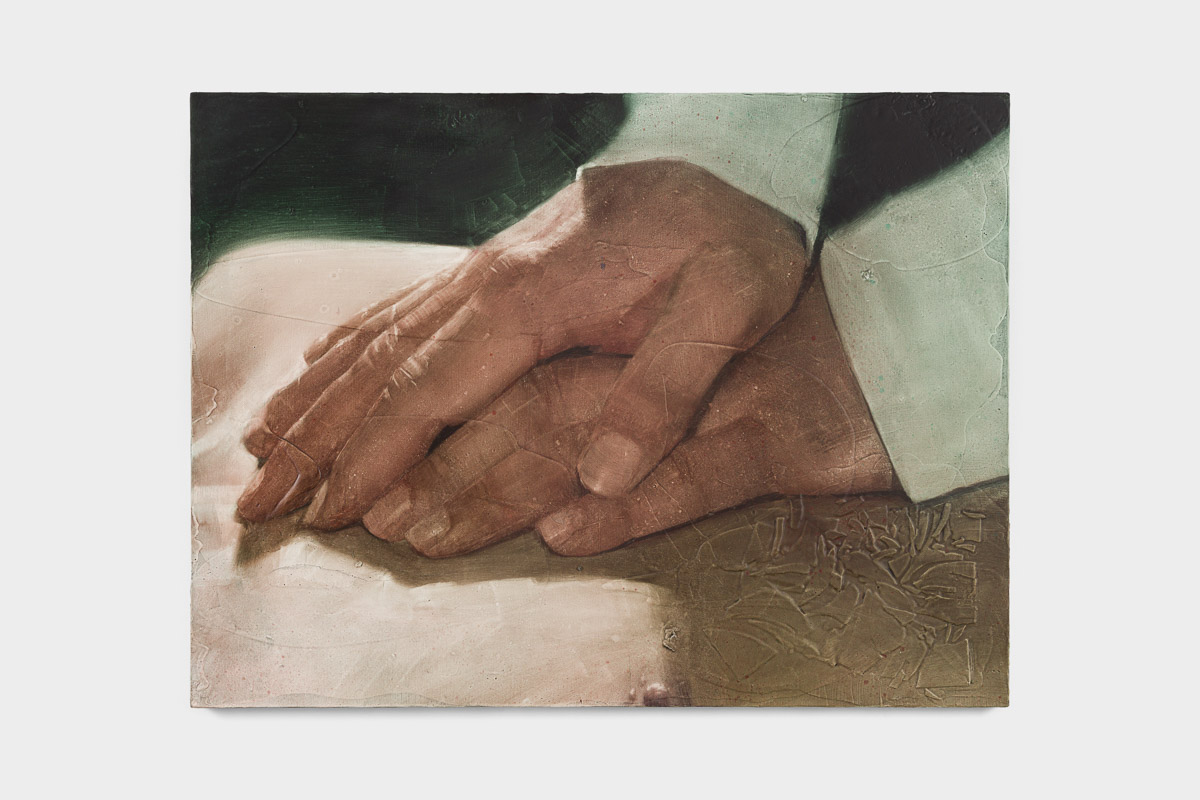
Nowhere is this atmospheric suspense more palpable than in the portrait of a woman whose face is halved by a dramatic shadow. Only one wide, vigilant eye stares out from her hiding place for a furtive eavesdrop. The viewer is left to only guess as to what or whom she gazes so intently. Even in moments devoid of human faces, the body language speaks silent volumes if you pay close enough attention. Hands rendered with a sculptural weight and a lived-in vulnerability, their skin mapped by tiny creases and shifts in tone rest or press on a male torso—a moment of obvious emotive intensity—but we will never know whether the owner of the hands is praying, rendering aid, or restraining his fellow.
Yaeger has steadily cultivated a singular visual vocabulary since earning his MFA from the Royal College of Art. His previous institutional presentations—from Polygrapher at Modern Art in London to earlier investigations like Silent Treatment—have consistently mapped the fault lines of modern communication. The art market’s ravenous appetite for the uncanny, and the psychologically and sexually charged has found its ideal vessel in Yaeger, whose meteoric ascent from London project spaces to global blue-chip representation has turned him into one of the most closely watched young painters working today. Hailed by critics as a standout new voice in a contemporary market currently fixated on sleek surfaces and over-explained identity politics, Yaeger’s paintings offer a counter-currency—a dark, slightly perverse fascination with opacity, voyeurism, and the allure of things left unsaid.
With Agita at Gladstone, he deepens these explorations, offering a suite of works that feels both urgent and unsettling—perhaps because they leave so much room for the viewer to fill with their own secrets. Confronting us with faces turned away, mouths muffled by hands or smoke, and eyes locked in private parables, these paintings capture the peculiar modern hunger for disclosure paired with an equal and opposite terror of being truly seen. In Yaeger’s hands, the whisper across the room echoes softly in the haunted houses of our own unexpressed thoughts.
Stay up-to-date with exclusive events and content.


