F L A U N T


In 1961’s Seduction of the Minotaur, Anaïs Nin states: “‘We don't see things as they are, we see them as we are.’”
When protagonist Lillian meditates upon the ephemeral nature of the Seine, she reflects on the distinct image of the sloshing river that exists before her. Not just any image, but her image—uniquely shaped by her contextualized set of eyes. She imagines that it must contrast from the image that her friend Jay might see, despite both looking upon the same river. It’s a moment that confesses how one’s personalized mode of sight is a method of constructing one's sense of reality—a method entirely incomparable to that of somebody else.
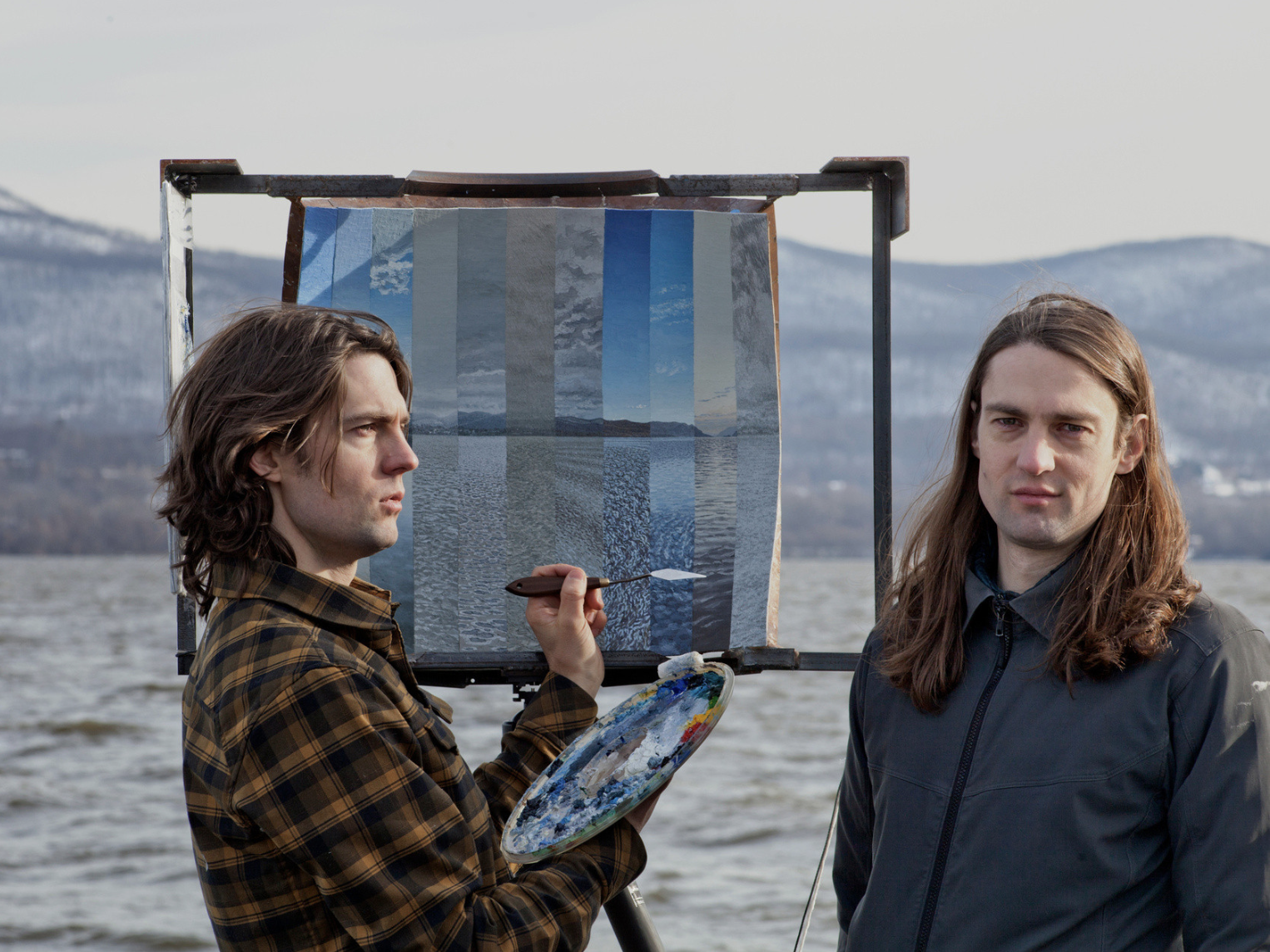
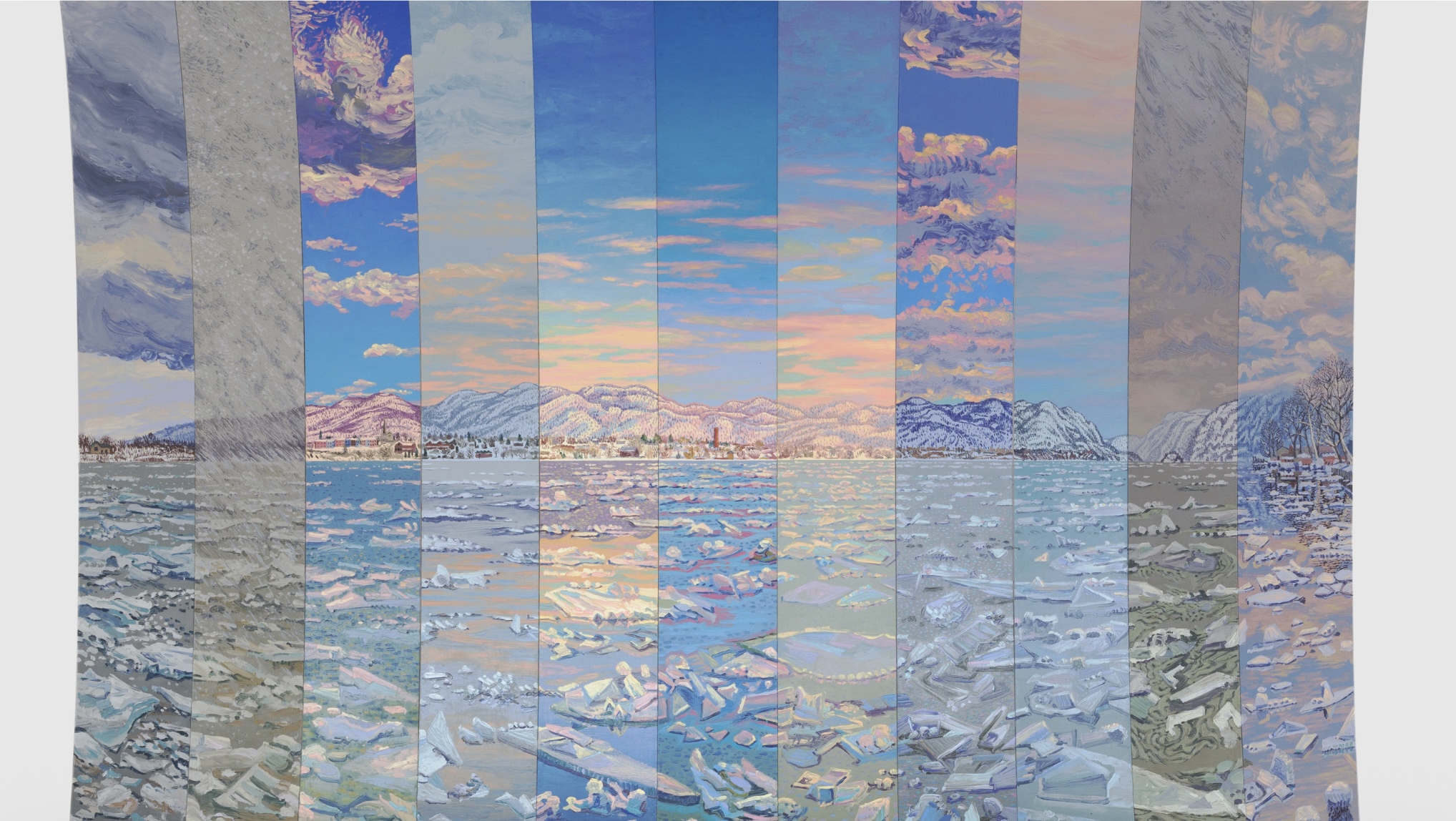
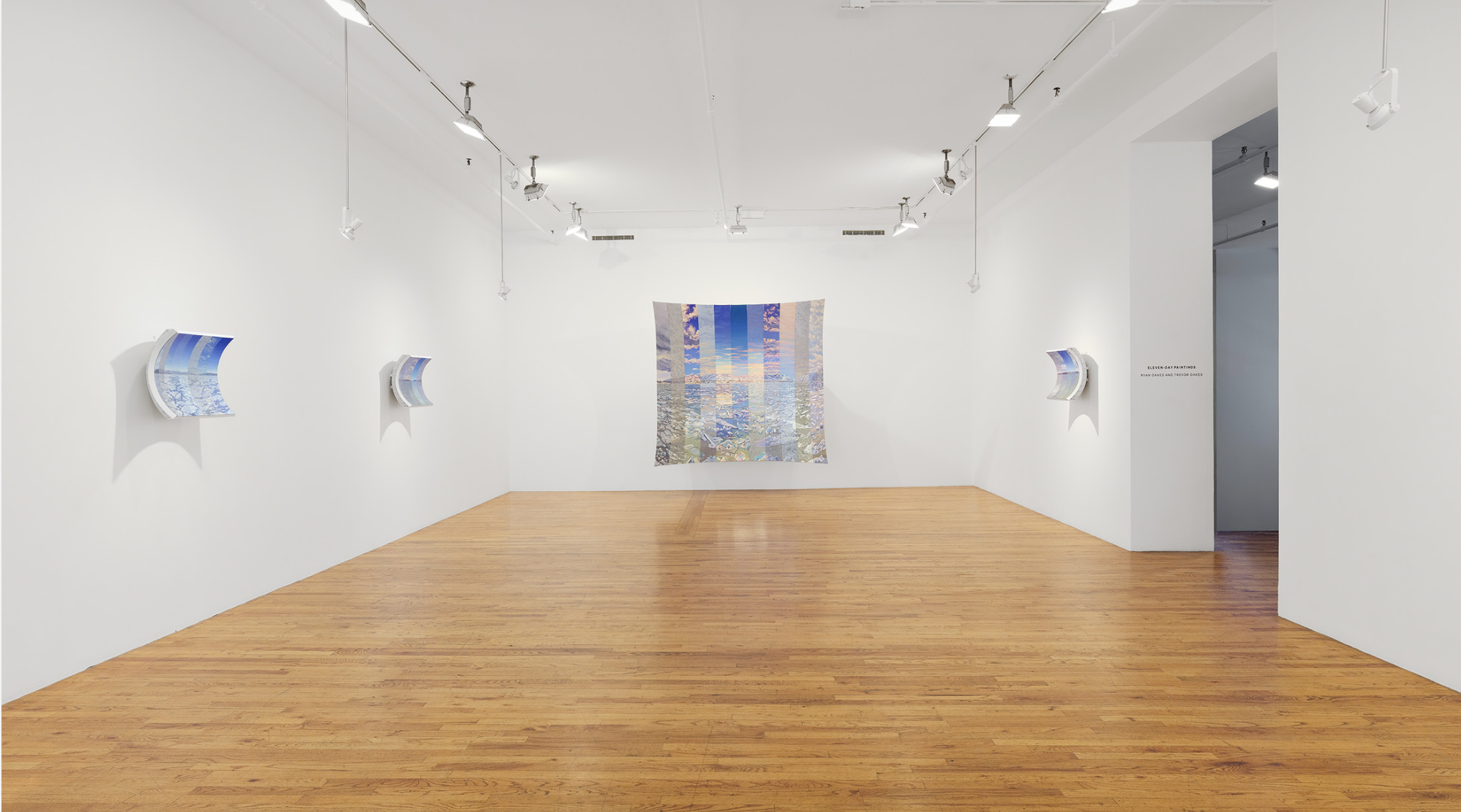
As I sit with twin artists Ryan and Trevor Oakes, whose thoughts flow effortlessly off of one another, I can sense that their senses of reality are deeply intertwined. As identical twins born and raised in Boulder, Colorado, Ryan and Trevor Oakes’ childhood, ornamented both by the natural complexity of the Rocky Mountains and by the life-long coexistence with one another, has manifested into a collaborative practice amalgamated by the exchange of ideas from one’s other half. As New York-based artists inspired by the dynamism between light and space, I sit down with the Oakes brothers to discuss their recent exhibition at Pietro Alexander in NYC, titled Eleven Day Paintings—a collection of curved easel paintings, each displaying eleven separate segments of the same view of the Hudson River, executed in plein air across eleven consecutive days.
Despite training and working within the scope of observational landscapes, Trevor insists that painting the world realistically was never the brothers’ intent. “It happened almost by accident,” Trevor says. “We discovered a method that enabled the transfer of a visual space onto a sheet of paper or canvas in a very swift way. Once we had that method, we felt we needed to see it through, and explore it. That's what led us into painting the world realistically.”
Eleven Day Paintings is contoured by this paradoxical idea of deliberate coincidence. The circumstantial weather conditions of each segment—stationed from the same vantage point of the Hudson River—contrasts from the other segment through sharp, vertical linework and color contrasts that reflect the particular day’s shade of cloudy skies or hues of blue daylight. Even though each segment is contextualized in time, the eleven panels harmonize into one image of an icy or sunny lake-scape that is nothing short of sublime.
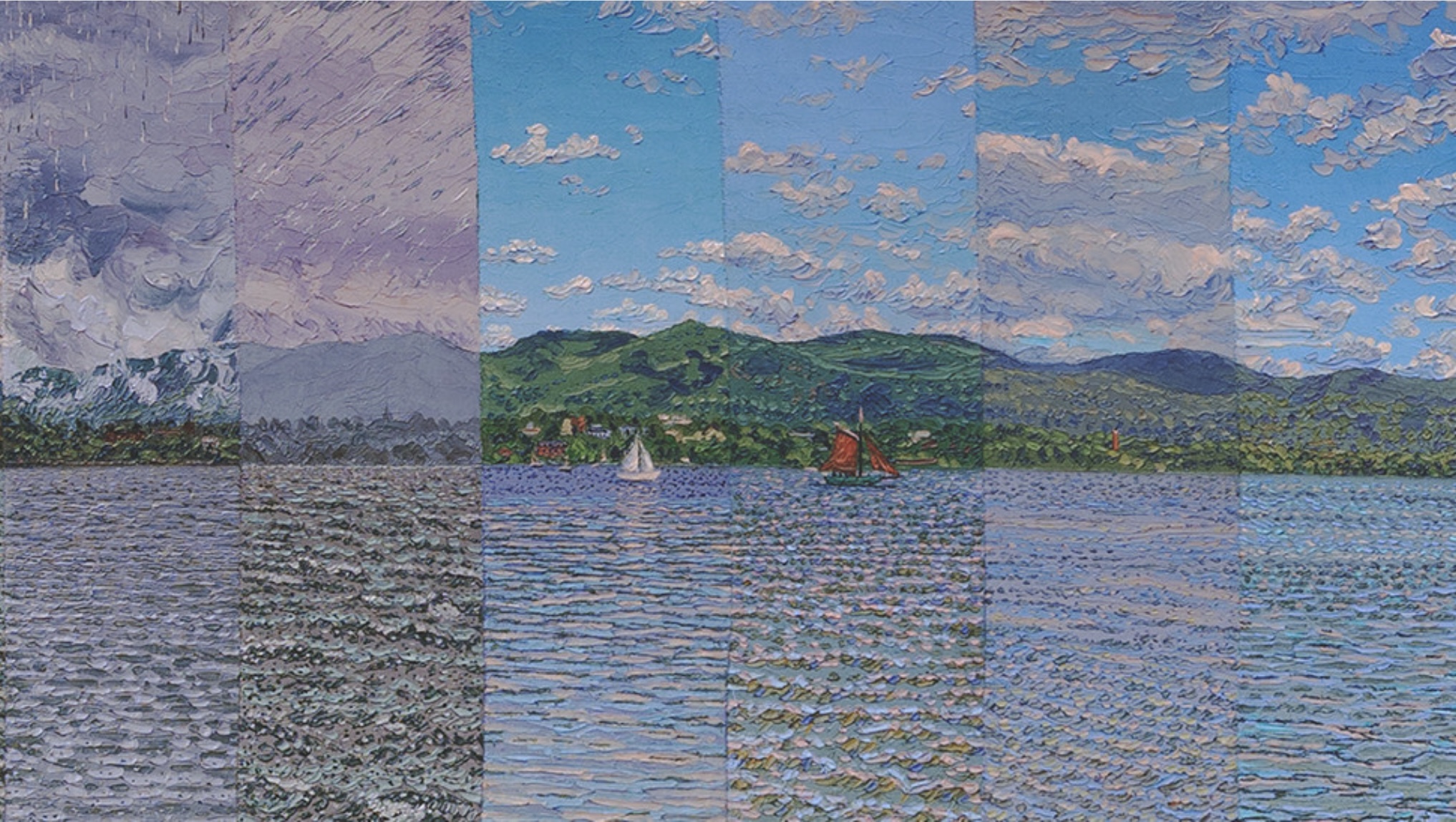
Unlike the painters from the 19th Century Hudson River School, such as Thomas Cole, whose work centered on attempting to prolong and capture a fixed second of an American vista, the Oakes brothers commemorate natural discontinuity of light and space as an oasis for both the artist’s and viewer’s interpretation. “If you do one painting, you get a set of weather conditions and compositions that happen by chance. Then, if you do a second painting that is a companion to it, you wind up with a completely different looking painting. In those differences, you really see the fullness of the idea.”
Watching differences unionize certainly does not come without its reservations. “The initial idea of letting the composition change as the weather changes, and responding to each day individually without trying to blend the days together, was Ryan’s idea,” Trevor says. “I was pretty resistant to it initially. All the prior paintings we had done had been this sort of fictional snaspshot where, even if they took two weeks to paint, you would keep the palette the same as it was on the first day. This went against the grain of everything we had ever done.”
I ask what the collaborative process was to overcome this divide—how they overcame the fatigue of extensively painting in plein air, how they split the workload between the two artists. But the answer transcends the mundanity of these mere mechanics. Instead, the conversation returns to the act of conversation itself.
“[Our process] is more of a dialogue. [One of us] is making the paintings from start to finish. We are not passing the paintbrush back and forth. The decision making is discussed,” Ryan and Trevor both say.
It’s a “dialogue” which Ryan emphasizes as existing exactly in that moment of the painting’s rendering without ever leaving the site. It is a “dialogue” that has existed within their power since they were born—one brother working as a left side of the brain, the other the right. Unlike a solo artist who might be doing the heavy lifting internally and in isolation, the Oakes’ prowess is enlivened by externalizing complimentary or contradictory viewpoints—by clashing binaries, by specific realities bouncing off of one another until materializing into one awe-inspiring, cohesive image.
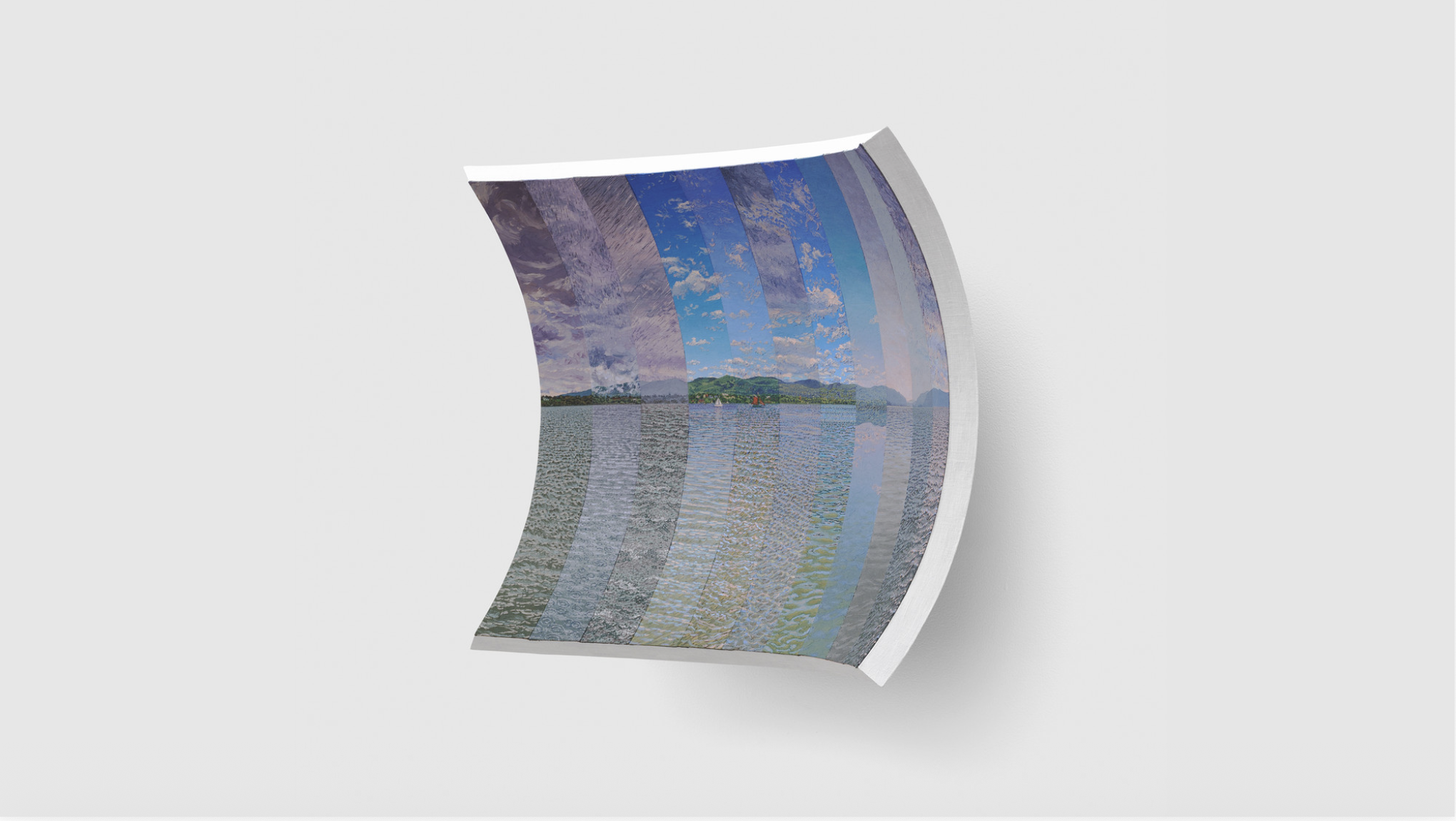
Executed as a curved easel, perception of the changing compositions of the Hudson River is not just subjective in content, but also in form. “Working on the spherically curved surface ensures that the images are not distorted,” Ryan says. “The curve of our easel responds to the shape [of the eye]. The substrate is a nod towards the eye looking,” Trevor also says. The curved easel, in plein air, is sort of aimed at a vista like a camera, then acts as an extract of the human's visual experience.
But since such a curvature renders the works’ viewing as a bit more dependent on in-person experience, I begin to worry about how the brothers confront an increasingly digital age, where art exhibitions are sometimes becoming more scrolled through on Substack feeds than digested in their proper gallery spaces. I begin to wonder: what happens to art like the Oakes', which is so physcialized and takes up space with a voyeur, when increasingly, the voyeur is retreating behind a bluelight screen?
“Even prior to [screens], it was flat images of books, flat pieces of paper. The flat imaging form is the canon in our world,” Ryan reassures me. “It's definitely best to see them in their curved form. But there's a second generation of them which exists on flat screens. And we can also work within that medium.”
“These are highly realistic images,” Ryan continues. “Whether they're drawings or paintings or a cityscape or a landscape, I think that plucking a place and logging it onto a piece of paper, then transporting it elsewhere to be viewed, I think that is something very exciting. Much of the content that we experience on our screens is something that happened somewhere else, from a different place and time. It is being recreated across the world or across the country to another viewer. So, you start to play with ‘When is the moment of now?’ The moment of ‘now’ was when that was recorded. The moment of ‘now’ is when it's experienced.”
Ryan and Trevor Oakes are not artists who shy away from the changing of times. Ryan and Trevor are emboldened by a perpetually self-modifying composition that occurs with the inevitable turn of the globe—unburdened by the pressure of attempting to contain a finite cloud or ray of golden light on the horizon, free from the constraints of a singular reality.
Ryan and Trevor Oakes' "Eleven Day Paintings" exhibit is on display at Pietro Alexander in New York City until October 29, 2026.
Stay up-to-date with exclusive events and content.


