F L A U N T


Do you remember your earliest experience of ‘ergonomic awe?’ The very first time you identified a planet glimmering among the stars, and felt connected to the entire solar system? Looked up at the moon, marvelled at how this rough grey stone stirred the tides, as well as the water your body is made of? Had a moment of vertigo at the edge of a cliff and grasped how gravity works to keep your feet on the ground? When the precise geometry of a cathedral and the kaleidoscopic symphony of its stained glass windows sent you soaring into the sublime?
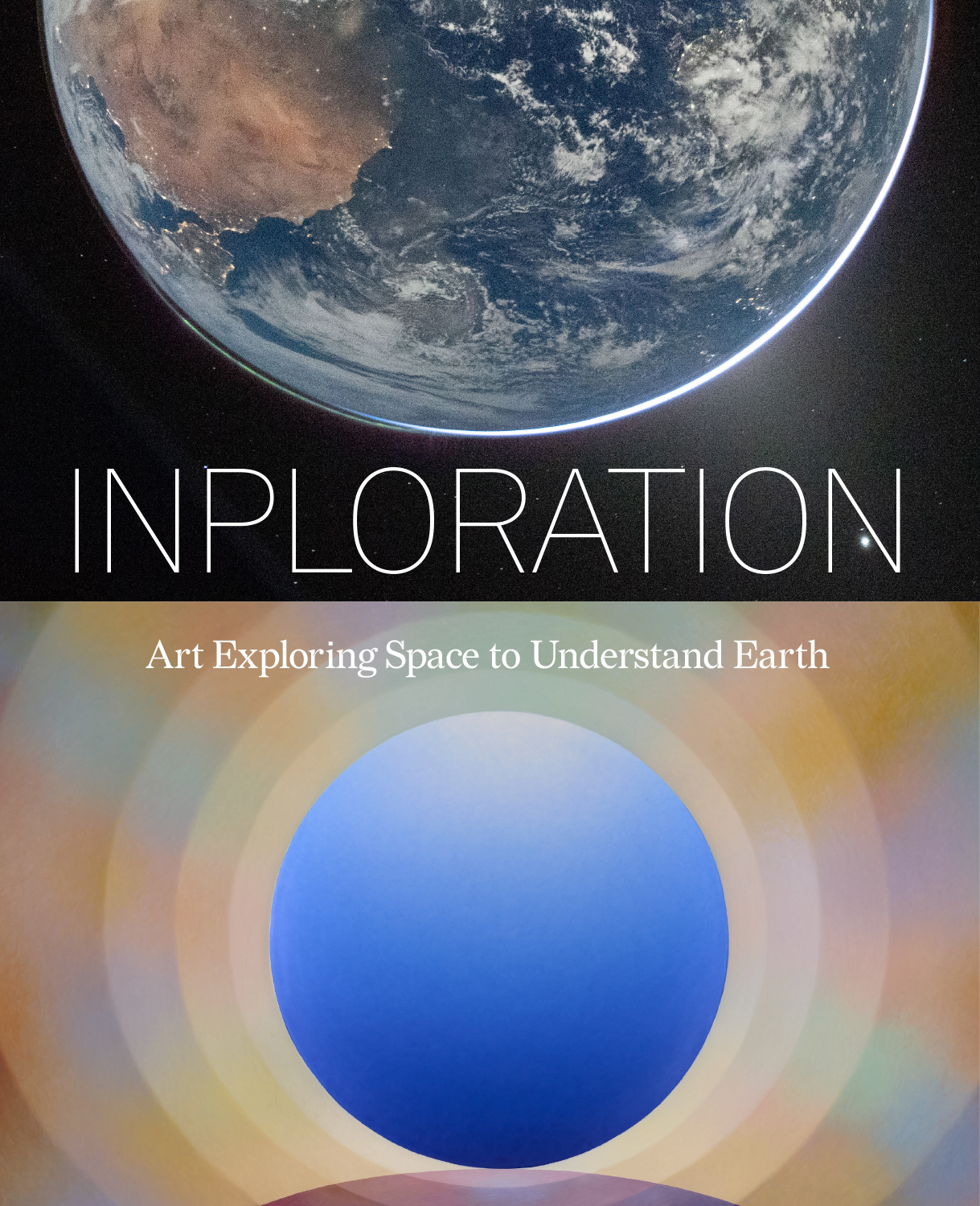
“Inploration: Art Exploring Space to Understand Earth” from Lawrence Azerrad and Richelle Ellis seeks to provoke these same effects of wonder and oneness via a survey of some of the most fascinating art of our time. More than (just) a beautiful art book, the concept of ‘Inploration’ is also proposed as an applied design philosophy, with interactive and collaborative installations, innovative architectural interventions, live performance events and an excursion into the musical with an accompanying gatefold vinyl LP release. All aspects of the idea are designed to resonate together, adding up to a movement to awaken future-forward global consciousness via creative action. Speaking from Los Angeles, co-author Lawrence Azerrad, whose resumé includes the books Mirror Sound: The People and Processes Behind Self Recorded Music,’ 2020; ‘Supersonic: the Design and Lifestyle of Concord,’ 2018 and the Grammy-winning '40th Anniversary Voyager Golden Record' box set, 2017) rewinds to the inception of the endeavour. “Richelle Ellis is an artist who works in themes of space exploration, has had her works on the sides of a satellite, has even had her work launched to the Moon. As a creative director and designer, I’ve been involved in a number of projects having to do with space and ‘futuring.’ We were introduced in 2021 by the Dean of Fine Arts at USC, and we both appreciated how the perspective from space can lead to an appreciation of our planet. As more and more of these ideas coalesced, we arrived at a concept about how art can help us to understand these ideas and get excited about them. That when ‘exploring space,’ exploring art is very much about exploring yourself; instead of going outwards to explore, this is a journey within. So we coined the term ‘In-ploration,’ obviously the opposite of the word ‘exploration,’ and had that word trademarked.”
On the cover is a sinuous female form entirely coated with ultramarine blue pigment, holding her ear to the ground to listen deeply to the Earth, an appropriate herald for the voyage of discovery to be embarked upon. From the Lita Albuquerque work, ‘hEARTH’ staged within the 2017 edition of ‘Desert X,’ and physically based on a plaster cast of daughter Jasmine Albuquerque, the figure represents ‘Elyseria,’ a time-travelling 25th-century female astronaut. A recurring character for the artist, mythic and mysterious, she has returned to deliver truths to struggling humanity as she finds her way back ‘home.’ And so shall we.
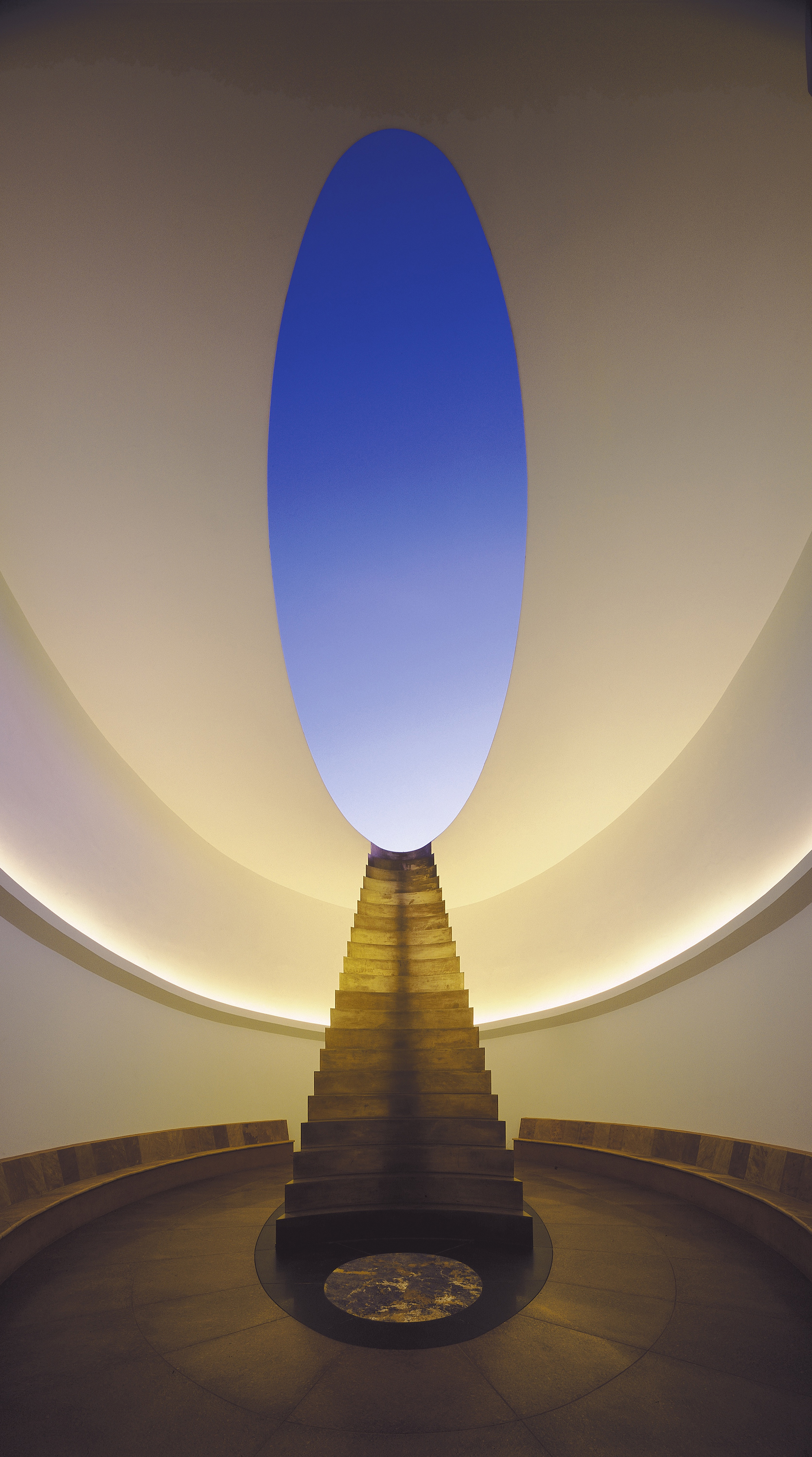
First chapter ‘New Overview Effects,’ investigates the two images that, with their startlingly omniscient views of our common home, revolutionized our conceptualization of the Earth. The first, ‘Earthrise,’ was taken from lunar orbit by astronaut William Anders in 1968 while on the Apollo 8 mission, and the second, ‘Pale Blue Dot,’ was captured by NASA’s Voyager 1 probe in 1990. These new views of ‘the blue marble’ are the ‘origin seeds,’ as Azerrad terms them, of Inploration. “Both of these artworks are all about perspective, and a perspective shift that I think is fundamental to us appreciating ‘who we are’ and ‘where we are.’” The foundational anchors locked in, an extended analytical essay which frames selected the art and artists alongside scientific, technological, philosophical and cosmological concepts is launched. It’s an atmospheric visual trip from the get-go: a pulsating nebula against the inky immensity of outer space as sighted by the James Webb Space telescope is brought into contextual alignment with works from contemporary artists such as Nancy Baker Cahill, (with the Augmented Reality work ‘Corpus,’ a hovering, branching virtual bodyform) Lia Halloran (handpainted cyanotype cosmic tableaux) and co-author Richelle Ellis (climate satellite topography rendered into camouflage patterns using Japanese washi fibers). Some of the works subsequently covered reach for the sky, such as Cai Guo-Qiang’s unforgettable ‘Sky Ladder’ of 2015, blasting a path into the heavens with a soaring trail of precision fireworks. Others reflect it; Cannupa Hanska Luger’s “Mirror Shield Project” is a collective assembly of participants holding large mirror panels to striking effect, staged in various locations to amplify resistance since its inauguration in 2016 to support the Water Protectors at the Dakota pipeline. And then there’s James Turrell, who with every iteration of his concept, such as ‘Wedge Work’ of 2024, a glowing neon-pink portal into infinity, takes us up into the sky without a spacesuit, using pure planes of light that let us dream with our eyes open.
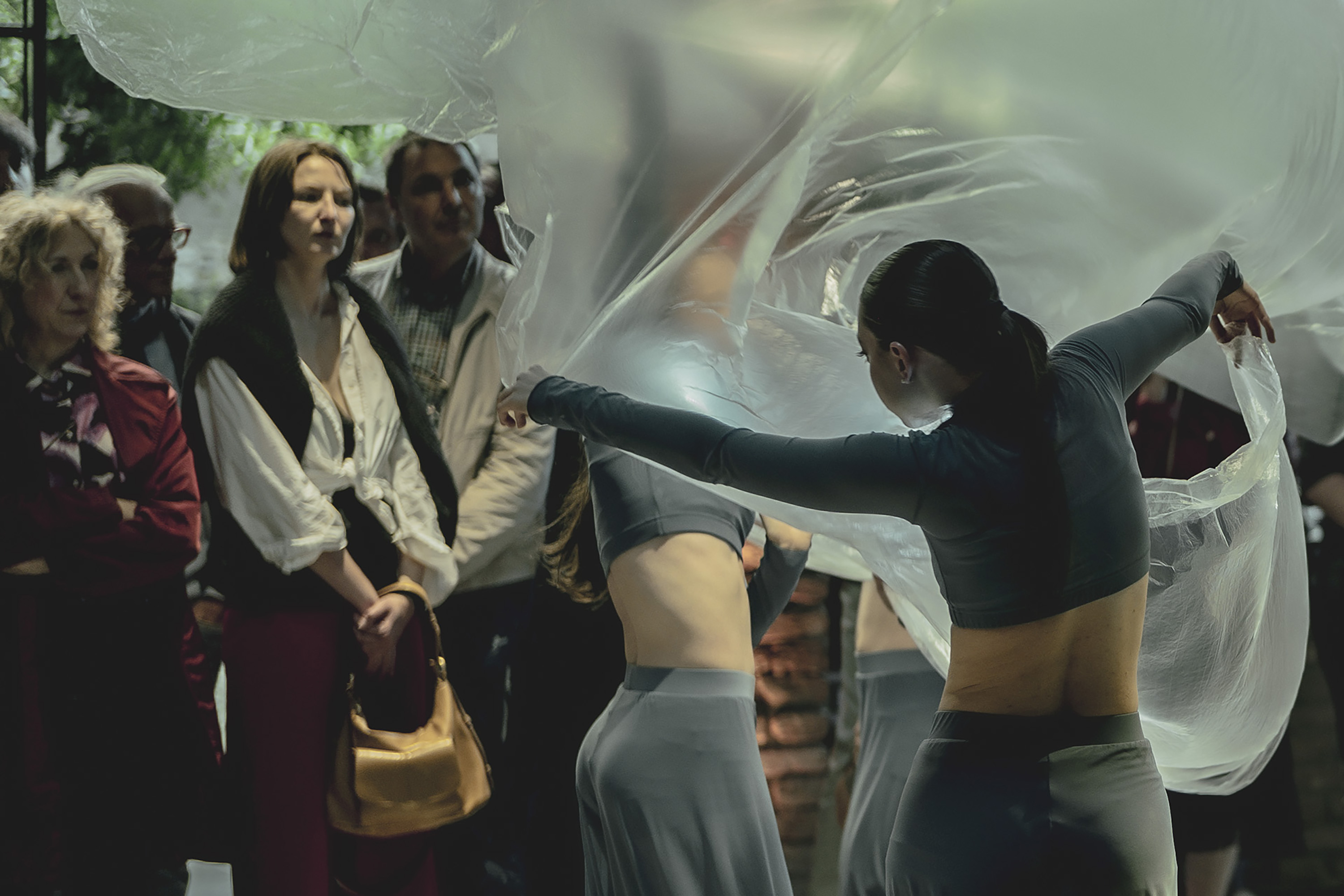
Part Two extrapolates upon the UNESCO-defined term, ‘Futures Literacy.’ Dedicated to ‘the art of rehearsing tomorrow,’ opened by explosive military rocket testing at Camp Swift in Texas and bookended by “Milky Way Over Ojai Ridges,” (2022) a luminous fibreglass globe by Russell Crotty. “The great thing about ‘futures literacy,’ especially in the way that UNESCO embraces it as a discipline, is you don't need to be a designer or a futurist or an economist, or any of those things, to meet those challenges. It’s a skill that anyone can really take to,” explains Azerrad. He is keen to draw us back to the fact that the vision of future is in all of our hands, despite the typical scenarios science fiction feeds us. “Why should our future look the way Ridley Scott imagines it should look like, or Walt Disney did? This doesn't always require an output that looks like a Kubrick film.” Inploration is determined to devise ways to channel this re-visioning into concrete ‘science fact,’ too. The Case Study, “Lunar Mission Control: Building Inploration in Public” details a multi-media dance and musical performance held in the very first ‘Universe Pavilion’ at the 2025 Venice Architecture Biennale, and the MIT Media Lab’s Space Exploration Initiative/ MIT Architecture collab imagining a potential Moonbase structure. “We looked at a lot of different techniques, including 3D printing, and the weight limitations of the building as a big factor, but it ended up as a complete compression tension sculpture. There are no nails or screws or glue or plaster holding it together, it’s a completely tension-built form, which is one of the most fundamental architectural forms of of humankind, for example, an igloo. The material, FOAMGLAS, is basically aerated glass turned into the equivalent of a pumice stone - it’s also very similar to lunar regolith.” The resulting pock-marked matt black curve, while a stylish extrusion anywhere, would also respect the moon’s own aesthetic rather than impose outside geometry and materials upon it. Venice, an ‘Impossible City’ of marble and glass, built up by hand from the mud of lagoon marshland, provided a macrocosmic frame for the Inploration exercise. “We were very conscious of the parallels between humanity and space and humanity and Venice. Both are places where you're permanently at the edge of survivability. You won’t survive for very long in water, or on water, without innovation. You can’t survive in space without innovation.”

By declining to dwell on the dystopian, artists can provide more ‘posi-topian' models that show how humanity can visualize overcoming the projected nightmare scenarios - rather than being forced down a ‘Mad’ Max route, instead forging a path to our return to a beneficent Earth. It’s about mining gems from the layers of the past to see further forward, as Lawrence delineates: “The third chapter of Inploration engages with ‘cultural cosmologies.’ There’s a lot of indigenous wisdom knowledge-holders who have consistently looked at these practices holistically. Like the Iroquois, with ‘the Law of the Seven Generations,’ where any decision that made took into consideration the impact that it would have seven generations ahead.”
The final section of the book provides guided workbook pages which advocate simple steps to take the practice into daily life; first, ‘GO OUTSIDE,' because when you do, “You begin to see that your inner world has patterns—just like ecosystems do.” After a thorough plunge into the world of Inploration, I’m drawn irresistibly to the pre-contemporary, the ancient artworks of which only the heaviest stone examples remain. I ask Azerrad if he sees this innerspace-outerspace confluence back through time like I do. “To answer your question, from what I understand about Stonehenge and the pyramids, a lot of these large earthworks, they were also used by ancient peoples to orient themselves not just here on Earth, but also with the cosmos, using alignments with the solstice and equinoxes. They were also about recognizing that we are part of a larger system that's always moving.”

So it seems that, with the most cutting edge composite imaging of furthest nosebleed space available for all to view on any device, we’ve found ourselves back at the beginning of art itself. From the very first stones cut, dragged and lifted into place to plot the rising of the sun and the movement of the stars, to the most technologically advanced techniques our artists, scientists, aviators and astronomers deploy for the same purposes today. “In order to maintain the stories of a culture, each generation must tell them to the next,” holds artist Cannupa Hanska Luger in a ‘Part Three’ pull-quote. The Inploration book, record and outreach events in the world will do the same for our moment in time. To capture the ways in which, through art, we traced a path into space, on a mission to better appreciate the planet we, and everything we know, has emerged from.
The final words of the book articulate the borderless, boundlessness essence of that mission: “To Inplore is to remember that I am not above, beyond, or apart from the world— but deeply, consciously, and responsibly within it.” INPLORATION is published on 27th October by DelMonico Books.
Stay up-to-date with exclusive events and content.


