F L A U N T


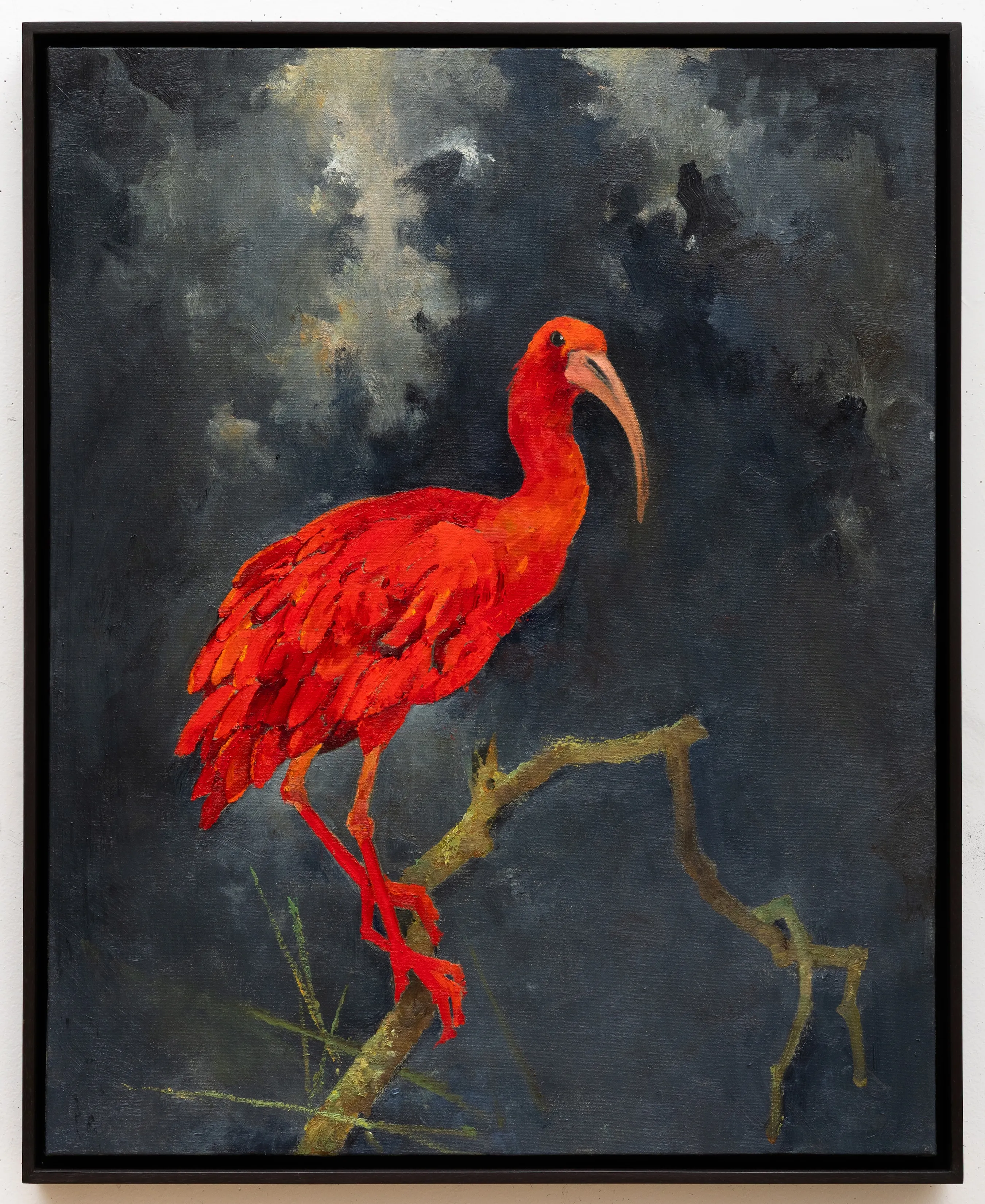
“If I were painting the Golden Gate Bridge,” John Alexander says, “It’d end up looking like the swamps on the Texas-Louisiana border.” He laughs, but he means it. Even after nearly 50 years in New York City, the Texas-born artist still has a hint of a drawl, and that generous manner of speaking I associate with southern charm. In the collection of canvases included in Nature Observed, painted between his loft in Soho and his second home in Amagansett, the bayous and wooded wilderness of his childhood color even the most placid ponds and fulsome flower beds.
Alexander inherited his love of nature from his father. Born in the 19th century, he was a Waldenesque figure who could decipher the calls of whippoorwills from those of quails and great horned owls, could identify every willow, toad, and blooming bush the two of them encountered. Time spent camping and fishing with his father in the bayous taught Alexander how to sit with the natural world, to not only look, but to see. It’s also what made him conscious of the indelible loss that accompanies change from a very young age. Driving back from excursions in East Texas, his father would point to the gas stations that now covered over creekbeds, the fast food chains that took the places of post oak groves. To this day, Alexander’s work can be read as a bid against the erasure that accompanies progress.
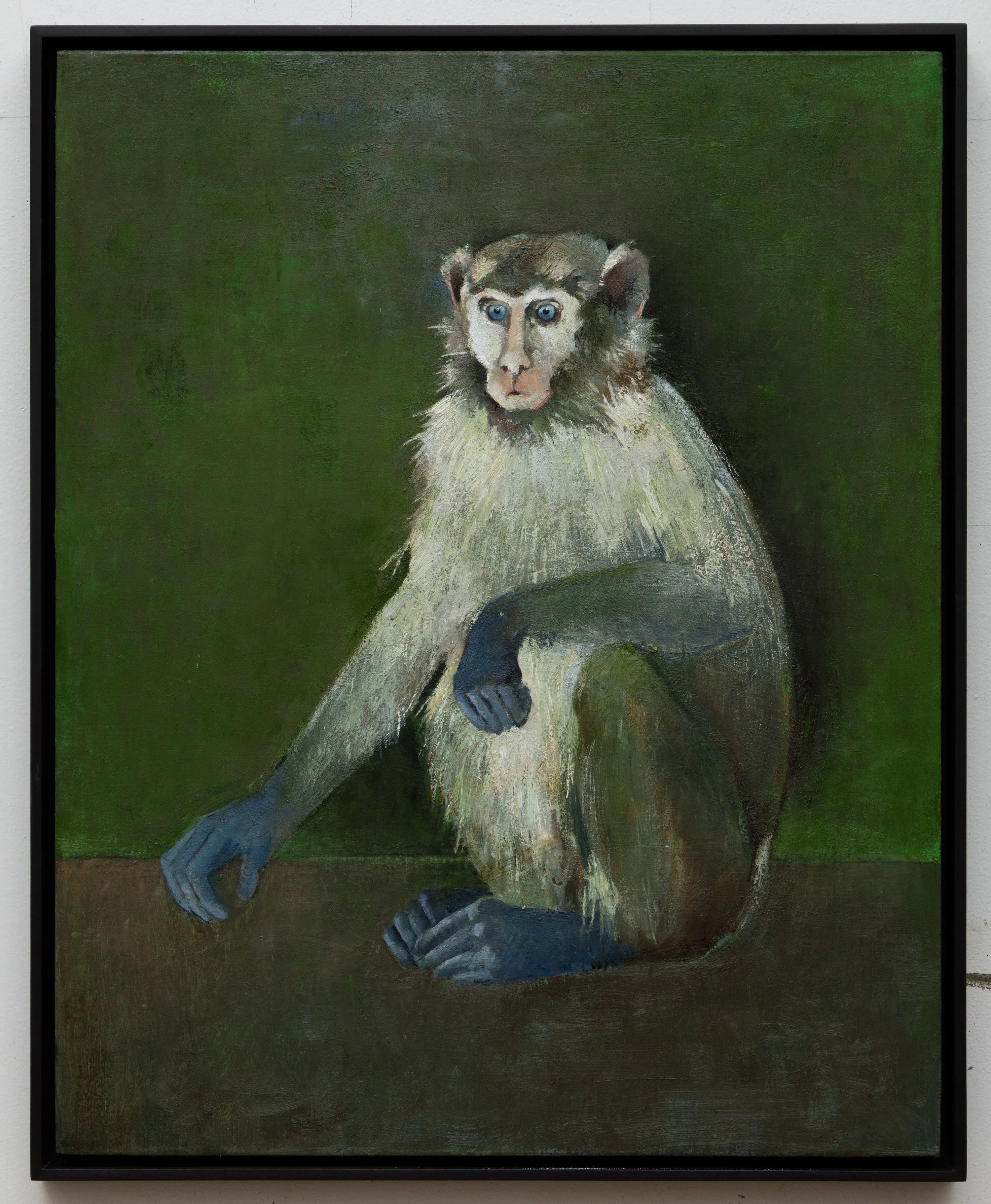
Given his upbringing, it’s perhaps unsurprising that when the young artist moved to Soho in the 1970s, the shocking absence of nature manifested in a change to his practice. “I’d always been a painter of observation,” he said. “Then suddenly there was this explosion of angst: apocalyptic, almost Boschian scenes with demons and flames.” It wasn’t until he found a place in Amagansett on the east end of Long Island, where he had a sprawling garden and a pond, that he returned to painting the world that he loved. If there are historically two kinds of landscape painters, those that depict nature from a distance as if seen through a window pane, and those that show nature from the point of view of someone immersed within it, Alexander is squarely in the second camp. “I have to have my hands in the earth,” he says.
Fittingly, the majority of the works in his fourth exhibition with Berggruen Gallery were painted in part or in full en plein air. Propping his easel beside his waterlily-filled pond, amid his rose garden and the plots of tomatoes and peppers, or elsewhere on the three-acre property, he documents in oil, charcoal, and ink, the beautiful, frenzied, fertile world around him. Expressive, exacting gestures and lush, lambent colors capture the majestic otherness of an ibis perched on a bare branch as in “Scarlet Ibis with Approaching Storm” (2025) and the burnished glow of coral roses against a darkening sky as in “Garden Secrets” (2025). He describes his process in terms of refinement: subtracting as much as he adds. Comparing the composition of an image to that of a symphony, he explains, “you have kettle drums, bass fiddles, piccolos, French horns. If it all works together, you have music. If it doesn’t, you have noise.”
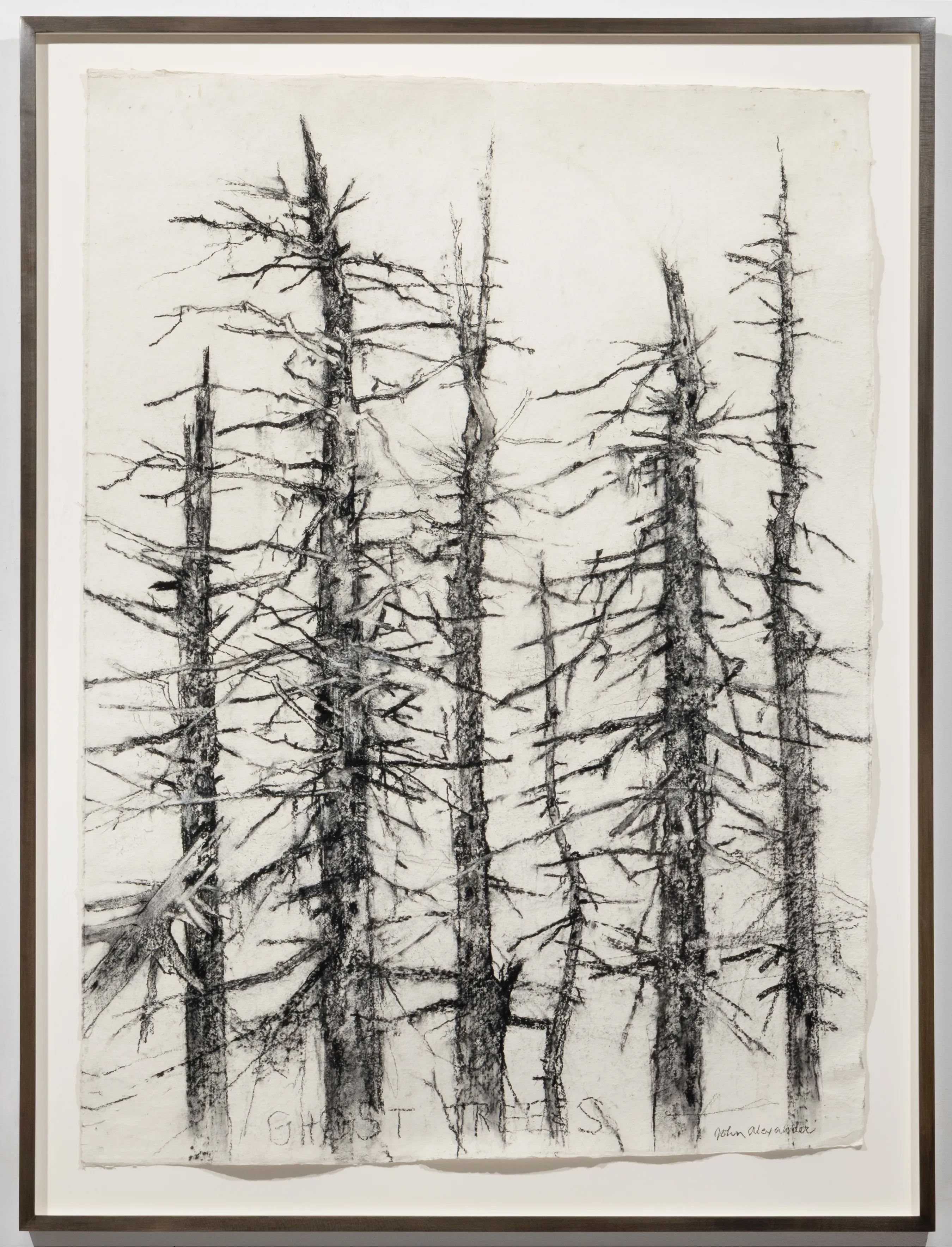
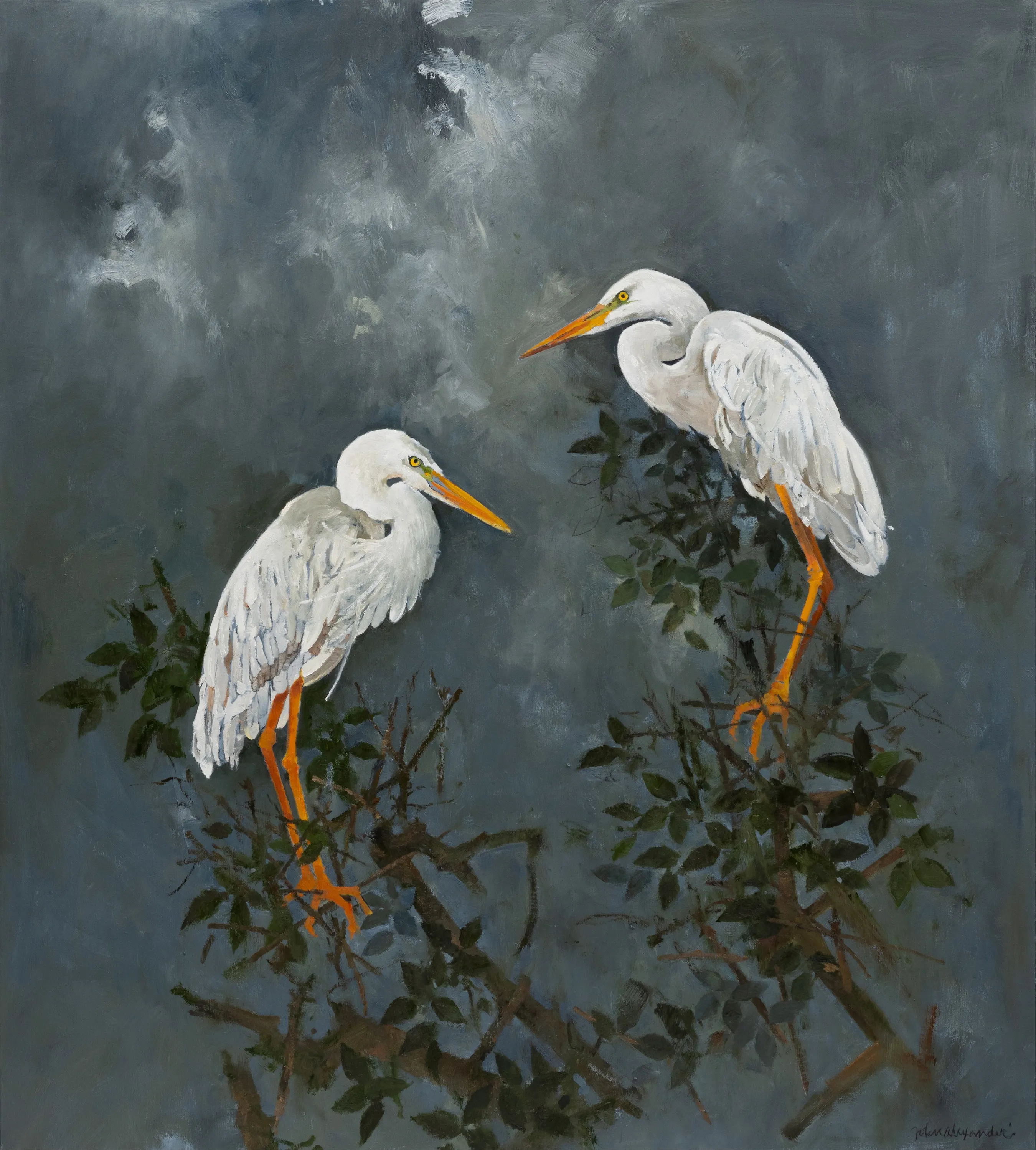
The balance and the beauty are not uncomplicated. His sensitivity to the precarity of his subjects, in particular, and the natural world in total, lends the canvases their emotional weight. They are, he says, “a glimpse of paradise before the wrecking ball hits.” Stormy skies and dead and dying trees engender a feeling of foreboding, a growing unease. In “Searching for Something” (2025), three great blue herons stare out from their place among a cluster of bare, broken branches, each bird imbued with its own distinct interiority. “I always want the viewer to feel that the painting is looking back at them,” he says. Meeting the unblinking, yellow-eyed gaze of the creature in the center, I can confirm that they do.
In his 80s, Alexander continues to paint with the urgency of someone who knows all too well what we—all of us—stand to lose.
What are the two approaches to painting nature that you think about?
One is viewing nature like you're looking through a window—like in the Renaissance, where the Madonna is in the foreground and way off in the distance there's a hilly landscape with a steeple. That was the rudimentary beginning of using nature as a subject. It wasn't until the 1600s, in the Baroque, that people really started to glorify nature. The figures became smaller, placed within nature rather than before it.
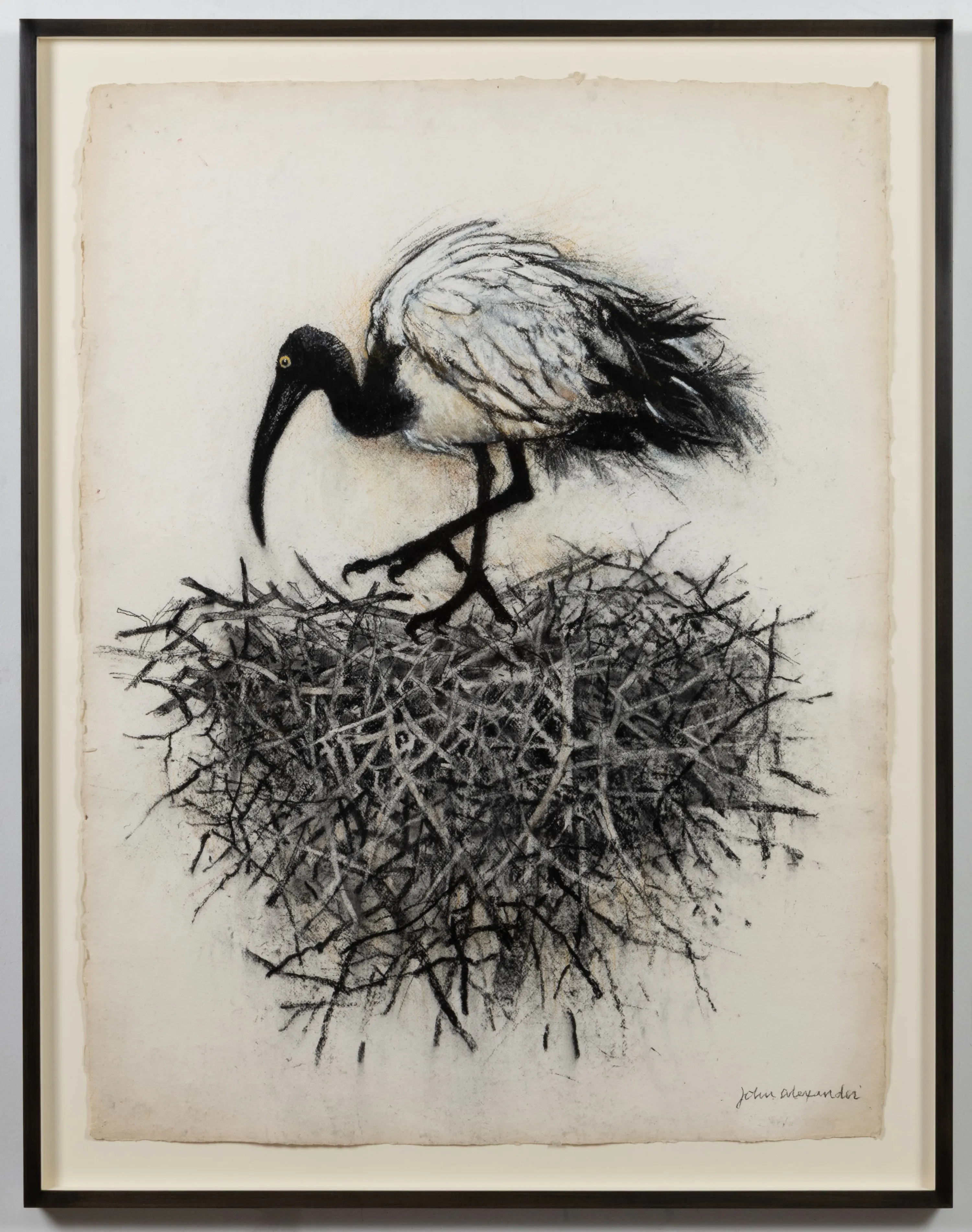
The other way—which I practice—is to get nature all around you. You're in the landscape. When I paint these jungled scenes, I'm working from situations where the nature is either all around me or right in front of me. I can smell it, I know what the leaves are like, I know what the wind sounds like. I'm a very keen observer. I try to immerse myself in the subject I'm painting—that's why you see so much repetition in my work, not in how things are painted or the color schemes, but in the subject matter. I paint a lot directly from my pond. Most of the birds you see, I've photographed and observed and sketched my whole life. I have a lot of bird feeders. There's direct observation and immersion—direct contact with the landscape. I think that gives a more honest version of how I interpret the landscape. I feel like my environment, and what happened when I was in New York City, shaped a very honest interpretation of nature as I see it.
What does your process look like? Are you painting plein air? Taking photographs? Drawing?
A lot of drawing. I have big outdoor easels. My studio in Amagansett is surrounded by a lot of trees, and there are big fields behind me, and these vines that grow all over the trees. I use and incorporate them a lot in my paintings. I built a wall outside where, at certain times of day when the sun's not directly on it, I paint out there. I start paintings in the studio and take them outside, or start them outside and finish them inside. It's always a process back and forth—but I'm never far away from the actual plant or bird itself.
How do you decide on those particular moments to capture? There seems to be so much intimacy. How do you decide which bird or which moment?
I try very hard to give my creatures—whether it's a bird, a raccoon, a squirrel, an owl—personalities. I've always felt that if you can give the animal a personality, you make the viewer look at the painting and feel like the painting is looking back at them. I go to great lengths to make the eyes follow you—to make the bird look aware. If you're walking around and glance back, you can sometimes feel like, is that bird looking at me?
A lot of my paintings are also about loss of habitat, which in my lifetime has been remarkably significant. There's a painting in the show called Red Cedar Blues—these big, beautiful, heroic-looking gray-blue herons, each with a different personality and expression. The red cedar is the dead tree. And "blues" can mean the blue herons, or it can be interpreted as melancholy—a dark, stormy blue. They have the blues because what they're looking at is their dead trees.
I believe that painting has to have some connection to the human condition. There's nothing wrong with beautiful design, but I don't have any interest in design. I'm more interested in art with spiritual content, emotional content, and a real connection to the human condition. I think that if you're an honest artist, you should be able to explain what you're doing and why—and there should be a narrative. Even in an abstract painter like Diebenkorn, there's unquestionably a narrative. Same with one of my great heroes, de Kooning. People call his work abstract expressionism, but to me it's expressionism, plain and simple. He could sit down and explain exactly what he was doing, what it meant. One of his great paintings at the Hirshhorn, The Wave—he was explaining how he kept watching waves at the beach repeating themselves, the reflections. There's a narrative there.
And Turner—if you want to look at a painter who exemplifies all of those things in one work of art, look at Turner. Just the sky alone has such power and passion. His concern for the human condition comes through in his subject matter alone—slave ships, people caught in storms, shipwrecks, the burning of Parliament. He brought all of that trauma and emotional drama into a canvas that resonates today as if it were being painted right in front of you.
I read that you've described your work as "a glimpse of paradise before the wrecking ball hits." How do you think about imbuing environmental awareness into what are otherwise just gorgeous paintings?
I love to come up with a title that connects to the painting. It doesn't always work, but I remember one—a swampy scene with birds jumping and splashing in the water—I called it Swimming in the Sea of Self-Righteousness. Titles mean a lot when they work. Sometimes it's just "Landscape in Blue and Green," but the wrecking ball one, I was particularly fond of. Paradise before the wrecking ball hits.
Sometimes it's just a matter of being outside and seeing something. We went today—Alexis from the gallery took my assistant Natalie Edwards and me to see the Golden Gate Bridge. We've had the worst winter in New York in 60 years, 30 inches of snow in the last three weeks, and just getting out of the car and picking grass off the side of the road—we all got out and started photographing flowers. Sometimes I'll be out in my yard at a certain time of day and I'll see a fresh new outcrop of something growing, and I just think, I want to paint that. By the time it's finished, I'll put a little stick or something slightly out of place in there to give it an edge. But sometimes it really is just about beauty.
You have to think of making a painting like a conductor leading a symphony—kettle drums, bass fiddles, trombones, piccolos, clarinets, French horns—you've got to mix it all together. If it doesn't work together, you have noise. If it does, you have music. The complexity of nature is overwhelming, but the trained eye, if you do it long enough, begins to understand what to take away and what to leave, what to move and what to keep. It all begins with structure. What ends up on the wall is as much the result of erasing as it is of adding.
You've been looking closely at nature since you were a child. Has your relationship to looking at nature changed over the course of your career?
I've become more conscious of change in nature. I was very fortunate—my father was old when I was born, so he had retired and we had a lot of time together. He was a great outdoorsman, a man of the 19th century—literally born in the 19th century. He understood the complexity of nature deeply. He could hear a sound and say, that's a barred owl, that's a great horned owl, that's a whippoorwill, that's a quail. He took me as a little boy deep into bayou country in the woods—we camped, we fished. He taught me an appreciation and love of nature.
And because he'd grown up at the beginning of the Industrial Revolution, he really saw the change. We'd be driving back from somewhere deep in East Texas, and there'd be an Exxon station at one intersection and a fast food place at another, and he'd say, "We used to come back up in here, and this creek came across..." I became conscious of that as a ten-year-old, and it stayed with me.
But you have to keep a positive attitude too. I've seen real progress in terms of bird life—many species are much more prevalent now than they were 50 years ago simply because we eliminated DDT. Herons, waterfowl—they're so much more common than even in the 60s. There's progress on some levels.
There's one painting in here that seems a little different from the rest—the cornucopia. It feels more abstract. Can you talk about that one?
It incorporates a lot of my subjects in a completely different environment. I have a very large cornucopia painting in my loft that I did in the 90s, and I look at it all the time. It was around Christmas, with a lot of dinners and parties and big presentations of food, and I thought it might be a time to go back and observe nature in that context. So much of the cornucopia painting is trees and bushes and living things. There was no specific reason I did it other than I just kept looking at the old one and thought it might be a nice thing to do. When John first saw it, he was very enthusiastic. Natalie and others who came through the loft were all encouraging, so I just kept drawing on it and adding things. There's even a little note I'd written in charcoal somewhere across the painting that someone at the gallery pointed out this morning—I didn't even know it was there. I started laughing. But it's just a collection of stuff.
Is there anything you were thinking about when putting together which works would be in this show and how they'd be in conversation with each other?
What I wanted was something coherent. I've had shows where everything was all over the place—one was a train wreck, one was a waterfall, one was something else entirely. I don't do very many shows anymore, so I wanted this one to have some kind of coherent theme, where the show became an entity that people remembered and talked about, as opposed to just a collection of individual works. I wanted it to hold together—where you could take any of the parts and put them back together with the other parts and it would still cohere.
I didn't think much about how things would look when hung, because I trusted John and the staff here to do a good job. We also had my loft, which is big enough to lay things out and see how they look together. But I was still painting when the trucks came— I'm a real stickler. I'd look at one and say, that works so much better here than over there, this area needs to be kicked up, is that corner as strong as this one? I worked very hard on all of it. When I look back at my long career, I remember shows where I'd go to the opening and think, I shouldn't have put that in. But I feel really good about this show.
It's interesting that there are more people looking at nature now than when you first came into the art world in the 70s.
When I first came in, it was all about Op Art, minimal art, conceptual art, color field. Now you see a lot more young people looking at nature—a lot more—and it's refreshing. There are several very good artists here at the gallery who paint nature. That means a lot to me.
Stay up-to-date with exclusive events and content.


