F L A U N T


At eighty-seven, Megumi Yuasa arrived in New York for the first time with the wariness of a man who had heard too many stories of violence. As a child growing up Japanese-Brazilian in São Paulo, he had absorbed the adults’ accounts of World War II—the atomic bomb, the deaths, the wreckage—and carried that inherited dread for decades. What dissolved it, unexpectedly, was brick. Staying in Queens during a six-week residency at SculptureSpace last autumn, Yuasa found himself stopped by the exposed masonry of the borough’s buildings: the variety of ochres and umbers, the mineral density, the decorative patterns pressed into each face. “Almost short visual stories,” he calls them. The city’s walls, it turned out, were made of his material. He had been working with clay his entire life.
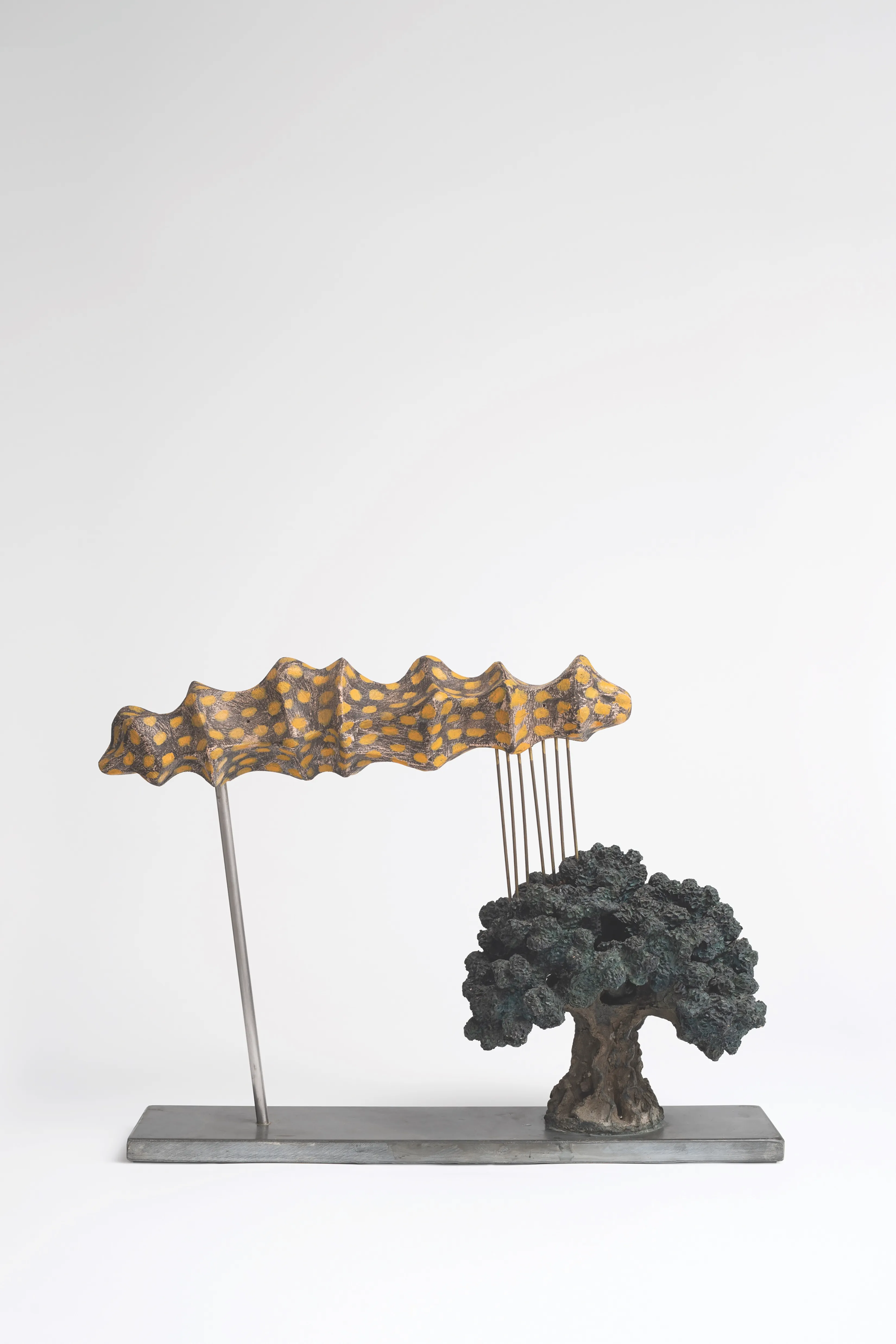
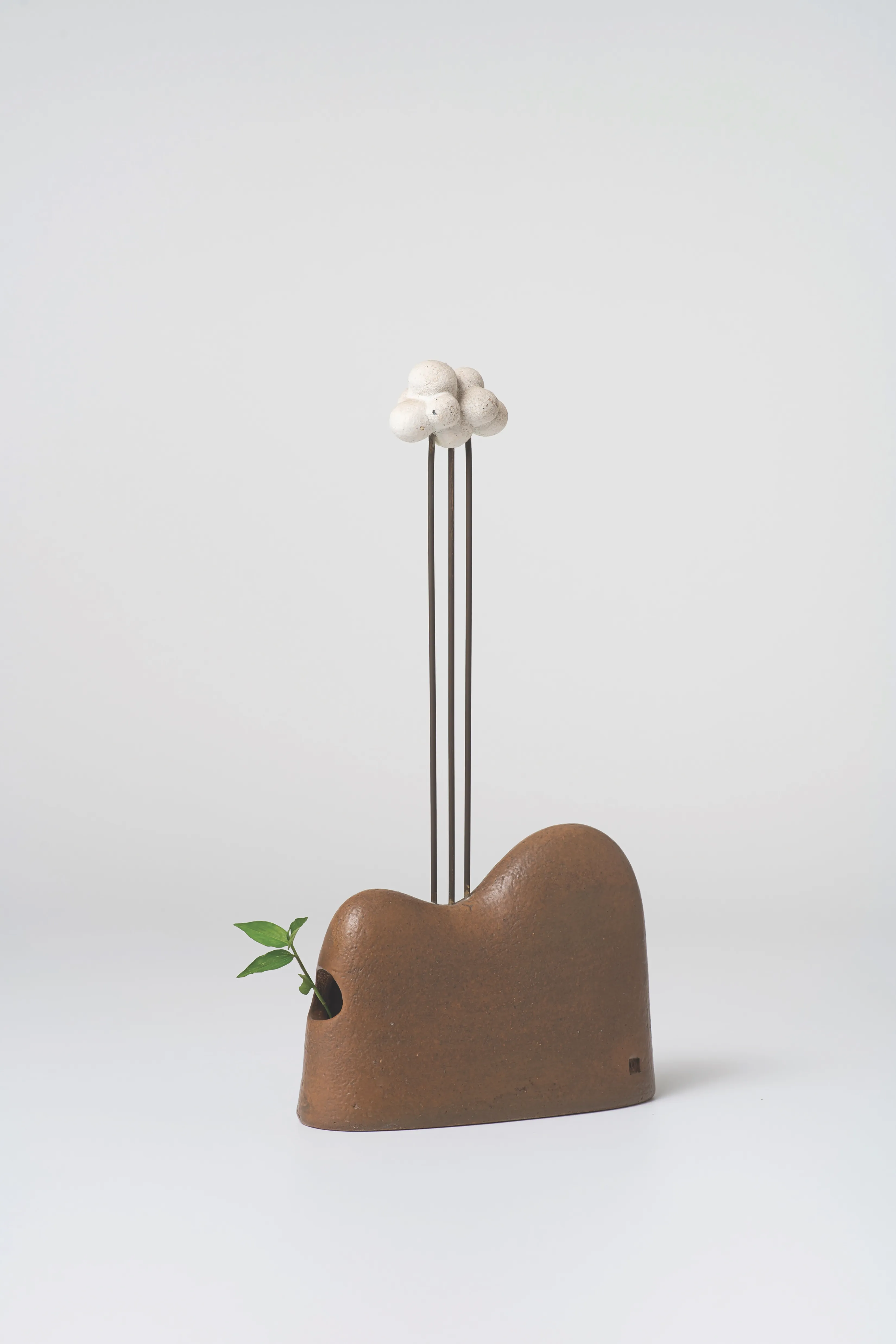
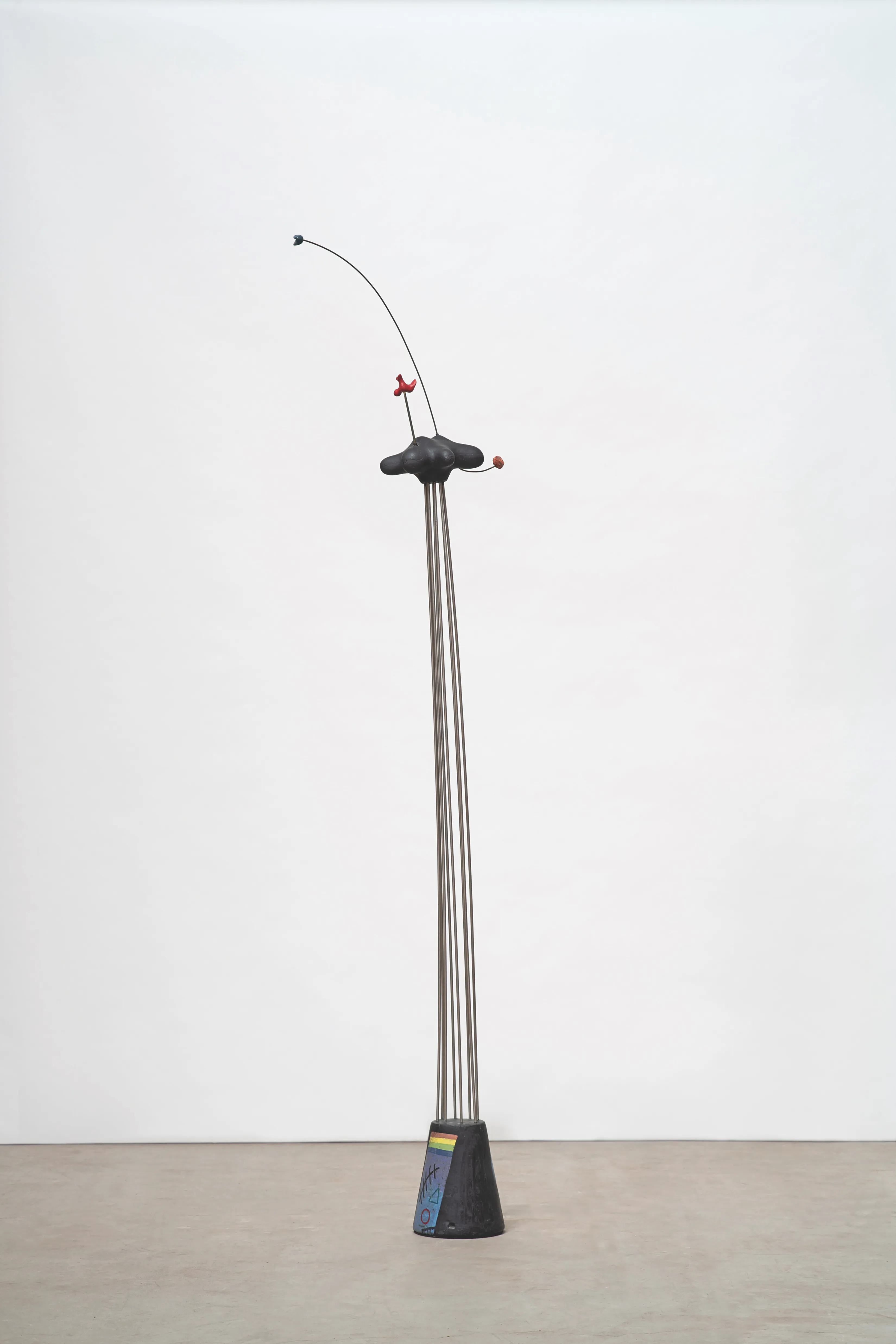
That life is now the subject of Letter to the World, his first solo exhibition in the United States, on view at Ortuzar through April 11. Spanning roughly 30 works from the early 1970s to 2025, the show traces a practice that has resisted easy categorization—too cosmological for craft, too material for philosophy, too quietly joyful for the weight of its biography. Compact ceramic constructions give way to vertically oriented sculptures that fuse glazed clay with iron, steel, and brass; slender metal rods lift small polymorphic forms into hover, the whole assembly suspended in a balance that feels both deliberate and precarious. New works produced during the New York residency—clay towers and a series titled Cabeça do Poeta—translate the city’s own material register back into sculpture, offering the street as both palette and interlocutor.
Yuasa was briefly imprisoned in 1963 for distributing notices for a Marxist reading group; dismissed from his job, he relocated with his wife Naoko to the rural interior of Goiás, where a daily, devotional engagement with clay began. He describes the art-making that followed as existential rather than political: “a way of thinking, of feeling, and of playing with life”—a spiritual and intellectual exercise inseparable from gratitude.
His Espássaro series—a Portuguese neologism for “Bird in Space”—pays explicit homage to Brâncuși, though Yuasa situates that debt within a broader inheritance. “It is not only Brâncuși who has influenced me, but artists from every era,” he says, “whose energies, objects, thoughts, and beliefs have shaped my thinking.” What he loved in Brâncuși was the pursuit of essentiality—“as if searching for the very essence of things.” His own Espássaro works take that verticality and render it contingent: ceramic density pulling against metal ascent, the sculpture never fully escaping the earth.
When the press release attributes to Yuasa the phrase “Everything is made from everything, everything returns to everything,” he gently reassigns it—the line belongs to da Vinci, Bohm, Bachelard, Dostoevsky, the Bible, Taoism, Buddhism, and Brazilian Indigenous knowledge. “All work—art included—is guided by the energies of thought,” he says. “Philosophical, psychological, scientific, and poetic, all at the same time.” The correction is characteristic: a man more interested in lineage than authorship, in communion than ownership.
The exhibition’s title, then, is not sentimental. It is not a letter written in words but, as Yuasa puts it, “an attempt at communication through the energies in works of art—a dialogue of energies, offered within a larger communion with the cosmos.” The world he’s writing to is everyone. The material is older than language.
You’ve described clay as something you returned to again and again since childhood encounters with the natural world. What is it about that specific material — its weight, its memory, its transformation in fire — that has sustained your attention for over six decades?
For me, clay contains and transforms the energy of the cosmos — both matter and spirit. It’s like what Leonardo da Vinci was talking about in the 15th century, “Everything comes from everything, everything is made of everything, and everything returns to everything.” In that way, I understand ceramics in communion with cosmology, philosophy, science, poetry, and other forms of knowledge.
Above all, clay carries within it the memory of something we did not witness: the origin and formation of the universe. In a sense, the planets and other celestial bodies are themselves ceramics—matter shaped by energy, floating in space, suspended in constant activity and transformation. Working with clay is a way to investigate our own origins: where did we come from, and where are we going?
The six decades I’ve been working with clay is still too short a time to unravel these mysteries, which remain largely untouched. In truth, what sustains me is curiosity—the desire to understand, even partially, the cosmic even that made our existence possible.
After your imprisonment in 1963 and your retreat to Goiás, your relationship to making seems to have shifted into something more devotional and daily. How did that period of rural isolation change what you understood sculpture to be for?
Not only because of my imprisonment, but also because of my Christian upbringing, I feel a deep sense of gratitude for the gift of life, and for the communion I share with everything and everyone. I make art as a way of thinking, of feeling, and of playing with life in that communion. I see it as both a spiritual and an intellectual exercise.
The Espássaro works openly invoke Brâncuși’s Bird in Space, but where his verticality reads as pure aspiration, yours feels contingent — balanced, a little precarious, shaped by gravity and touch. What drew you to revisit that modernist icon on your own terms?
It is not only Brâncusi who has influenced me, but artists from every era—well known or not—whose energies, objects, thoughts, and beliefs have shaped my thinking. Brâncusi, however, impressed me deeply through his pursuit of a form stripped of all superfluity, as if searching for the very essence of things. When looking at his work, it sometimes feels as though the object itself returns your gaze. And I see his works coming directly from the simple act of looking at the world: a stone that becomes fish; a bird that becomes Bird in Space—for me, a symbol of freedom. My desire to create the Espássaro works grew from a sense of gratitude and a wish to pay homage to one of the great masters of sculpture, who instilled in me a deep respect for everything that exist and that manifests itself before us.
Your philosophy — “Everything is made from everything. Everything depends on everything. Everything is everything” — feels less like an aesthetic position than a cosmology. Is there a moment when that understanding crystallized for you, or has it always been implicit in how you work?
I can’t claim this as my own philosophy. Rather, my understanding comes from a wide study of many sources, accumulated over many years: the writings of Leonardo da Vinci, David Bohm, Fyodor Dostoevsky, Franz Kafka Fritjof Capra, and Gaston Bachelard; the Bible; Taoism and Buddhism; the knowledge of Brazilian Indigienous peoples; as well as other artists; and many, many others.
All work—art included—is guided by the energies of though. These energies are philosophical, psychological, scientific, and poetic, all at the same time—operating simultaneously.
During your residency at SculptureSpace, you encountered New York’s red brick architecture and described it as your “palette.” What was it like to arrive in this city for the first time at 87, and to find your material already embedded in its walls?
I have always considered bricks to be one of the most dignified, intelligent, and creative forms of ceramics. I was familiar with Brazilian bricks, and ceramic roof tiles, but the variety of colors and texture I encountered in the United States impressed me greatly. The different minerals added to the clay, and the decorative patterns impressed into each brick—almost short visual stories—are remarkable.
The exposed brick buildings in Queens, where we were staying, helped me accept, adapt to, and even enjoy living in New York during my first visit. In truth, I was very hesitant to come to the United States. As a child, I had formed prejudices from hearing adults speak about [World War II in Japan]—the deaths, the destruction, the violence, the atomic bomb. Encountering those multicolored bricks helped me dissolve those precjudices.
The exhibition is called “Letter to the World.” Who are you writing to — and what are you trying to say?
It is not a letter written in words, but an attempt at communication through the energies in works of art—the desires and designs of both the artist and the cosmos. It is a dialogue of energies, offered within a larger communion with the cosmos.
Stay up-to-date with exclusive events and content.


