F L A U N T


What makes up a childhood? Is it a room? A sense of belonging? Is it the people who fill a space, or the instability that empties it out? It might be a feeling that is half-understood yet fully felt. In Prey, on view at Anat Ebgi this spring, Veronica Fernandez renders memory as something porous and sensorial, a living and breathing atmosphere—one that expands, contracts, and reshapes itself over time, until what remains is how it continues to reverberate.
The exhibition takes its title from a linguistic slippage—prey and pray—drawn from a poem Fernandez wrote about a figure in a state of urgency, closing their eyes as the room around them seems to cave inward. “When they close their eyes, they’re finding this sort of escape,” Fernandez says. “Whether it’s through prayer, or through this sort of imagined world and hoping for something better.”
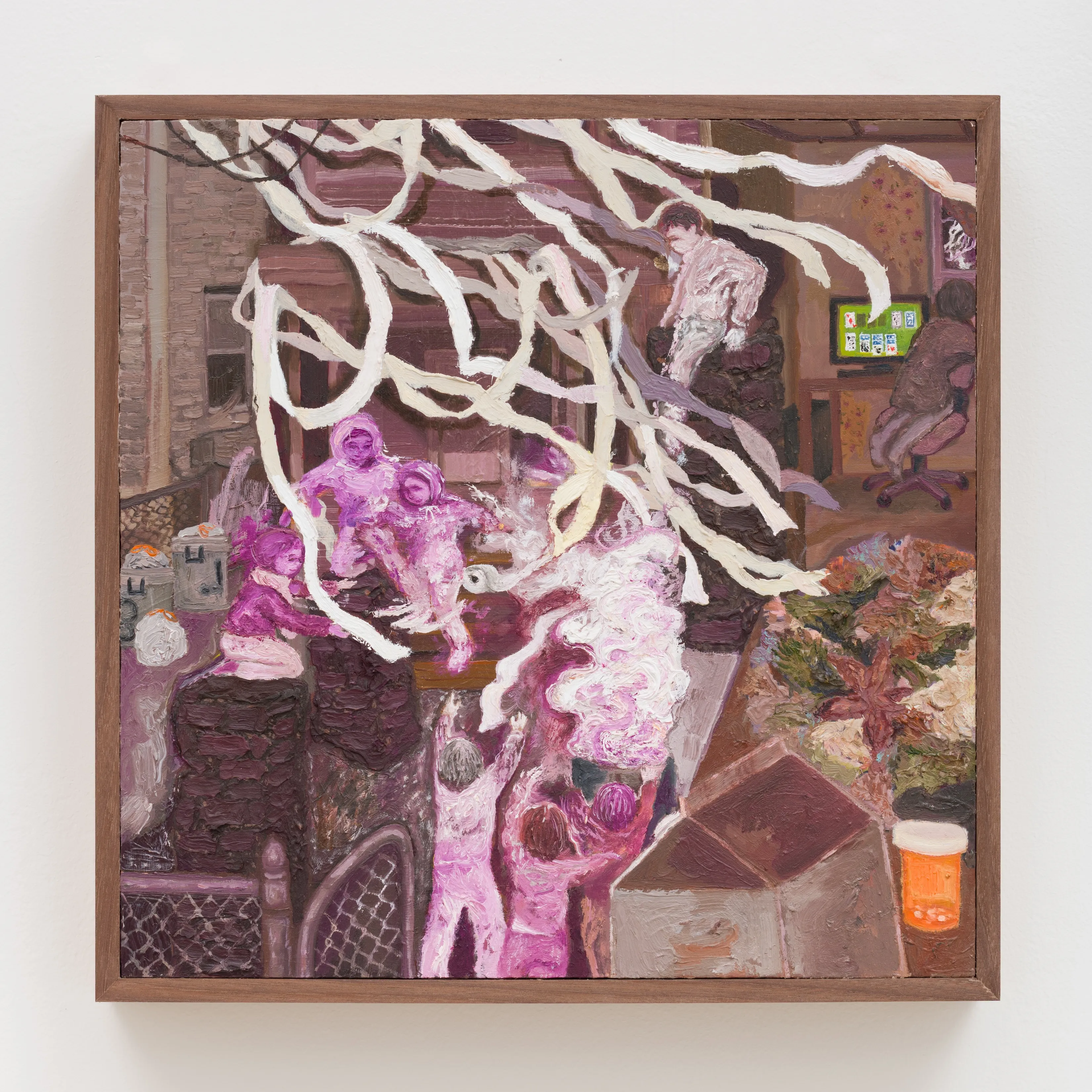
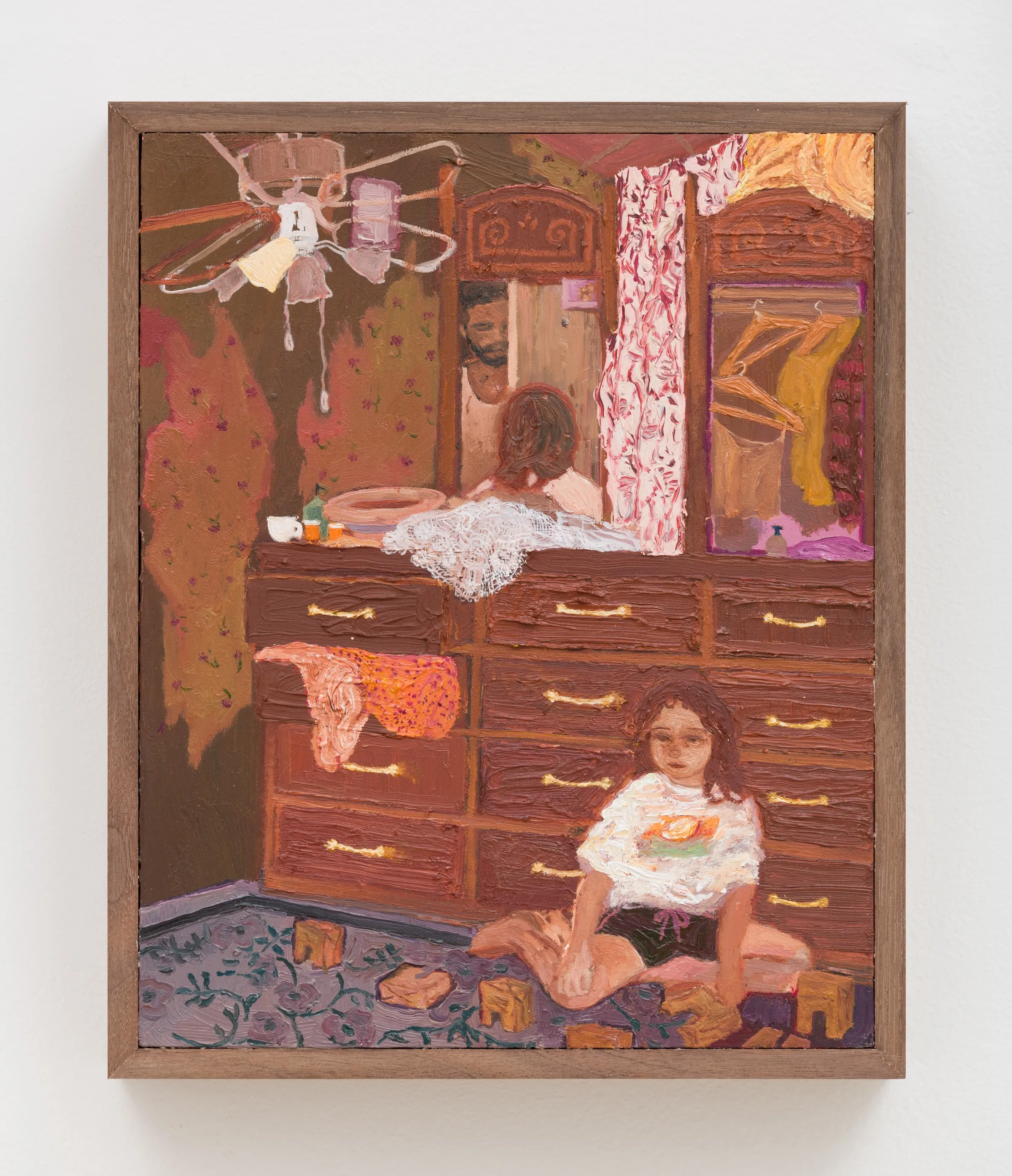
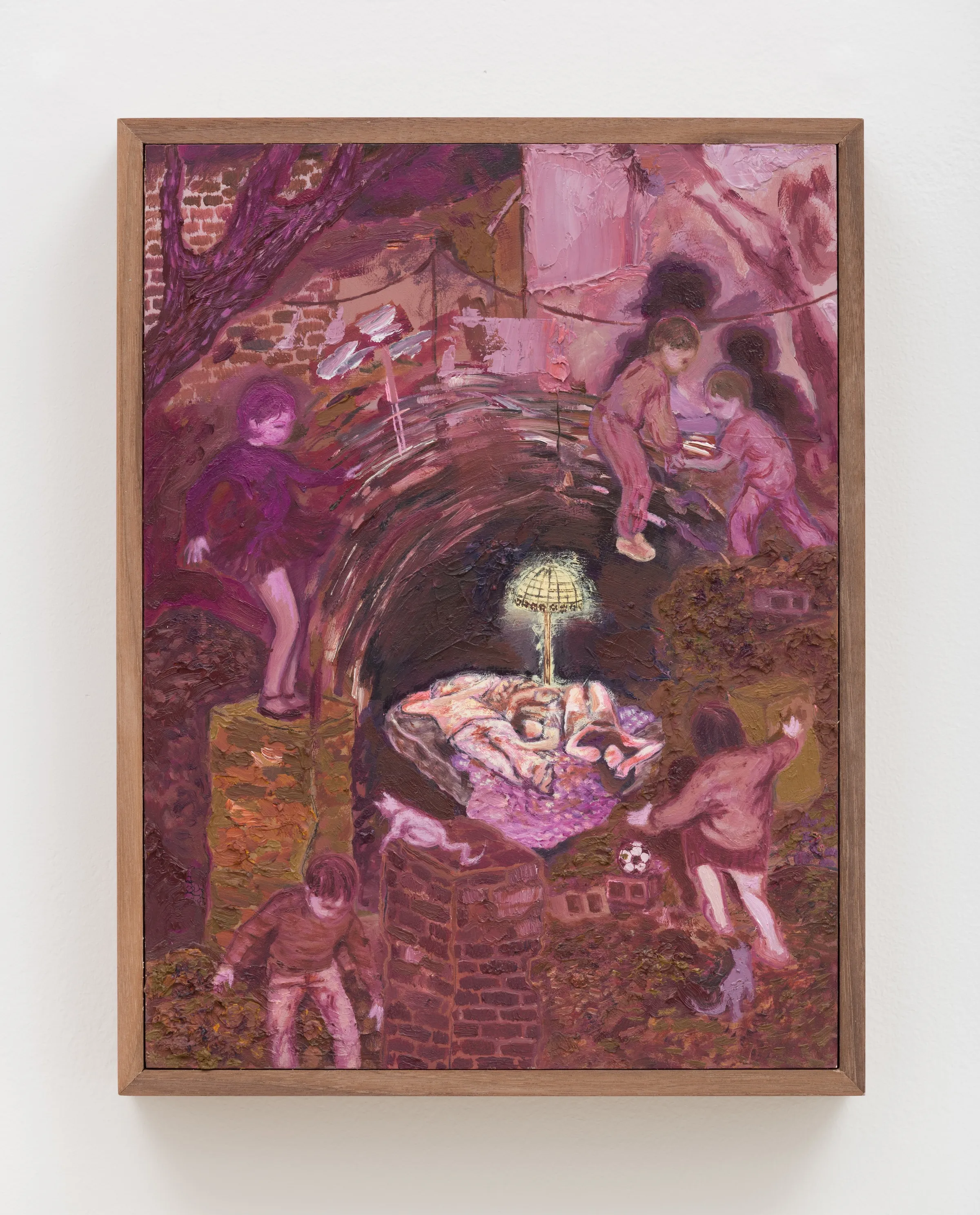
Stemming from photographs, fragments of family lore, and handwritten notes, Prey’s works concern themselves with whispers of the past—whether they be Fernandez’s memories or someone else’s entirely. Children, the hallmarks of innocence that they are, are depicted through these compositions as figures in the midst of formation—in “Kids Feel Alive (Mischief Night)” and “Chased Through the Night,” draped strands of toilet paper loop across trees, marking territory while evoking the thrill and unease of adolescent boundary-testing. Elsewhere, in “Stranger Asks for Toilet Paper,” a child plays on the floor while an adult figure hovers in uneasy proximity. Interiors open outward, exteriors press in, and geographies—New Jersey, Los Angeles, somewhere else entirely—spill into one another.
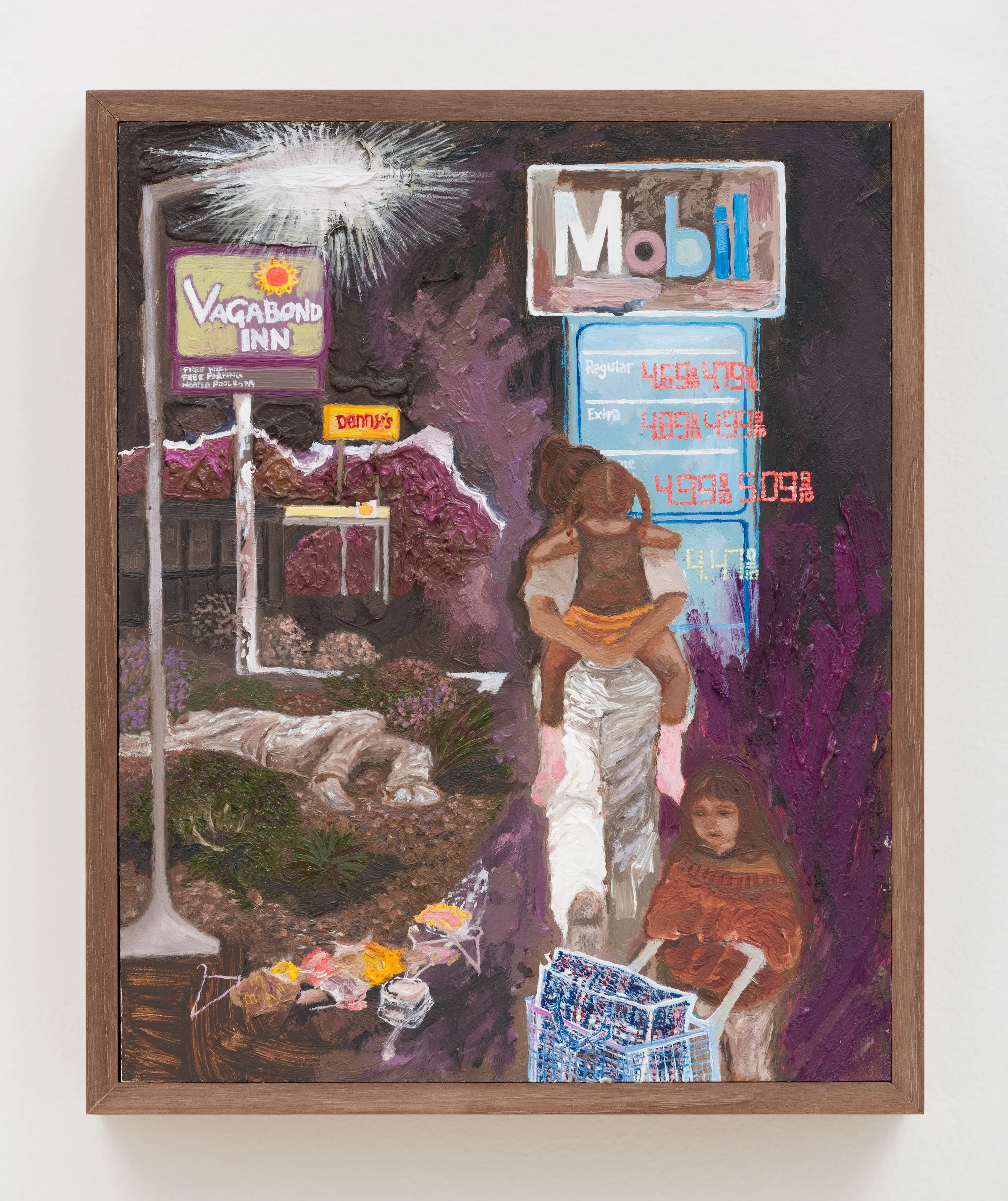
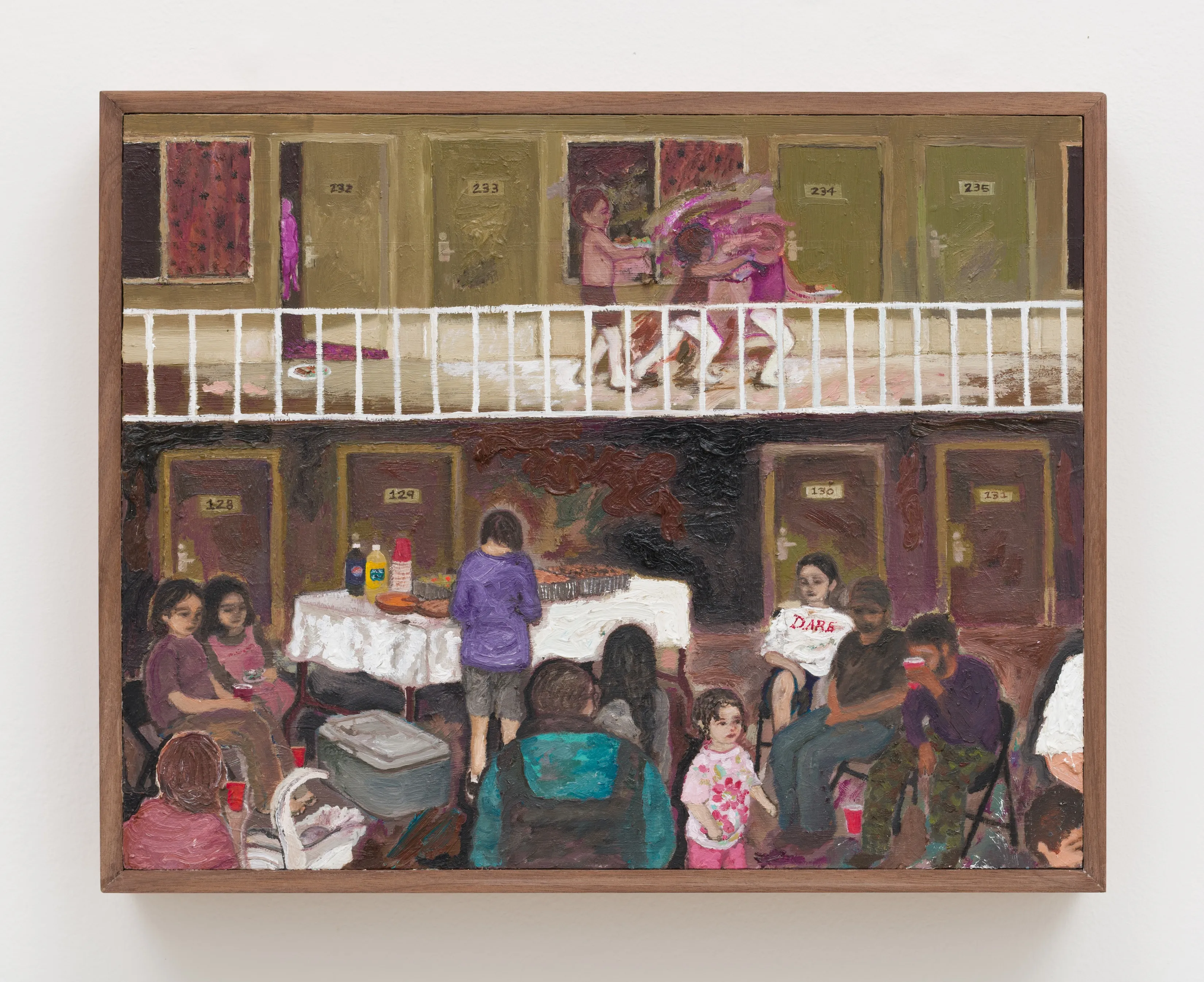
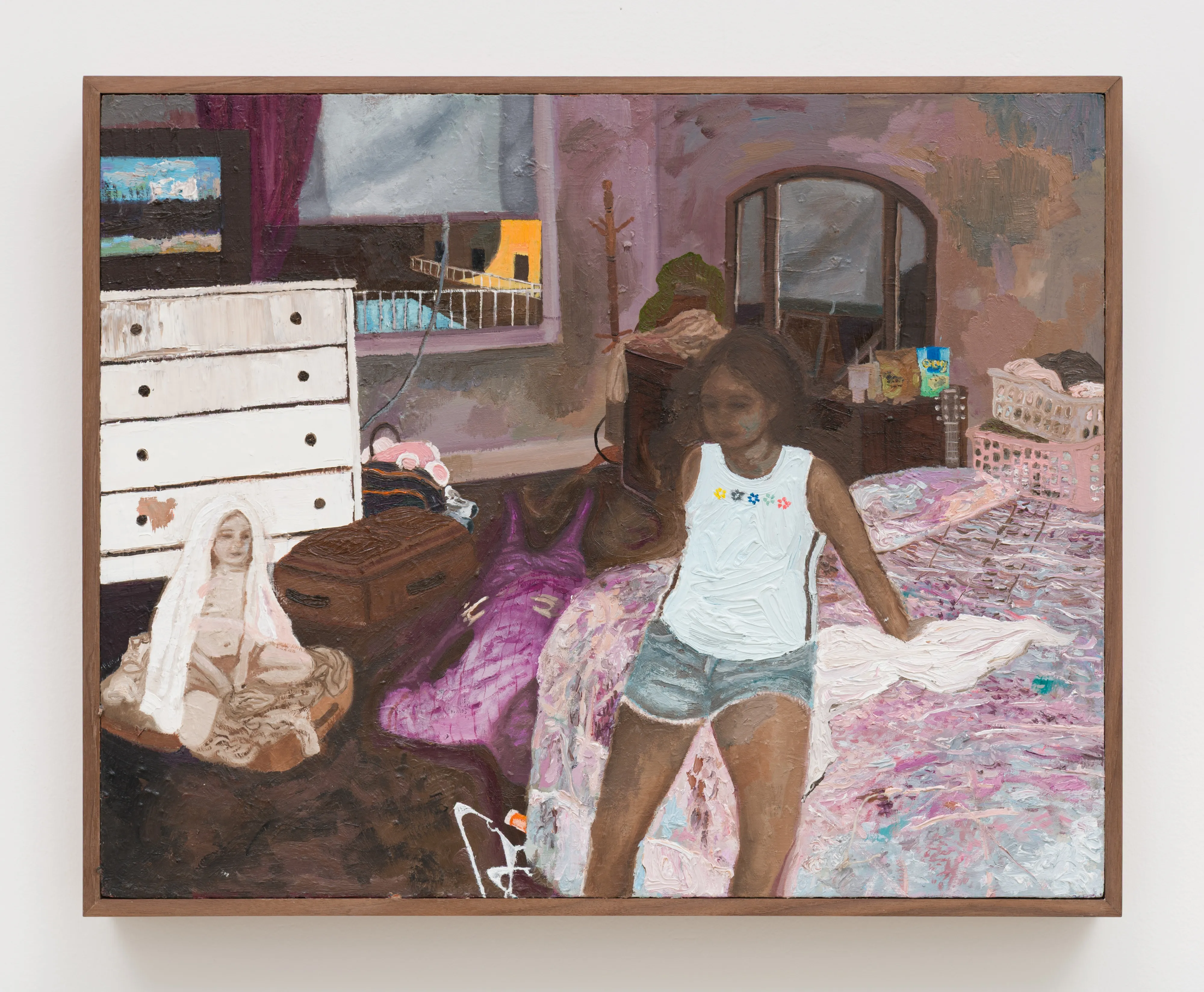
Raised by a single father and moving through periods of transitional housing, Fernandez returns to environments where permanence was never guaranteed in Prey: motel rooms, shared beds, spaces where entire lives compress into one canvas. The emotional register toggles in a way that reflects those who endure these realities, allowing for a complicated warmth to shine through. “Different emotions can live on the same plane,” Fernandez notes, “It’s about realizing that this situation they’re in may not always be their fault, and that it’s more of a societal issue.”
Materially, this tension is embedded in the work’s architectural choices. In “Spaghetti Car, (Seeing Red and White)” streaked paint drags the eye across the canvas, while “Closer to Power” builds thick, nearly sculptural density. Her palette—umber, ochre, sienna, punctuated by quinacridone magenta—casts the scenes in a saturated warmth that complicates any straightforward reading. The paintings feel fantastically, imaginally architectural, as Fernandez might put it, emitting child-like innocence through depictions of portals and distorted furniture.
What Fernandez ultimately offers is a method for how we process experience—an insistence that even the most specific histories have a possibility of collective nostalgia. At the inception of Prey, Fernandez reckoned with the question of, “How do I make someone feel open and compassionate for something that they’ve never gone through?” The answer lies in what childhood leaves behind: the capacity to recognize vulnerability, to hold contradiction, and to extend care. Standing before the work, one may not have lived in these motels or ever faced these circumstances, but the sensation is palpable: the strange, undeniable fact that memory, in all its persistence and the meanings we assign to it, is how we understand one another.
I wanted to start off with the title of Prey, which carries a double resonance with the word pray, as in prayer. How did that sort of pairing come up for you—what kind of emotional or psychological kind of space do you think it opens up in the work for you?
Usually, when I make my paintings, they stem from either photographs or stuff I'll write down—I write a lot of things, like my own poetry and different notes of advice my family members have given me. Or I’ll make note of when my family just says something interesting, like life advice, things like that. I write down and read the back of things people wrote on photographs. For this show, I wrote a poem. It was called I want to fly. It was about this person in a state of urgency, just one of those states where they're closing their eyes and they're feeling like the room they were in was collapsing in on them. When they closed their eyes, they tried to pray. I'm not necessarily a religious person, but I was thinking about this person leaning into some sort of faith as a last resort. The works in Prey were inspired by this person. When they close their eyes, they're finding this sort of escape—whether it's through prayer, or through this sort of imagined world and hoping for something better. When I wrote that poem, I did some drawings, and basically all the figures in the drawings were like running away from something or sort of running into each other. They were in that defenseless state of prey, and that sort of came into play with the poem, where they actually leaned into prayer. The poem ends with the line, “I should have prayed for other people,” insinuating regret for not having prayed for someone else or thinking of someone else, because now they're in that state of urgency and they need someone to call out to them. So it kind of had that thread both ways from the word prey to pray.
So you’re inspired by your own memories and memories that belong to others?
I’m able to recall so many memories from these things. There's parts of the show that touch on families and motels, which is something I had gone through. It also touches on the psychology of neighborhoods and different places within them, and how those places could affect those who inhabit them. I’m definitely inspired by my own experiences and these different circumstances.
You mentioned that you were moving through a lot of different spaces in your early life. I’m curious as to how that experience kind of shaped your own sensitivity to the emotional charge of these environments…
When I was younger, my family lived in transitional housing, and my dad was a single dad, and a lot of my works are inspired by the dysfunction and not really having that stability in my life. When I fast-forward to the present day and reflect on the emotions I've had about growing up in these environments, it becomes obvious how so much trauma is a part of a generational cycle. When creating these works, I was thinking about my own life, but it also was very much inspired by families living in motels in LA. I really challenged myself to make work based on different places. I make a lot of work from Jersey, where I was raised, but now I live in LA and have different memories—how was I going to combine them? I wanted to incorporate that in this body of work because, even though I hadn’t done something like this before, it was very close to me.
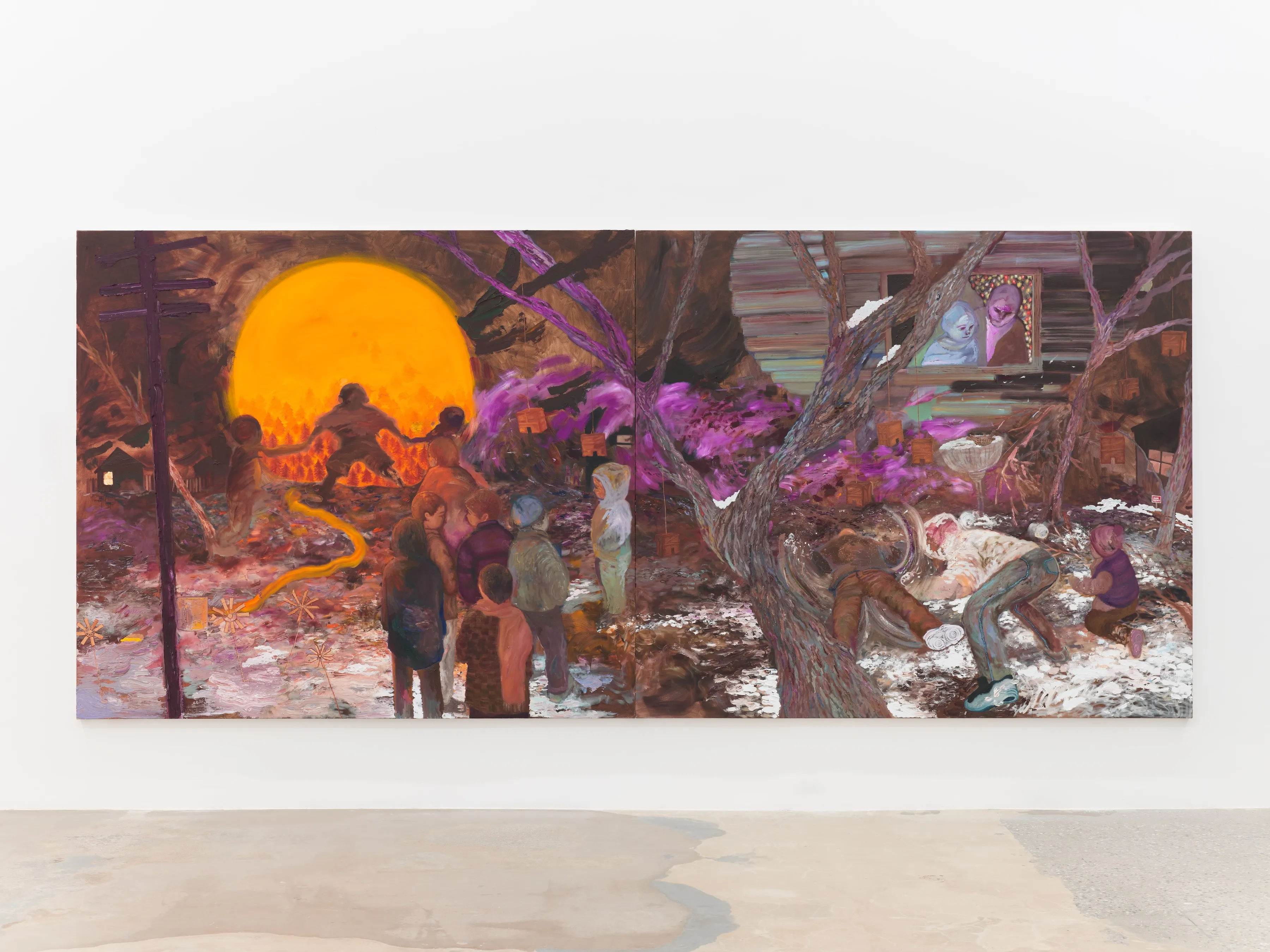
My sister and I have an unofficial nonprofit—on paper, it's a nonprofit, but we always do a lot of work with organizations. This time around, we did a lot of work with families living in motels. Somar, where I was living, I realized that down the street was Vagabond motel. A lot of the paintings [in Prey] have these children—in the really big piece, there's these children sort of lined up. I had noticed that the kids at Vagabond were all lined up because they were taking a bus to their school in a different town, I'm assuming, because they all were getting lined up and stacked. That's something I did when I was younger. I lived in a shelter, and we had to line up at the bus stop and then we went to go to school in a different district. I found out all the families at that hotel were homeless, and that was something I really resonated with. With these experiences come all these different rooms with all these families whose entire lives were sort of condensed into these rooms. It was just something that I felt very connected to—growing up in this way, you're picking up so many things and grabbing what you can. Maybe you're getting evicted, maybe you can't afford rent anymore. Maybe you're changing towns for some reason. You never really know what's happening, but it feels like you're always taking pieces of you and moving it along. It was a real feeling I had grappled with before, but then I also had these real life examples that I was working with around me. It’s heartbreaking and emotional and interesting, but also something that gets overshadowed. And also, some people have never gone through these situations, and they don't know what these feelings feel like. I want to make them feel that…
It can be a huge undertaking, to conjure up that emotion for something that many of us haven’t experienced.
How do you make such a specific feeling nostalgic for everyone, and how do I make someone feel open and compassionate for something that they've never gone through before? Or maybe they've had similar emotions that get evoked from the paintings that may have nothing to do with what's happening in the paintings. Maybe they feel it through the paint or texture or whatever it may be, maybe movement, you know, like using both the content and the way that I paint it, even if they don't know the story behind it.
I thought it was interesting that you kind of shine a positive light on these memories and experiences, they're not inherently negative. They never come across as such. Was that intentional for you to do? I think a lot it's easy for this topic to be awash in despair, because it truthfully is a hard reality. It is sometimes hard for people to paint this positively or to just render even neutral.
I'm very intentional with this sometimes, but then sometimes I've had people see my work, and depending on their background they might consider it in a completely different way. I've had people come to me and say, “You're so bubbly, but your work is so dark.” I had no idea it felt like that dark. But also, I could also see the nature of the content—especially with the motels—feeling very dark to people, because that's not something that they've ever gone through or could imagine going through and. They feel very compassionate for the figures, which for me, I try to level it out and have that balance of like something feeling very unstable and hurtful to different people, but also having it feel warm to someone at the same time. Different emotions can live on the same plane in a painting. There's one painting where this girl is on the floor and she's playing with like these houses, and there's also a man in the mirror and he's asking her for toilet paper. It's a complete stranger, and it stems from a memory of one my first instances of living in a not so great neighborhood. We were living in this apartment, and my neighbors would always ask us for stuff, and they were just these grown men. I was a young girl, and I would think, “Why is this person very vulnerable?” Like, why is an adult vulnerable? Asking someone for something like that can feel very uneasy. But then it's also painting adults and people who are in survival mode through a lens of compassion. It’s about realizing that this situation they’re in may not always be their fault, and that it’s more of a societal issue.
It’s about understanding that their character isn’t the thing that puts them in a position to be this vulnerable.
It’s understanding that life is in shades of gray. It’s knowing that this is not bad and this is not good. This is just the nature of life, especially in the US. There’s so many factors at play.
Speaking of this ambiguity. I find that some of the scenes you paint suspend between an interior and exterior space. Maybe it’s bedrooms that open into lots or social gatherings that blur into landscapes. Is there something that kind of draws you to that boundary between the inside and outside?
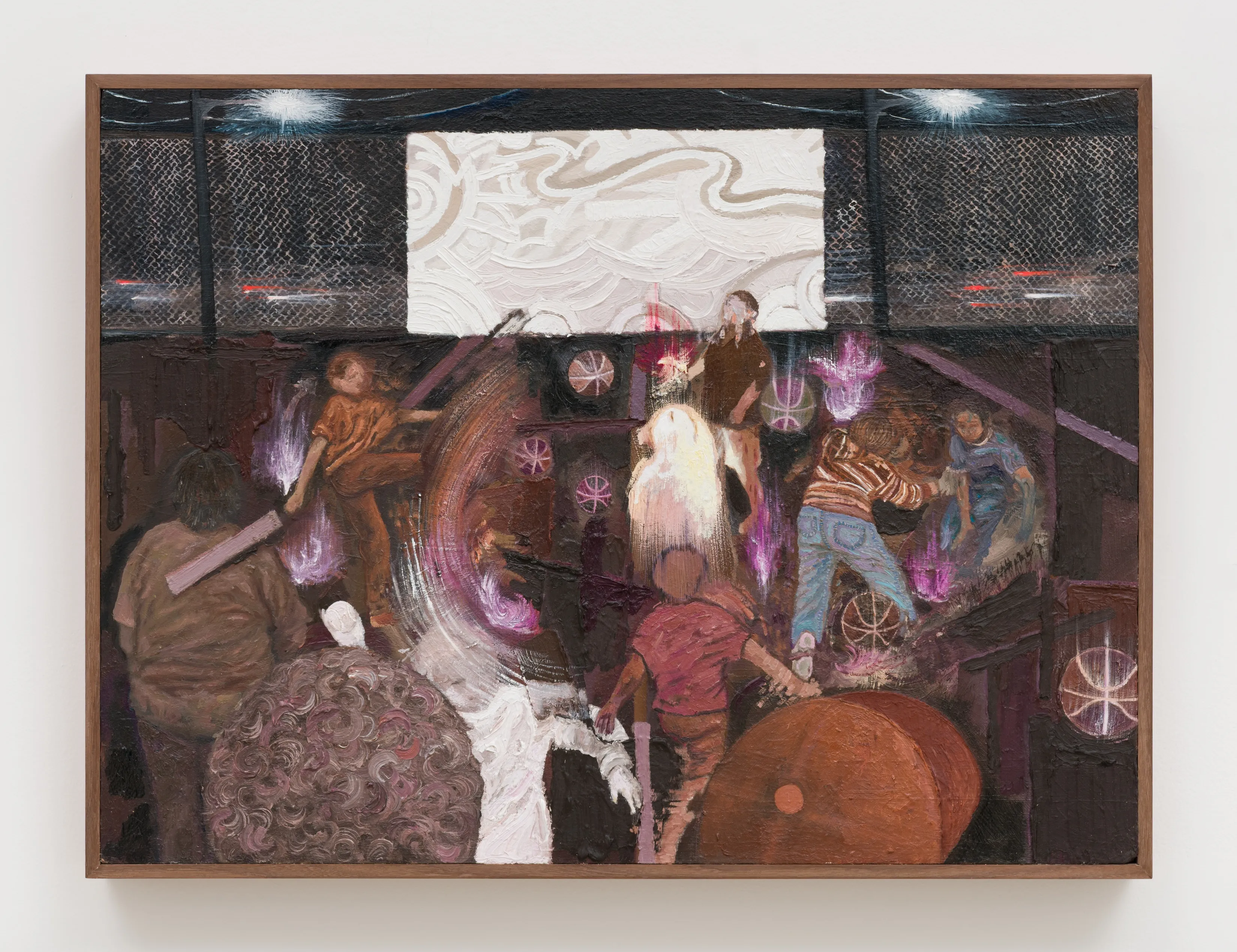
I definitely love painting bedrooms. There's certain things that I just love painting like. I love painting sheets. I love painting dressers, anything with wood, because I love using texture to show wood and so forth. So just aesthetically, some of those things I'll always add, but especially with this body of work, because I was thinking of how neighborhoods generally look so different. It doesn't look like just one specific place in time. Some of the references are from California, and some of them are from Jersey, which is why some of the paintings may have snow, and some of the paintings may have environments that I’ve seen in California. But then also I try to add a very fantastical, “imaginal" element to it—different portals, or maybe cutting up space with objects and so forth. There's a painting with a wall ball area, and there's a painting with a highway and a painting with trees and all sorts of things. I just want to combine all of these spaces and houses…
I really enjoy that description— elements. Imaginal.
It’s fantastic!
It’s fitting! It really fits into these central themes of childhood as the site of emotional formation. How do you think those kinds of early perceptions continue to shape our adult selves?
It goes back to painting people through the lens of compassion. I wasn’t always compassionate, especially entering the teenage years, you're realizing all these things that people have around you that you're lacking. Sometimes you're born three feet under everybody else, and then you are always playing catch up. You're kind of picking at yourself and naturally, you lean into the adults in your life, and you're like, “why didn't you make me into this type of person?” Now, I'm very grateful for my upbringing. It’s common that when your parents aren't there it’s because maybe they had to take up extra shifts, and they couldn't always give you the attention that they would have wanted to if they had that full attention and support as well. Especially my dad being single, he was surviving on his own as well. He also was raised by a single mother, and these different things become factors in a child's life that they’ll be grateful for later on, because it allows us to adapt into who we’ll eventually become. It’s given me a totally different perspective on the world and how I look at other people when I engage with them. It’s that understanding as a child that lets you view the world through a more gentle, understanding lens. Not everything is meant to be perfect. Everyone's so different, everyone can fall into different things, whether it be good or bad. You have to learn how to grow from there.
I think I would say maybe 80% of us develop that compassion a lot later in life. You can't really put a name to the things that are happening to you and others, until you just kind of go through life and you learn that these are things that happen, and you can kind of turn that into compassion.
There’s so many children in my works in a sense of confusion, and that's where my technique comes from. Whether it be time or instability, the breaking up of space and so forth comes from these children feeling the weight of the emotions, but not knowing how to express what they're going through. There's always that layer of confusion—”Oh my gosh. Like, what is going on?” But then they're also trying to be playful and curious. There’s that push and pull.
Stay up-to-date with exclusive events and content.


