F L A U N T


Creation can’t be constant. If anything, the absence of its reliability is what drives the artist to seek, to continue forward. It’s a spur-of-the-moment phenomena that’s only conjured in certain settings, when the influx of light is just dim enough and the space has dissolved into an easeful silence. As I’m finding my way through these beginning sentences, I’m hesitating, pulling away and remembering neglected chores that should be attended to, though I know their sudden urgency is born from avoidance. Distraction is another necessity in the process of rendering a blurry image or a shapeless story. I get up to rub moisturizer onto my face. Flip onto my stomach. My mom sends me an Instagram Reel. A car drives by my open window, blaring a song that beams me back in time to another living room, another page.
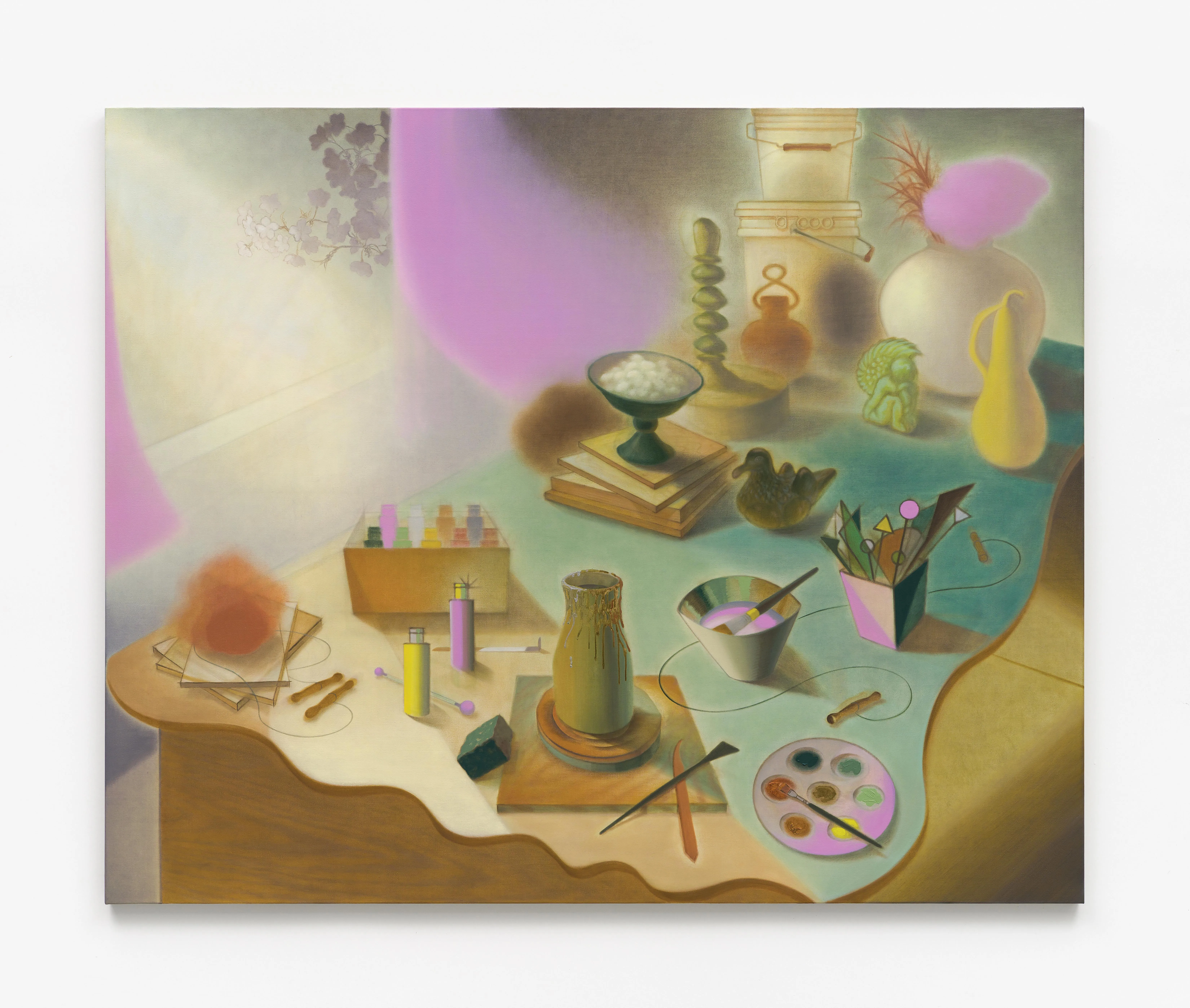
Whether the act of pausing is deliberate or involuntary in nature, it is undeniably effective in the process of conception. Deviation is a metamorphic catalyst, bridging the gap between the canvas and the ether. The work of Guimi You narrates this delicate balance plainly, paying equal reverence to moments of motion and suspension. Her summer exhibit at New York’s Lehmann Maupin is titled When the Sun Shines Again, a presentation of several works which embody the essentiality of both states. “In Korean, I often use the word jiguryeok,” the artist shares. “It refers to endurance, persistence, and experience that comes from years of practice. At the same time, consistency alone is not enough. The time we spend outside of the studio is just as important as the time we spend inside it. I don’t think of a pause as an interruption, I see it as a period of preparing for a new beginning.”
In many cases, a lapse in motion will trigger material shifts in location, emotion, or character. You has lived in many places—and to the painter, a place is “never just a background.” Born in South Korea, the artist spent her formative years practicing traditional Korean painting using hanji paper and ink, techniques that linger in her diffusions of shadow and admiration of empty spaces. Oil painting became a subject of exploration after moving to the UK in her late 20s. It wasn’t an easy transition. “Water-based and oil-based materials behave very differently, and it took time to understand how to work with them,” she recalls. Eventually, You discovered that the slow sensibility of her early training proved valuable in other mediums. Sharp outlines and definite boundaries have no place in the hazy world of her canvases. She is disinterested in works that appear too polished, choosing to invest in procedures of raw naturality and explaining that “every decision, hesitation, revision, and repeated gesture leaves its mark.” In the structural authenticity of her presentations, You aims to leave ample space for introspective wandering. Art, to her, should be available to hold the experiences of each individual beholder through tangible displays of human effort.
When the pandemic found the artist in Northern California, the gentle climate and fluctuations of natural light became points of fascination. Its seclusive season ultimately coalesced in the thematic structure of When the Sun Shines Again, envisioning paintings that emerged as a hopeful, private renewal. While taking a ceramics class—not a complete pause in creation, but certainly a diversion from her typical medium of oil painting—the essence of the exhibit further solidified itself in You’s awareness. Her instructor announced that she’d taken a step away from the wheel after getting married. It had been a long break, but never one that was meant to be permanent. She reminisces, “One day I was sitting in her studio as sunlight poured through the windows onto the worktable, lighting the clay and the tools. It was such an ordinary scene, but it suddenly felt incredibly beautiful—like sunlight shining on someone who’d found the courage to begin again.” When the Sun Shines Again is a luminous collection dedicated to the artist’s return after such distance, suggesting that much like the sun’s perpetual cycles of rebirth, the work happens regardless of direct action.
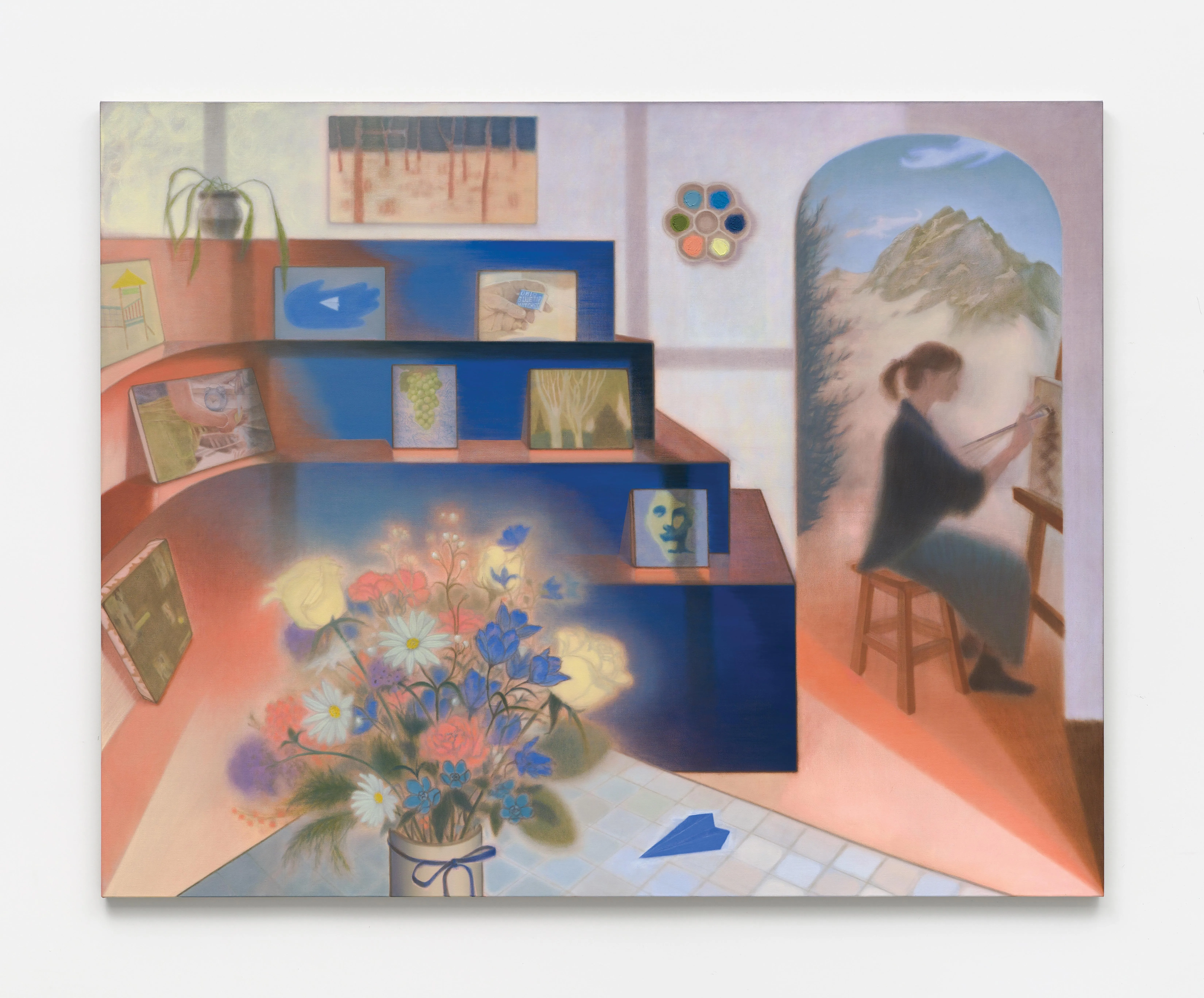
You’s paintings are invested in imagery that might typically be associated with the external. Sprawling yards, tranquil parks, and idle hillsides melt into one another in harmonizing hues, yet in the quiet resonance of their construction, these spaces are made to feel personal. The painter’s hushed landscapes imagine an innately complete solitude that manifests as both honest and satisfying. “To me,” she says, “making art is really about spending a long time in conversation with yourself, and that conversation usually happens in silence.” “The Shape of Silence” (2026) brings this thought into being, taking inspiration from You’s pottery ventures to compose an image of the introspective artist at work. A series of structurally disparate creations are displayed on an organized shelf above the figures’ head–ranging in form from spiral to equine, geometric to abstract. Maybe they’re pieces of dialogue, or simply objects of unbounded expression. As You explains, “making anything meaningful is never easy, but I believe that quiet process is what gives a work its depth.”
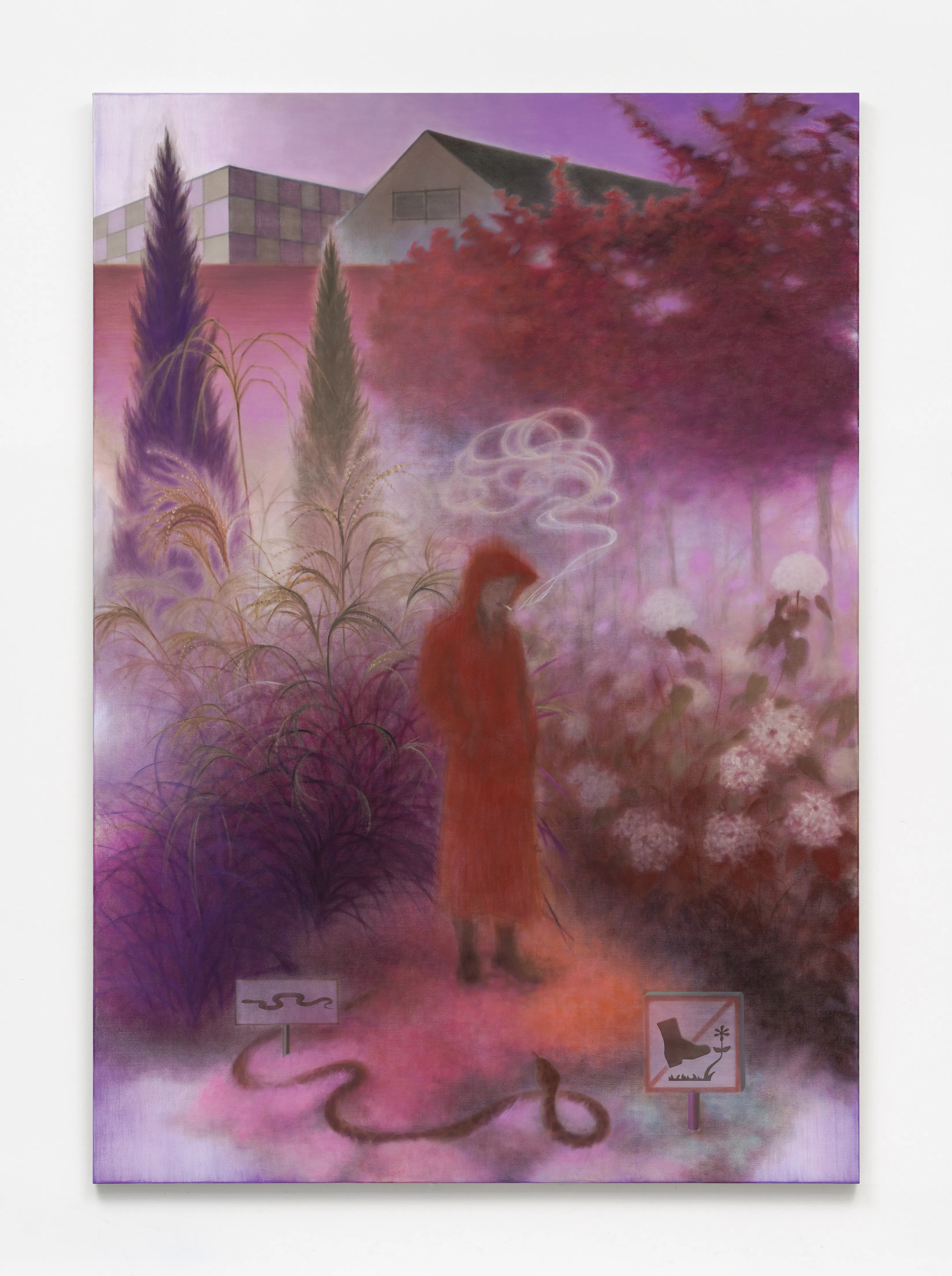
Pieces like “Violet Haze” (2026) feature solitary human figures to convey the therapeutic ambience of an otherwise uninhabited scene. “I want people to feel like they’re simply another part of the landscape,” the artist says of the blurred boundaries between her painted figures and their environments, “I don’t see them as separate.” The work is composed entirely of soft, dusky purples, burgundies, and browns, establishing itself as one of the collection’s darkest paintings. A white halo of smoke drifts up the center of the painting before spiraling above the form of a hooded woman. At her feet and between two seemingly prophetic warning signs, a snake glides through the misty grass. The uncertainty brought forth by You’s vague yet intentional illustrations consider that emergent self-discoveries are most apparent in moments of tension and stalled motion.
How do we know when to stop? How can we discern the finitude of a diversion? Fear often lines the precipice of an oncoming pause, making us believe that the craft may become alien in the absence of daily ritual. “Musicians often say that if they stop practicing for just a few days, their hands lose their sensitivity,” You names. “Painting feels much the same. Whenever I take a break, it takes time and energy to get back into that rhythm.” The artist is well acquainted with the slippery behaviors of both energy and rhythm. She trusts that her hands know what they’re doing anyway. Relief comes to the forefront some time later, blooming in the realization that there is no revitalization without departure, no inspiration without stepping outside the comfort of routine. As someone who is admittedly less disciplined than You, I’m aware that maybe I pause too much, and might be too lenient in my lengthy leaves of absence. No matter how many cycles of retreat and return I perform, however, the light remains present in my periphery. It has never once been lost.
Stay up-to-date with exclusive events and content.


