F L A U N T


“And the months to seasons, which are far other, foreign/ To our concept of time. Better the months—/ They are almost persons—than these abstractions/ That sift like marble dust across the unfinished works of the studio/ Aging everything into characterization of itself.” John Ashbery, “Grand Gallop,” Self Portrait in a Convex Mirror.
Often I take the train across the Brooklyn Bridge just to get a look out the window. The temperamental infrastructure cascades into a horizon I can’t see. Every building is a contradictory and somehow complementary brushstroke. In every frame is a painting.
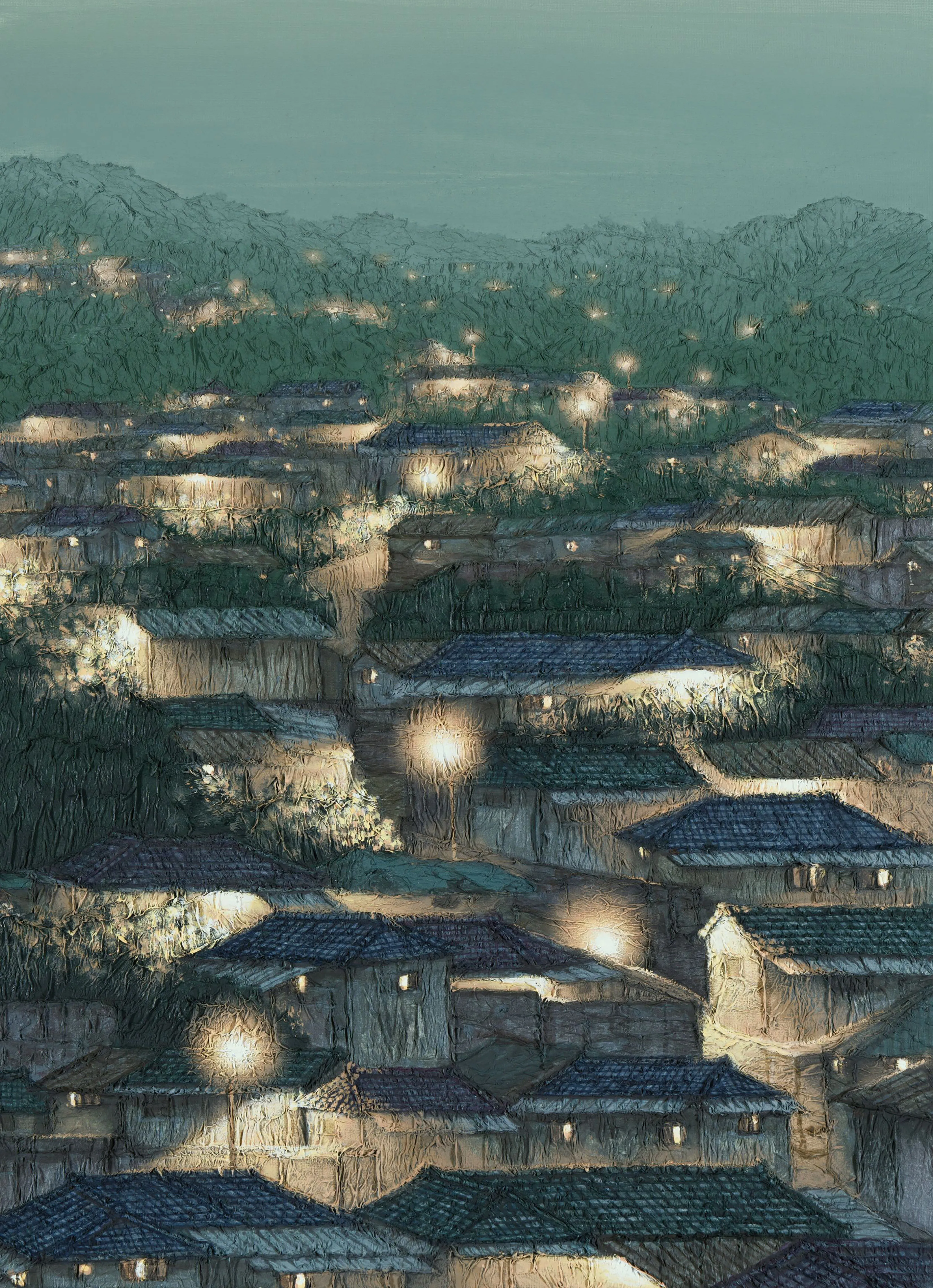
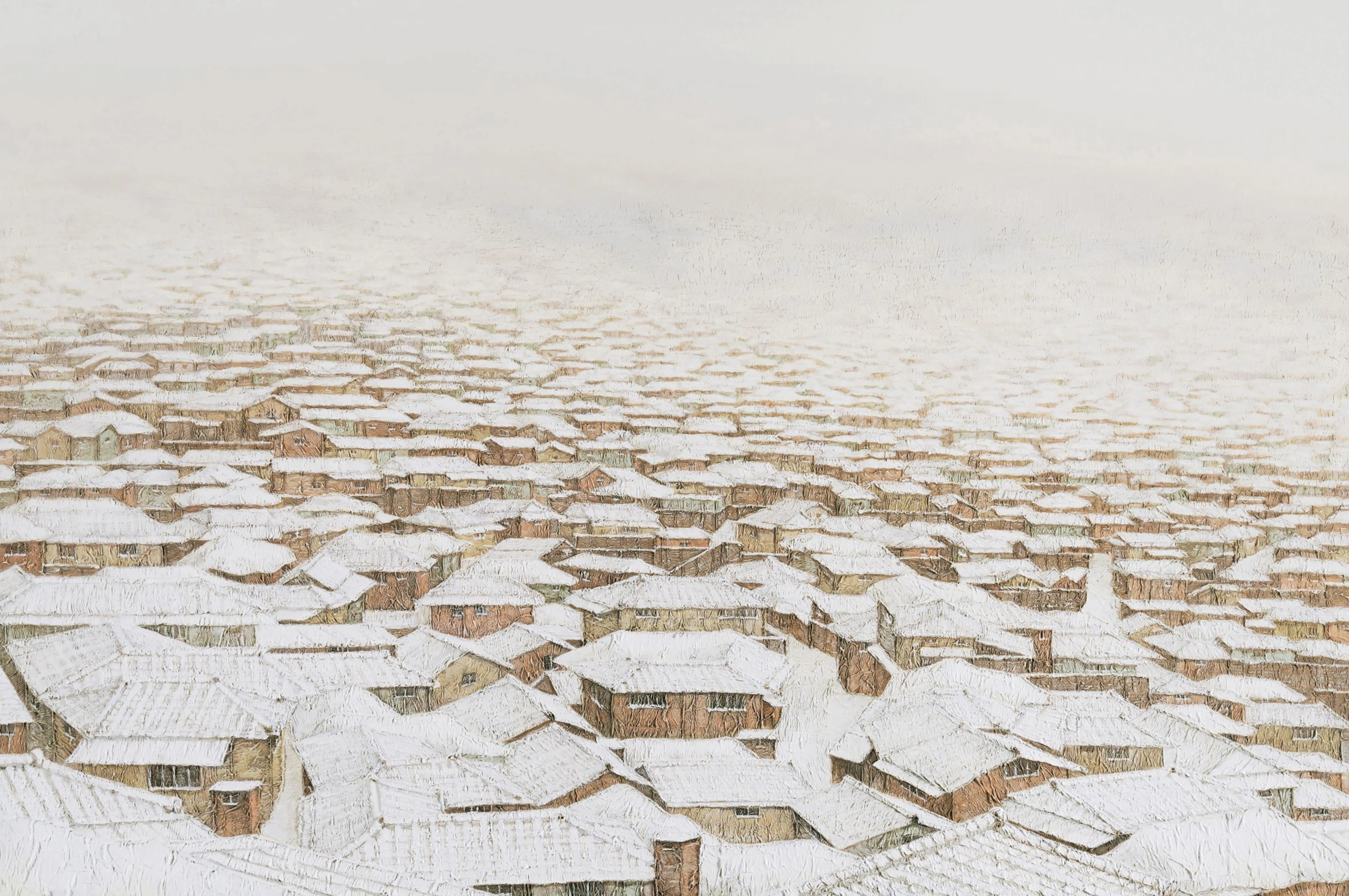
Korean artist, Youngju Joung, paints the way memory blurs into an open sky. The skylines of Seoul’s daldongnae are the subject of her paintings exhibited in Pause and Flow at Almine Rech in New York. These are crowded villages built during intense periods of modernization, when rapid development drove people to resettle on precarious terrain. They are retained in constant construction and destruction. It’s a similar place to where the artist was born in 1970 and then grew up, and it is here where she remembers.
Over the phone, we speak, in translation, of the dynamic of change, where everything is always “in process,” which New York is no stranger to, a city where she says “the past and the present exist in harmony,” a place where “speed and slowness coexist.” She’s only chosen works in which she’s “fused vanishing landscapes with the emotions and memories of the seasons.”
Joung speaks with her eyes pointed up, her hands moving in circles, catching waves. I can feel the flow. I can also feel the pause.
In the construction of these scenes, Joung paper mâches a material called munjong-i, a specific type of paper called hanji, on the canvas, which structures the landscape. Lines protrude in an act of sculpture. It’s the same paper that was “used on the sliding doors in my grandmother’s house where I lived as a child,” the artist says, “It serves both as a symbol of the longing for my childhood and as a medium that evokes the warm memories of my hometown.” In “Autumn 1112,” there is a sky that resembles the bark of a tree. Joung tells me it’s a tree she knows very well, too. Leaves the color of sunset hug the houses that line its foundation. I want to touch it.
Despite the chaos of industrialization and urbanization, the work delivers on its promise of peace, a feeling the artist is dedicated to holding in place, capturing what is so quickly gone. The light emanating across each canvas is warm despite the weather. Joung exudes a sublime sense of calm, and holds my hand in hers with the same softness that is in the paintings surrounding us, where the buildings bubble into reverie, and where life itself is dreaming. What will be born? In terms of the show, the artist says, “I am watching and waiting for the answer.”
Where do you go when you paint?
I paint where my studio is located, Yeonheedong
What landscapes are you revisiting?
An old urban neighborhood slated for redevelopment
Can you expand a bit more about the history of the dal dongnae, and your artistic relationship to them?
I was born in 1970 in a neighborhood similar to a daldongnae (Korean hillside shantytown), which emerged spontaneously in the early stages of Korea’s economic growth, when the country was still extremely poor and beginning to industrialize. This type of settlement is a place of great significance in Korea’s modernization history. Growing up there, I translate the experiences, memories, and emotions I went through into landscapes in my work.
Please tell me a bit more about your layering process, specifically with hanji, and how it was relevant for this particular show. How is material put in conversation with subject in your work?
I first make a sketch on the canvas, then crumple and unfold “munjong-i,” a type of hanji (traditional Korean paper), attach it to the canvas, build up the forms one by one, let it dry, apply color, and finally paint in the lights. “Munjong-i” is the paper that was used on the sliding doors in my grandmother’s house where I lived as a child, and it serves both as a symbol of the longing for my childhood and as a medium that evokes warm memories of my hometown.
*Mun means door, Jong-i means paper in Korean
This is your first show in New York, following another in London. What are you hoping your work will bring with it? How have you seen the meaning in your work shift—or, perhaps, stay the same—across global audiences?
This is my first solo exhibition in New York, so I feel both very excited and full of anticipation. I am curious to see how people living in New York, one of the most developed cities in the world, will respond to images of Korea from a time when it was extremely poor, and I also wonder how New York will receive me. I am watching and waiting for the answer.
Tell me about the title you chose: Pause and Flow. Do you believe the naming of a show contributes to, or changes, the work itself?
For this exhibition, I have chosen to show only works in which I fused vanishing landscapes with the emotions and memories of the seasons. Having my first show in New York and presenting it in spring gives the exhibition a special meaning, as the beginning of the season coincides with the beginning of my work’s journey in the United States. The title of the exhibition reflects the way I pause in the memories of a season, then let time flow again, enter the next season’s memories, and pause once more, capturing both the stopping of time and the flow of memory. In this way, it expresses the ongoing cycle between the changing seasons and my own recollections.
What are you looking forward to seeing here in New York?
New York seems to be a special city where the past and the present exist in harmony. It is a fascinating place because speed and slowness coexist here. In Korea, anything old is quickly thrown away. Although I came to New York for this exhibition, I would like to stay longer and experience more of the local side of the city.
Stay up-to-date with exclusive events and content.


