F L A U N T


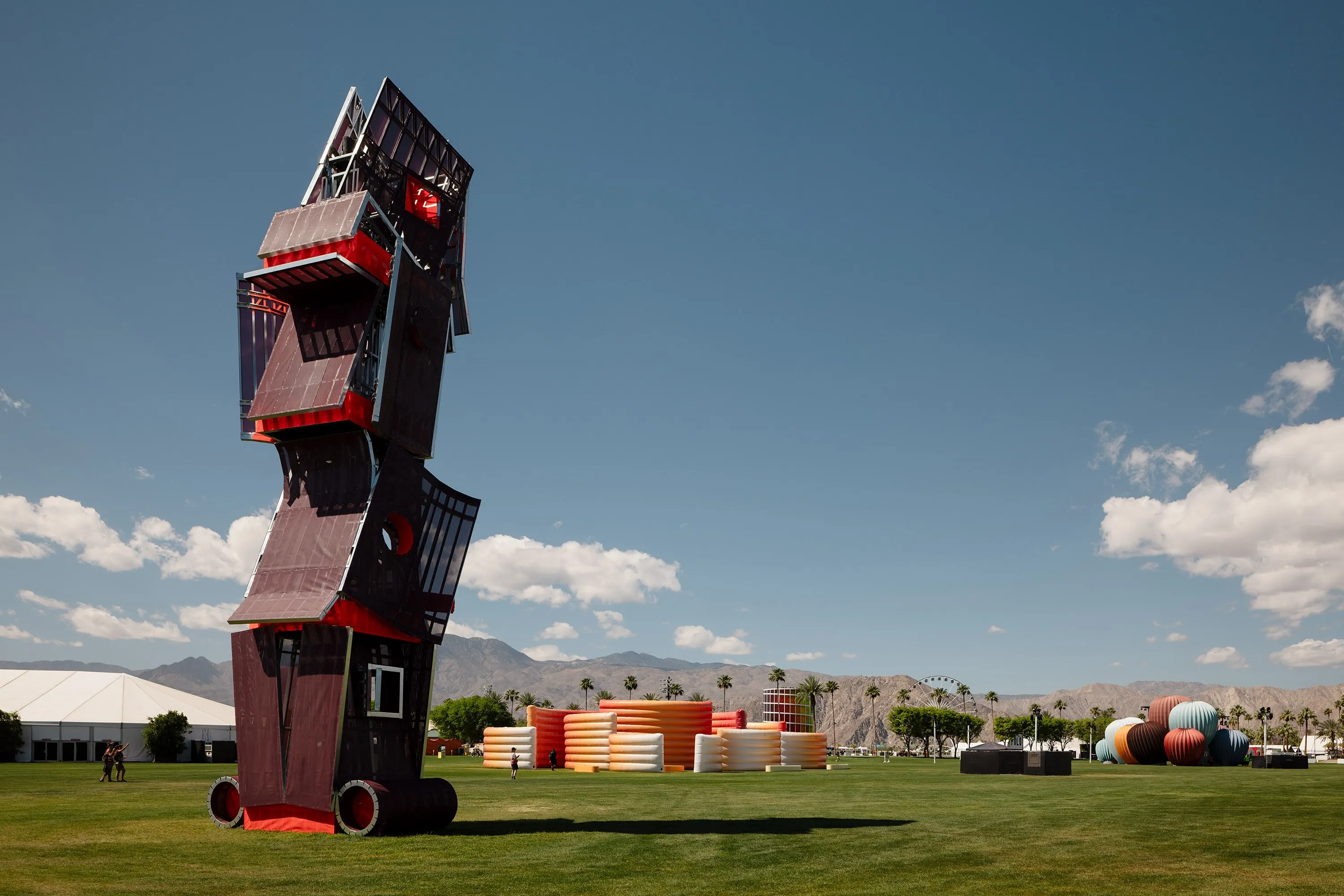
For the Coachella Valley Music and Arts Festival, Public Art Company, led by Raffi Lehrer, reflects on the duality of purpose and intention through The Los Angeles Design Group’s “Visage Brut” that found home on the Empire Polo Club grounds this year. The structure asks a deceptively simple question: Is meaning defined by what something is made of, or by how it is perceived in a given moment?
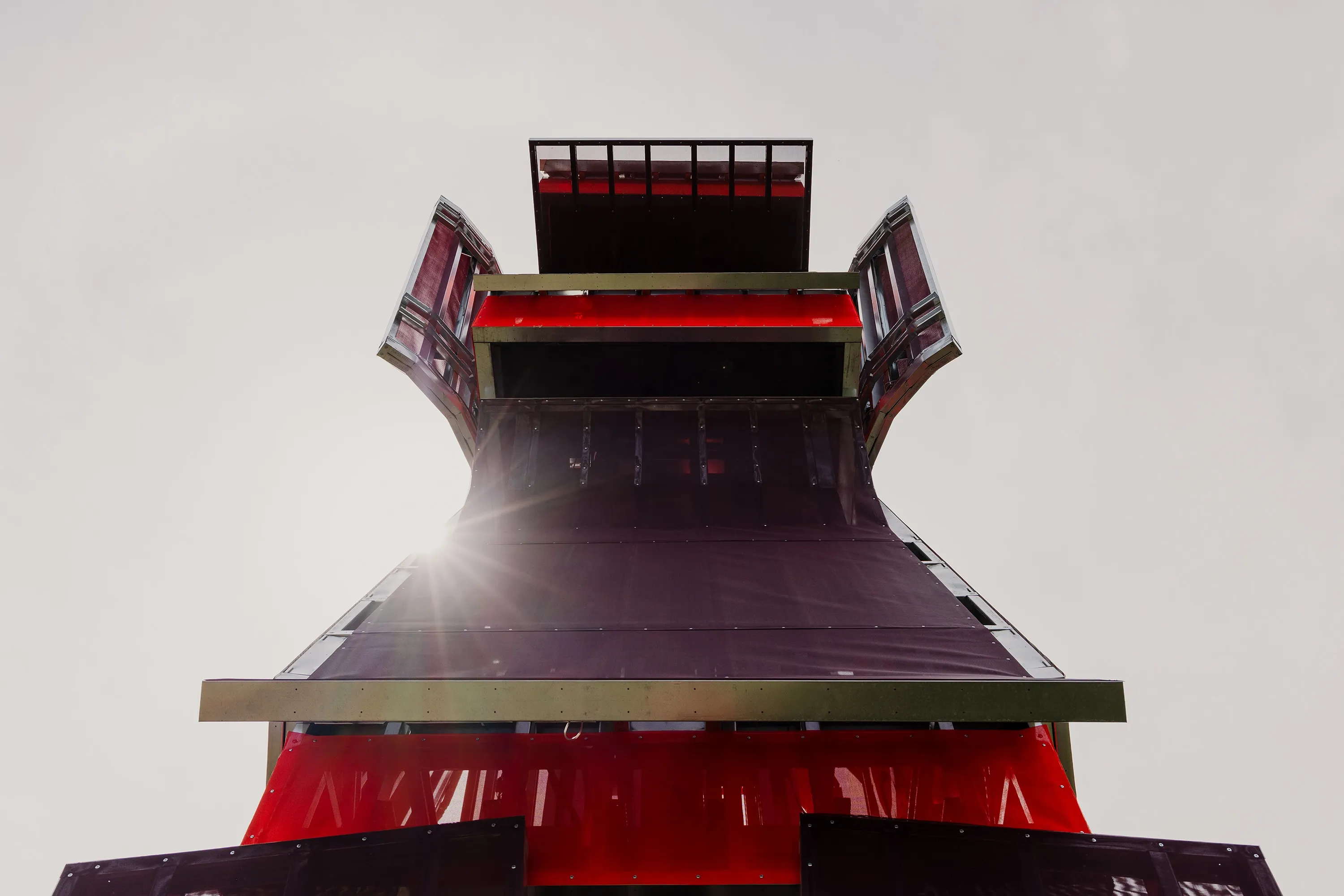
The LADG, the practice of Ben Freyinger and Andrew Holder, is known for merging historical ideas with contemporary urban challenges. “Visage Brut” is a soaring steel totem composed of modular boxes, with each one folded, rolled, or warped to the edge of structural integrity. Born from an experimental collaboration with software-assisted steel fabricator Stud-IO Construction, the tower transforms the industrial material into something more figurative.
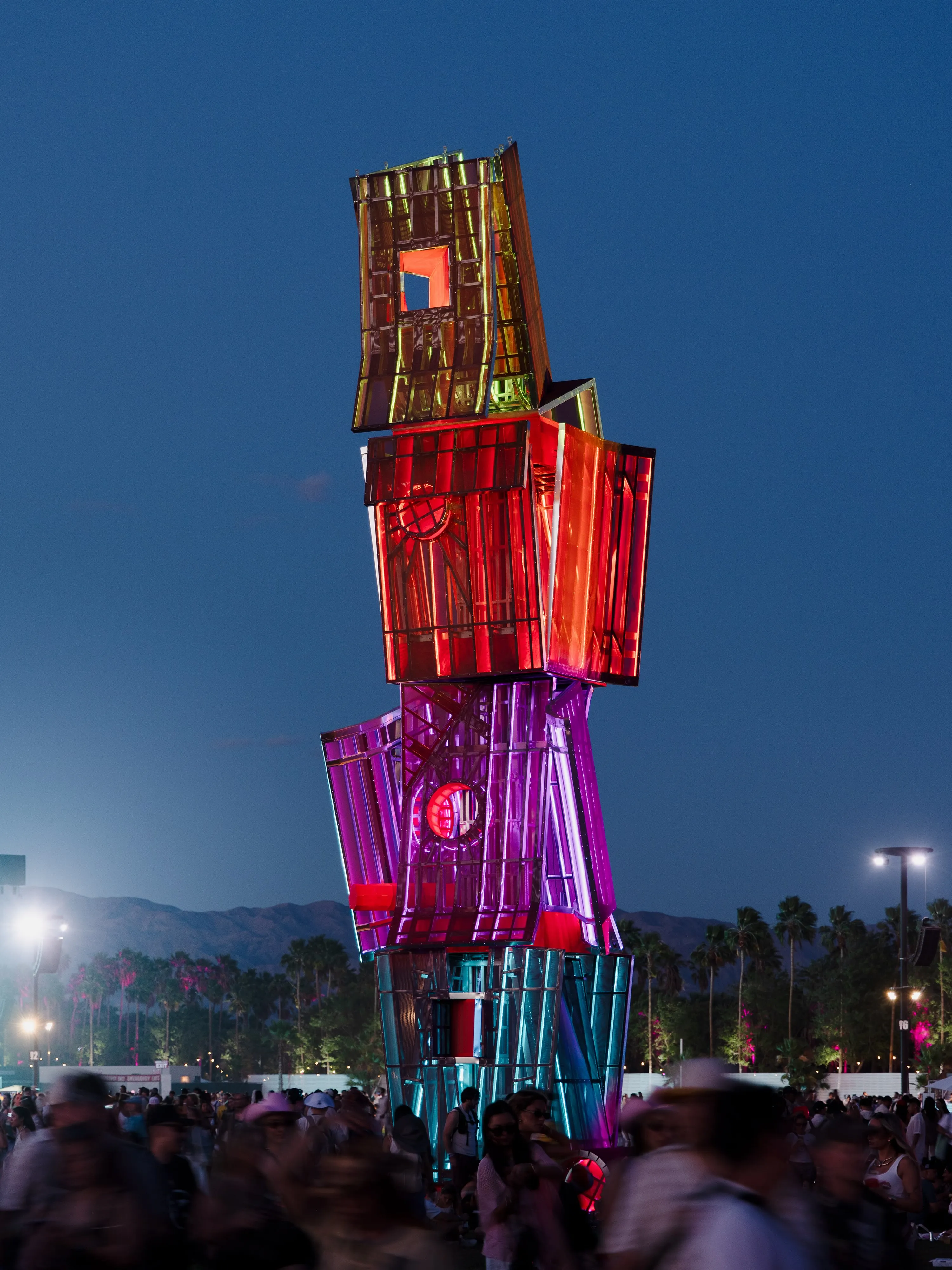
What makes “Visage Brut” particularly resonant in this setting is the way it performs differently depending on when and how you encounter it. In daylight, it reads as mass and surface, its skinned mesh between presence and absence. By night, that solidity dissolves, leaving something closer to s a sketch. The work exists in a constant state of in-between: both heavy and weightless, both industrial and expressive, both object and image.
Architecture, particularly in the realm of public installation, often presents as something that is fixed and resolved. Here, that certainty is resisted. Instead, “Visage Brut” suggests that built form can be contingent, relational, and responsive, not only to environment, but to time, light, and perspective. Within the context of Coachella, a space that's defined by flux, movement, and shifting perception, this instability becomes the meaning, as“Visage Brut” transforms with the crowd around it.
See here, Freyinger trace the edge of this in-between, using “Visage Brut” to explore how form can teeter between conditions and circumstance.
“Visage Brut” feels suspended between structure and character. How do you approach imbuing an industrial system of modular steel with almost figurative presence?
For us, the distinction between structure and character is not always clear. We operate on the assumption that architectural elements exist on a spectrum, with structure at one end and decoration (character or figuration) at the other. Particular elements can fulfill both roles simultaneously, sitting somewhere in the middle or, in some cases, occupying the entire scale.
How does this technology shape the formal language of the piece, and where did you allow for deviation or intuition, especially with Stud-IO Construction, where software-assisted fabrication is involved in the process?
In this piece, technology serves as both a means to resolve tectonic assembly and a way to "paint" in three dimensions. The steel studs function as structural lines, but they also begin to operate as "just lines"—strokes or marks in three-dimensional space.
As the installation shifts from solid mass to illuminated lattice over the course of the day, how do you think about transformation, perception, and the role of light in revealing the work’s dual nature?
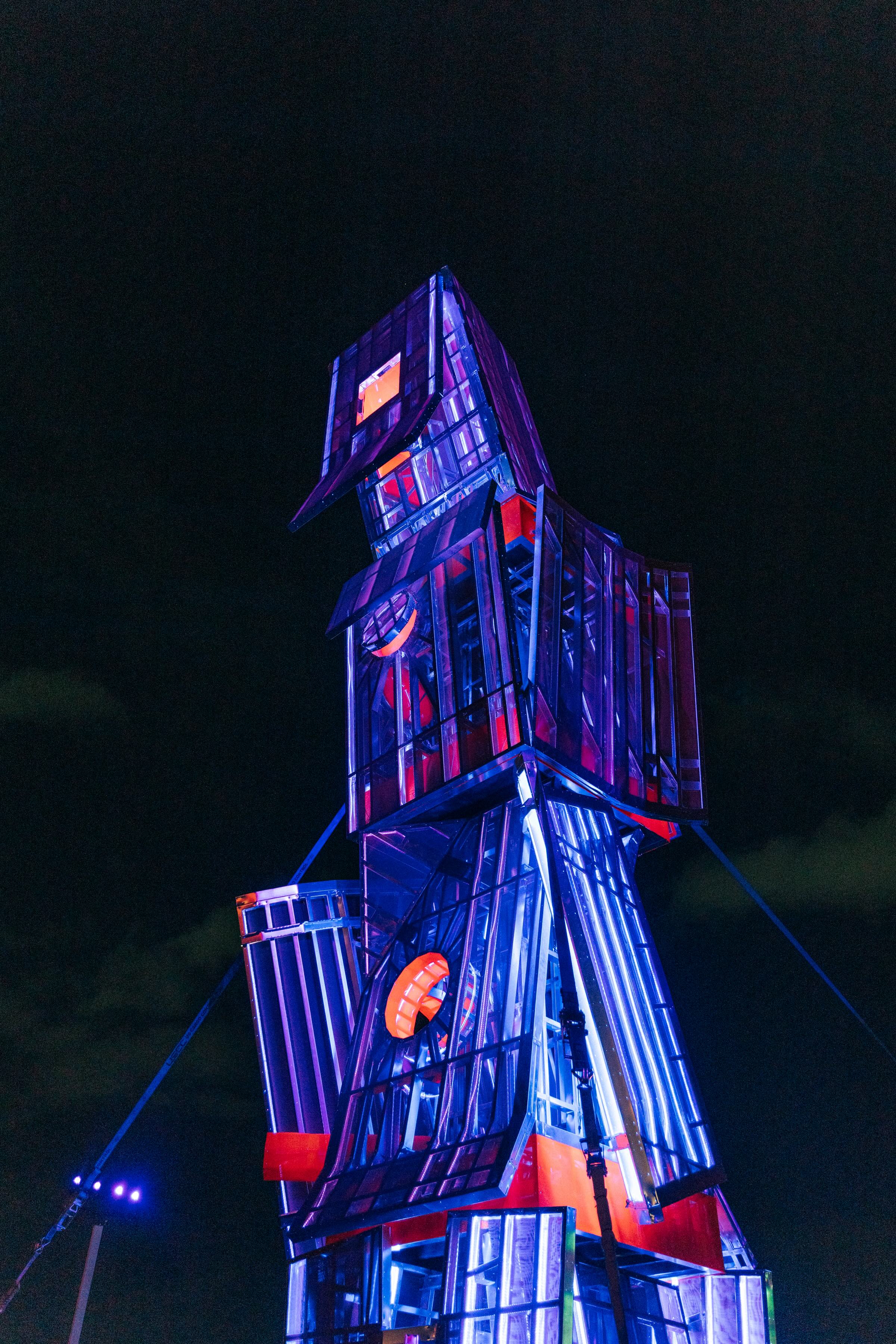
The piece has two primary lives and many lives in between. When fully lit under direct sunlight, it reveals its formal attributes at the periphery (the skin). In complete darkness, when illuminated, it reveals its tectonic structural DNA (the studs). This nighttime reading produces a specific effect or character that is distinct from its daytime counterpart. Every lighting condition in between represents a transition between these two states.
Stay up-to-date with exclusive events and content.


