F L A U N T


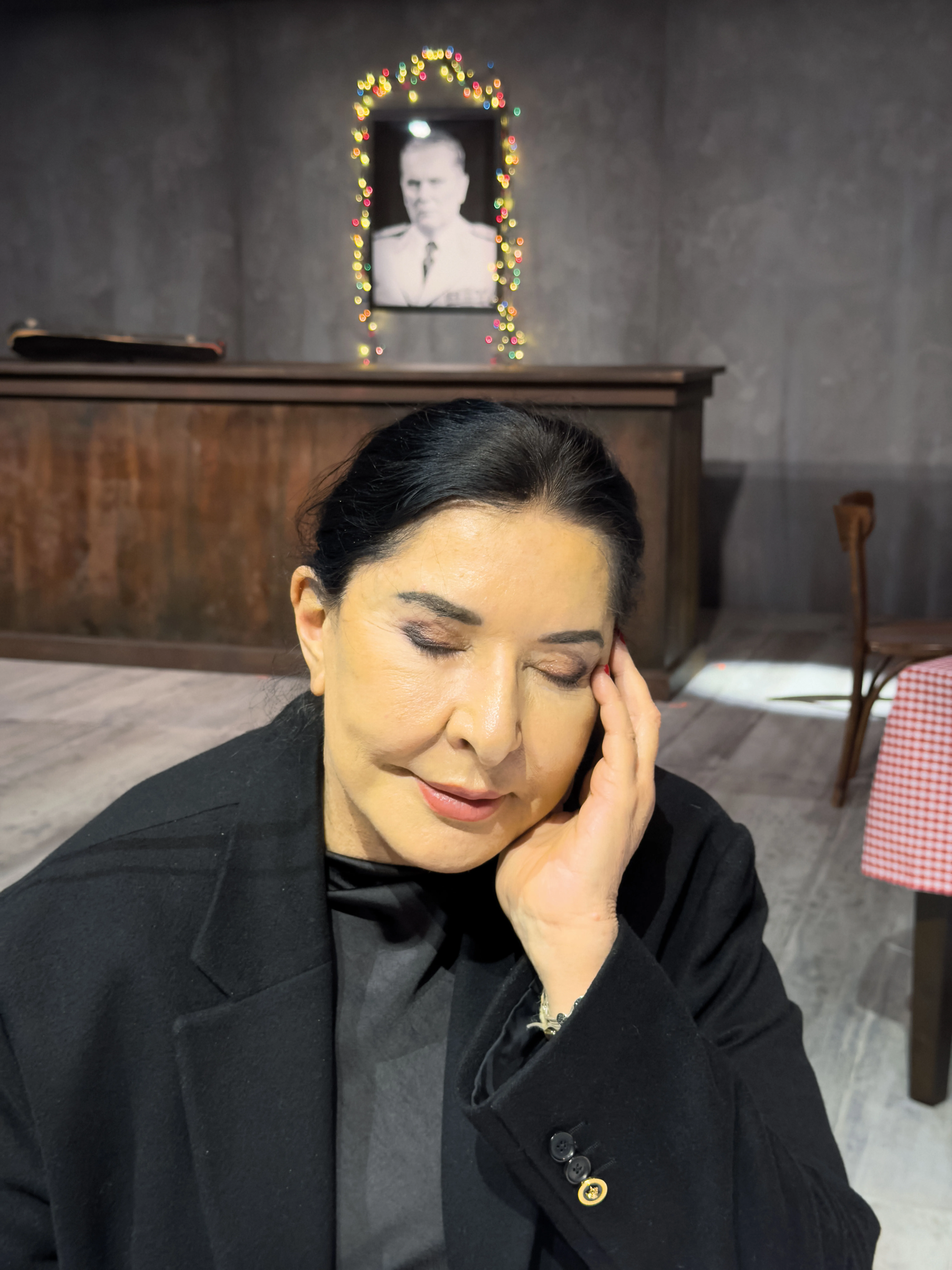
Marina Abramović is perched over a bowl of kimchi. She’s telling me how she’ll soon be 80 and that she wasn’t hugged or kissed as a child by her mother. We’re in her Tribeca apartment. On the window sill stands a trio of wooden folk figurines that I suspect are Balkan, each observing the streets below funnel the willing to polling stations that will see the election of a new “socialist” NYC mayor.
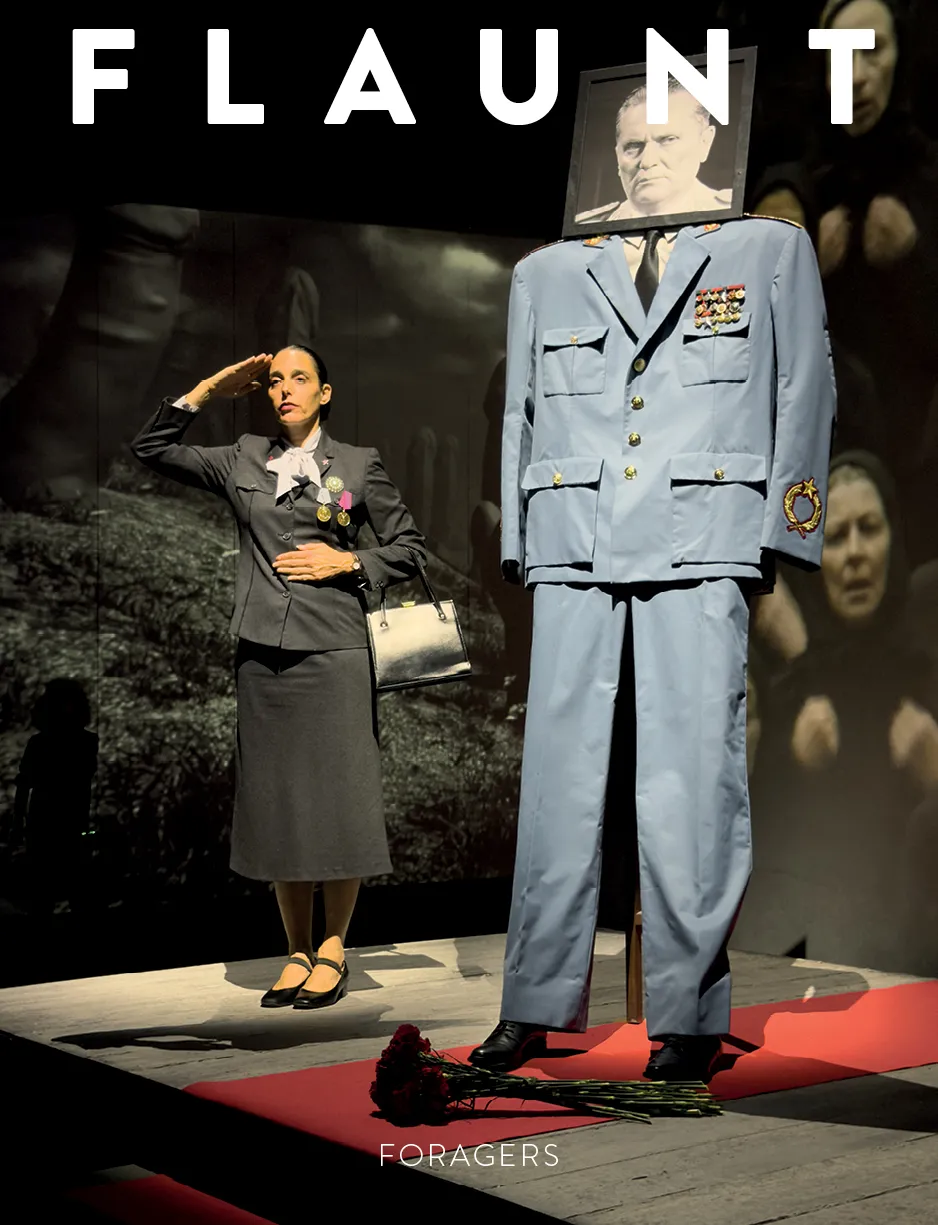
Abramović can and will chew the fat on socialism. In 1945, a year before her birth, her native Serbia became part of the nascent Socialist Federal Republic of Yugoslavia under Josip Broz Tito, whose persona she reincarnates for her new performance panorama, the soulful smorgasbord that is Balkan Erotic Epic. Debuting in Manchester in late 2025, with photographs from the premiere by the acclaimed Juergen Teller featured herein—with a subsequent staging in Barcelona this January and forthcoming plans for a couple of cities in Germany and NYC’s The Armory this fall—the piece is brute and bombastic, ballsy and beautiful.
Over the course of Balkan Erotic Epic’s four hour run time, a litany of expression—choreography, sculpture, video, animation, theatre, live music mixing—is peeled back like an Old World onion, not without the process’ occasional pungency, its metaphoric tear tugging. Inside this sensorial cauldron? Well, we witness, among many many things, centuries long-gone lore and ritual in alchemic collision with various character reprisals à la Tito and his wife Jovanka, a slew of orgiastic ancestors, and one particular biographical figure whose reprisal spelled profound and unexpected emotional liberation for the artist.
Considering its cultural and geo-political past is as complexly dense as it is diverse, there is no universal agreement on what actually constitutes the Balkans, but we know Serbia sits snug in its womb. Given the region’s amorphous nature—and therein the sometimes wistfully elusive notion of defining one’s motherland—I recall Josip Broz Tito’s mother: Catholic, poor, bearer of 15 children, only a handful of whom survived birth or infancy.
Sure, Tito’s adoption of communistic atheism maybe didn’t groove with mom’s Holy Trinity, but it’s well known they smoothly hurdled all that and loved each other dearly. Were dictators, revolutionaries, and/or Party Secretaries-cum-Presidents alike tight with their mammas during this tumultuous saga of Europe, regardless of the occasional mass murdering, the theory, the godlessness? Stalin? Nope. Tolstoy? Nope. So why is Tito an exception?
“If they only can see,” says Abramović, “from my country, the man was treated like a god, and the woman was like a slave, basically. And it is always like this. It’s still traditional. The mother will peel the grapes for the son and bring him breakfast in bed, and the daughter should clean and do everything else. This is such an unbelievable, constant kind of problem, and it’s always there, and nothing can change.”
What can change? The weather, the moods, the fashions, the promises, but above all—and perhaps most critical to Abramović—one’s artistic advancement, that sweet and powerful projection forward into the unknown. After all, as singer Robyn Hitchcock croons in a particularly on brand titled song for this interview, “Nietzsche’s Way”: and history refuses to do them any favors…
So let’s go back for a minute and recall a handful of career highlighting performances whereby the artist in question sought to do us no favors.
There’s the iconic Rhythm 0 (1974). Abramović stands without moving for 6 hours and allows the show’s attendees to electively employ their choice of 72 objects on her body however they desire, the likes of which include lipstick, scissors, a sheet of white paper, an empty gun, a bullet, handcuffs, a rose, a feather, a scarf, etc. Interactions commence with soft, gingerly acts like brushing her hair, but that gets boring, and soon participants are tying her up or holding a knife to her throat, Abramović at one point enjoying the loaded gun to her head.
That same year, she performs Rhythm 5, whereby she curls up inside a massive burning star—a frequenter on communist flags, its five points representing workers, peasants, soldiers, intellectuals, youth—and eventually passes out. Some observers fear she is dead.
A couple years later sees the commencement of a romantic and artistic relationship with fellow artist Ulay, the two of them famously performing another controversially goosebumping consideration of trust and risk. In Rest Energy (1980), Abramović squares a bow’s arrow onto her heart as Ulay steadies the bow, the two of them pushing its string to maximum tautness for a full four minutes. Eight years later, the two’s separation is punctuated by The Lovers: The Great Wall Walk, where each ambles from opposite ends of the Great Wall of China to meet in its center and bid adieu.
There’s Balkan Baroque (1997), where Abramović sings Balkan folk war songs and scrubs blood-crusted cow bones. There’s Spirit Cooking (1996), a cookbook that compiles a series of symbolic “recipes” and dictates from the artist:
With a sharp knife cut deeply into the middle finger of your left hand. Eat the pain; Draw a circle on the floor with salt; Boil 13,000 grams of jealousy.
Lastly, there is the performance at NYC’s MOMA that takes Abramović’s star power—unlike the communist favorite, its points innumerable—stratospheric: The Artist is Present (2010). Abramović sits silently in a gallery at the museum while visitors briefly sit down opposite, invited to stare back. I invite you to Google the surprise appearance of Ulay after many years of distance and not feel the brevity and bewilderment and bulldozing and beauty that our human relationships can and will endure.
Abramović, as you might surmise, has tended to polarize through her career. Much of the above raised hell at the time: her body as pain medium, as sexual medium, the audience defining the narrative arc, the mortal risks, the rigidity, the sometimes gross and infected and worn, the durational mettle—all subject to stir conversation, obsession, anger, condemnation.
All of this was invited in and yet at times rendered irrelevant. Because Abramović, as much as she is amused by hoopla, fame, and the ticklishness of controversy, is always questing for something deeper—that transcendence of spirit, that weightlessness, that opening one’s eyes to a consummately altered room you haven’t actually left, your pulse even and steady.
She’s also funny. There’s almost always a layer of levity at work in the output, and no matter how macabre or deranged or sheets-soiling as it might read, Abramović’s primary aim is not the low-hanging fruit of taboo recoil. She’s deeply committed to holding up a mirror to history, to facts. “It is all real. I never invent anything,” she says, as she shows me black and white animations from Balkan Erotic Epic on her laptop:
RECIPE FOR LOVE POTION FOR YOUR LOVER OR HUSBAND TO NEVER LEAVE YOU
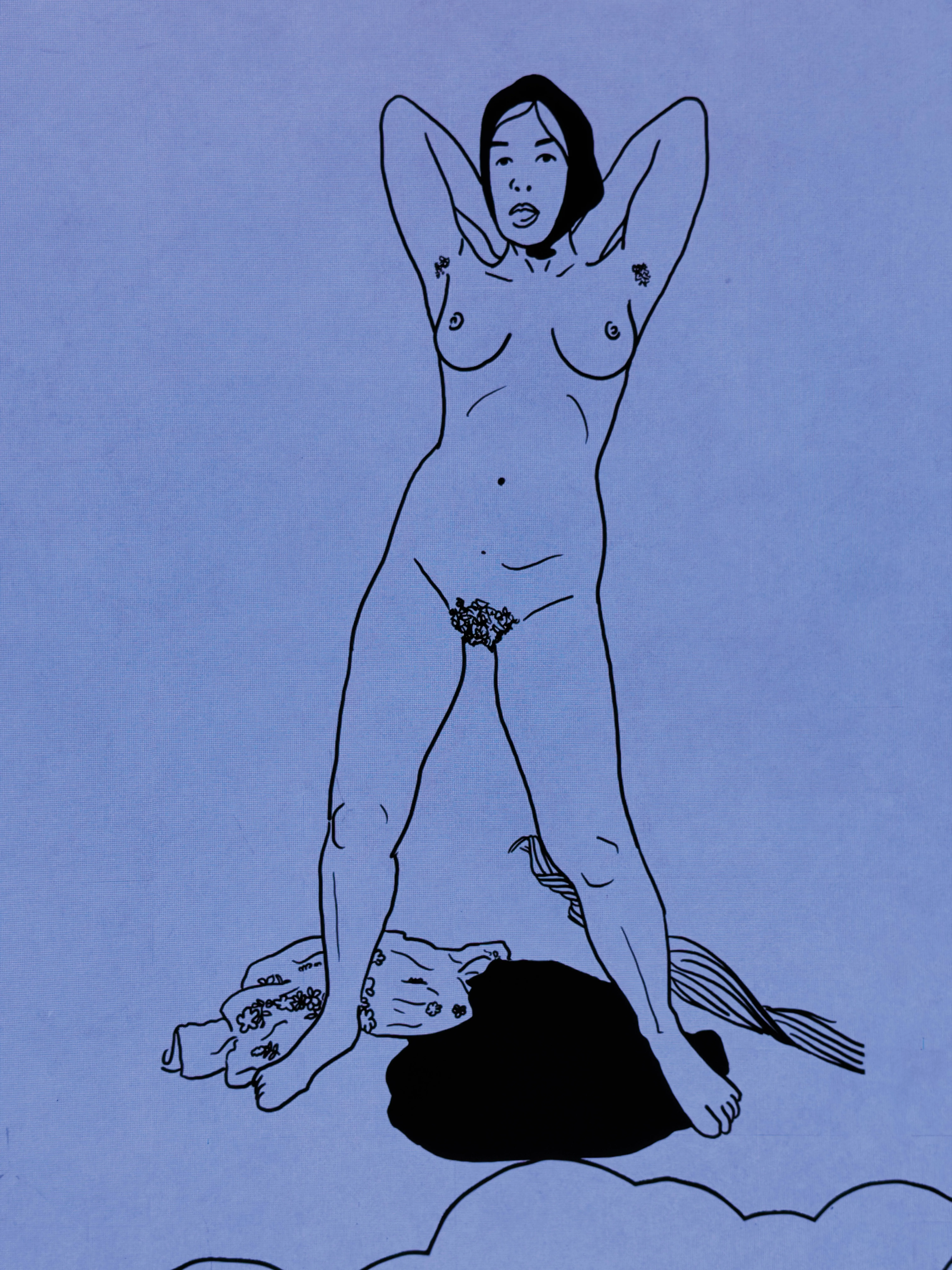
Pluck three hairs from your forehead, pluck three hairs from your eyebrow, pluck three hairs from each armpit, pluck three hairs from your nipple, pluck three hairs from your vagina, place the hairs in a glass of water, add three drops of menstrual blood. Add three drops of blood from your ring finger. Boil the water. Strain the water so that there is no hair left. Secretly give this to your close friend so that she can put this in a glass of wine for her lover or husband to drink.
“This one is even worse,” she says, clicking open the next animation. “Croatia, 14th century.”
LOVE POTION TWO
If the woman wants her lover or husband to love her in Balkan, she would take a small fish and insert it in her vagina and leave it there over the night. When the fish dies in the morning, she would take the fish out. Then she would make a powder of it, then mix it with the coffee and give it to the husband. It was believed that if he drinks this coffee, he will always love her.
“Be careful what you’re drinking in Slavic countries,” Abramović deadpans as the animated folklore continues: there’s distracting the enemy on the battlefield with strip teases, banging on one’s naked breasts to encourage a robust cabbage yield, bolstering the bullishness of one’s testicles via commingling caresses with the actual balls of a bull, and drilling a trio of holes into a local bridge on the eve of one’s nuptials to stave away the odds of anxious impotence:
Then he will take his phallus out and penetrate this bridge, each hole, saying repetitively, “In the same way I penetrate these holes of the bridge, I will penetrate my wife.”
It all loops, repeats, pervertedly pounds away to varying effects. See, central to Abramović’s practice is repetition, scored by a stubborn resolve to smooth the psychological edges of experience, to diminish preconception, to break through. Much of what we repeat in this life, after all, is crude, ugly, painful. Later, she’ll tell me in a taxi headed uptown that the BBC is soon to publish a series of her lectures on the transformational potency of repetition.
“To me,” she shares, “repetition of performance art is rooted so deeply in old rituals. Ancient rituals are all based on repetition. Repeating the same thing over and over again in order to open consciousness to another dimension. If you do something for a long period of time, your breathing becomes very, very balanced, and you get exactly the same amount of oxygen with every molecule of your body, and this stabilizes your mind. And that’s something that we’ve never understood: how to live in presence.”
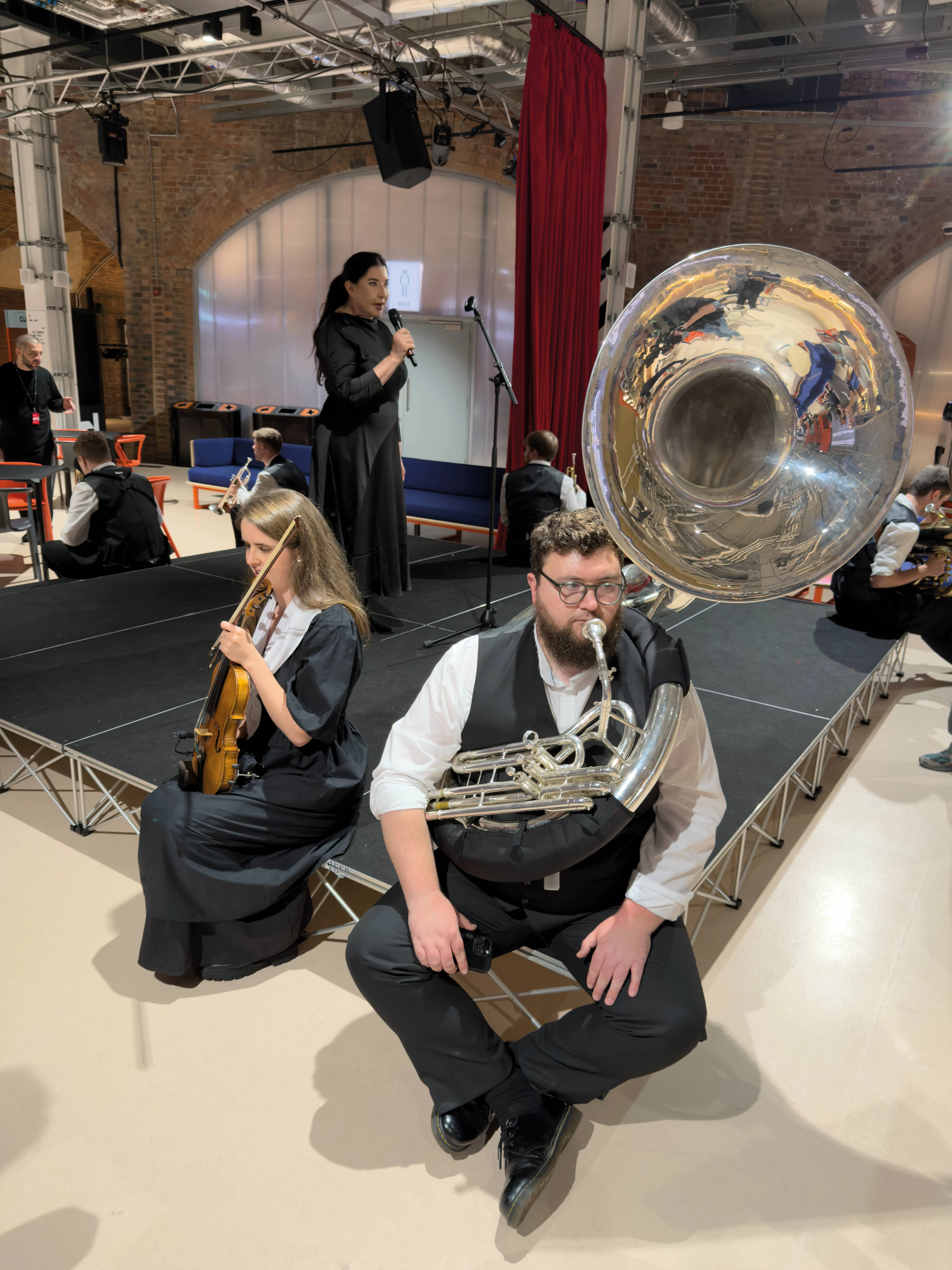
Abramović, though, is the arbiter of presence. Consider her recent appearance at Glastonbury, the UK’s most famous music festival. She nervously concedes an invitation, she tells me, and the musician PJ Harvey forgoes three songs in her own set to make room for Abramović on stage. Then, the artist stands in front of a quarter million people in a custom Riccardo Tisci smock and implores seven minutes of silence:
“The world is in a really shitty place,” she declares. “There are wars, there is hunger, there is protest, there is killing, there is violence. But what is happening if we look into the big picture? Violence brings more violence. Killing brings more killing. Anger brings more anger. Demonstration brings more demonstration. Here we try to do something different. How can we actually, all together, give unconditional love to each other?”
Glasto attendees listen attentively and take heed, each person placing a hand on their neighbors’ shoulder. Soon the entire festival has commenced the imperative practice of quietude. And the scene is chilling—the weight of it, all the world’s wiles and wariness on the table of that fabled festival field—all distilling and amassing, filling like an invisible balloon until it ascends into the sky, into something greater, something more diffuse and kinetic.
“I call this intervention,” Abramović says as we finish watching it on YouTube. “This is not performance. This is 250,000 people. It’s enormous. What if you fail? But what if you don’t take the risk? If you don’t risk anything, you’re always in the same shit. Always telling the same story. And yet, it was complete silence. I mean, these people have been drinking since the morning. They take mushrooms, they do whatever. English people, you are not easy by the way. You’re sarcastic and all the rest, but in the end, when you open your heart, you really do. I truly tried to put every molecule, the tissue of energy, of course, every cell of my being into this. I was expecting someone would scream, the child would cry, whatever. But no, it was silence. It’s almost unthinkable actually.”
The medium, as they say, evolves. At nearly 80 years old, Abramović has—and most certainly not overnight—shapeshifted from performer to interventionist. But of course, for anyone on this sometimes blistered, bullshit, and bogus journey we call the human experience, we cannot intervene with others until we have done so with ourselves. And maybe that makes the road a little less wrought with stones, less pocked, sometimes even beautiful.
Here is the conversation, then, with pictures and files from Balkan Erotic Epic splayed out before us as talking points.
Set the Balkan Erotic Epic scene for me?
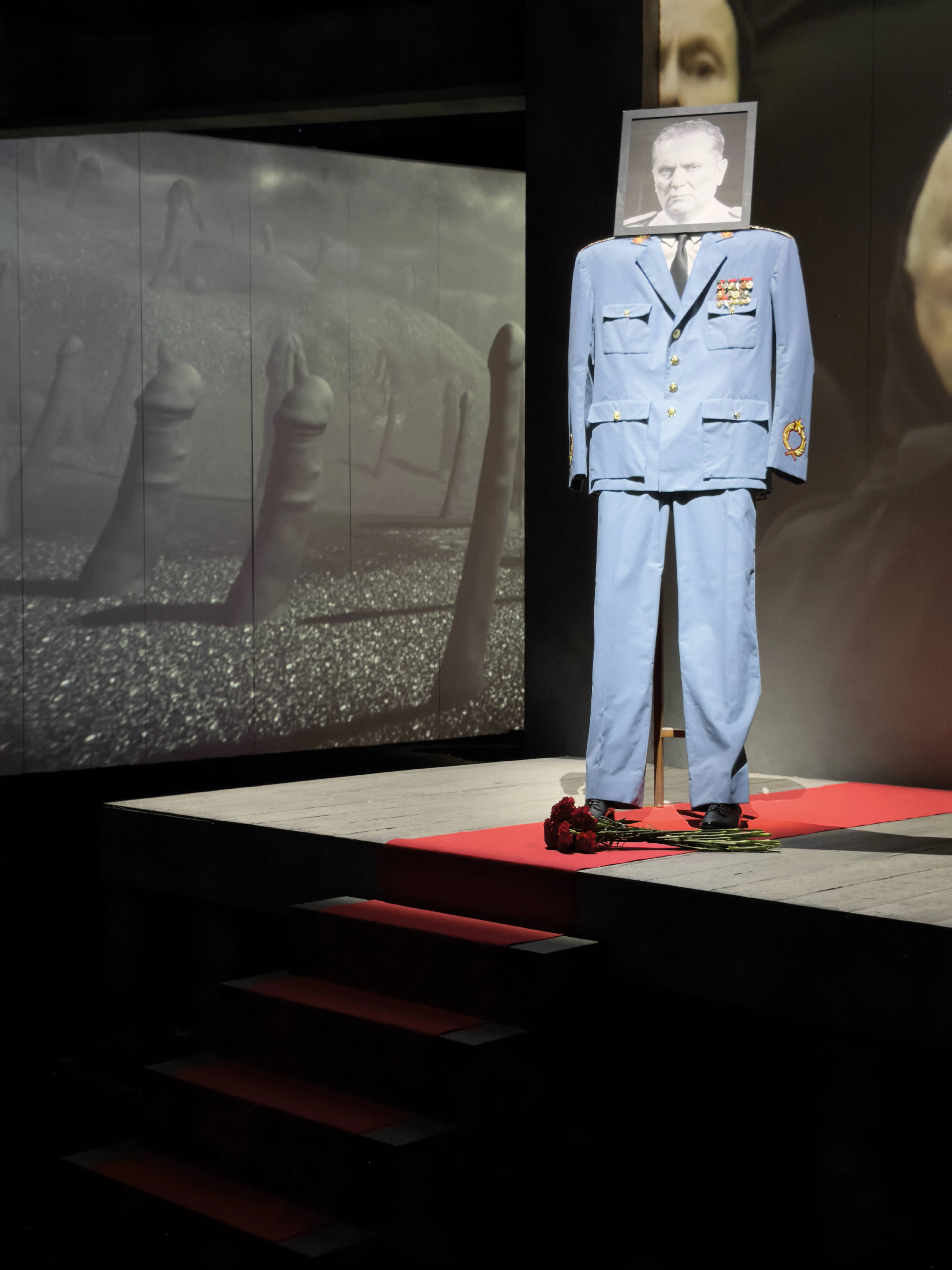
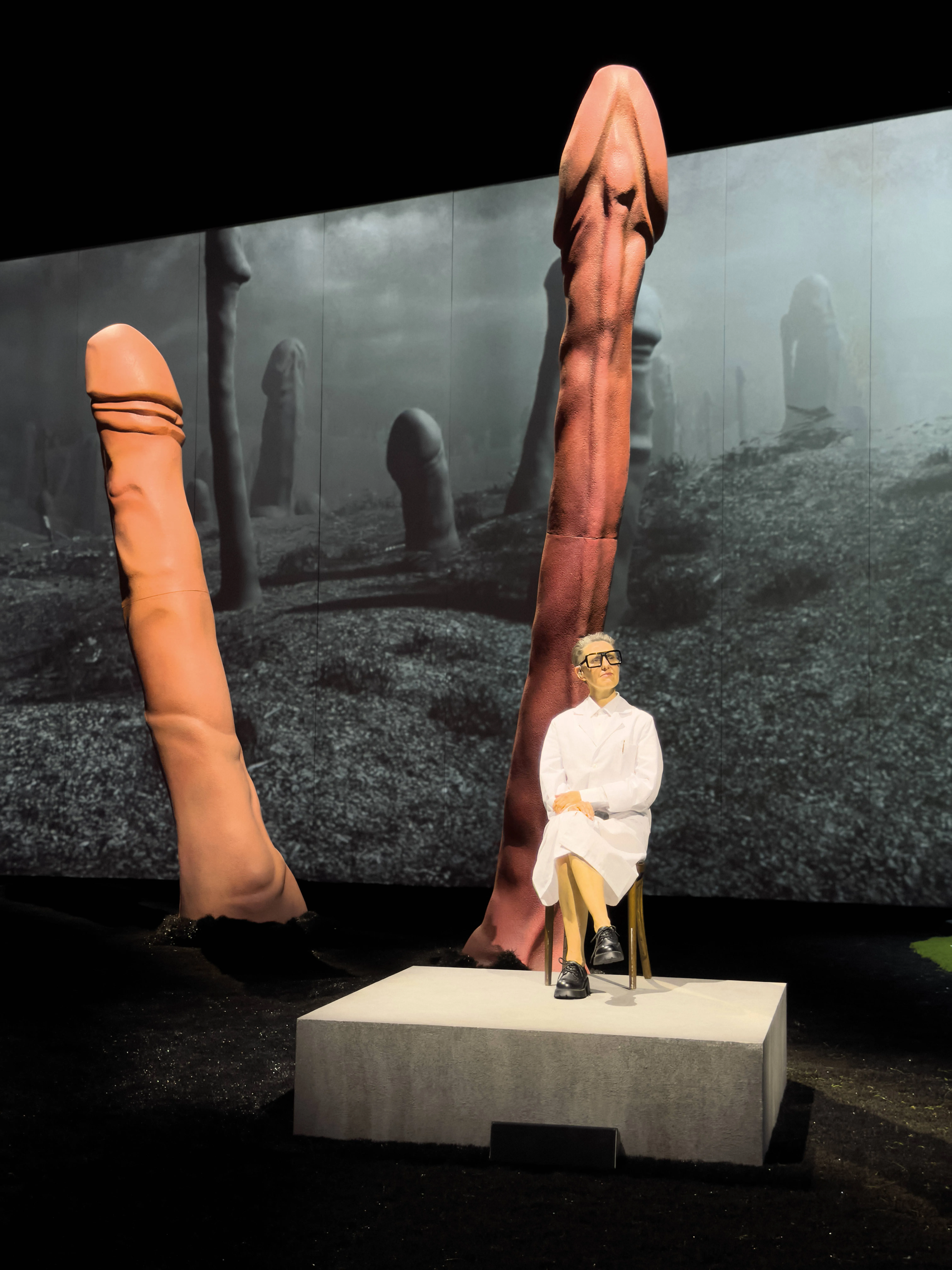
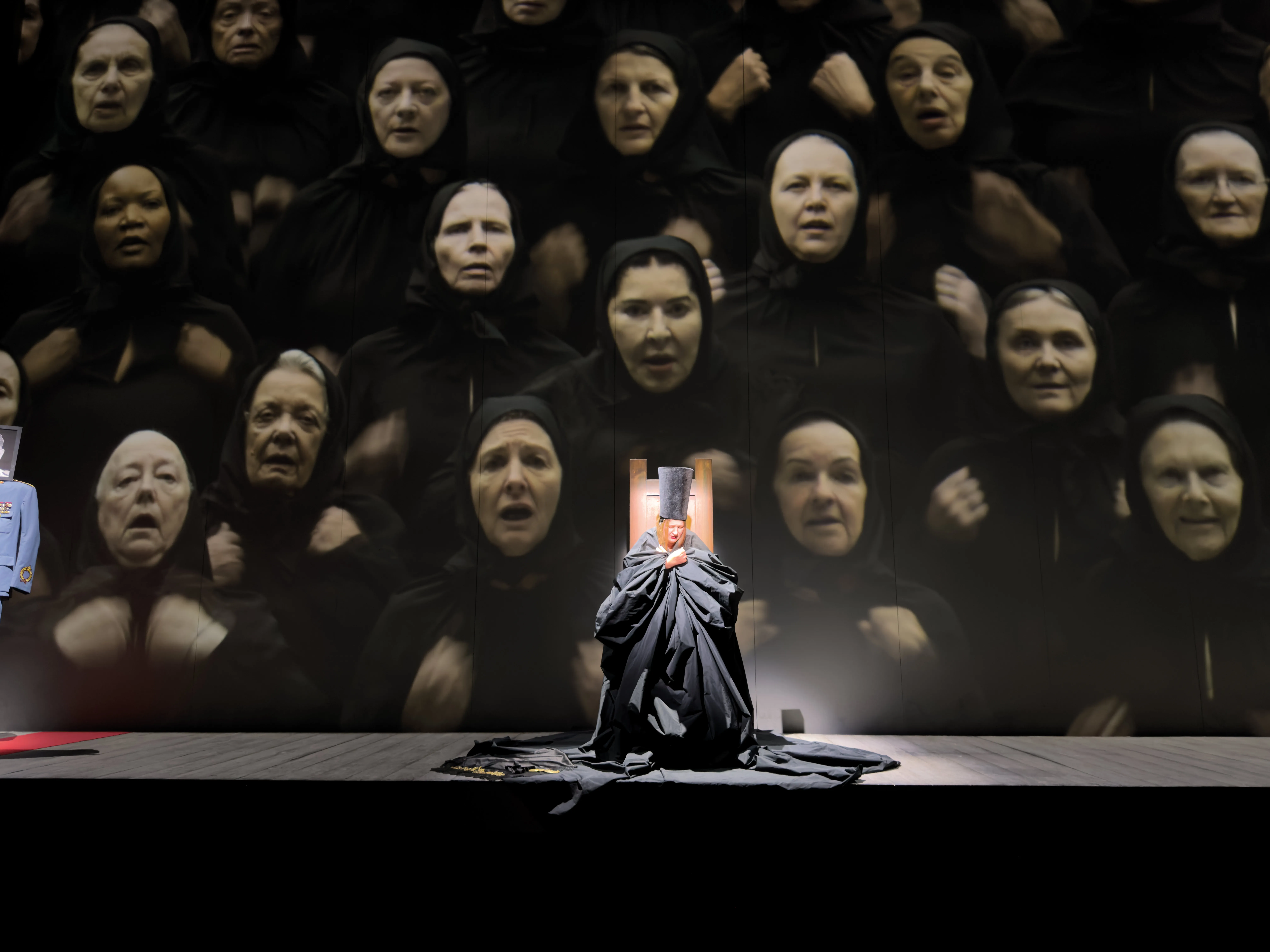
The space is enormous. We covered the entire space with the black grass, if you can imagine that. When you arrive here, the first thing you see is Tito’s Funeral. And this is all the women, literally beating their chests. It’s really dramatic. Then there are the magic potions with these mushroom—really big—four to five meter cocks. You call this once Giacometti. This one you call Picasso. We don’t have a name yet for the small one…
Then the wedding ritual with the Romani people… If the woman is pregnant but doesn’t have enough milk, they pour milk over her. We did this for four hours, pouring milk on somebody. It was insane. There’s another one—a crazy time dancing with skeletons connected with red tongues. Everybody’s naked for four hours.
And what are these images about?
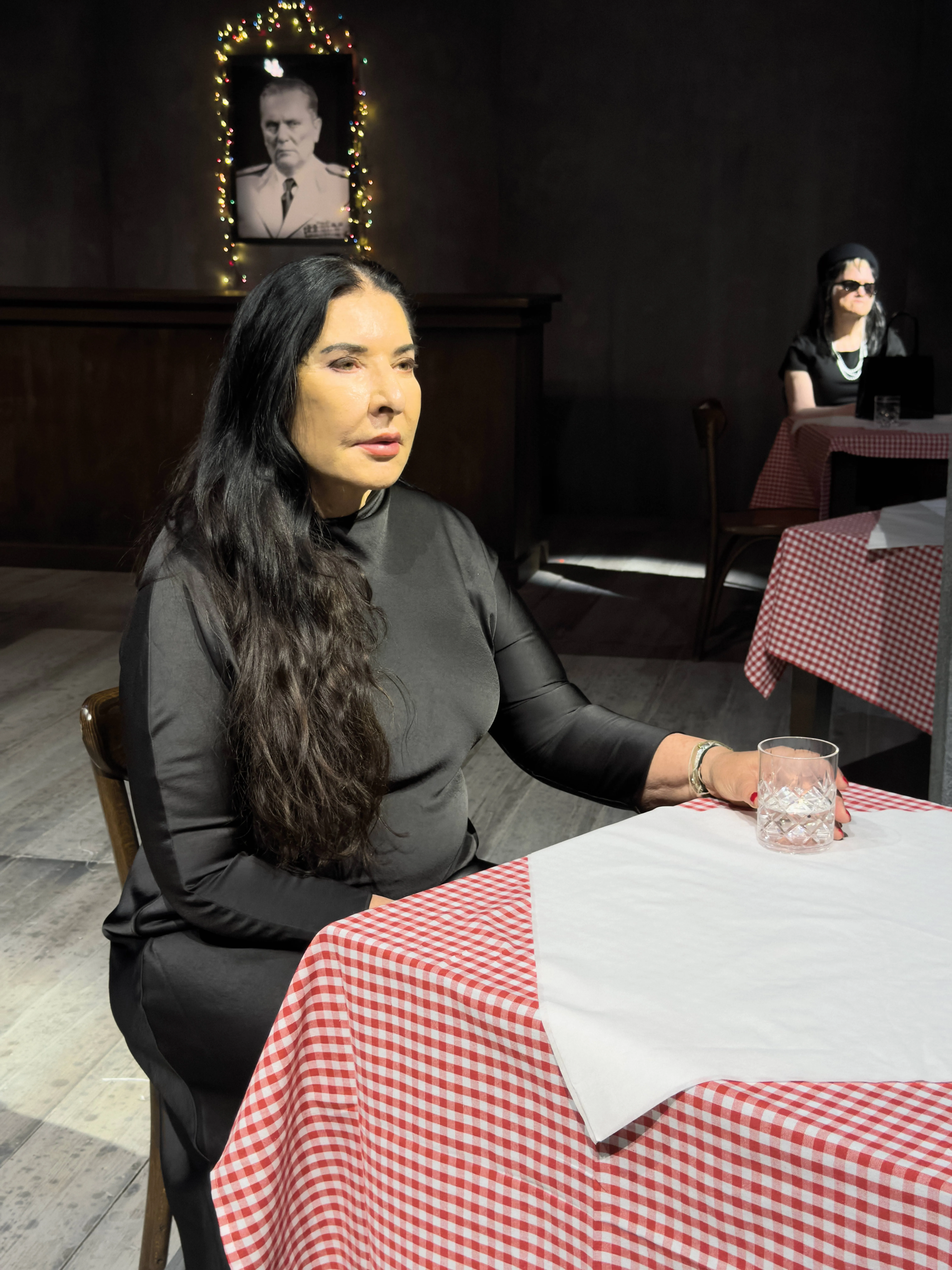
This is our taverna, the homoerotic dance. This is the scene: tonight, my heart is broken, tonight my soul is in pain. It’s hard when you love, but you stay alone, and then you drink vodka and smoke cigarettes and everything goes to fuck all. The ancestor dance is another one. You go to the corridor and you see these ancestors in snow caps.
But the one thing that’s important is that I invent another character, and that character is my mother. So she was hardcore communist, and absolutely hated spiritualism. Doesn’t believe anything. So she comes, she controls everything we see—what the vagina women are doing, for instance. She writes little notes and she writes the names down.
She puts them on her little red list.
Yes. But she comes to a juncture where there is a gypsy guy, and she loses control. In the end, she sits on the table and then she goes crazy, into this kind of frenzy. She goes into this, I don’t know, this zone. Then she really starts undressing—she completely forgets herself. And then it’s like everything’s falling apart.
So do you feel like you liberated something in her?
Oh my god—not her, me! I feel so good. I didn’t even realize how important this piece was to me until I did it. Really, I never felt as though any artwork that I made felt the complete liberation of this heaviness that was my childhood. Or just feeling so alone, so abandoned, as my mother never kissed me in my life, because she always thought that she would spoil me. And only when I found her diaries after she died, I understood that she wanted to make me a warrior. She never wanted me to suffer like she suffered with my father, who left her when she was 42 years old, and had basically been unfaithful all his life.
Do you think she succeeded in her plans?
Actually, she did just the opposite. I am so emotional. But at the same time, I had courage from my father. So it’s a strange combination. But then, my father and mother come from totally different backgrounds. My father came from absolute poverty. He was a communist already in the 30s, and went to prison for his ideas of communism. At that time, he lived in Montenegro, a small village. And my mother was from a very bourgeois, very rich family. She went to Switzerland, studied there and learned about Trotsky and Marx and Engels and Lenin and all of this literature. And her idea of communism was really more intellectual.
But united under communism.
It’s totally two different backgrounds. They met, and then during the peace, they discovered they had nothing to do with each other. They could never actually be together. I was born in 1946 and so I had the military discipline constantly—but only from my mother—my father was always here and there, not around. But my mother was like, I had to sleep in the bed that is completely, strictly straight. It was like a kind of nightmare. And then I was constantly punished, and I never was good enough for anything.
And then, you know, sex was a big taboo. I lost my virginity at 24. Everything was dirty and I could never even have a friend. If anyone who was male called me on the phone, she would pick up and say, “What are you doing with my daughter?” and put the phone down, and everything was immediately cut off. So that kind of rigidity, and absolute lack of any kind of pleasure, any kind of abundance in emotions or sexuality, didn’t exist.
But in Balkan Erotic Epic, things are different?
Yes, I created this image that I want—whatever she could not do in her life, I wanted to do so in this piece. To actually see her wandering around and be seduced by the gypsy and then lose complete control. Every night when she was doing this, every night I was there sitting and looking, and every night, I felt more and more liberated. I still live this piece every night and think about it. This was the deepest liberation in my work that I can possibly do.
At the same time, I never became a kind of feminist, for the simple reason that my mother was commander, and she was in the army, and she was the director of museum art and revolution, and she was so competent and in very important positions. So I always felt that anyone I have to go against is her, nobody else. I had to struggle constantly to become strong, to stand up to her.
Do you feel she wanted you to have things she didn’t, but couldn’t express it well?
I know that when I gave her one of my biggest books of my work she cut every page out where there was nudity, and cut a book of 400 pages to 36, you know, to show around, because nudity for her was unacceptable, because it was abnormal. She was always worried that I should marry a lawyer, the doctor or architect who can take care of me. It was so complicated, and so Balkan.
As Balkans, we have such extremes. On one side is so much love and passion. The other side is cruelty and vulgarity and heaviness. And it’s just drama all the time. Take the old Slavic souls. You know, the Slavic people are never happy when they’re in their country. They’re also never happy when they’re outside of the country. What is actually wrong with us? It’s always a kind of loneliness and kind of soul-search you never actually find. I mean, you see it from Dostoevsky, Tolstoy, Bulgakov, you know, Kafka—all of them, they have this sadness. There’s an emptiness you can feel despite riches all around at times.
And perhaps that heaviness is the actual unifier, if two people’s extreme backgrounds can’t be melded?
This is the thing—after the war, everybody who’s partisan had a completely different treatment. Anyone who was not partisan and not a member of the Communist Party had a different treatment. She was in the elite, so that was the treatment. I mean, I had a piano lesson, I had an English lesson, and I had a French lesson. I was really treated at the same time as a communist, but the bourgeois communist. My father absolutely ignored all of this. When my mother was a member of UNESCO, and she went for three months to Paris, the first thing my father did—we had a very big apartment with beautiful chandeliers—he took a chandelier, then took a big hammer and he swung it. We enjoyed it so much. My mother almost had a nervous breakdown. That’s my father. It was always about freedom.
And so what became of them in what we might call real life?
In 1968, which was a huge movement of course, my father was in the square talking to students. He gave his membership to the communists to throw it away. And my mother was absolutely against the strike, and incredibly pissed off about what was happening. There was really something about bourgeois communism versus true communism. My father died extremely disappointed that everything went to shit. And my mother thought that everything was fine. So there’s two things that never could be really put together.
Let’s shift topics a bit and talk about genitalia—there are live vaginas and sculpted mushrooms as penises presented in a sort of absurdist, comical way in the performance, but there’s real depth of origin here, right?
I started looking into this whole thing in 2005 actually. I found that with the pharmacist, the vagina was used for everything—for healing, for fertilization, for sicknesses, for potatoes, for cabbage, for, I don’t know, crops to grow. It was unbelievable. First of all, we don’t even know where life comes from. We don’t know what’s behind the universe.
So for the only people that could make a connection to that kind of unknown, it was through their own genitals—male, female. And this is how everything starts.
It’s true that not just in the puritanical sense, but in many cultures, genitalia is taboo.
Yeah, it’s something you have to shame. That’s the whole thing. With the woman, with #MeToo, why they never come forward for 20 years–even erase what’s happened to them—because it’s all this fear and shame. They’re ashamed to actually be abused, they’re ashamed to be exposed. And these women in the piece are just the opposite. They’re owning it. This piece, the Balkan Erotic Epic, has elements so therapeutic, and also it’s not even erotic, it’s so primordial. This is what people say—it’s transcendental.
Is this moment in time different in terms of a person’s reception to these kinds of erotic parables or celebration of genitals?
I don’t know. If you think about performance art in the ‘70s, all the stuff we were doing, so much of it was not only performance, but it was the flux of what was happening. There was lots of stuff. Everybody was naked, everybody was doing crazy stuff, and the public reaction was totally liberating. But everything now, because of political correctness, is not possible. So for me to do such a thing right now is more important than before when it was possible, because everybody said to me, “You can’t do this.” People need to look into the real deal of our old rituals, to rediscover the past and rethink the now. This was the main thing. This is about humanity, really, not about pornography.
What about the notion of hard work? What did you discover about the amount of effort that went into this project, about yourself?
I discovered, I feel, that we created a new form of art. And why? It’s never been put together— the dancers and long duration of performance. This is magic. The choreography—it’s time, sounds, it’s rhythm. Exhaustion becomes evident, that vulnerability becomes really clear, and you can see it. Then you connect vulnerability and this exhaustion with the public.
Many would argue we have gotten further and further from planet earth in ways. What do you feel the piece says about our relationship to nature?
That’s the thing. How all these sexual organs are connected to nature, and everything becomes one. If you leave sperm in the ground, you have the crops grow better. If you stop the rain, you know you can feed the village. If you have impotence and you can’t make children, then fuck the bridge. Everything is connected. That’s kind of incredible.
Like with the onion, you have to first masturbate and you have to have erected the cock, and you have to hold it in one hand, and then with the other hand, you plant the onion. But then the woman has to come and piss on it, and that is fantastic. I’m studying cabbage now. All root vegetables are fantastic. Potatoes are my big idea. So we’ll see what happens.
Does this particular enthusiasm come from having experienced so much? Or was it always there?
I think 80 is the new 40. I have no idea how I got to 80. Just work like hell. I see people my age, and it’s like, they’re half-dead. But the one thing that is so important is to create, to make things. They say to me, “Oh, my God, people your age are mostly repeating everything, they don’t make new forms of art.” This is done already to me. Now this is living its own life. Honestly, to me, the only option is to work and to make new things. I’m dreaming about new work that I want to do.
You’ve just come from Japan where I understand you received the Praemium Imperiale Award for Achievement in Sculpture. Any highlights?
It was wonderful. I sat next to Hillary Clinton for two hours. I talked to her about Balkan Erotic Epic. She was so amused. I don’t think anybody had ever talked to her about these sorts of things.
The performance brochure harkens the propagandist literature of the era you’re talking about, that you reawaken in this performance—and of course its weapons, its regimentalism.
We used to sleep with a pistol next to the bed. My father gave me a pistol when I was 14. When women had a pistol, they said it was to protect her. Very lethal. And silver. And iconography. If you witness any totalitarian regime, they have exactly the same iconography. You see, there’s no difference between North Korea, the government right now, or any of the parades of Hitler. It’s all the same. It’s all about symmetry to demonstrate power. It’s always about power.
And what are you experiencing at this stage of your life that’s special?
Wisdom. I have more fun than… I have much, much more fun. I love every day. I woke up this morning to see the trainer next door. He kills me. And I was like, just have mercy on an old woman. But he says, “Fuck this” and just push, push. You have to move. You have to walk. And I see people of my generation who would rather drink than go to the gym or they just don’t take care of their bodies. I just had the knee replacement, like six months ago, and I just don’t give a shit. I already had one, so I have two knee replacements, two hip replacements, one shoulder—just replace everything.
With all that in mind, what do you have to say at this stage about resilience?
This is all so good. The human body is incredibly strong. I remember two years ago, I almost died from this embolism. Not aneurysm, embolism. You know, whatever. God, this was something I could not control. It was so frightening. Like, I get a cough in the country? This really gave me a wake-up call, how important your health condition actually is. There’s nothing worse than actually being old and being sick. But being old in a healthy body is incredibly joyful. And at this stage, I know not to make the same bullshit decisions or mistakes like I’ve done before. So it’s like the whole ordeal made so much sense, and now I actually understand life in the way I never did.
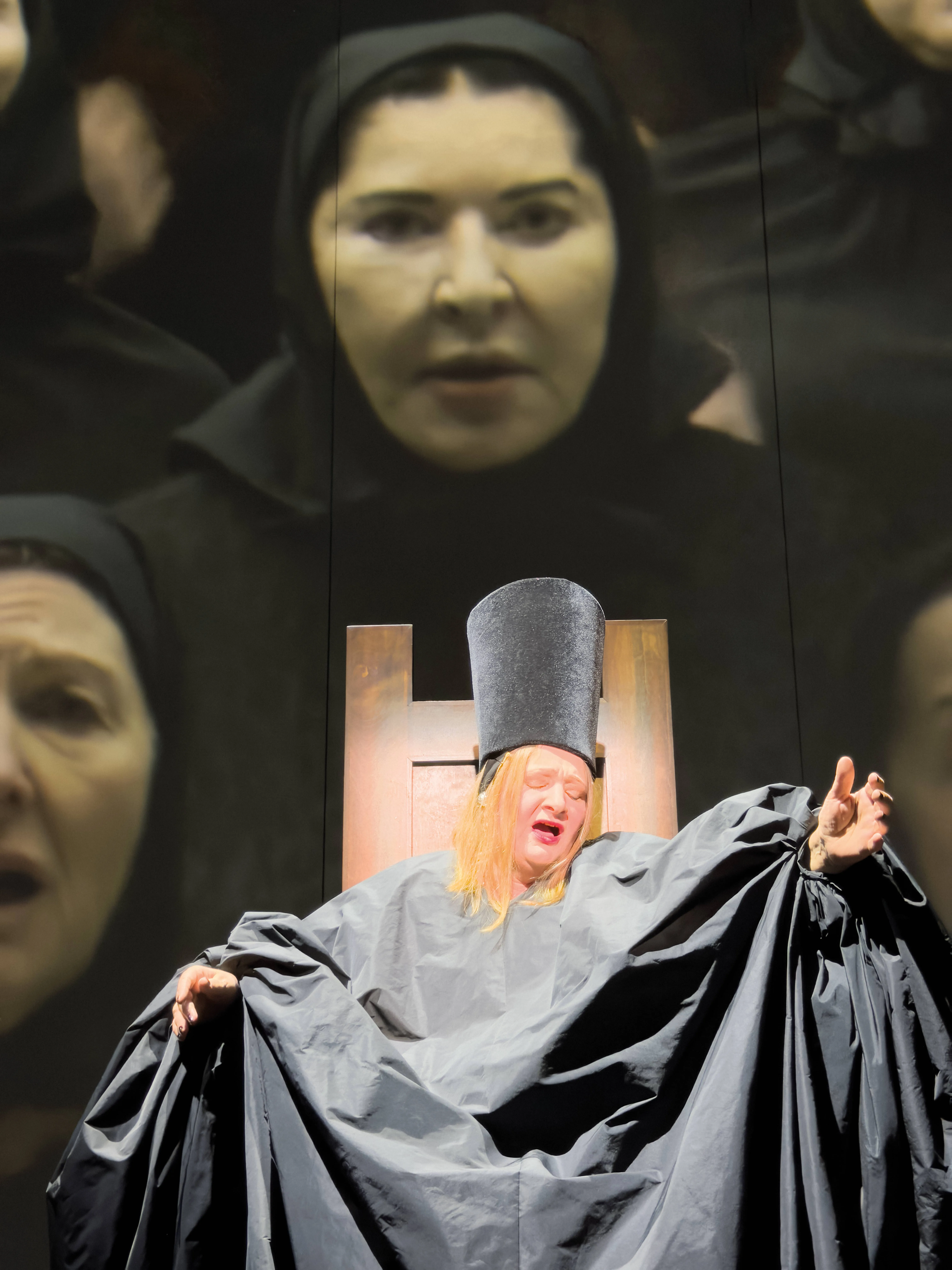
Photographed by Juergen Teller
Creative Partner Dovile Drizyte
Written by Matthew Bedard
Post Production: Louwre Erasmus at Quickfix
Balkan Erotic Epic: Artist, Direction, Concept, Design: Marina Abramović
Choreography: Blena Azizaj
Durational Performance Direction: Billy Zhao
Film Direction: Nabil Elderkin
Composition: Marko Nikodijevic
Composition, Sound Design: Luka Kozlovacki
Set Design: Anna Schöttl
Lighting Design: Urs Schönebaum
Costume Design: Roksanda Ilincic
Flaunt Research Assistant: Abby Shewmaker
Stay up-to-date with exclusive events and content.


