F L A U N T


On the phone, I tell Marcel Dzama that my days are colored by his artistry. Living in Brooklyn, I often come across his mosaics at the Bedford Avenue station: 400 square feet of blue and gold glass tiles that depict his signature ballerina figures in Zorro masks, dancing alongside wildlife beneath the sun and the moon.
Later on, as I ride the train, I see his art card, “The underground helps the garden” (2023), installed just above the train window. In it, vibrant flora and fauna make their commute in a subway car. Standing next to a peacock is Mother Nature wearing a long, greenish-blue dress patterned with yellow amoeba-like shapes. She holds the Earth gently in both hands, leaning down as if to place our planet on a seat. It’s a lot to carry around all the time, I’m sure.
Today, Dzama is just as concerned with the weight on Mother Nature’s shoulders, which he explores in Into the Blue, an exhibition on view at Sies + Höke in Düsseldorf, Germany, this fall. “A lot of it has to do with what mankind is destroying for the greed of a few,” the Canadian-born artist tells me. Across the show, environmental anxiety, political repression, and the possibility of imagining a new world beyond such abuse converge, illustrating a future where nature seems poised to outlast the systems that exploit it.
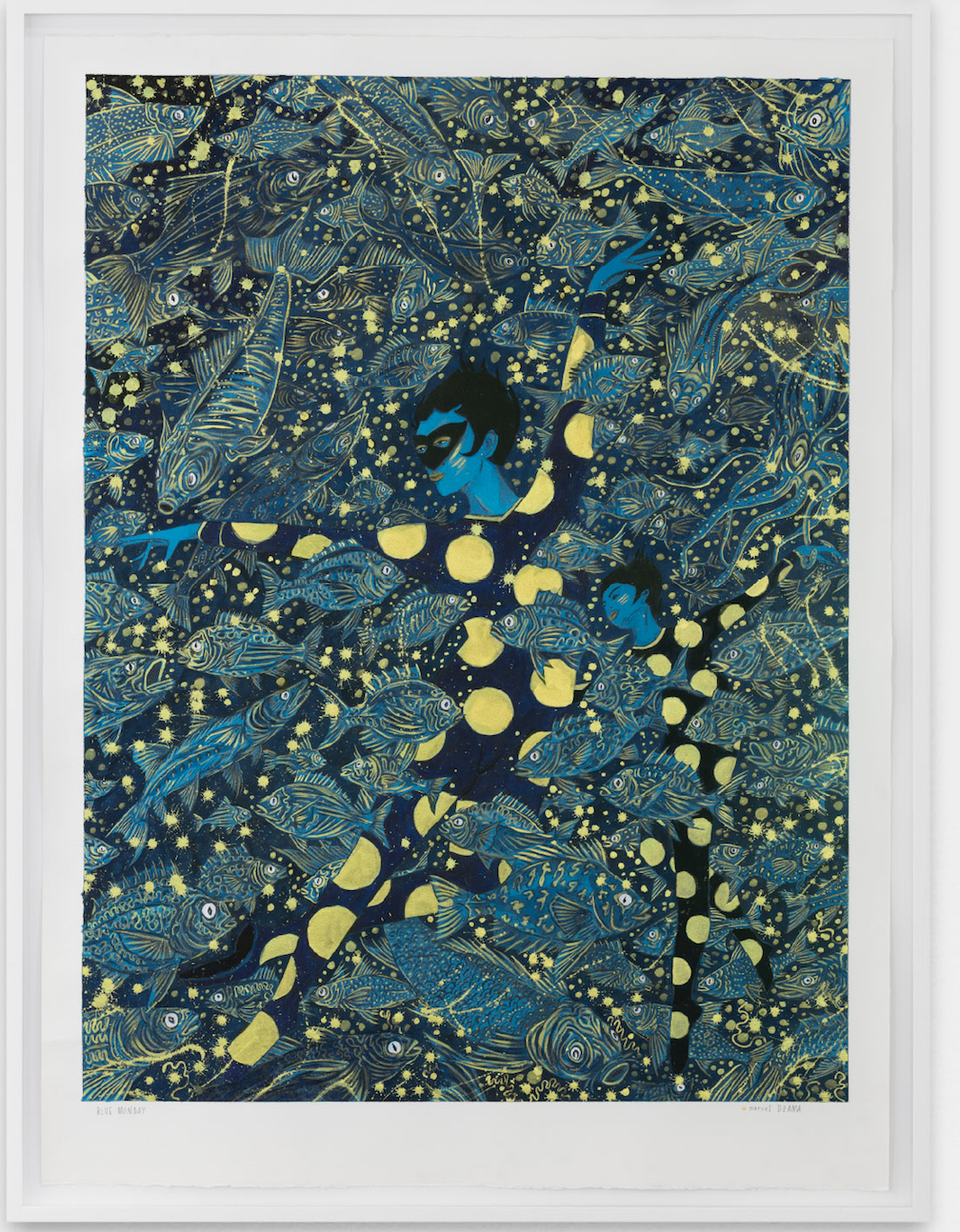
In the show’s eponymous painting, a diver, their body translucent and covered in yellow polka dots, camouflages into an assortment of fish swimming in deep blue waters. In “Blue Sunday,” “Blue Monday,” and “Yer Blues” (all 2026), similarly outfitted figures in yellow polka-dotted catsuits dance elegantly while surrounded by fish. “Originally they were drowning, but they’re more like ballet poses now,” Dzama says. “But it was about drowning in bad news or trying to drown out my thoughts of the bad news. There’s so much every day. You’re flooded with it.”
“I liked that I could have this idea of drowning, but make it beautiful,” Dzama tells me. “Maybe it’s hopeful. Maybe this is rock bottom in the US and we’ll move to a better society from this.” Having a child compounds this sentiment; he says that ever since his son was born, his work has become more and more about Mother Nature and mankind’s abuses against her. “There’s a lot of worry and anxiety that comes from hoping for a better future for my son and just for humanity in general,” Dzama says. He illustrates this feeling in “A worried mind a worried world.” (2026), which depicts a woman resting her head in her hand while sitting with four cats. Her brows are furrowed, and it appears as if she’s looking just past the viewer. Disassociating from reality, she seems overwhelmed, drowning in her worry.
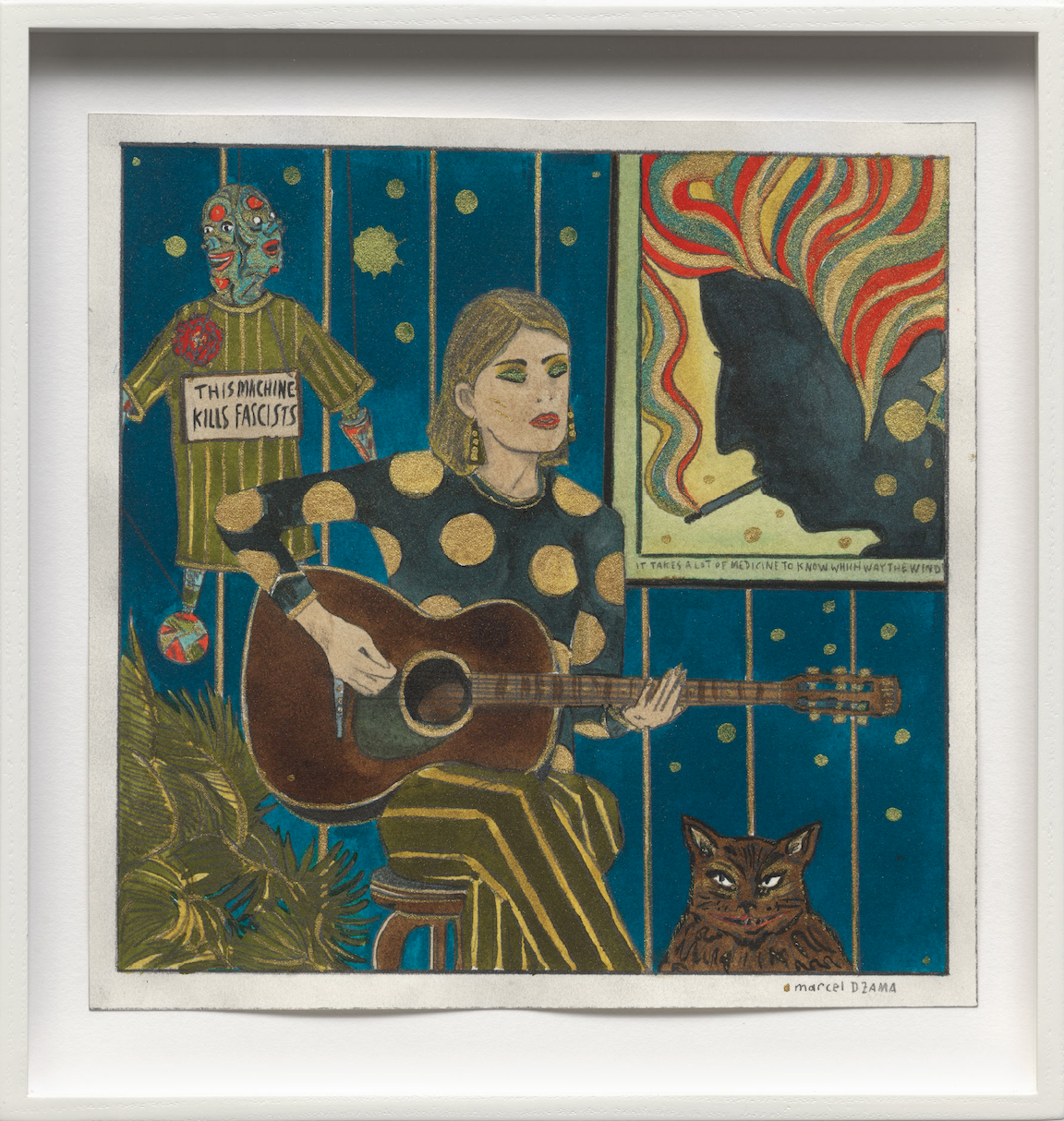
At the same time, “if you become more hopeful and joyful, they’re not stomping down your spirit as much,” Dzama says. That might look like “Rebellion, dance and resistance” (2025), where dancers leap under dazzling stars and a big, bright moon, or “Rebel song” (2025), in which three orange cats play instruments as a woman strums on a guitar, its body etched in writing. “This machine kills fascists,” it reads. Or it might look like letting the love and connection Dzama shares with his son seep into his work. “My son was doing a marine biology class at camp, and he was showing me all these different sea creatures,” he says. “They found their way into my drawings.”
Dzama has always been fascinated by the natural world. Growing up in Winnipeg, Canada, he spent a year living with his grandfather, a farmer in Saskatchewan, and drew bears, skunks, and tree people. His early drawings were sparse, with one or two figures against a blank background. After moving to New York in 2004, his compositions became denser and more claustrophobic.
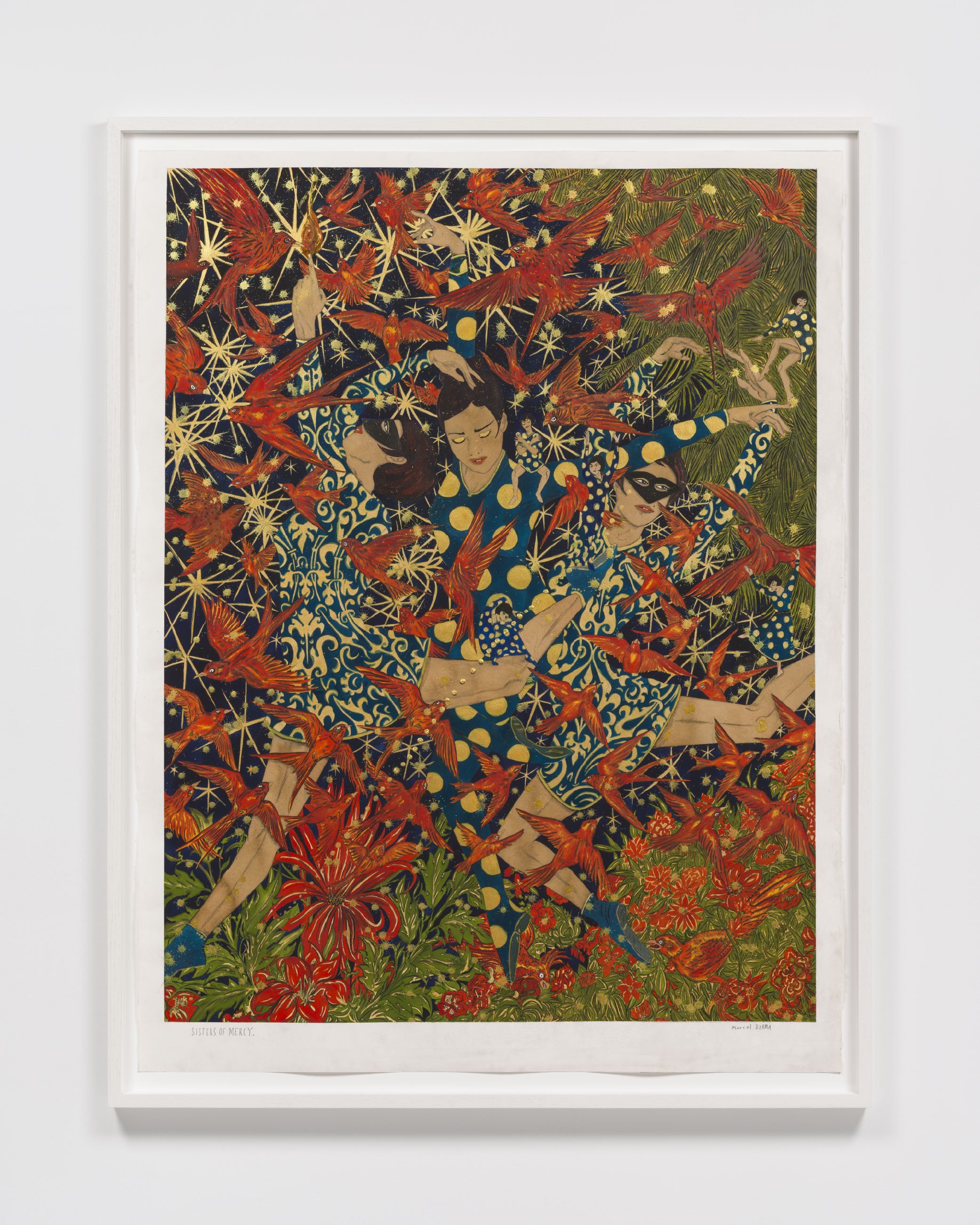
Around the same time, dance entered his work. While living in Williamsburg, Dzama bought a stack of 1970s ballet magazines at a stoop sale. He began studying the dancers’ poses, drawing inspiration from Balanchine, the Joyce Theater, and Oskar Schlemmer’s Bauhaus costumes. “I started to give them ballet poses to put some order to the chaos,” he says. In Into the Blue, he seems to use water in a similar way, suspending the world’s typical rules while also maintaining harmony. The diving figures float alongside the fish; dancers appear to hover over the water; the hierarchical boundaries between human, animal, and plant forms dissolve.
The works also carry the influence of surrealist Spanish poet and playwright Federico García Lorca, whose work Dzama has been fascinated and inspired by for years. The exhibition will serve as the German premiere of his To Live on the Moon (For Lorca) (2023), a film commissioned by Performa based on Lorca’s 1929 Viaje a la Luna (Trip to the Moon). Dzama combined his own visual world with Lorca’s screenplay and biography, with Lorca’s niece, Laura, serving as the narrator. In the film, Lorca’s ghost is resurrected as the moon, while fascism’s attempts to control nature are eventually undone by nature itself.
Many of the works in Into the Blue similarly imagine a world in which systems of surveillance, oppression, and exploitation are dismantled by the very things they seek to control. In “Note to all” (2026), Dzama depicts a saint-like figure with a banner that reads “I didn’t come from your rib, you came from my vagina,” addressing the state’s use of religious text to justify controlling women’s bodies. In another, this one called “Civil disobedience becomes duty when the state becomes corrupt” (2025), two anthropomorphic pigs dressed in military police uniforms escort a woman whose cheeks are stained with tears (I can’t help but notice that she resembles the Mother Nature figure in Dzama’s subway art card).
In “An arrow of truth” (2026), one of those polka-dotted swimmers has surfaced out of the water, the night sky twinkling above her. Two cranes with red, yellow, and brown feathers appear on either side of her, offering hope and longevity as she shoots an arrow into the distance. I don’t know if it’s a coincidence, but within range of her aim is another work hung just three paintings over; in this one, called “When false idols fall” (2026), a Humpty Dumpty-like man with a bow tie and striped pants sits on a brick wall. I imagine the arrow flying into frame and knocking the round-faced businessman off his ledge. “You don’t win a battle against Mother Nature,” Dzama says. “If you’re trying to use it for greed, you’re not going to win. You’re just going to destroy human life.”
Stay up-to-date with exclusive events and content.


