F L A U N T


Technology is a chase. Snap a picture on your smartphone, and you’ve bypassed a whole night’s sleep’s worth of waiting to see the image you’ve captured. Hell, ask the LLM of your choice to represent whatever prompt you could dream of stringing together into an image, and you’ve surrendered the entire process to the perennial Algorithm. In nearly all aspects of life, the public has begun to reckon with how they will move into a new era with today’s burgeoning technologies—assuming blind allegiance, willful defiance, or sitting in the ambivalent in-between.
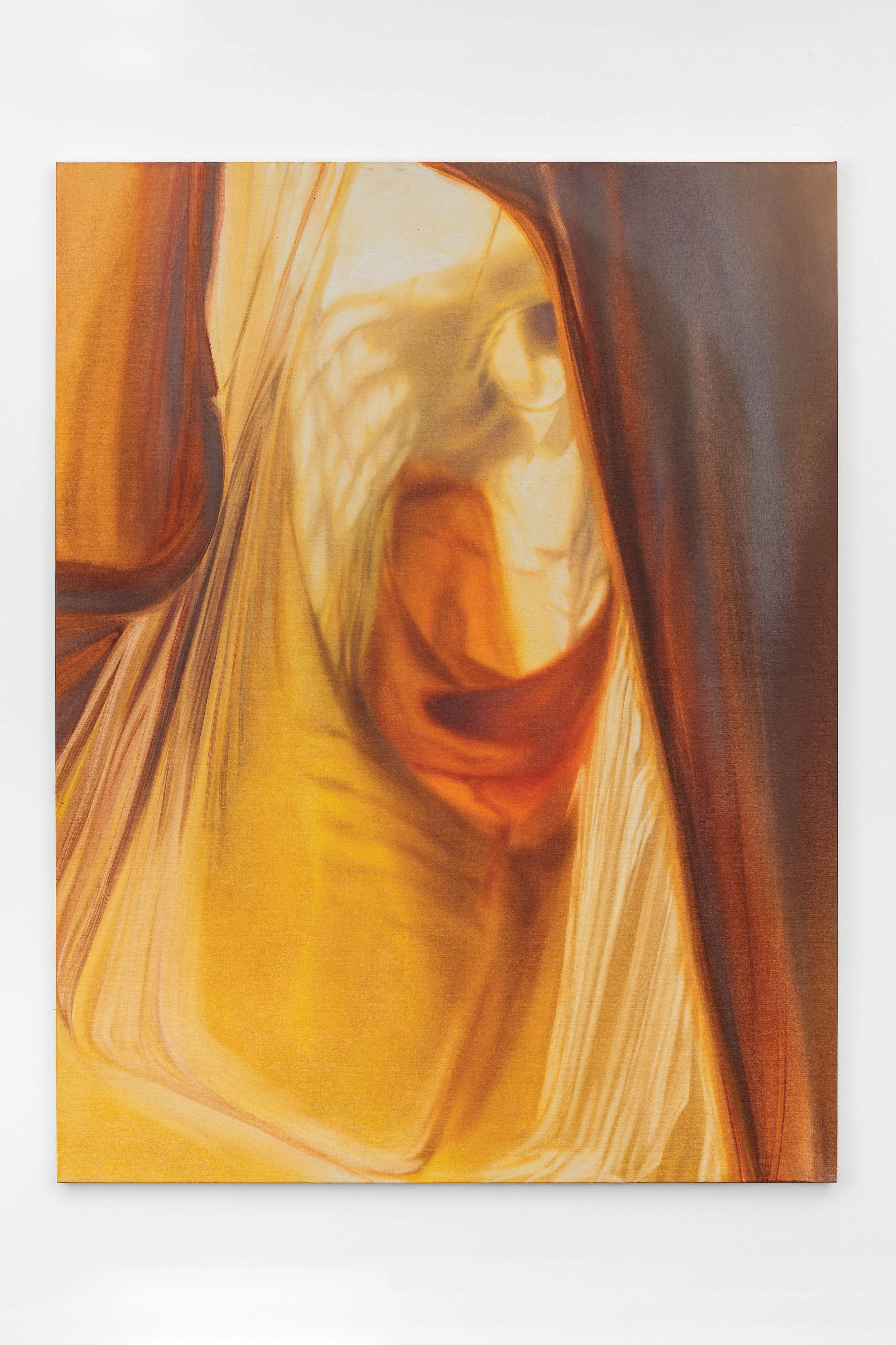
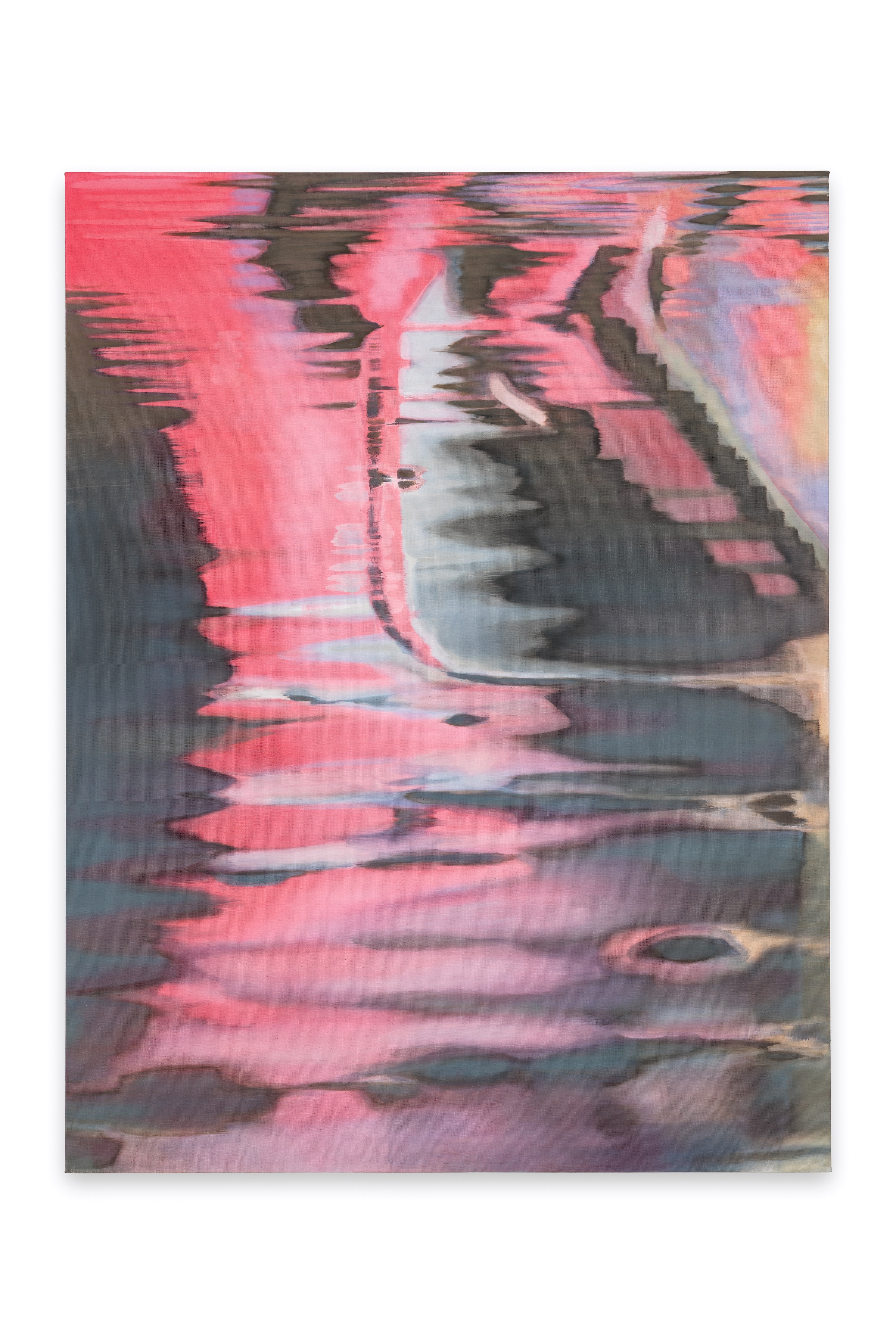
But what does it mean to reclaim The Creative Process as it once was, the winding journey that precedes a gratifying destination? Artist Evelyn Plaschg, whose media have ranged from graphic design to oil paint to music, has flipped the script on creative automation—taking photographs of the physically and culturally commonplace, and distorting them into paintings beyond comprehension or reality. Her works are vibrant and dizzying, ruminating on color and form and reality. A zipper becomes skin, or a wound, distilled down to its permission to open. Fabric folds into something bodily; color thickens into substance; ordinary objects lose the function that once made them traditionally legible to the human eye.
There is something almost radical in that slowness. Master paintings have long been discussed through the time they demand—months, years, entire lives organized around looking, layering, revising, failing, beginning again. The contemporary image economy, by contrast, moves with a reflexive immediacy. A photograph can be taken without intention, an image can be generated without contact, and a memory can be outsourced before it is fully felt. Plaschg’s practice moves through the digital world only to return, insistently, to one of the oldest artistic media known to man.
Born in Gnas, Austria, and based in Vienna, Plaschg came to fine art after working in graphic design, moving through drawing and works on paper before arriving, only in recent years, at oil paint. This summer, Plaschg appears in ibid., a group exhibition at Kunstverein Nürnberg – Albrecht Dürer Gesellschaft, on view from through September 6, following her June presentation with Gallery House and Kirchgasse Gallery during Zürich Art Weekend. This September, she will release her debut album via Plot Toy, returning to music after three years.
At the center of many art-world debates of today is the question of process: which processes matter, and whom do we want making art—humans or machines? Plenty of artists throughout history have delegated parts of their processes—to assistants, to chance, to systems—but what feels newly urgent is not delegation itself, but the disappearance of friction. When the distance between idea and image collapses entirely, what is lost in that absence of resistance? What happens to the body in the act of making?
Plaschg’s work seems to insist on that resistance. Her paintings do not reject the photographic or the digital outright; rather, they pass through them, metabolizing the image until it becomes something else entirely. The source dissolves. What remains is a surface that feels labored over, worked through, touched. There is a tension between recognition and estrangement—a sense that the viewer is seeing something familiar, but can no longer name it with certainty. In that instability, meaning expands rather than resolves.
To paint in the year 2026 A.D. is to stare in the face of a shortcut and deliberately choose to take the long way home. It is to privilege duration over immediacy, embodiment over efficiency, doubt over resolution. Plaschg’s practice does not offer an answer to the technological condition so much as it lingers inside of it, stretching time where it has been compressed, thickening images where they have been flattened.
Below, Plaschg discusses the slowness of painting, the physicality of color, the bodily charge of zippers and fabric, working between abstraction and figuration, and what she is chasing next.
Tell me about yourself—where did you grow up, and who has been influential in your life, personally or artistically?
I grew up in Austria, in the countryside and for school I moved to the next bigger cities. Fine art came rather late. I had ambitions in graphic design before, and it was my friends who encouraged me to start with art. After my studies, I started to work with Gallery Layr in Vienna.
Are there any artists whose work has inspired you in your own creation, or where do you draw inspiration from?
It changes. I like the period of the Abstract Expressionists and American painters in the ’60s and ’80s. And now, for example, I am interested in practices like Jacqueline Humphries or Wade Guyton.
I think painting became, after a long time, something I’m really interested in or drawn to, but it developed very slowly. It took me a very long time to see myself as a painter and also to start painting, because I came more from graphic art and drawing. I was working on paper for a long period of time and just started three years ago to use oil paint, which is my medium now, during a residency program at ISCP in New York.
What made you want to paint?
It’s a visual way of receiving or perceiving the world, to use visual intelligence to communicate. I like painting especially because it’s a very manual and rather slow process. It’s a very old medium.
I’m especially interested in where photography and painting meet. Our habit in the modern western hemisphere is to be surrounded by an incredible amount of photographic imagery and digital media, and I’m interested in intertwining those two ways of seeing, or those two mediums: seemingly immediate photographic imagery versus a very slowed-down process oriented around painting, if that makes sense.
That does feel very relevant to the times of today—choosing to slow down. What are themes, ideas, or emotions that you see across your body of work, and how do they show up in that work?
With most of the works I’m producing, I start with videos and photographs that I take with my smartphone of the environment surrounding me. So there’s a recording process in advance, and I look out for objects. The body plays a central role, as do culturally produced environments.
I think I look out for a certain physicality: industrial surfaces, textures, and also the subjective or collective physicality in relation to architecture or fragments of urban life. From an archive of photographic imagery, I carefully pre-select images and often isolate them, zoom in, transform colors, and translate them into this pre-painterly logic.
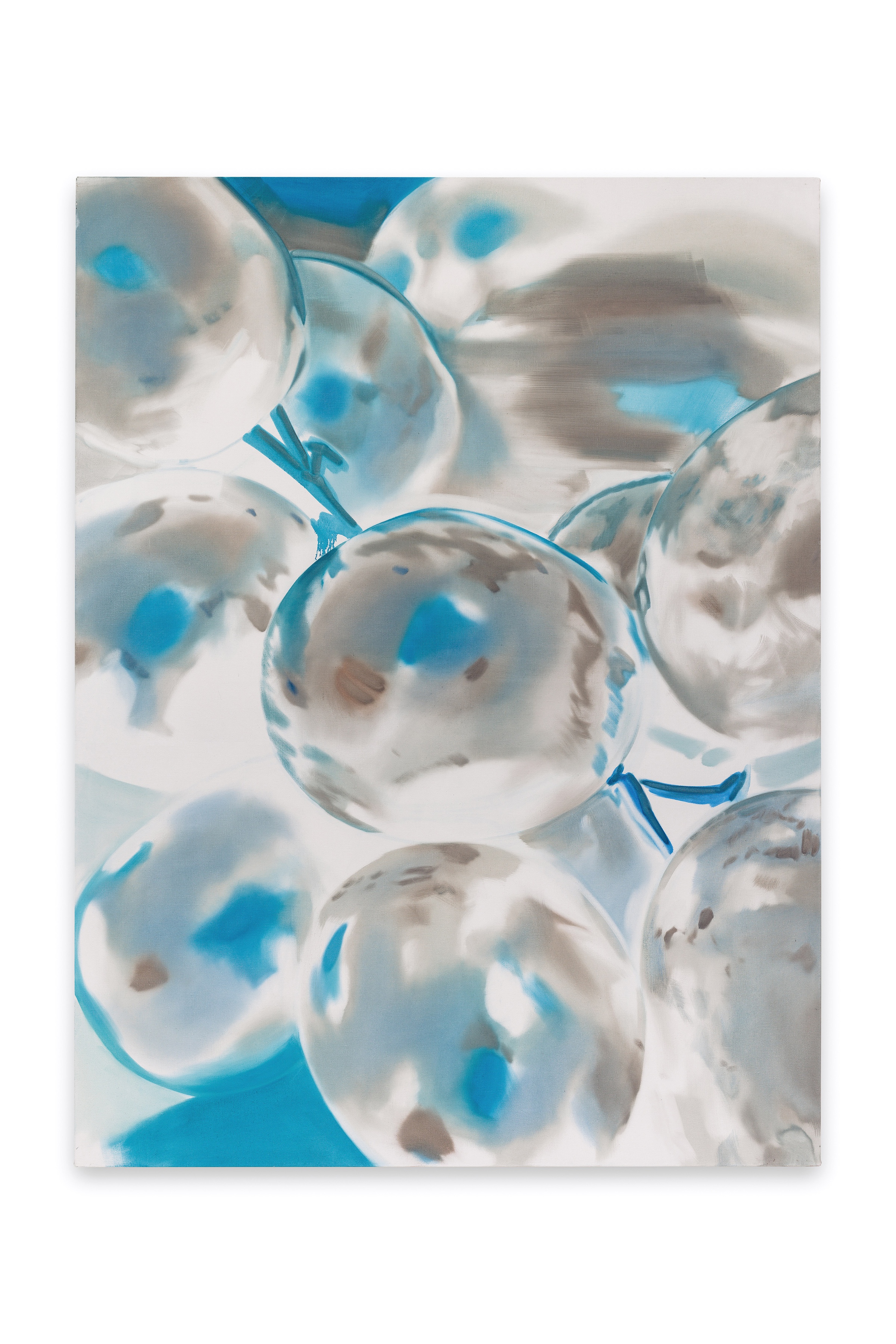
I like that the things I look at, through the process of painting and altering the image, are able to transform into something else and change their meaning. So the original function of, let’s say, a significant image of an avocado I painted changes throughout this process. It’s not necessarily representative of the fruit anymore; it can become something else, like a brain or an organ or a cell.
Often when I paint, I work with fabric, too. The folds, how I see the garments, often remind me of something in the body or a detail. It’s a very physical approach. I’m interested in color. I see color not only as a description of a surface, but as something that has the potential to bring a thing into a different world. It is a physical substance that behaves in a certain way. It is dense or resistant, but it’s moving.
Across your body of work, paintings appear zoomed or blurred. With your photography and how you take these images and transform them into painterly logic, can you tell me about perspective in your work?
I don’t think so much about perspective, but I have the tendency to isolate details from a background. I like to use contraction as a method to shift hierarchies. Often there’s not a background and a foreground, it’s all one.
I am, of course, interested in creating image depth with sharpness or blurriness, and I like to alter an object so that it becomes disorienting. I like to give up the hierarchy of up and down, left and right. I really like to create this unsettling feeling that you don’t know what you’re looking at or where you are in relation to what you’re looking at. You create some uncanny architectures that can be in front of you from a very small detail or thing.
Two pieces that really stood out to me when I was looking through your works were two paintings, both named Permission, one from 2024 and one from 2025. Can you tell me about these two works?
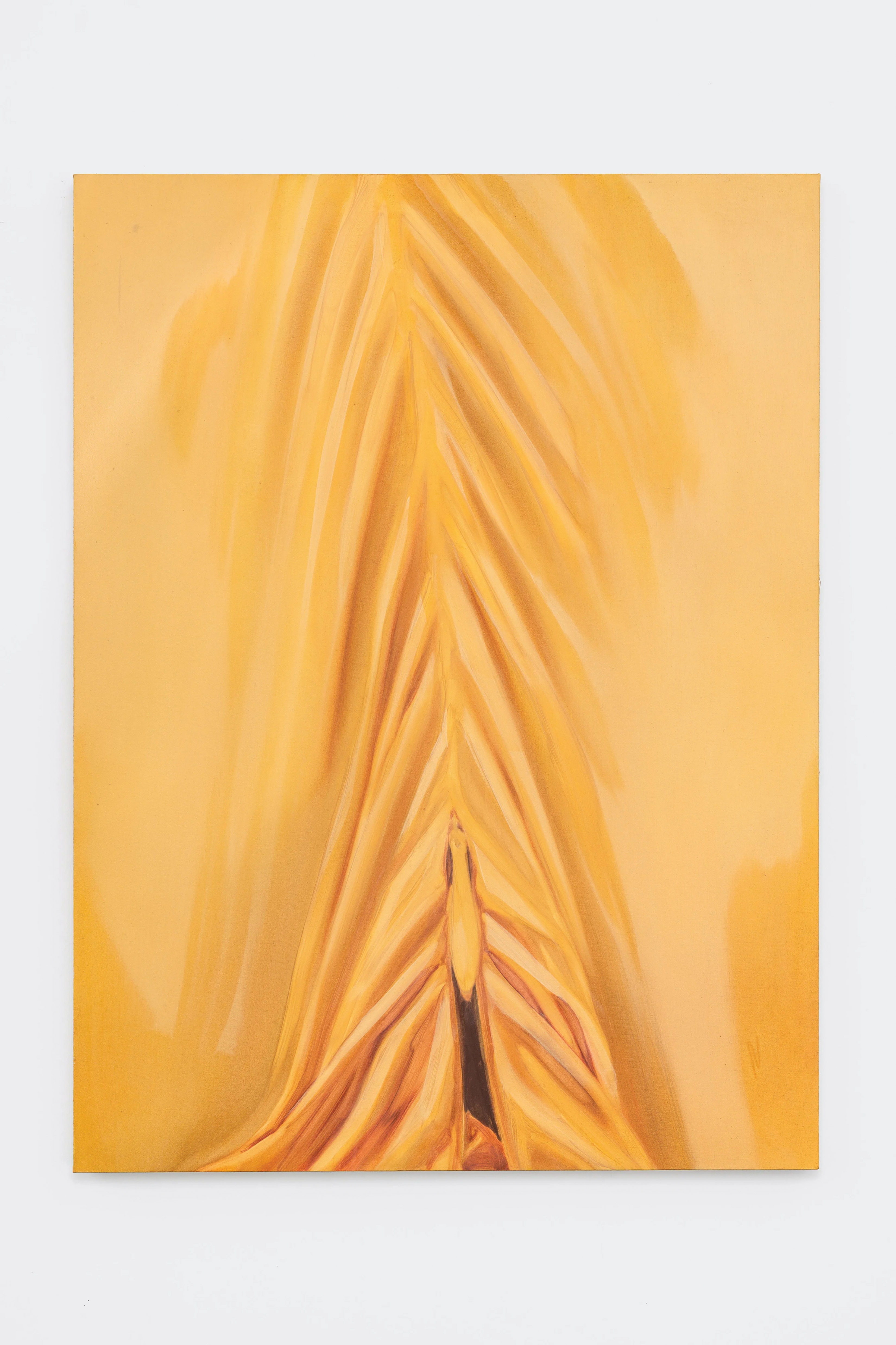
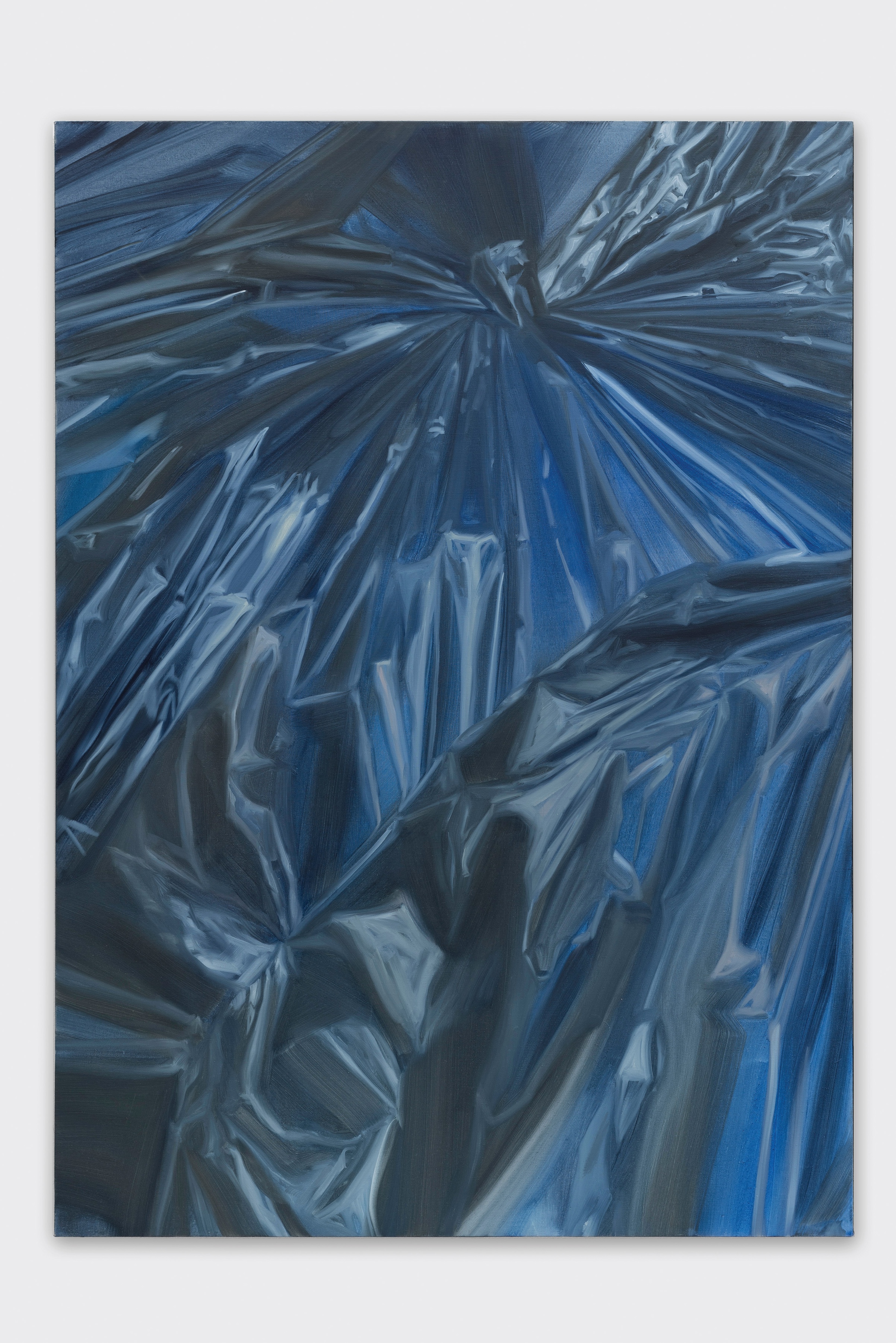
With these works, I looked at a garment of mine, a nylon clothing, and staged some photographs. In the yellow one, called Permission, there is a zipper depicted with folds hanging beside it. Zippers reoccur in my paintings as a metaphorical object. It’s opening and closing, like skin or something you dress with.
The blue one is pretty large. It’s two meters by 150 centimeters, while the yellow one is rather small, like 120 centimeters in height. There’s this little gap or opening on the bottom of the zipper. I painted this one twice. It’s called “Viscid” from 2025 in red, which has a strong connotation of a vulva.
The blue one also involves a zipper, but it reminds me of a cascade of color floating down. It’s viscous but also cascading.
What made you want to revisit *Permission* as an idea a year later?
There’s a trigger of permission to open up, or let it flow, involved for me. It’s an association, something like free-floating or pouring down. Maybe it’s also just pouring down or falling, involved in the structure, that made me think of the term *permission*. Sometimes you try to be in control, or you keep something closed or secretive.
What are your biggest aspirations as an artist?
I want to continue developing a body of work that is precise in what I do. I hope I can show more internationally, and I want to travel.
For future shows or next projects, I want to work more installatively again, as I did in my last show. I’m interested in assembling paintings. It’s important to put the paintings into relation with each other. Often I hang them in a sequence, but I’m really drawn to this idea of an image body or body images that can behave in a space, not only on the wall.
What are you working on now?
At the moment, I’m working on something different because I also make music, and I will release my first album in September with music I’ve been working on over the last few years with the label Plot Toy.
In the studio, I’m trying to repeat what I’ve been working on. I use the same images and do variations of them. It feels like a laboratory somehow, or like a photographic laboratory, in the sense that I stress colors and explore color relations. I’m interested in how to really cook down the things and objects I’ve been recording into very minimal structures, exaggerate and deconstruct them again. I try to move into that abstract zone because I think my paintings, including their process, are always in between figuration and abstraction. They are mediating between those two spheres. I try to find that sweet spot where the work still has some kind of representational function, but it’s doubling and dissolving.
You’re so interdisciplinary and work across media. In recent years, you’ve been named in the press as an artist to watch or as up-and-coming. How do those titles resonate with you? How do they make you feel?
It’s flattering and I’m happy if I occur as this kind of artist, but I know that these things are also very quick to change. I wouldn’t rely on those terms. For me personally, as a practicing artist, I need more for myself to keep going and continue the process and to feel stable in myself or with what I’m doing. But if there’s interest, I’m very happy about it, of course.
The theme of this issue is “Chasing the Sun.” When you think about your career and your artistic life, what is something you feel as though you are chasing?
When I think about my career and artistic life, it’s about moving around internationally with what I do and to be able to cross borders. What drives me is stepping into different scenes, meeting interesting people, and things I don’t know about yet. On the one hand, it’s trying to relate to the art world. At the same time, there’s this urge to figure out how to paint, how to make a good exhibition and how to really pin it down. To make good work that deals with questions that are in my head. It’s such a strong urge that keeps me going. I think it would never run out of thoughts or ideas about how to make it better.
Is there anything else you wanted to add?
The subject matter I’m choosing comes from an interest in the apparent naturalness of our material environment and the desire it evokes. Many things seem self-evident, but are very often the result of cultural construction or industrial optimization. For example, in the fruits I paint, it’s maybe the most obvious because they’re connected with nature or something nurturing. At the same time, there are things that have been bred for hundreds of years by humans.
Stay up-to-date with exclusive events and content.


