F L A U N T


In his anticipated show Familiars at Richard Heller Gallery, the acclaimed British painter Von Wolfe brings together two image-making technologies separated by centuries, effectively collapsing time and technique upon canvases that reframe our very notion of authorship, agency and self-expression. His often unsettling hyperreal paintings begin with diffusion models, which recombine myriad fragments drawn from the vast history of visual culture according to probabilities rather than conventional compositional rules. From the near-infinite amount of images this process can produce, Von Wolfe then selects the anomalies – configurations that possess what he describes as a quiet, yet profound, immediate charge. These anomalies then become the starting point for large-scale paintings made via the painstaking techniques of the Northern Renaissance. Working chiefly in the tradition of Jan van Eyck and Petrus Christus, Von Wolfe begins each canvas with a monochrome grisaille underpainting before building colour through successive layers of translucent oil glaze. As such, the digital image is therefore not simply transferred to canvas, but translated through an exacting physical process in which the painting gradually acquires its distinctive luminosity, and the watermark of human collaboration
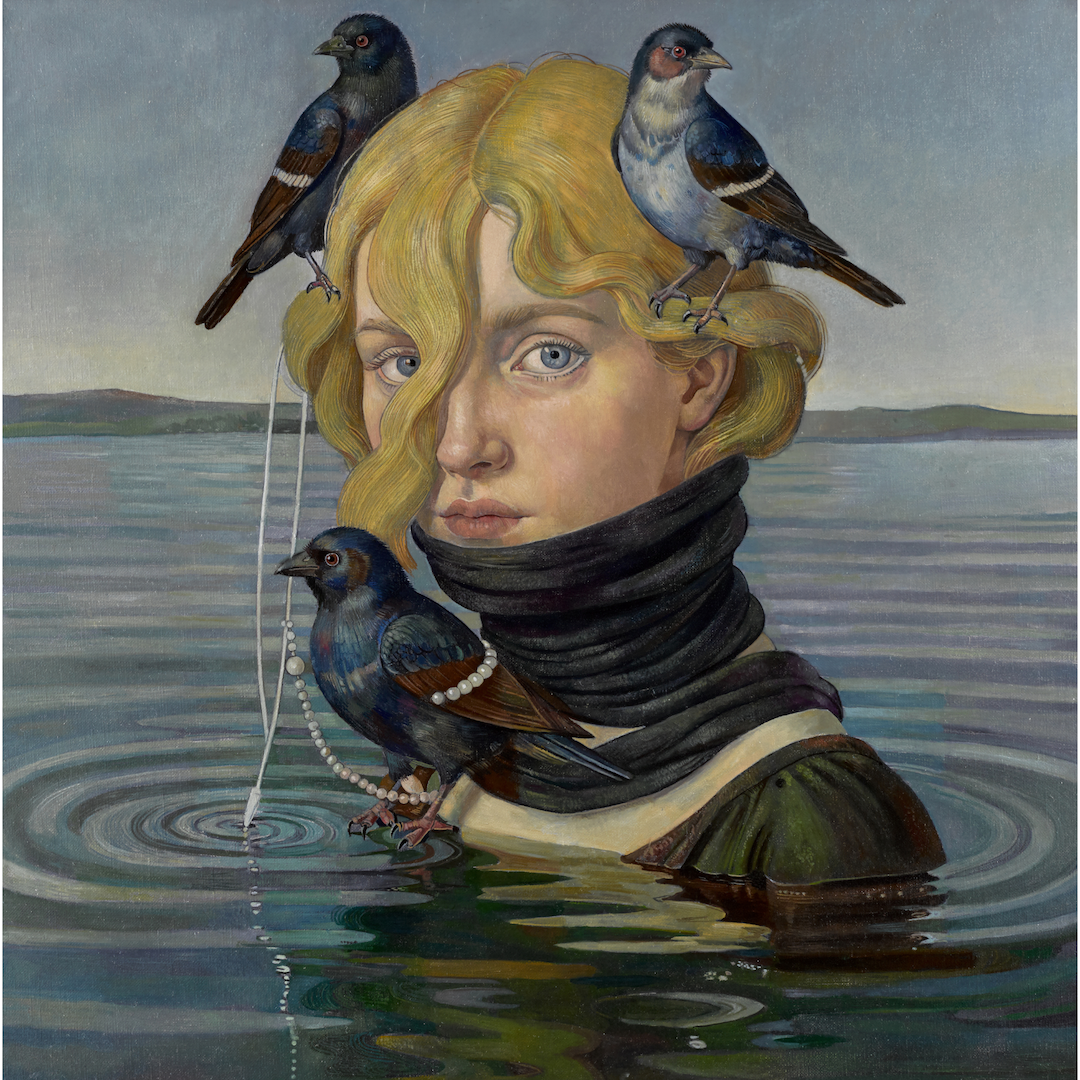
The artist describes the resulting world presented as ‘latent realism’ – a step beyond magical realism in which everything appears recognisable, yet something absolutely fundamental has shifted into the uncanny (in cutting-edge tech ‘latent realism’ describes the philosophical position that unobservable, hidden variables modeled by math or AI possess an actual, independent existence). In these new paintings, women balance on books, bend across furniture or appear suspended in moments of impossible stillness, all the while staring out at the viewer with an intensity that suggests tempestuous and confrontational interiority. Mirrors, pearls, ropes and thresholds recur, while animals, such as cats, owls, egrets, doves and corvids, accompany the figures like witnesses, doubles or, as the title of the show esoterically suggests, familiars. These strange scenes are rendered with such optical conviction that their surreal impossibility is never allowed the comfortable distance of fantasy. In fact, they almost feel like visual portals into an alternate artificially generated reality. Ahead of the show, we spoke to Von Wolfe about perception, consciousness and constraint, and found out why Los Angeles might just be the ultimate latent-realist landscape.

In Familiars you have employed the term ‘latent realism’ – can you unpack that notion for us? Where does it reside, in the painting, the process, or in what is perceived?
Everywhere. That is the point. Latent realism names a condition in which reality appears identical to our own but something fundamental has imperceptibly shifted and the shift is distributed across every register simultaneously. It is in the image: a woman balanced upside down on antique leather bound books, a cat tethered to an ankle by coarse hemp rope, an egret perched on a chair back like a silent judge. These are impossible configurations rendered with the full technical resources of Northern Renaissance realism. The impossibility does not announce itself. It sits inside the room like a guest who has outstayed his welcome but refuses to explain why he came. It is in the depicted world: rooms that hold more absence than any room should,windows framing steeples that belong to another painting entirely, mirrors that double the figure but at a different weight. The world within the image has undergone a subtle torsion, everything familiar, nothing quite right.
It is also in perception itself. These paintings pose a question whether they mean to or not: do we believe what we see, or do we see what we believe? Prolonged looking reveals a disturbance. Every surface carries identical visual weight; a leaf in front has the same ontological presence as the moon behind it. Following Rousseau, I call this
ontological equality: everything matters equally because everything is equally dreamed. The hyper lucidity is not an enhancement. It is a restoration. And yes it is in our conception of reality. Kant’s Critique of Pure Reason failed to deliver an unconditioned vision of things in themselves; his own noumenal concept admits as much. If there is an accessible absolute, we cannot reach it through the categories of human understanding. Everything we encounter is mediated. The digital is simply another paradigm of seeing, as oil paint was before it, as photography was before that. Latent realism is not a technique. It is the name for the gap between four registers – image, world, perception, ontology – and the fact that they fail to align. That gap is where the painting lives.

Why do you think the impossible seems so much more disturbing when rendered with absolute realism?
Because the painting refuses to grant you permission to disbelieve. There is an entire economy of contemporary painting built on disclosed artifice, the failed gesture, the uncertain mark, the visible brushwork that says this is a construction, do not mistake it for reality. This currency trades in the idea that authentic human making must show its own hesitation. I stand apart from that economy. Not in opposition artists like Kantarovsky and Armitage are serious makers
but in difference. For roughly a thousand years of Western painting, from tempera on panel through high Renaissance devotion, process occupied the background. The image came forward without showing the hand. The icon does not require the gesture to carry weight.
So when I render an impossible scene with grisaille underpainting and translucent oil glaze until the canvas seems to generate its own light, I am doing something stranger than deception. I am refusing to signal that this is a construction. Every thread, every pore, every reflection in the cat’s eye is rendered with a precision that feels almost forensic, almost reverent. There is no escape hatch. You cannot comfort
yourself by saying well, obviously this is stylised. If the impossible were rendered expressionistically, your response would be: how
imaginative. The distance between image and reality would be acknowledged by the style itself. But when the impossible is rendered with absolute fidelity to optical law, that distance collapses. The image insists: this is real. And your mind, which knows perfectly well that a woman cannot balance upside down on books, that a crocodile
cannot become a mask your mind has nowhere to go.
Consider the Sistine Chapel ceiling. When restored in the 1980s and 90s, revealing Michelangelo’;s authentic palette, brilliant, startling, almost garish, the reaction was outrage. Conservators were accused of turning the ceiling into Disney. The authentic Michelangelo had become the impostor, displaced by a romanticised phantom that
centuries of accumulated time had produced. Both are authentic. The image as made and the image as received. The layers of time do not falsify each other; they compound. Hyperrealism produces the same vertigo. It makes reality feel unreal because it reveals that what we call reality was never as high resolution as perception makes it seem. The painting restores full resolution and in doing so, exposes the gap between what is there and what we allow ourselves to see.
Is there a sense of the gap between the visible body and interior experience being the place where consciousness resides?
Yes. And the paintings hold that gap as their subject matter. Eve Kosofsky Sedgwick’s concept of opacity, the quality of being fully present yet illegible, withholding something essential that no amount of looking can exhaust is what I am after in every face in this exhibition. If these figures were too naturalistic, too calmly observed, they would settle too easily into your categories. Oh, she looks sad. Done. The reading completes itself and the encounter ends. But when the face operates at theatrical intensity slightly too much it resists that consumption. You cannot finish reading it because it has not finished itself. In Reflected Inversion, for example, the body performs a perfect handstand under extreme physical stress while the face performs serenity wide eyed, composed, yet edged with a strain she refuses to acknowledge. The bodies confess what the faces withhold.
This is not coldness. It is sovereignty. These women are not there to be decoded or consumed. They exist in their own psychological space, and you are only ever partially invited in. Their restraint becomes a power: an assertion of selfhood that does not require performance. And here is where the animals enter. They are neither pets nor props. They occupy the space with their own awareness, often indifferent to the drama unfolding beside them. What cannot be said about the women is spoken by what sits beside them. Psychoanalytically, they embody repressed affect mute witnesses to whatever has been withheld. Consciousness is precisely this: the irreducible privacy of interior experience, surrounded by a body that betrays everything except the one thing that matters. The paintings do not resolve this contradiction. They suspend it.

Why is the erotic tension in Familiars carried predominantly by female figures?
Because the history of looking at female bodies in Western art has accumulated such weight, such entrenched patterning, that any attempt to redirect that current must work against enormous momentum. The female figure who refuses to be seen in traditional terms is doing something more difficult and more interesting than the
male figure who simply exists. She is carving out a space for existence within a visual language that has spent five hundred years presuming her availability. John Berger's proposition men act, women appear was devastating and accurate. Laura Mulvey diagrammed its mechanics. The female subject in Western painting has historically been positioned as the object of a gaze she does not return, the nude as a site of presumed access where looking itself is structured as possession. What interests me is what happens when that circuit severs. When the subject refuses the position assigned to it. When a figure meets your eyes with curiosity, challenge, indifference, or deliberate ambiguity the circuit of objectification breaks. A face that cannot be read cannot be possessed by fantasy.
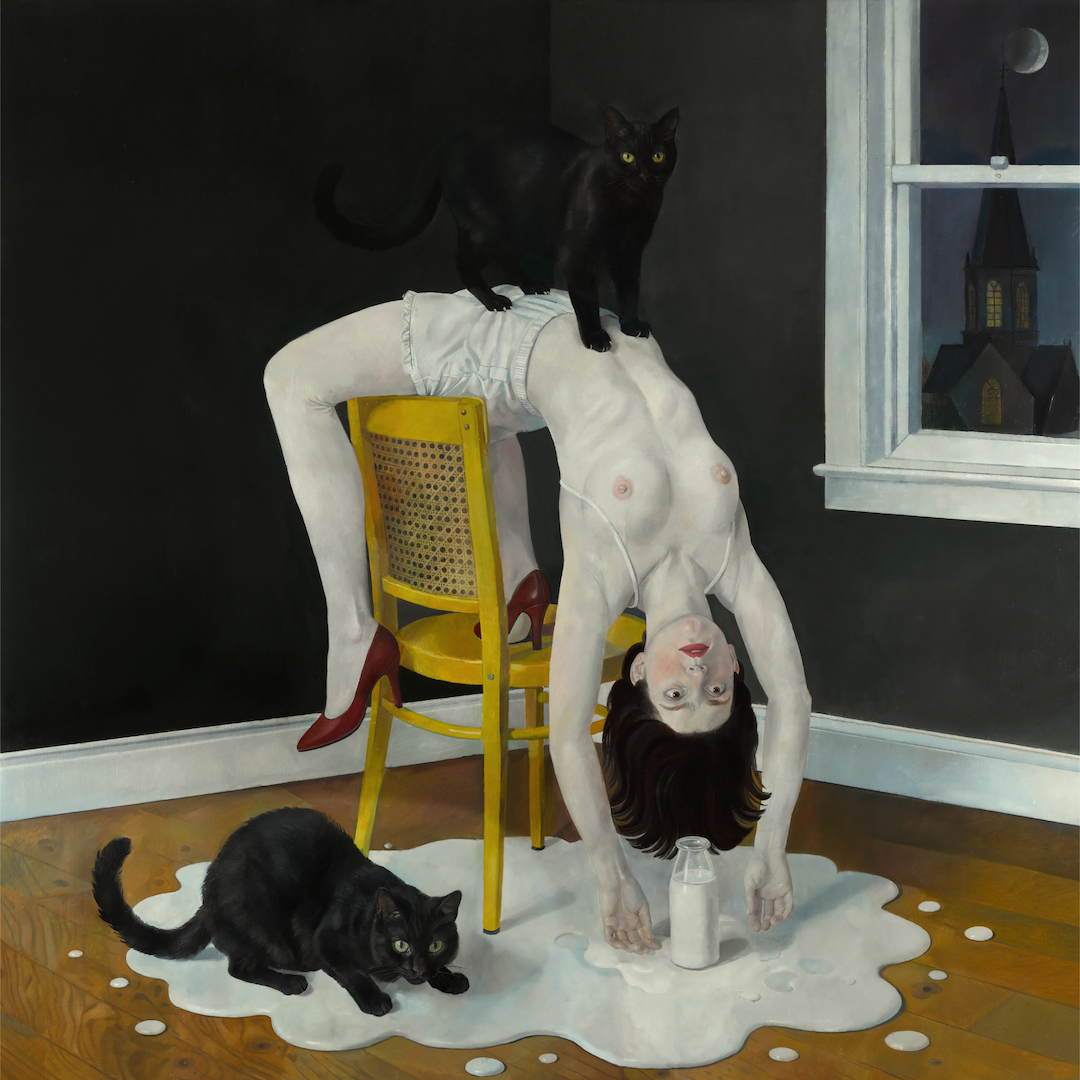
My cats perform this refusal more radically than any human figure could. In Prey, in Her Dark Familiar, they look directly at you with a self possession that is almost unnerving. They do not perform. They do not invite projection. They simply are. You enter the gallery expecting to look at paintings and discover, slowly, that the paintings may be looking back. The animals understood this first. They always have. The female figures in Familiars operate in the same register. Spilt Milk summons Fuseli’s The Nightmare – woman flung across furniture, incubus upon her chest – except here the incubus has multiplied and softened into black circling cats, and the intensity has shifted from intruder to sleeper. What grips you is not what entered the room but what is happening inside her: an interior drama legible in the architecture of the body itself. The painting participates in a lineage running from Titian through Velázquez and Fuseli to early modernist nudes yet arrives by a route unavailable to any predecessor.
The eroticism here is sublimated into texture: fur, leather, skin rendered with a precision that feels almost forensic, almost reverent. The viewer approaching these paintings expecting gratification finds instead something resembling respect, or distance, or the acknowledgment of an interior life that does not include them. This is not an exploration of the female body as such. It is an exploration of the act of looking itself, who gets to look, who gets to refuse being looked at, and what happens to desire when its object declines to cooperate.
Does ‘latent realism’ take on a particular resonance in Los Angeles, literally the dream capital of the globe?
Los Angeles is a city that does not know whether it is real. If that is not a latent realist landscape, I do not know what is. Built on fantasy the orange grove, the silver screen, the endless highway leading to a Pacific that delivers nothing it promises. Architecture as collage: Spanish colonial revival beside Googie diners beside Gehry’;s exploded geometries. A light famous for being unlike any other too bright, too flat, too unforgiving, making everything look simultaneously more real and more artificial than it could possibly be. Hollywood: a factory of constructed realities that has convinced the world its constructions are the realest things there are. The sign precedes the referent. The image comes before the thing. Los Angeles is a backlot that forgot it was supposed to be fictional.
These paintings arrive in that city carrying their own version of the condition. Rooms that look real but contain impossibilities. Women who look present but withhold their interiors. Animals that look like pets but behave like oracles. They are perfectly at home here because they share with Los Angeles a foundational commitment to the
proposition that reality and appearance have never been identical, and that the gap between them is not a failure but a condition. Walk into Richard Heller and you enter a system of echoes. Birds, ropes, mirrors, pearls, returned gazes, thresholds between interior and exterior the same motifs recur across twelve paintings and two drawings. Each time you encounter something familiar, you see it differently. T.S. Eliot called this ‘the still point’: the moment when perception stops cycling and simply holds. That is what these paintings offer. Not explanation. Not meaning delivered ready made. A space to dwell, where the familiar becomes unfamiliar and in that unfamiliarity becomes newly visible. Angelenos already know, in their bones, that the real and the unreal are not opposites. They are neighbours. Sometimes they are the same thing.
Von Wolfe: "Familiars" exhibits September 12 –October 24, 2026 at Richard Heller Gallery 2525 Michigan Ave. #B-5A, Santa Monica, CA, 90404, US
Stay up-to-date with exclusive events and content.


