F L A U N T


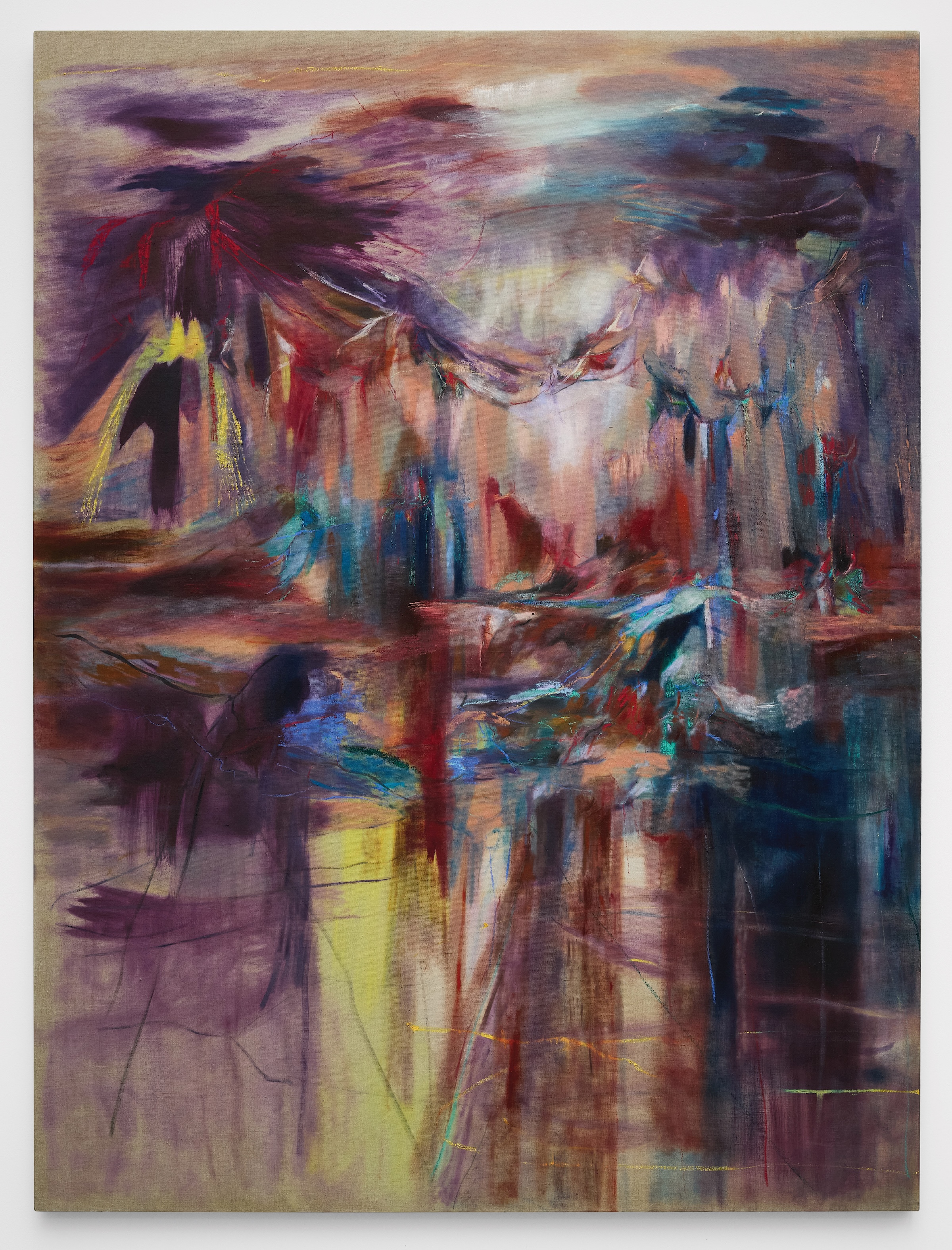
There’s a phrase in Arabic, ‘Ruh al-Ruh’ that literally translates to ‘soul of the soul.’ It’s an affectionate expression between lovers, children and family that tries to explain the feeling of one’s soul having originated from another’s soul; the feeling that one would be incomplete without the other.
The New York-based Syrian artist Nour Malas has spent the last five years engaging brush with canvas in a material exploration of the political and intrapersonal surrounding world. Studying Fine Art and Art History at the Goldsmiths University in London and Sculpture at the School of the Art Institute of Chicago in Chicago, her return to painting comes with a renewed sensibility to the unconscious world.
Following a trip to Syria, Malas created a series of works focused on life in Syria, before the war and in the years after, which was presented at Art Basel Miami with Dubai-based gallery, Carbon 12.
“That process made me think a lot about my grandmother and the female roles in my family. When I returned to the studio I wanted to go back to the matrilineal; I see my grandmother as a spirit guide. Painting allowed me to access that,” Malas shares.
Most recently, her show Garden of Prayer opened as her second solo show with the gallery PATRON. Her first work in the collection, titled “L’ame de L’ame,” or (‘soul of the soul,’ in French) is a thoughtful start of the artist’s latest chapter in painting figurative and abstracted works. With rich colors inspired by the 16th century Italian painters like Titian, it is a portcullis to an ascended state, or an invitation maybe, to lift the eyes to see the spectral spirits within Malas’ work.
Named for the 1971 jazz composition by Max Roach, Garden of Prayer is a perfect blend of jazz as it was developing at the time combined with the devotional intensity of the gospel voices of The J.C. White Singers. Likening the improvisational framework of jazz to Malas’ process within the studio with reverence to the unconscious, this latest show comes on the heels of five years of intense work for the Syrian-Canadian artist.
A formal painter of metaphor and query, Garden of Prayer is a turning point in the artist’s oeuvre that expands on the world she started building at the beginning of her career.
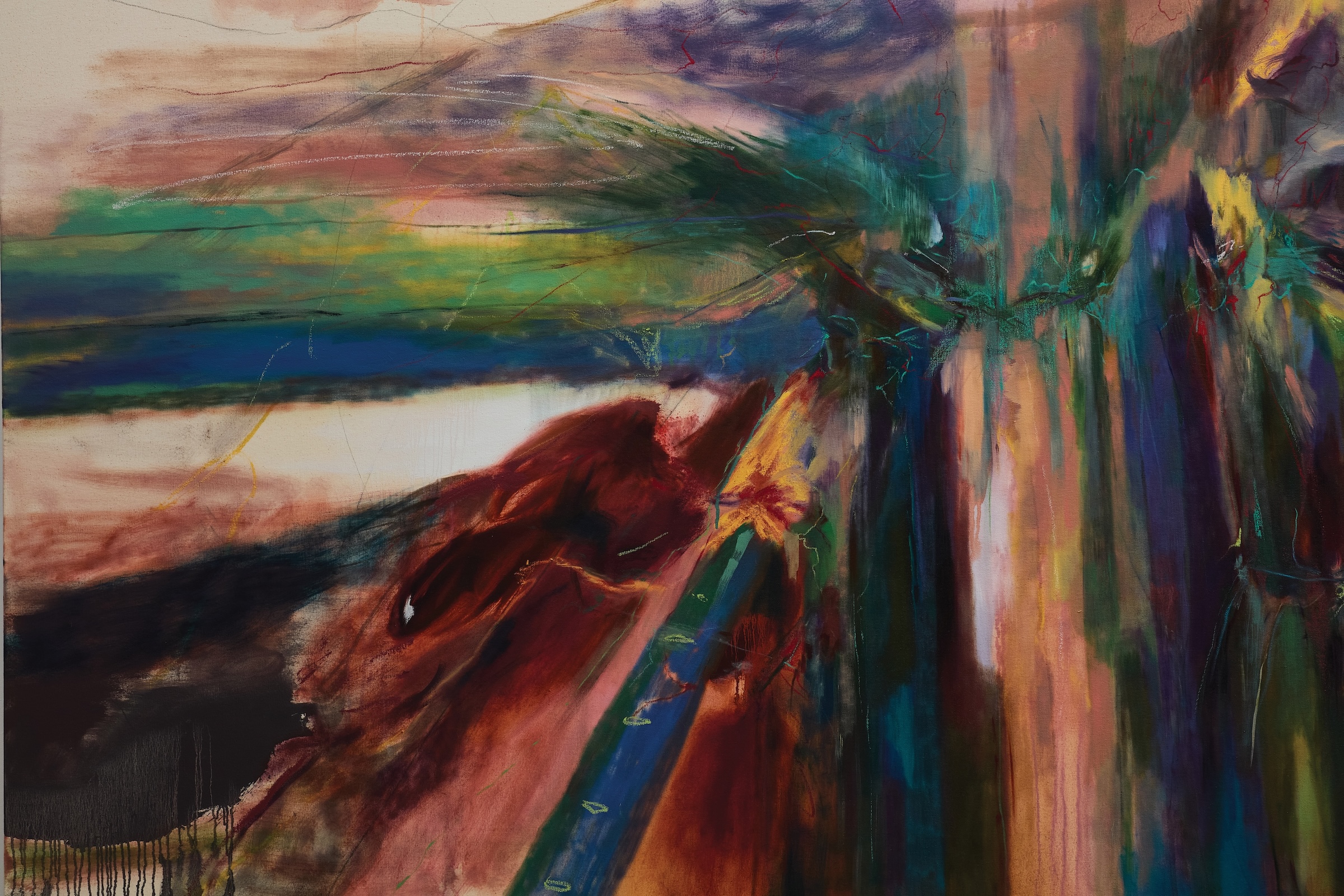
Speaking to a palette of brighter colors than Malas’ previous exhibitions, the works form distorted landscapes or portals, as the artist referred to them as. “Over the past year I’ve been going to The Met often, looking at Pieter Bruegel, Hieronymus Bosch, 16th-century Dutch paintings, and alchemical and spiritual paintings,” Malas comments. “I’m not trying to paint like them, but I’m interested in how these ideas about alternate realities and spiritual imagery have existed throughout time.”
Malas works with compositions of duality, symmetry and horizons in the work, a synthesized extraction of memory that mediates the future alternatives or shared histories in a changed landscape. “I was also studying crowds, energy, wind, movement. The Met show that sparked my thoughts on spiritual painting reminded me of the sublime — Caspar David Friedrich especially — his skies and sublime elements informed ‘Spiritual Wasteland,’” Malas contemplates. The works within this exhibition open up the longer you look at them. “‘Spiritual Wasteland’ was one of the first I did; I initially wanted it to be a monochrome pink, but it became something else. It reads like an otherworldly landscape, an upside-down or inside-out terrain imagining a new world,” Malas muses, “It feels communal and societal, asking how to go through darkness with no power but still imagine another potential for our people.”
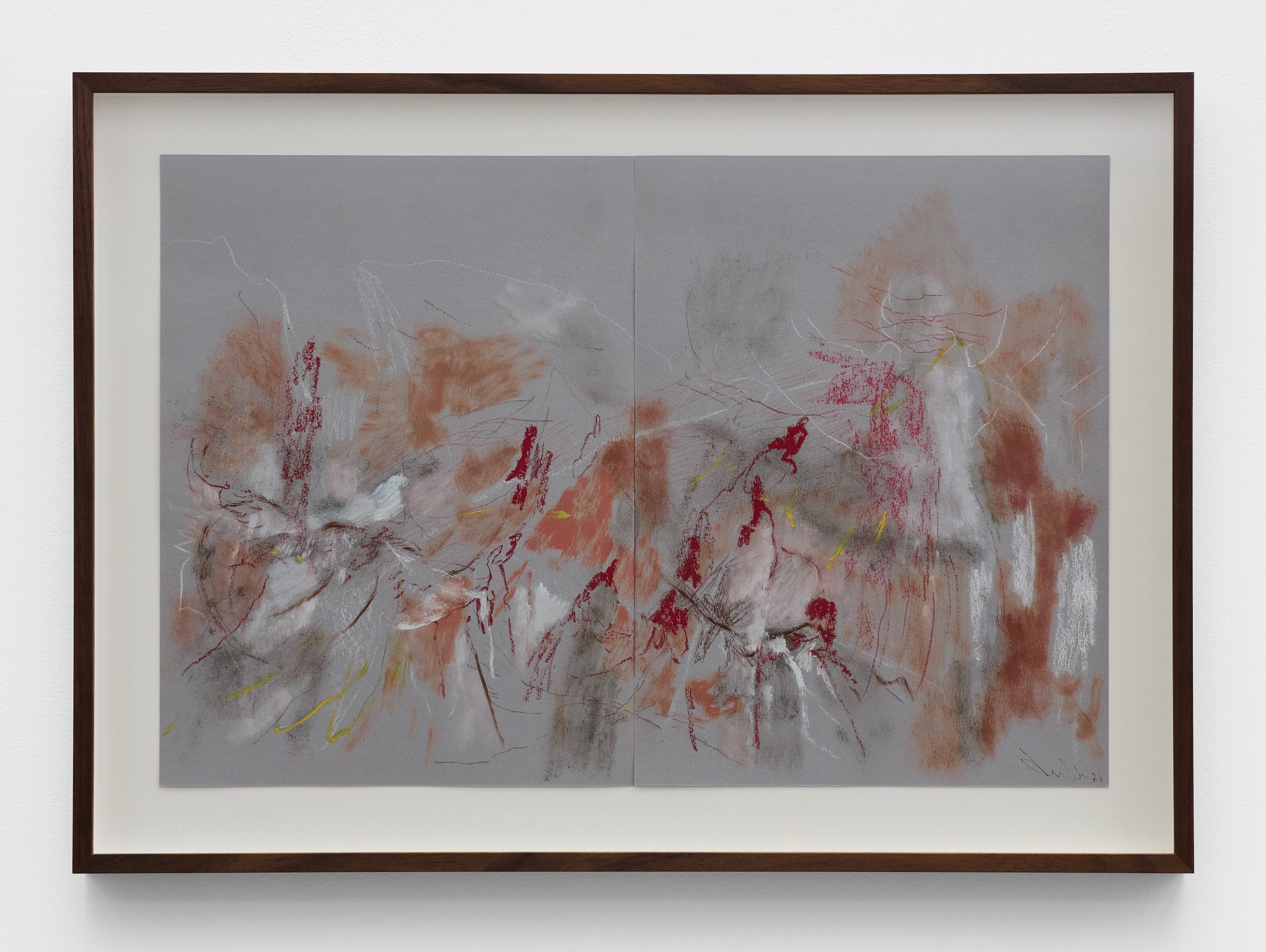
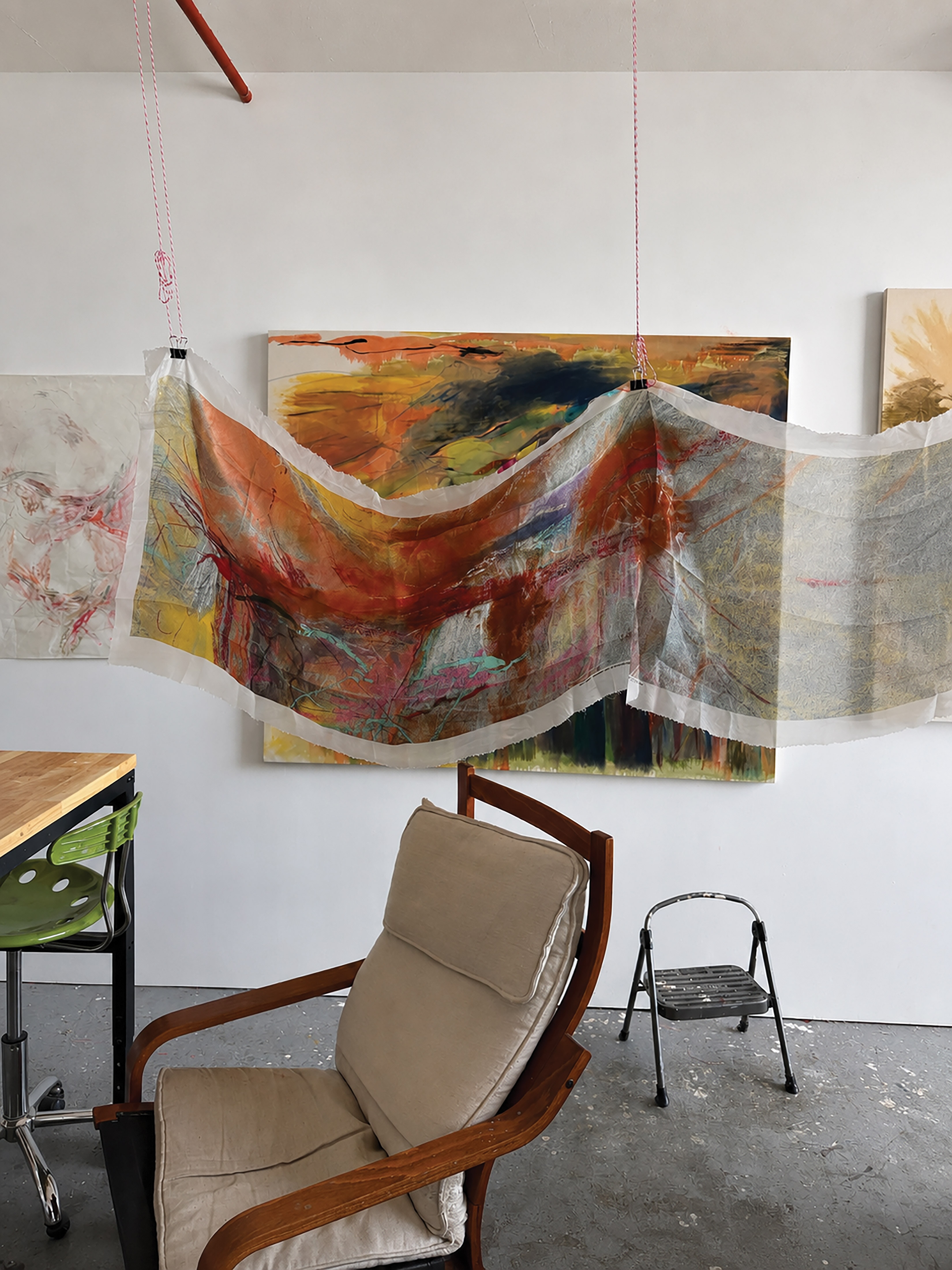
Malas returns to sculpture in Garden of Prayer with “Long Division,” a hanging cloth with the composition from “Born for Love” caressed in the silken folds. “When I learned I was doing the show I insisted on including a sculpture—my challenge. I didn’t know what it would be: clay, wood.” Malas mediates. “ I thought formally about options. Eventually I landed on fabric because I wanted something that connected painting to sculpture and that I could work with by hand.” In the center of all of these conflicting portals, “Long Division,” hangs like an open embrace. “The drawing on ‘Long Division’ is the diptych drawing in the first room, called ‘Born for Love.’ I like working on two separate pages or two separate paintings together—duality, pairing, twin shapes, kindred spirits—that’s a recurring theme even from my sculpture days.” Malas comments.
With Garden of Prayer, Malas has turned the lens of the work internally, drawing on themes of matriarchal lineage and shared histories. “Garden of Prayer is a show I didn’t fully understand until later. It wasn’t until writing the press release that things became a lot clearer. I was following the work as it unfolded and surrendered to the unknown until the end.”
You just came out with your new show in May. It looks amazing, it's your second solo exhibition, which is around five years since you began your paintings. Is that correct?
I began making paintings when I was 16, but I fully devoted myself to painting in 2021. So what is that, five years? Yes. I had my first solo in New York — a small Henry Street solo show in 2023 with my Dubai gallery — and this is my second solo show with Patron in their larger space. I've known Emmanuel, the co-owner of Patron, since grad school in Chicago; I met him in 2020 or 2021. He encouraged me to explore painting and drawing — I was in sculpture then — and he was a mentor. Working together has been a very natural evolution.
I'd like to go back to the very beginning. Your mom, Rafia Koudmani, was really involved in the art world, and you must have had a really early exposure to these ideas. What was the first idea that really grabbed you? Color, ideas, concept — what drew you in?
I'm visually and emotionally sensitive. When I was younger I absorbed everything like a sponge and needed time alone to process. My mom being involved in the arts was huge. She did photography later in life and would show us her work and projects, which made creativity feel accessible. My best friend and I also did creative projects on weekends. We made a magazine, taught neighborhood art classes, made clothes, remade music videos --so creativity was always part of life.
The moment art felt like a viable path was when I was 16 and met my art teacher. She introduced us to art movements, artists, theory, and conceptual art --postmodernism, sculpture, still life and a whole other world opened up. After that, art was the main thing. I worked various jobs to support studio time, and thankfully over time my work directed my life so I can now dedicate myself fully. Making has always been central to me; I love painting and will likely paint forever.
How did you begin to collect references for Garden of Prayer? Were you looking to answer a specific question? You were coming off two intense years of work.
After doing a four-panel piece for Art Basel Miami with Carbon 12 in December 2025 -- a painting looking back at the Syrian war over the past 14-15 years. I had to return to childhood memories and my grandparents' house in Syria. That process made me think a lot about my grandmother and the female roles in my family. When I returned to the studio I wanted to go back to the matrilineal; I see my grandmother as a spirit guide. Painting allowed me to access that.
Garden of Prayer is a show I didn't fully understand until later. It wasn't until writing the press release that things became a lot clearer. I was following the work as it unfolded and surrendered to the unknown until the end.
The way you use movement in the show is powerful — there's visceral energy in ‘Spiritual Wasteland' and then moments like ‘Sweetness and Lightness.’ Did you consider how the pieces related to each other? Any favorite moments?
I love that comparison, the energetic differences. Spiritual Wasteland was one of the first I did; I initially wanted it to be a monochrome pink, but it became something else. It reads like an otherworldly landscape, an upside-down or inside-out terrain imagining a new world. It feels communal and societal, asking how to go through darkness with no power but still imagine another potential for our people.
Sweetness and Light is a portrait of my mom, my sister, and me — very abstracted, angelic, spiritual, and the most personal painting in the show. It thinks about care, nurture, and softness. I wanted that tone alongside the whirlwind of emotional landscapes.
It's nice that you have that balance. Where did the blues and greens come from?
There's no single typical answer. I had a psychic reading in November before I started this work; she mentioned seeing a lot of purple and blue around me and that my grandmother was channeled through those colors. Colors can be portals to emotion — for this work the dominant emotion is hope and a metaphysical connection to earth, which felt more linked to green and blue than pink. I still wanted pink for the feminine, but green and blue opened the show up.
I went to LA in February toward the end of producing the show to cleanse my mind and be in nature. My environment always influences my work. After coming back I made Pools of Love, Mothership Connection, and Sweetness and Light — the greens came from the nature I was surrounded by. Sometimes it's as simple as that; other times it's metaphorical.
In the press release you mentioned 16th-century Italian references like Titian. What were you consuming at that time?
Over the past year I've been going to the Met often, looking at Peter Bruegel, Hieronymus Bosch, 15th-century Dutch paintings, and alchemical and spiritual paintings. I'm not trying to paint like them, but I'm interested in how these ideas about alternate realities and spiritual imagery have existed throughout time. I was also studying crowds, energy, wind, movement. The Met show that sparked my thoughts on spiritual painting reminded me of the sublime — Casper David Friedrich especially — his skies and sublime elements informed Spiritual Wasteland.
Has the sublime shown up in this work? Which piece speaks to it?
It's present throughout. Past works, like those for Art Basel and Frieze in 2025, were more direct, but here the sublime becomes one element within the broader emotional palette.
How was it going back to sculpture for the show? Was there an alternative direction you considered?
When I learned I was doing the show I insisted on including a sculpture — my challenge. I didn't know what it would be: clay, wood — I thought formally about options. Eventually I landed on fabric because I wanted something that connected painting to sculpture and that I could work with by hand. I did a monotype printing workshop and tried printing on silk with a friend. I initially imagined a tent, but silk worked well. I worked on top of it and we kept it simple: the first step outside painting was to get the painting out of its frame, creating a focused connection to the paintings.
Anything we missed that you'd like to speak about?
I want to mention the drawing on the Long Division’ is the diptych drawing in the first room, called ‘Born for Love.’ I like working on two separate pages or two separate paintings together — duality, pairing, twin shapes, kindred spirits — that's a recurring theme even from my sculpture days.
You use shadows or reflections of light in many pieces…
That likely comes from my sculptural background; I think a lot about spatiality and reflection, geometry, symmetry, and horizons. Sometimes I think of reflections on water — that's very present in Spiritual Wasteland.
For the issue "Chasing the Sun" — we explored metaphors like chasing memory or emotion, or what happens when you reach the sun. Are you personally chasing anything? How would you interpret that metaphor?
I see it collectively — freedom is the first thing that comes to mind. On a personal level, I don't feel like I'm chasing anything specific in my work. Freedom is where I'd land.
Stay up-to-date with exclusive events and content.


