F L A U N T


The story begins with one stitch, then another. “My mother was a seamstress, and she’d do piece work,” says London-based artist Mohammed Z. Rahman. “She received a sack of unassembled bits, and she would do one kind of assembly stitch,” again and again, paid for the total number of garments she finished. This assembly act extended to the way they, their mother, and their four older siblings approached homemaking as a British-Bengali family in East London. “I came to making because we used to make stuff for the house,” Rahman recalls. “My mum, she would do the curtains, and my sister, she taught herself woodwork.”
Now, Rahman’s making includes zines, painting, sculpture, installation, and public murals. As part of the first generation of the family to attend higher education institutions, Rahman had a dissonant experience studying anthropology at SOAS in London, frustrated by the field’s simultaneous insight and opacity—visual art seemed more immediate and emotional than the prohibitively academic, paywalled texts they read in school. With an anthropologist’s attention to the ethics of representation and an unflagging commitment to cultural legibility, Rahman weaves a chorus of voices and perspectives into fantastical, vernacular histories of migration, labor, queerness, and class.
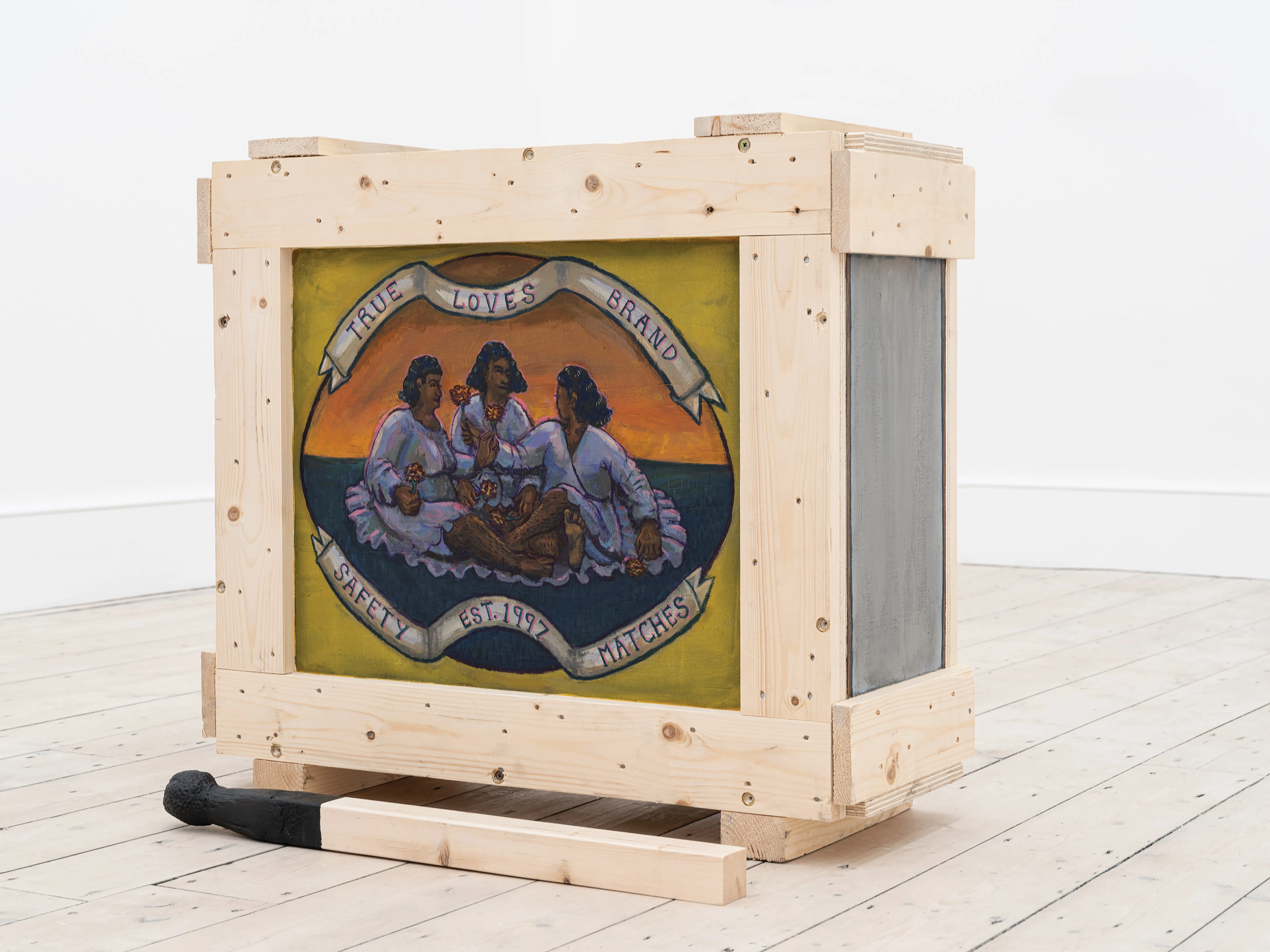
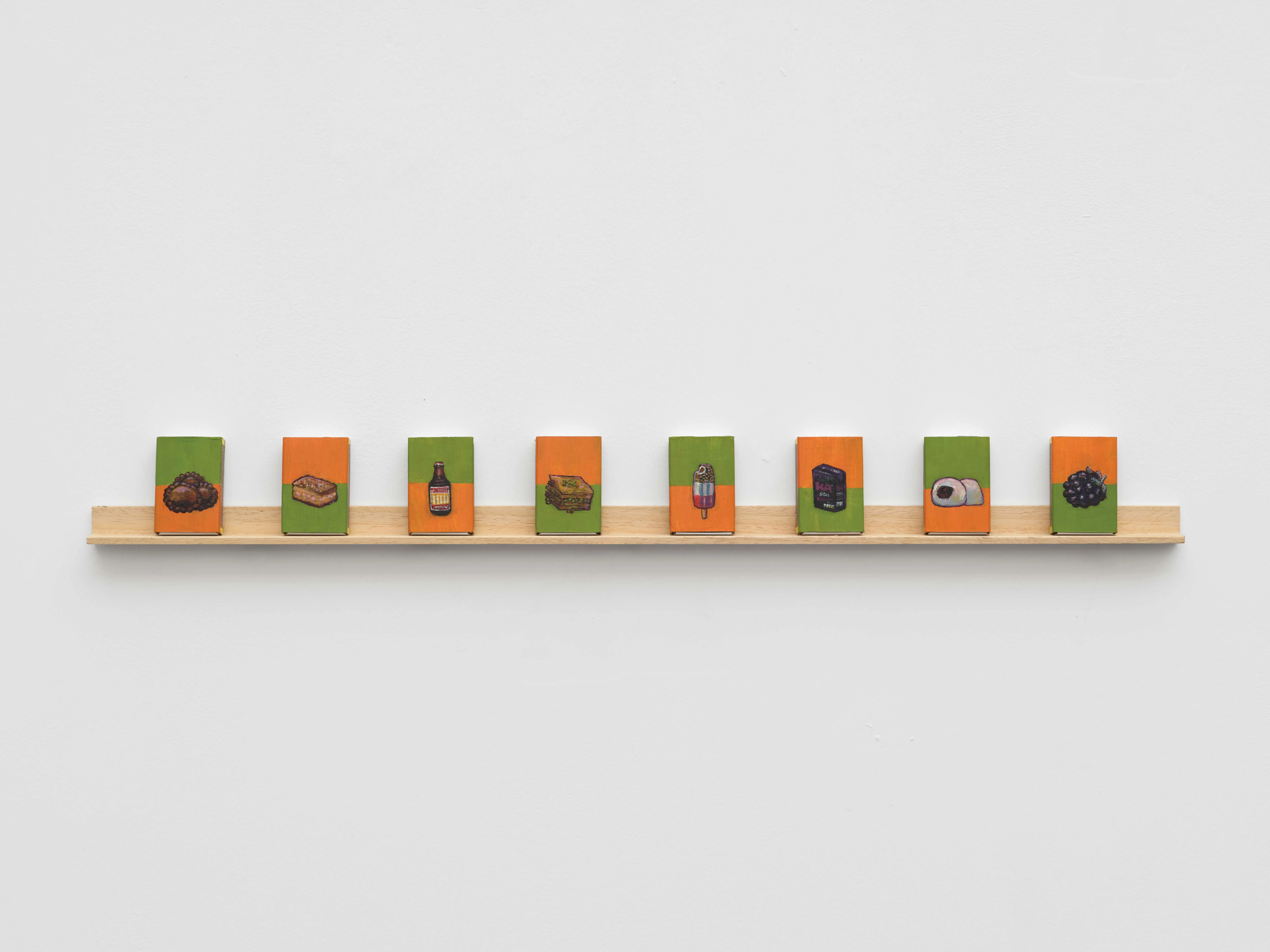
Rahman’s work always begins with an intimate encounter—with a person, a show, a song. Currently in the Giardini Pavilion at the 61st Venice Biennale is Rahman’s “Rolling Heart,” an open-framed pine structure forming a porous room around a selection of paintings on wood panels and shipping crates, as well as a grid of matchbox paintings, “Lover’s Vigil” (2024), each one adorned with a breakup talisman. “There’s a double register in the work that is both personal and socio-political,” Rahman says. Each matchbox is an emotional access point, a relic of heartbreak, like a candle, a house, or a single sock—but broader meditations on grief ripple out from these mundane images. “[I was] witnessing massive destruction, child mortality, seeing [the genocide in Gaza], feeling helpless as somebody who lives in a country whose government is complicit in the global war machine,” Rahman says. Working against the insidious obfuscation of racial capitalism, Rahman underscores the labor of world-building by using unfinished wood and asking the tech teams to sign their structures.
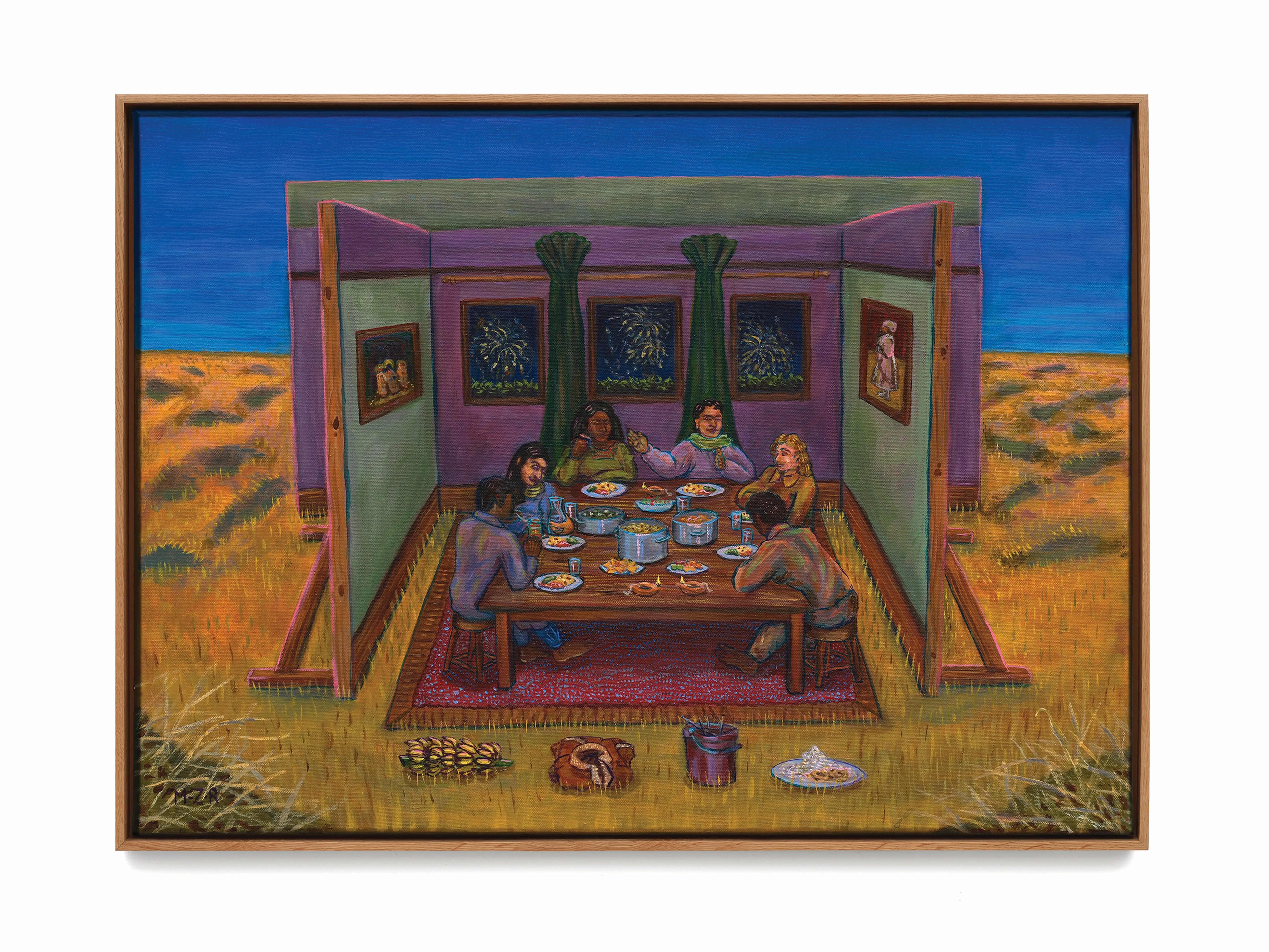
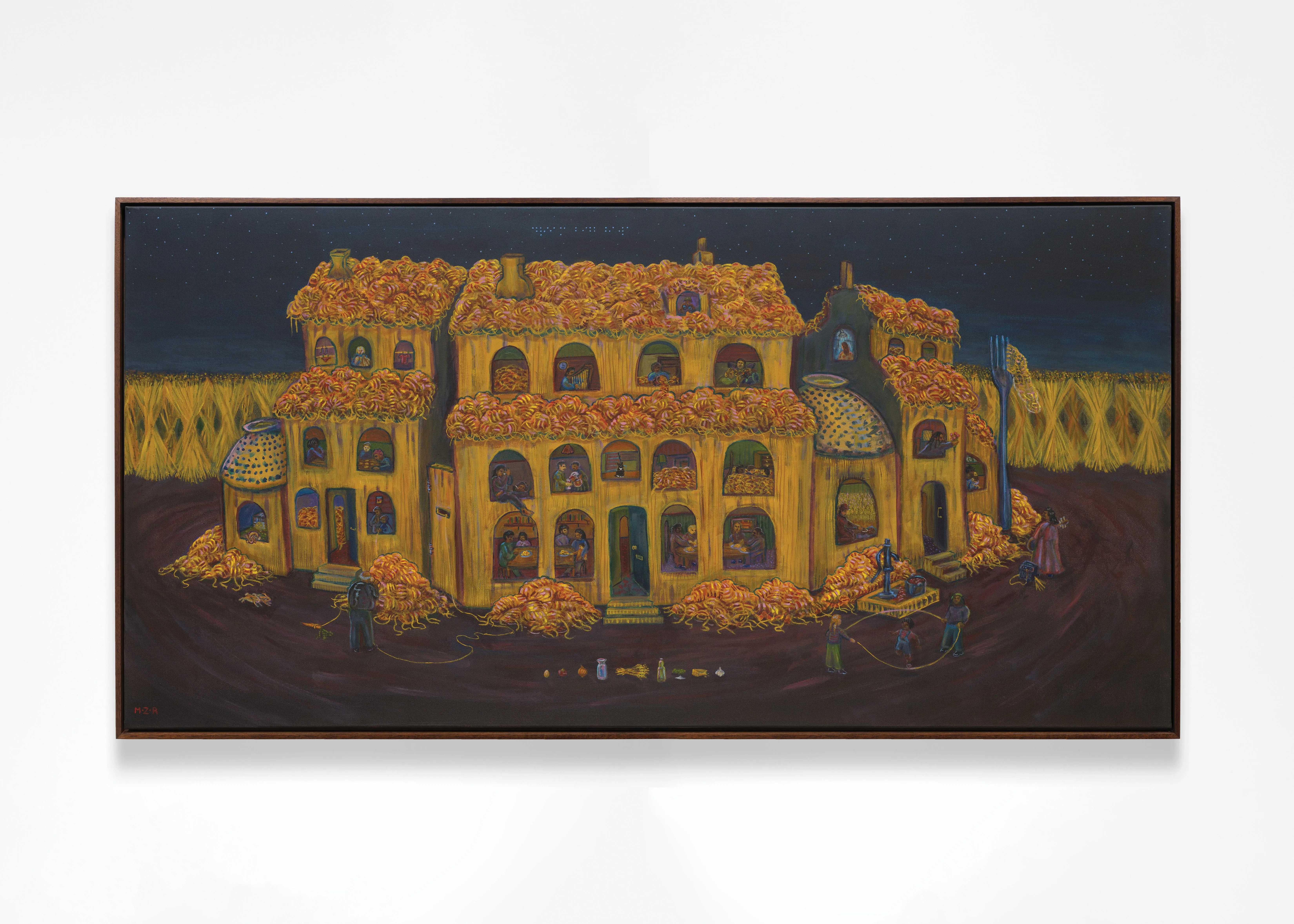
Building frames around their work is also “an act of hospitality” for Rahman, who organizes these spaces on a domestic scale to make them “unifying and welcoming,” especially in institutional settings. Never the Same, a solo exhibition on view at London’s Tate Modern until November, was seeded in a story shared with their young niece, and a tarot card; from the bricolage of their lived experiences, Rahman fashioned two “rooms,” or acts, of paintings exploring home, love, and belonging. In the first act, “Spaghetti House” (2024) integrates children’s fantasies and memories of young adult houseshares; in the second, “The Lovers” (2024) combines eclectic totems, including scriptural references to forbidden fruit and a Bangla numeral, into a vision of pansexual desire.
“Homemaking is foundational to my practice,” Rahman says, and this notion has a double register for the artist, too. The domestic scenes they visualize are imagined, amalgamated, and adapted—and they are quite literally homemade. “All the works I’ve got at the Tate and in the Venice Biennale, except one, I made in my bedroom, or on my kitchen table, in pieces,” Rahman says. This act of stitching, of joining, of finding one’s own way—it’s a kind of alchemy for Rahman. Their work follows what feminist theorist Sara Ahmed has called “desire lines”—the unofficial, anti-hegemonic paths toward more inclusive, fluid modes of being. Rahman’s walls are never solid things—they are incomplete, or mere partitions. The colors of each scene are vivid, but stormy. The conditions of these worlds are precarious. That is both their threat and their promise.
“I didn’t learn the history of Bangladesh or my people in school,” Rahman explains, “and as hard as it is, I’m seeing an opportunity in this unrelenting, ferocious, generative approach that you have to take to build something from nothing—or rather, from things that are hidden.” In their view, this eros-fueled, revelatory storytelling fosters interpersonal connection and political action. “Once people can place themselves in history,” Rahman says, “they have a leg to stand on in terms of organizing politically and effecting the positive change we want to see in the world.”
I'd love to hear just a little bit about where you grew up, how you came to art.
My parents were migrants from Bangladesh and they migrated to the UK in the '80s. A lot of Bangladeshis in the UK—a lot of the women—were doing work in the textile industry, working in factories, particularly in East London, and that's where my mum's family settled. So my mum was a seamstress, and she'd do piece work, like garment work. She received a sack of unassembled bits, and she would do one kind of assembly stitch. Say they were bras, she would just do this one joint, and they'd count up how many you do and pay per piece. That's why it's called piece work.
We moved around quite a lot, very working class. I'm the youngest of five siblings and our dad's not in the picture. My mum's work was precarious and we relied on state benefits—the whole thing. But I came to making because we used to make stuff for the house, to make the house that we lived in nice. My mum would do the curtains, my sister taught herself woodwork. She'd salvage wood and cut it up and make shelves. So there was this very organic creativity in our house and part of our family.
In terms of anthropology, I'm the first generation in my family to go to higher education, so I didn't really have a sense of what university meant in a career-oriented way. I had this very naive, but I think correct, desire to just go to uni to get educated. So I did a degree in social anthropology, and it politicized me….a lot of gender theory and migration studies. I remember reading an ethnography by Kate Gardner, an academic who studies the working-class Bengali community in East London. It was such good scholarship, but someone like my mum, people from my community, they just wouldn't be able to read or access it. It's paywalled, it's written in this really academic English. That kind of bothered me. There are these huge bodies of information out there, how can they become accessible to ordinary people? That really was a big part of my move from anthropology, though I wouldn't say move, because I think they both inform each other. I still use it a lot.
I'm zine-curious too.
I think zines were kind of an antidote to the very thick academia I was reading, and I used to notoriously sell them out of my jacket and bag at house parties. I wanted to make toilet literature —-something to read and consume in the space of one poo. And as a zine maker you have no censor, you're the producer and the writer and the illustrator all at once, it's very well-rounded. Eventually a curator discovered my work: Eliel Jones (now at Centre Pompidou in Brussels) for the Brent Biennial 2022. I made these paintings about the migrant history of Brent, and that kind of research and image-making, and folk history-making, go hand in hand for me. I'm interested in making formats where there is a lot of information, but you can go as far as you want to go. At face value they still function, but if you start researching, I keep show notes and a bibliography of the research that's gone into them. I just really want to make art that you don't need any sort of level of education to access, because so much art is designed to make people who are not in the know feel small and stupid about themselves, and I think that's a really cursed thing to do.
Well, because you work across a variety of mediums, do they have a different kind of language or function for you? Is there a form you turn to say a certain kind of thing?
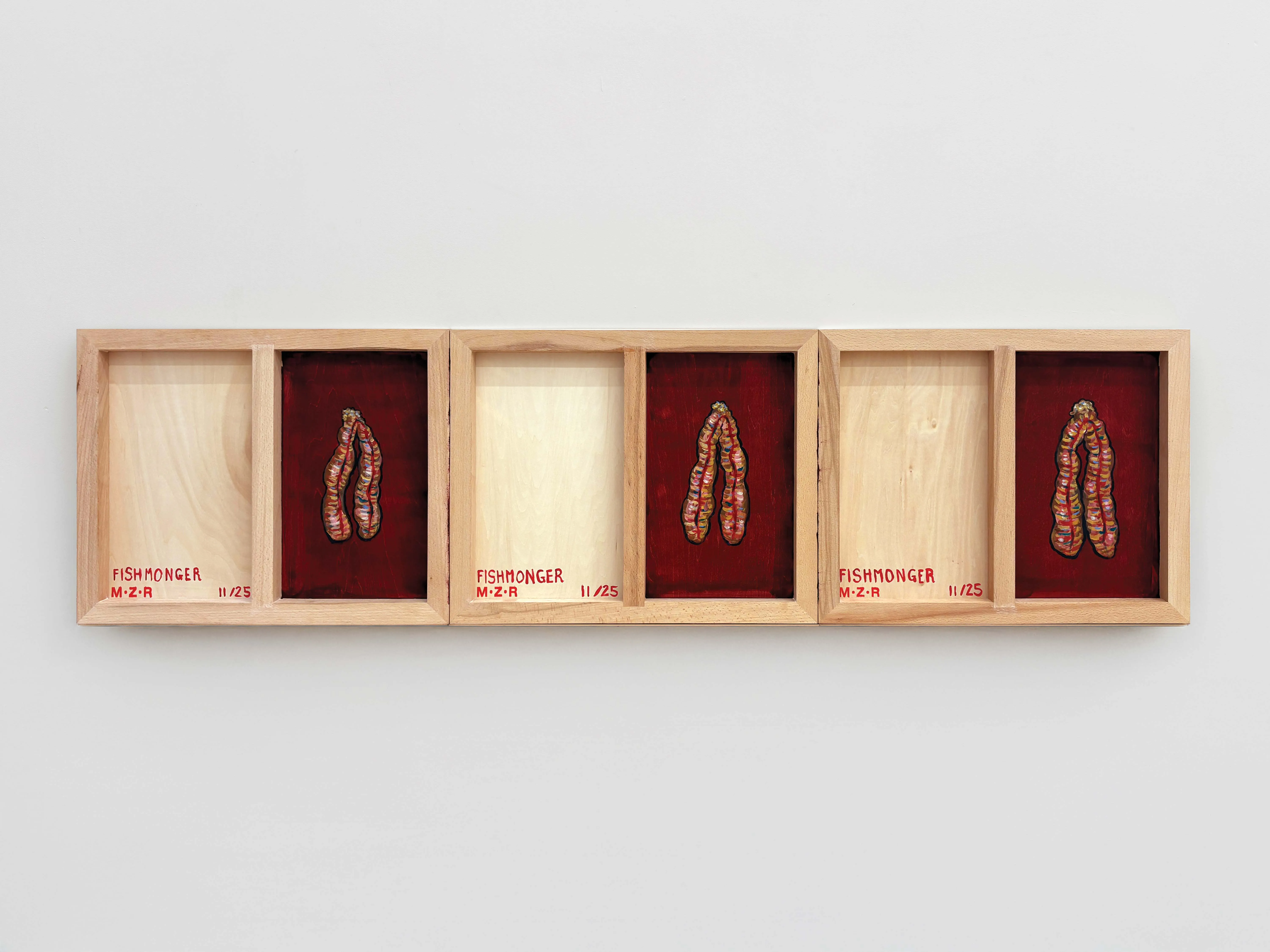
My miniatures, little matchbox paintings—I feel like when I want to make something very delectable and small, miniatures are really good for that, and I came out of using my tiny box bedroom as a studio. But then when I make a matchbox series, I make quite a lot of them, so they can also be quite expansive. I play around with scale—I'll do a whole big wall of tiny paintings, then paint a big shipping crate as a matchbox or a box of chocolate. There's a bit of an Alice in Wonderland effect in my work. I've done murals too. I really relish showing public art, because art should be for people. The mural I did on Hoxton High Street, co-commissioned with Peer and Hackney Council, was part of the legacy of the London Against Racism murals commissioned in 1995. I worked with a cohort of young East Londoners to develop an anti-racist mural, and the conversation led toward the idea that there's a more insidious form of racism prevalent now compared with the '80s, when the National Front was kicking people's doors down. I made a cutaway of paint on the side of a residential block; a diorama, rooms you can see inside, quite childlike and playful—with references to the history of Hoxton and the lived experience of the young people, who brought in objects from their homes and talked about their family histories.
I wanted to ask you about those timber structures specifically, because I think framing seems to be a motif in a few different forms. How does it work for you?
I work in a bit of a magical realist style. There's always magic in my work, even when it's about social reality, and framing is a great device to suspend one's sense of reality. With these framed structures, you step into them and they transport you. They're very immersive, even though they're very porous. I think there's something precious about that in the context of big art institutions where a lot of the audiences I'm speaking to have traditionally not felt welcome. There's an act of hospitality going on. Bringing art down to function on the level of the domestic is a very unifying and welcoming scale to work in. Homemaking is really foundational to my practice—it's always a kind of homage to the humble beginnings of it.
How do you think about building a story through those details, even though not everyone might recognize the same thing in them?
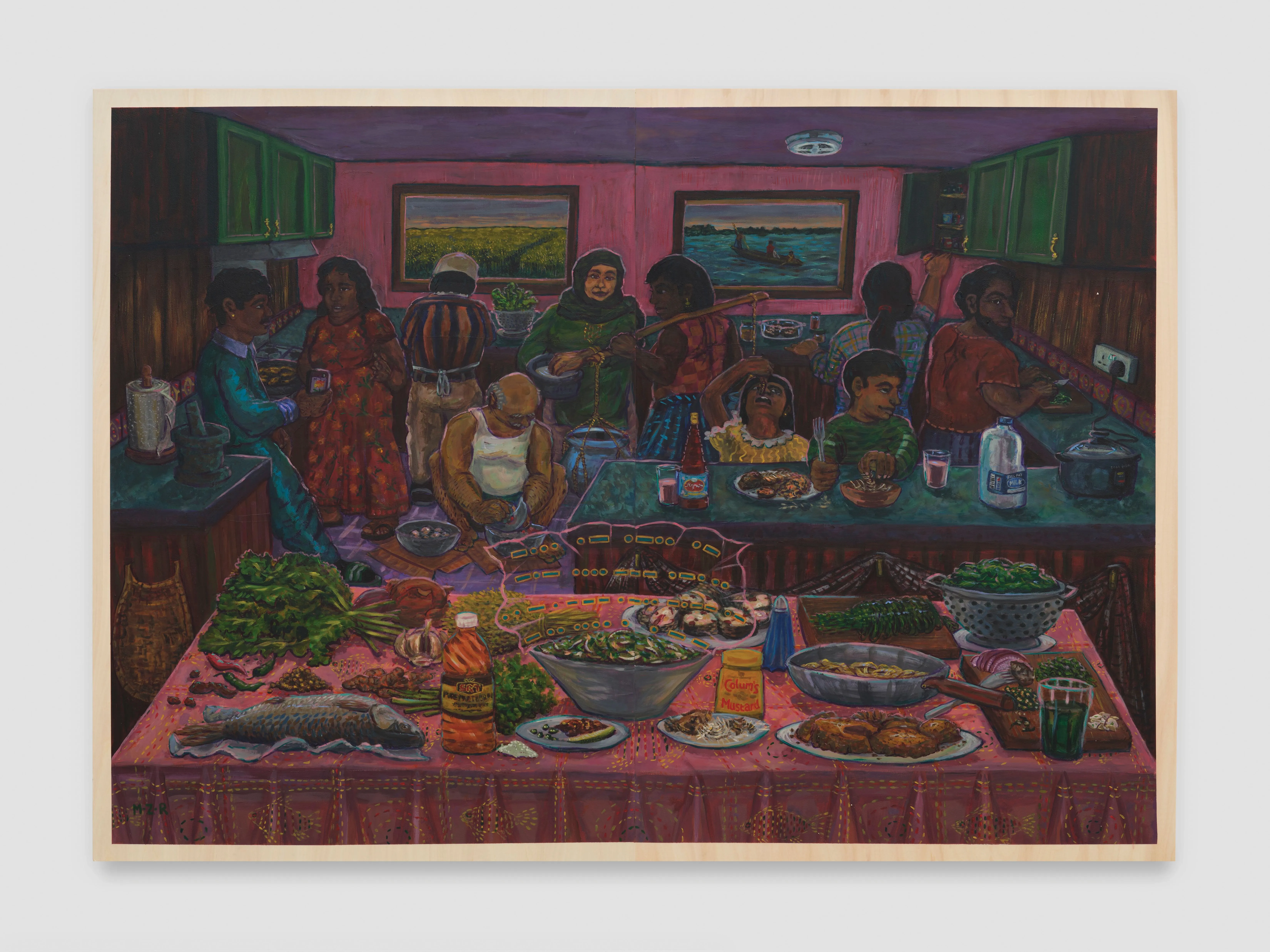
I like using these symbols…sometimes rows of objects that function almost like subtitles, so people can insert their own meanings. We're at a moment in the politics of representation where people are disillusioned with representation politics as they came out of the 2010s, hashing and rehashing what it means to be queer or South Asian or working class, when actually that changes so much from decade to decade. Just take a two-hour flight in one direction and how you're read is completely different. What I want to do is build a visual vocabulary, a material vocabulary, that builds solidarity, so people can see commonalities at a glance and connect with communities they weren't born into. It's also why I use Braille and Morse code, and international alphabets, to create a sense of cosmopolitanism. Coming from a migrant background growing up in London, and having lived in Bosnia and Herzegovina as a teenager, there's a cosmopolitanism in our day to day—the things we eat, the clothes we wear—that's always at odds with nation-state narratives.
Are these images or objects a bid for recognition, but also comments on globalism and interconnectedness?
Some of the objects are "if you know, you know"...an experience, or something I've been reading about. I did a series of matchboxes, “Full Life,” depicting objects from the Museum of Transology in the UK, cocoons from UK butterfly and moth species, and objects inspired by Shon Faye's The Transgender Issue. In Venice I've got “Lovers Vigil,” another matchbox series, with objects from the Zagreb Museum of Broken Relationships — people submit objects from breakups and write little stories about them. That piece is also about grief on a larger scale. With the ongoing genocide in Gaza, the sense of witnessing massive destruction and feeling helpless as somebody whose government is complicit in that global war machine—the flowers and candles speak to that collective sense of grief. There's a double register in a lot of the work that is both personal and socio-political, but also light-hearted and heavy. It's in the palette too—simultaneously dark but very colorful, because I'm talking about histories that are conflicted or unresolved, and I don't want to gloss over things.
I wanted to hear your thoughts on the notions of masculinity that you saw as a child, and where you are now with that thematic exploration.
I wrote and essay and did some paintings about this when I was working at my uncle's restaurant in Essex in 2018. A lot of that generation migrated to the UK from Bangladesh in the '70s and entered a very racially hostile environment—a lot of skinheads, the National Front very popular, real tangible violence. Their lived experience was one of being constantly under physical threat, so their hyper-masculinity is a way to assert dominance in a system where they're very disempowered. Being the tender, queer, soft person I am, that was a real point of friction—wanting to understand these figures in my community while feeling outside yet inside of that. I can see where that masculinity comes from, but it's ultimately quite isolating, repressing emotion and joy. I tried to write an ethnographic text about it, and that was another moment where I came to painting: a little series of small paintings representing the people working in the kitchen, the belly of one of these uncles, his hairy paunch, to bring that masculinity down from its pedestal. I was trying to get across the humanity and emotional landscapes of people who are so dehumanized in society, and who are actually very vulnerable. In recent years I've thought a lot about how the war-on-terror discourse has picked up again, and who is deemed a worthy target of state violence, with the anti-migration sentiment here and in the States. That humanizing gaze is something I want to offer to the public.
Do you think that representation is a really key part of political autonomy? Like you must see yourself somewhere to be able to act?
I work in the figurative because there's something very immediate and human and recognizable in it that the layperson will connect with. With representation come thorny questions of what kind of person you're representing, what kind of bodies, what kind of material culture—there's real due diligence in terms of appropriating other people. We have to trace where things come from and give credit where credit's due, as a way of working against systems of erasure. Working in the figurative keeps me on my toes, because there's always this messy process of ethics that comes with it. The best way to work through that is to have literal conversations with people and bring their voices into it. It's such a laborious but precious part of the practice.
Is there anything specific you wanted to tell me about, whether it's the new work or the current shows?
The show I have at Tate Britain is called Never the Same, part of Art Now. In 2024 the Tate bought two works from me at Frieze. One is “The Spaghetti House,” based on a story I have with my niece—at the time four, now six—about a house made of spaghetti. She randomly asked me one day to tell her about the time I lived in the house made of spaghetti, and it became a way to talk about living in vibrant house shares in my twenties and in Bosnia and Herzegovina as a teenager. The political function of the work is to take the dreams of children seriously. The other is “The Lovers,” a rendition of the tarot card but with the visual cultural vocabulary of someone who grew up in a Muslim background and is Bengali, a representation of pansexual desire. Around each one I've built new bodies of work; the title Never the Same comes from the quality of storytelling and folk histories, how every time you tell them they compound and morph. With the whole show I'm thinking about what happens when one hasn't inherited a visual vocabulary of making. Image-making is actually forbidden according to my religious upbringing—so this work is a process of piecing together what I have to speak to these big grand themes of homemaking, childhood, and love. That's on until the 8th of November. And then the Venice Biennale—I'm part of the Giardini show, actually the youngest artist in it.
Stay up-to-date with exclusive events and content.


