F L A U N T


With the discovery of gold in the Sierra Nevadas, westward expansion in the 1840s defined the American milieu as something perpetually self-edifying. Words like “Eurkea!” fell from the lips of pioneers, luring settlers into the mystifying land stretching before them—a land permanently manipulated by that abusively-American act of “becoming.” Columnist John L. O’Sullivan described this “becoming” as divinely-sanctioned—as a movement purported by the righteous “Manifest Destiny.” “Becoming” was, and is, recited as a sort of patriotic prayer, invigorated by an American obsession to stretch capital as far west as possible until reaching the edge of the Northern American continent. That is, California.
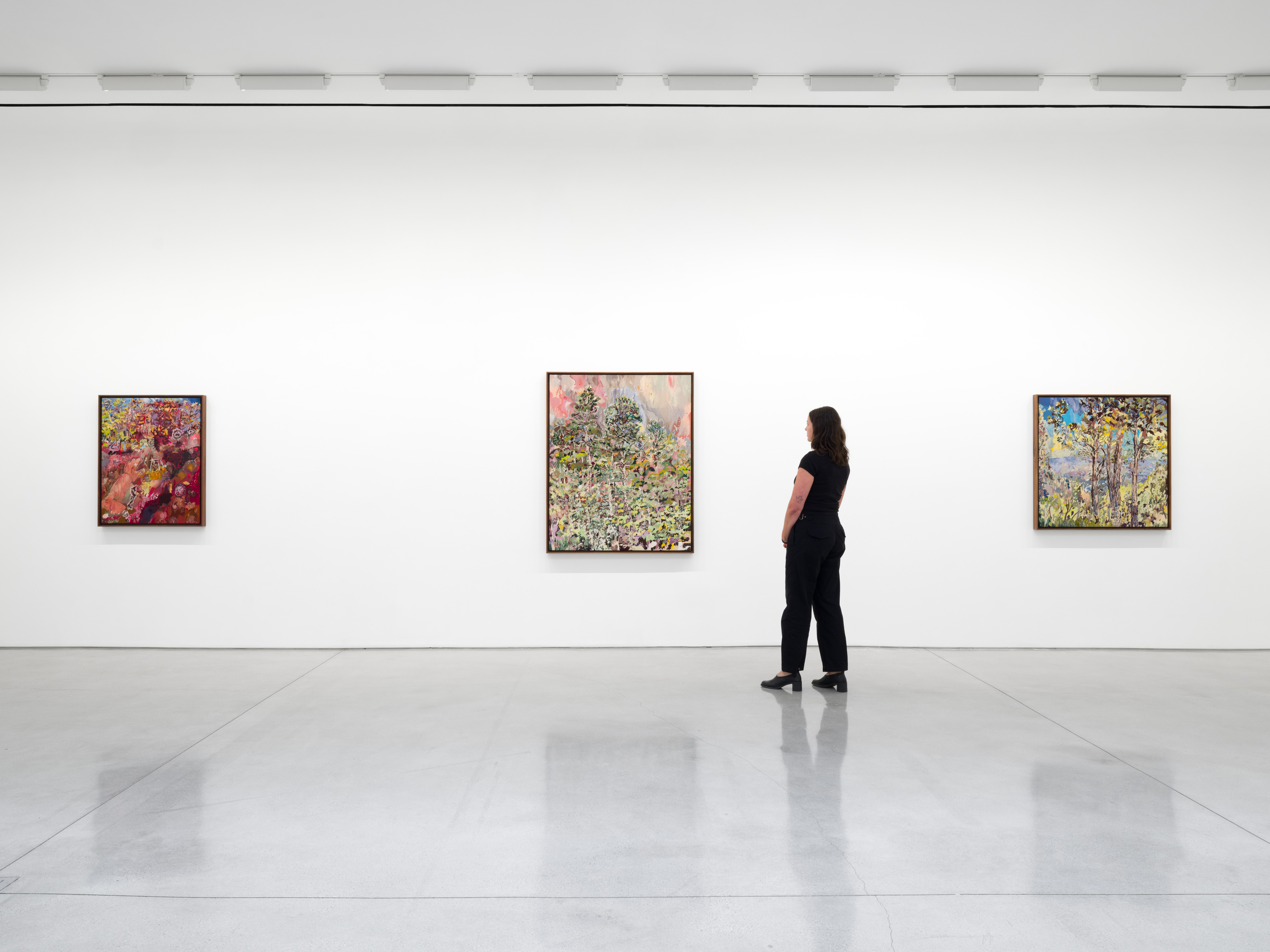
As I meander David Kordansky Gallery’s newest exhibition in Los Angeles, though, an unusual stillness seems to exhale from the walls of Ivan Morley’s Trees. Sitting down with Morley in the midst of a bustling city on the edge of the West, the eternally-transitive Californian hubris that has, for centuries, insisted on restlessly going somewhere relents. Because before these almost psychedelic, Californian landscapes of embroidery on watercolor, I hear the faint echoes of Mary Oliver’s “When I Am Among The Trees,” articulating a certain gladness that one feels when they sit in the hushed shade of a tall oak, asked by Nature to not move or expand—to simply “Stay awhile.”
Splitting his time between the Southern and Northern regions of the Golden State, California-native Ivan Morley recounts the beginnings to Trees with a bohemian ease emblematic of Big Sur—the coastal oasis that he and his wife have comee to call home since buying a property on the ridge where his wife grew up. Just below Monterey, Big Sur’s forested shores have served Morley as an artistic muse, perfectly evocative of the silent, yet rapidly evolving dynamic between art and forest endangerment across California.
“It’s a place that has a way of sucking you in. Being primarily a city boy, [Big Sur] worked on me rather than me working on it,” Morley says. Mid-sentence, he pauses to reflect, taking a still second to breathe. “I get quieter about it because I think one of the first things that someone who lives [in Big Sur] does is get quiet about it so that other people don’t come. It’s been confusing to me as a painter because moving there, I stopped trying to depict it. Instead, I began responding to [Big Sur] with immersion in the environment. Which in my earlier work, happened through reading and memory, not solely personal experience.”
Like many other Californian artists and writers before him—Didion, Keith, Steinbeck—who contemplate the natural complexity of the Golden State, Morley’s work also operates within a regionalist framework, unabashed in presenting both the state’s sunshines and wildfires. Having displayed exhibitions from New York to Munich, I wonder, though, what it is about California that calls him to sit down, stay, and create an exhibition of landscapes depicting this particular corner of the world. The same corner of the world where Morley's home has been almost burned down by intensifying wildfire seasons.
“When I see news of wildfires happening in Canada and parts of Europe, I think of it as a way of our Southern Californian culture spreading,” Morley says, laughing dryly. “But, really, I think I just have a long-term love of Californian artists that didn't happen until I moved to other cities. The way that an artist like Ed Ruscha responds to the place and the region is what I love a lot. There was a movement of Middle American painters called the ‘Regionalists’ who were reacting against Western European Modernism, like Charles Burchfield, Grant Wood, even Georgia O’Keefe. And I like working within a movement of art like that, which doesn’t quite fit into this conversation of that Western European thing.”
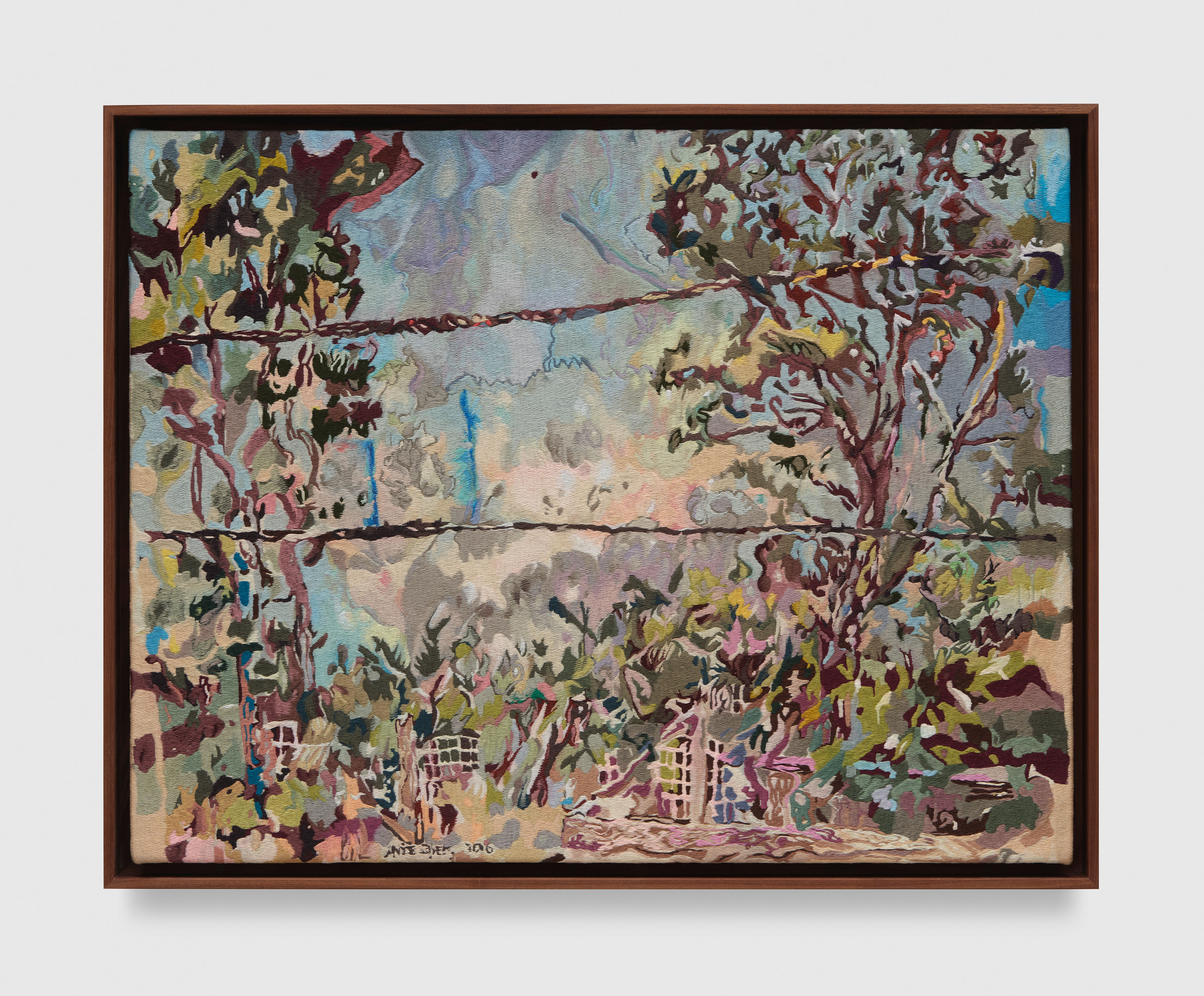
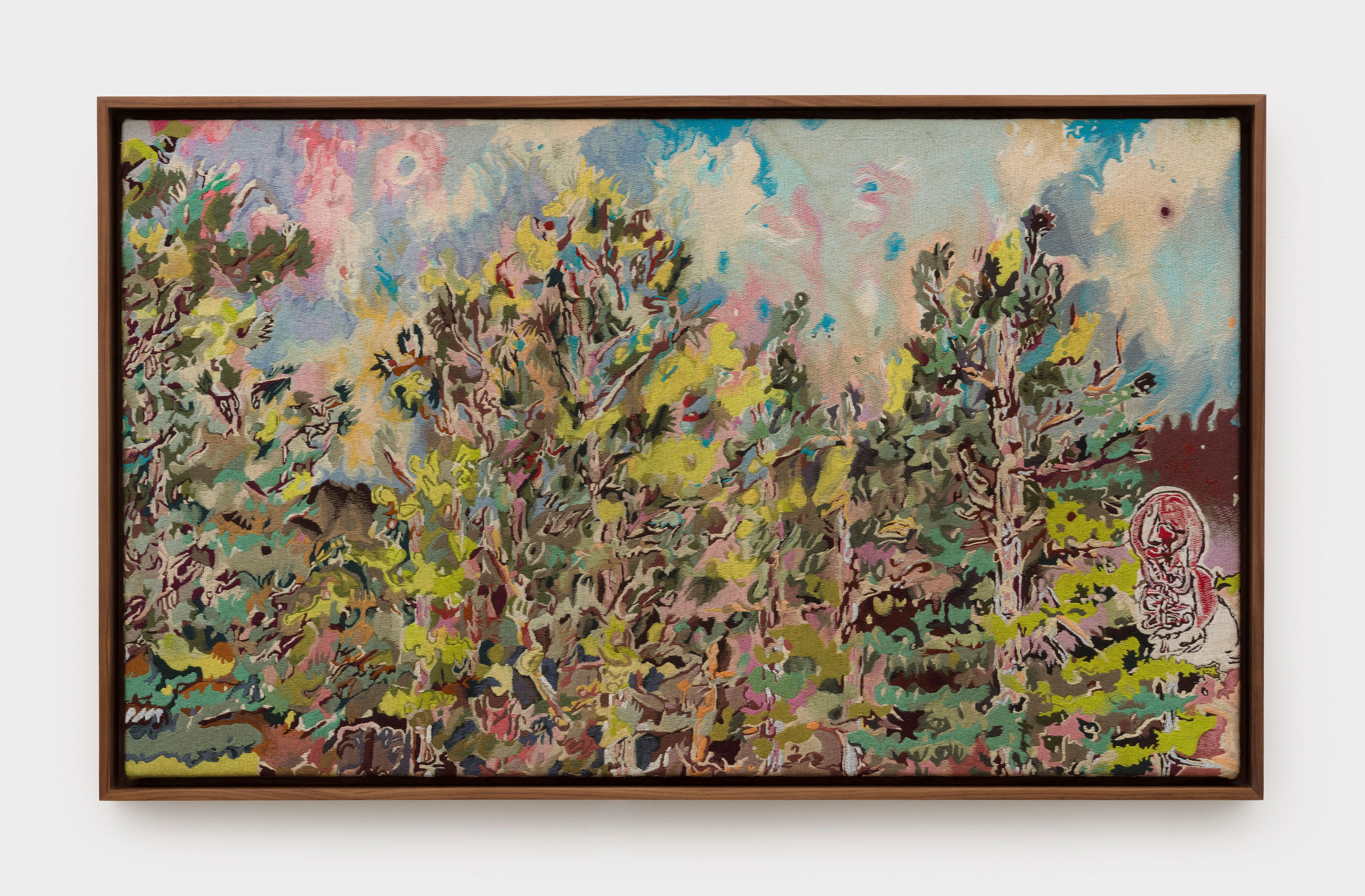
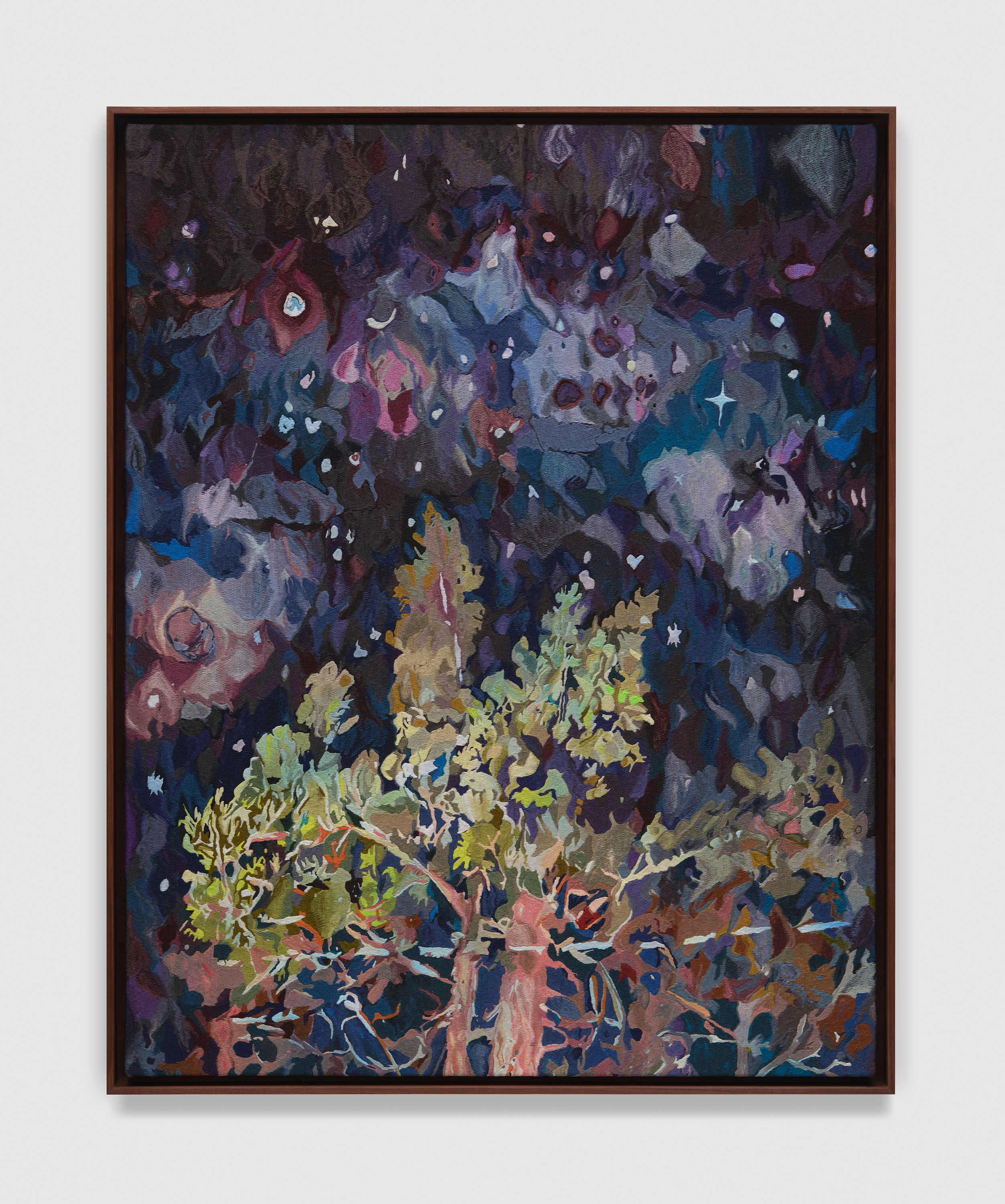
To describe Trees as “elaborate” feels insufficient in properly applauding its kaleidoscopic complexity. Standing six feet from the pieces, Morley and I discuss how one might mistake Trees as a series of paintings—as Cézanne-esque oils on canvas characterized by geometric simplicity reminiscent of a French Post-Impressionist tableau. But, unlike these predecessors, Morley’s medium transcends brushwork. After beginning with a coat of watercolor, Morley embroiders an expansive palette of vibrant fabric through the canvas, threading together abstracted scenes from his Big Sur home that can’t help but conjure the sublime.
“In 2000, thread began helping me empty out the baggage that I had from using this paint that was the same paint used by Titian or Velasquez,” Morley says. “I grew up with a mother in the clothing business, which allowed me to think about colors in that context instead of the painting context. So at this point, we’re not looking at a landscape with trees anymore. We’re looking at colors that are manufactured by a thread company. It’s something reminiscent of accessing a different world of sweatshops in downtown LA, instead of some art studio in Paris.”
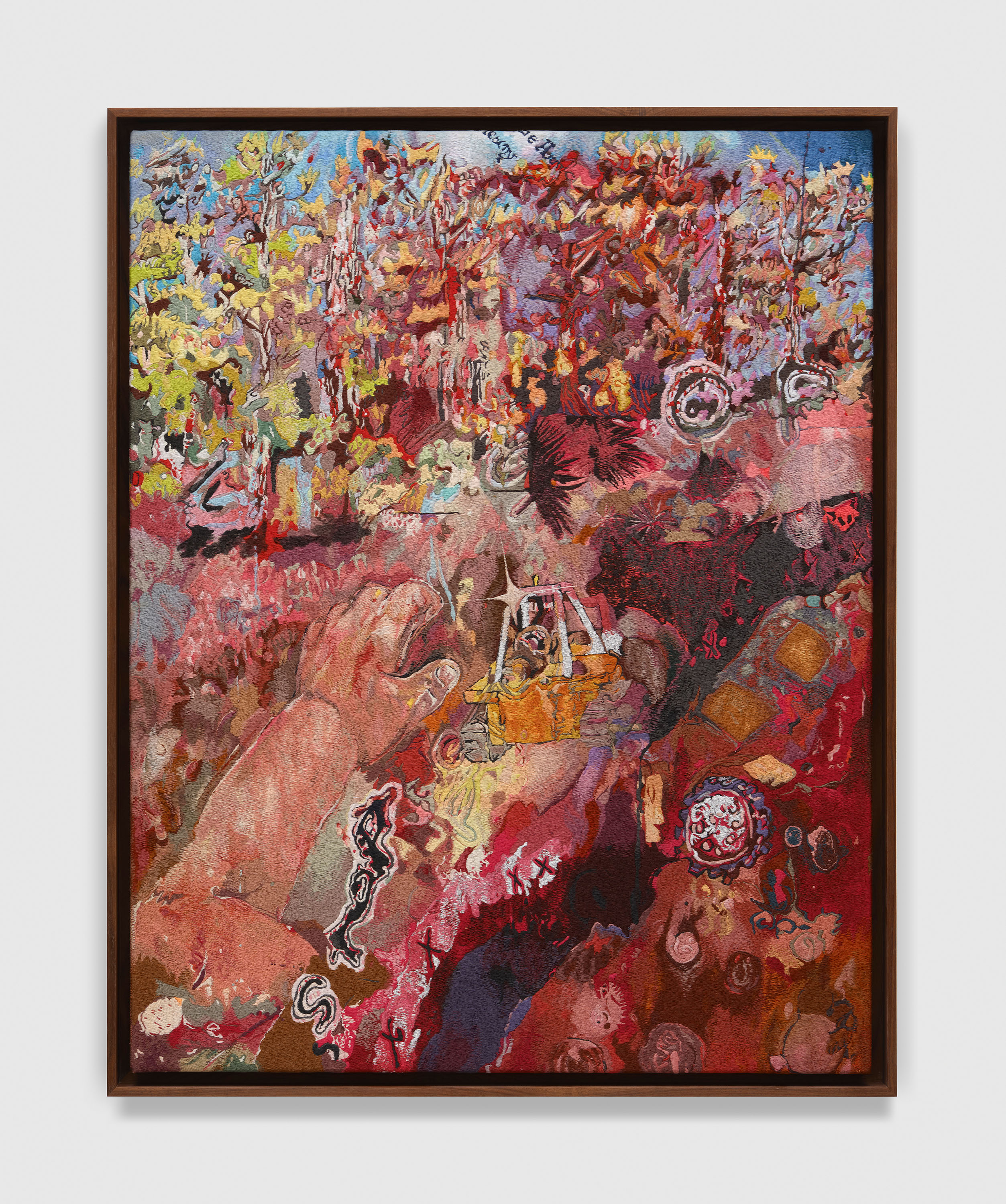
Insistent on deviating from traditional painting standards, I wonder about the challenges of such a time-consuming embroidery process—a process which produces mark-making and necessitates a forward-moving practice, unyielding to revision. I ask how it feels to have every stitch sitting there in the work, whether “mistakes” are visible or not.
“The impulse for perfection is there all the way through. It always is. But, these just have to include every choice I make,” Morley says. “Even looking upon the surfaces of the works, it’s hard for me to understand what’s happening on the surface because I am so familiar with how the thread went through [behind].”
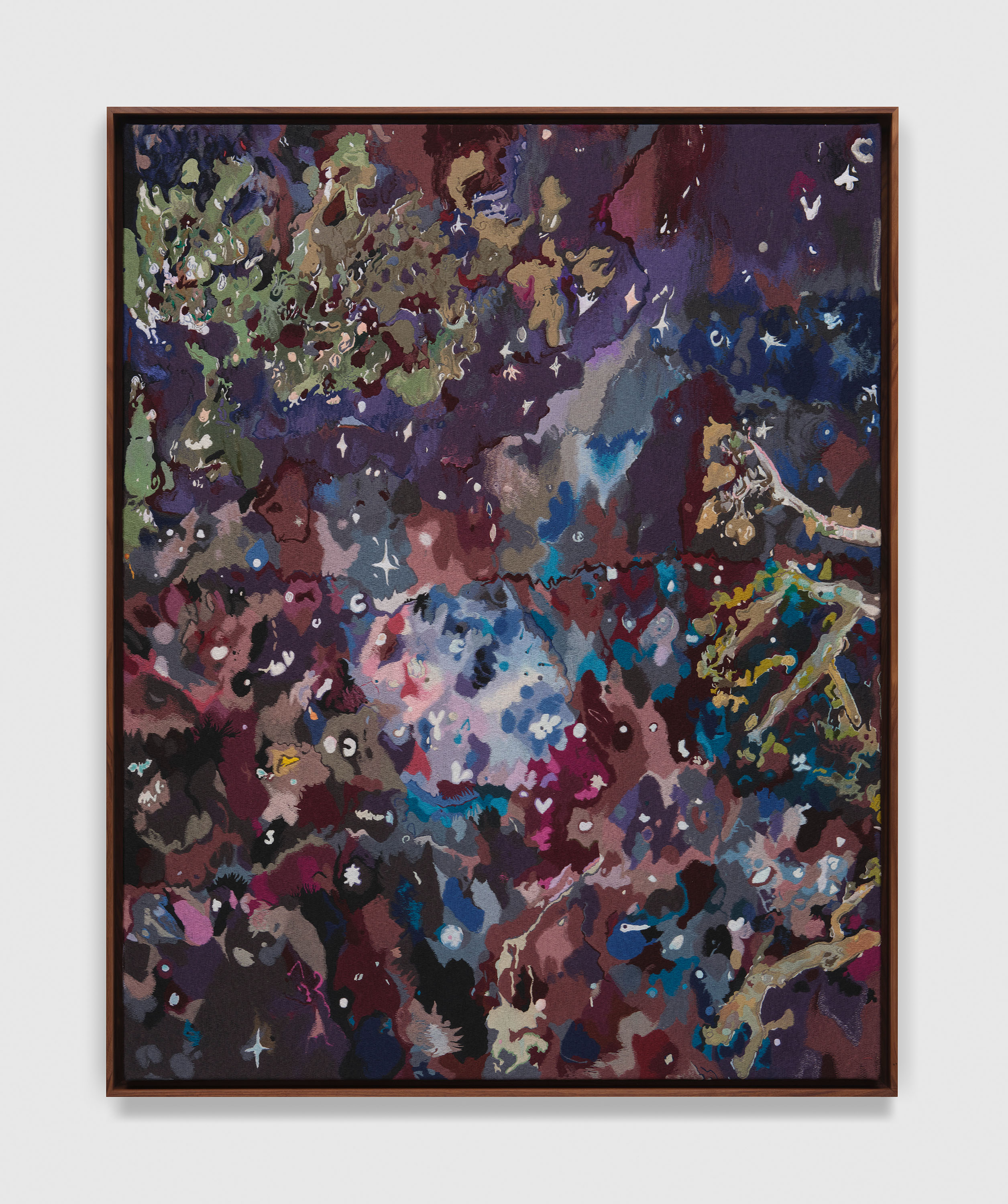
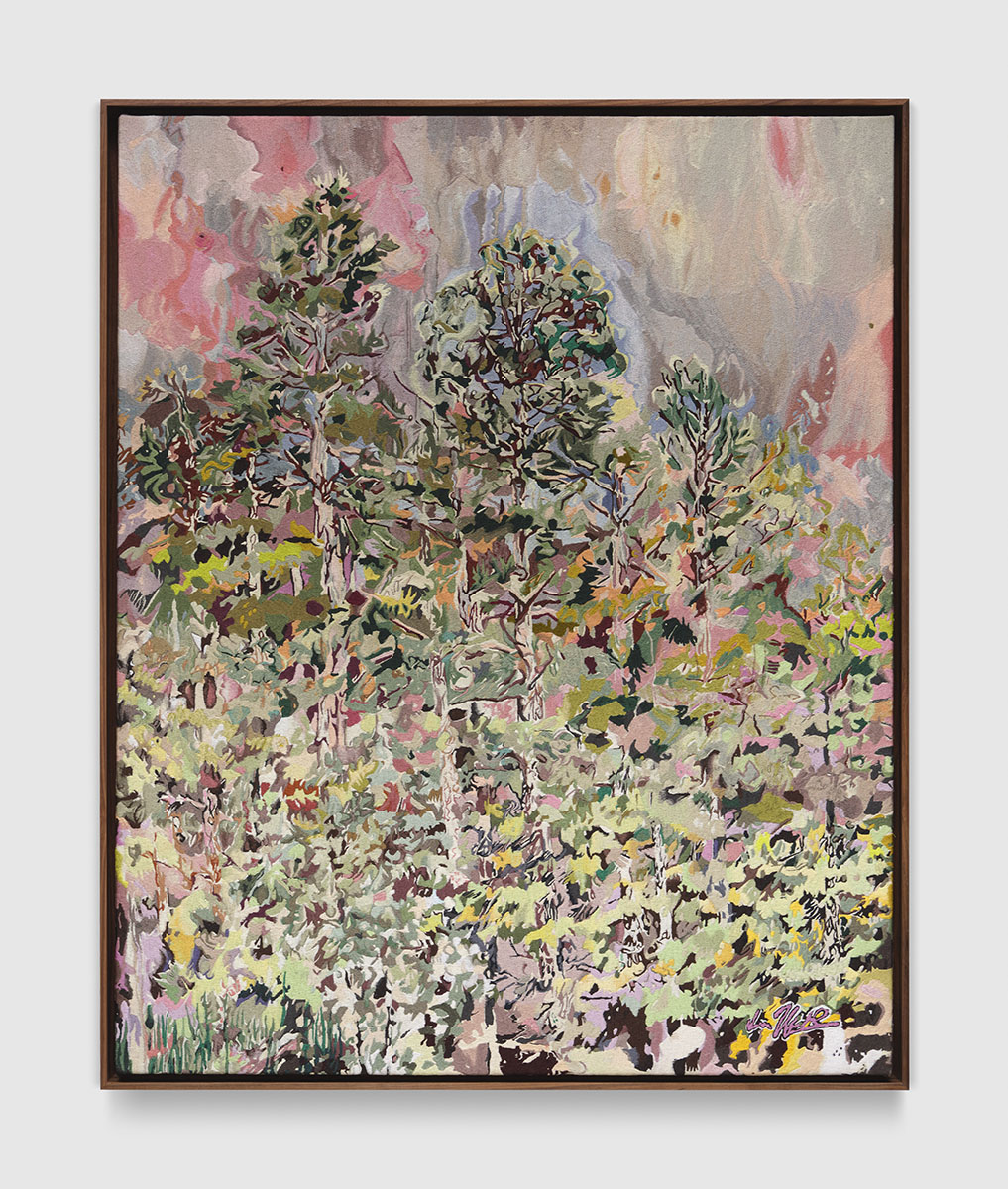
Notable, though, is that each of these landscapes and their “imperfections” mainly point in-land, towards the East. From the edge of the continent, they do not reach out further west to situate the sea as a subject of greater, conquerable abundance. I feel confronted by this reversed, eastern directionality. For as a region that simultaneously rests on the limits of 1840s westward expansion and is dramatically impacted by wildfires, works like “Overcast” offer a glimpse of Big Sur infernos that beg the voyeur to look backwards as a means of contemplating the intensifying effects from all that came before—both historically and ecologically. Despite symbolizing the finish line for America’s alleged divine “becoming,” Morley and I reflect on how present-day burn scars and mudslides frequently closing Big Sur’s interstates powerfully articulate these trees not solely as idols of Northern Californian imagery, but as evidencing, silent witnesses to mankind’s Invisible Hand. Witnesses whose stories of passive endurance are not overexplained by Morley, calling out directly for change in something like climate legislation, but simply hang there, inviting subjective interpretation. And for Morley, that engagement is enough.
“I had a teacher who recently passed away named James Hayward,” Morley says. “He had this quote that I’ll try to get right. Which is, ‘Let the work of art go. It has to make its own friends without the artist holding its hand.’ I would love to be a fly on the wall [hearing viewers’ interpretations]. But what I hope that happens when people see these has a lot to do with connection…That these are tools for a viewer to access something that they weren’t able to access before. And I don’t think a viewer needs to have any sort of training to do that.”
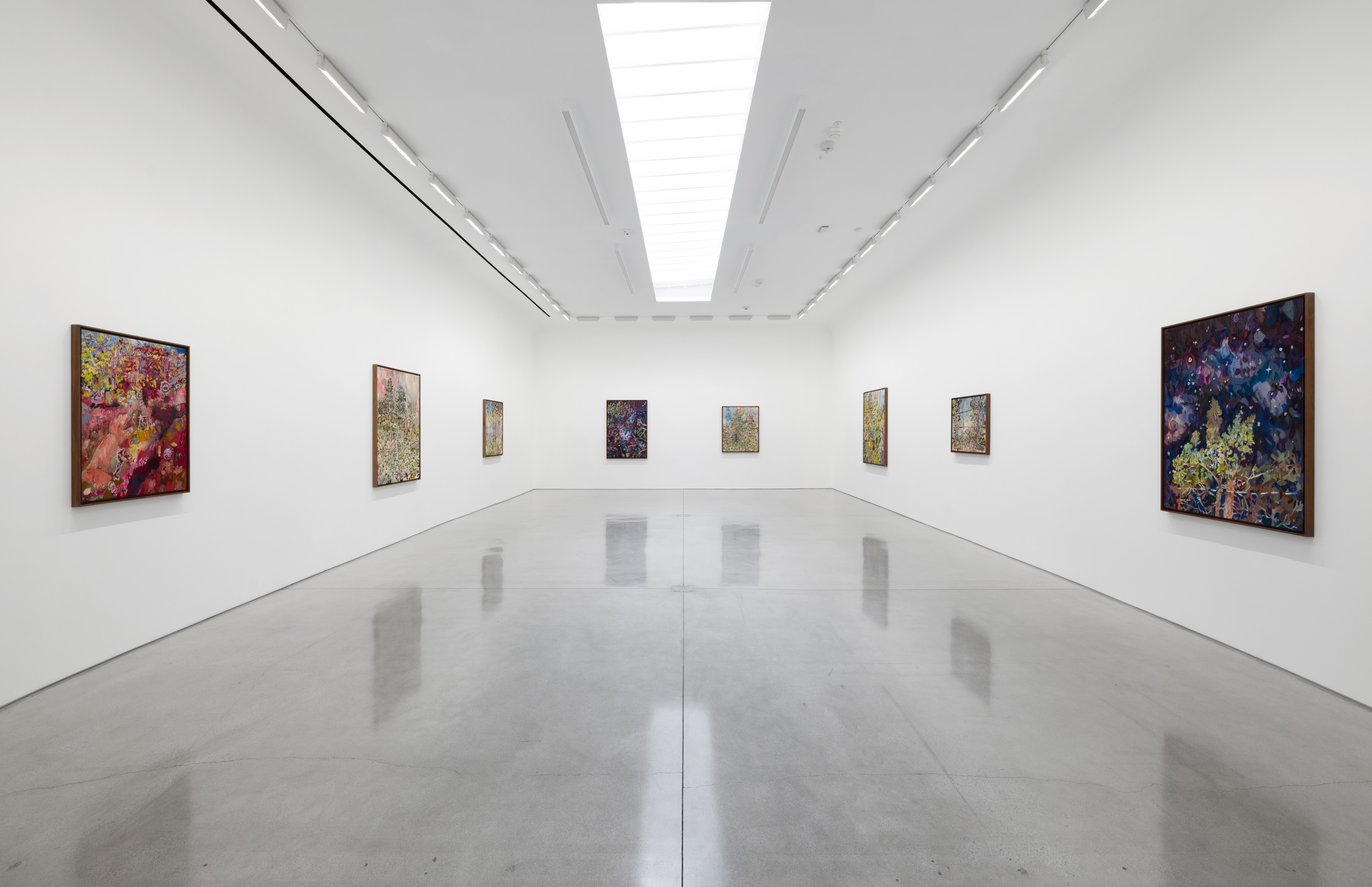
As I leave, I step out onto an energized La Brea Avenue. Cars honk and impatiently run red lights. The wind tousles my hair. The silence of Morley’s exhibition is suddenly unfamiliar. Yet, slicing through the cloudless blue above, I look up at the necks of palm trees, envious. Their fronds crinkle. Their stubborn stagnancy in the midst of this street's need for speed vindicates a certain grounded composure that, despite existing in the complex world of becoming, remains as is. Trees harbors that same peace in immobility—to embroider meaning in a land one already inhabits, and, like the oaks or willows, to find the courage to simply stay awhile.
Stay up-to-date with exclusive events and content.


