F L A U N T


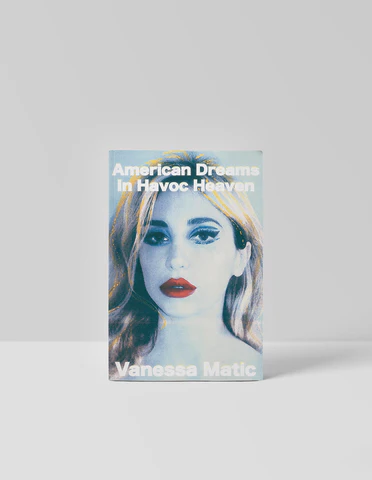
For decades, poetry has occupied a quarantined space—repeatedly rendered as a rarefied discipline, sealed off from the mess of lived experience. In Vanessa Matic’s American Dreams in Havoc Heaven, that membrane comes to a head. In terms of posture, the collection seeps, leaks, and smolders at the fault line between paradise and collapse, faith and fraud, intimacy and empire. These poems act with a volatile intelligence—less concerned with meaning than with exposure—where love, violence, religion, and politics are stripped of their ceremonial garments and returned to the body. Matic’s writing does not offer belief systems or moral scaffolding. It insists on sight. On presence. On the uncomfortable recognition that heaven and havoc have always shared the same address.
Matic’s practice has long resisted containment. Moving between New York’s underground, Berlin’s avant-garde, and Los Angeles’ commercially-viable art circuits, she has treated writing as connective tissue—binding poetry to image, sound, performance, and communal ritual. Her debut collection, Romance & Revolution, announced a voice unafraid of contradiction; her founding of the Agape Lodge Poetry Society expanded that voice into a living, breathing ecosystem where poetry is enacted as much as it is read. In the conversation that follows, Matic speaks to FLAUNT from within that liminal space—where art and life collapse into one another—reflecting on survival, solitude, collaboration, and the radical act of continuing to make something real in a world that increasingly prefers illusion.
Tell us a bit about yourself. How did your writing journey begin?
I’m still not entirely sure how to define myself—especially when it comes to art. I’ve always believed that a farmer is an artist. Anyone who uses their mind and hands to shape life, to move things forward, is practicing an art form. And to me, living itself is the greatest art.
My first published piece was a short story I wrote when I was around ten years old. After that, I filled notebooks with rap lyrics, Tupac sketches, and fragments inspired by beat poets like William S. Burroughs. I used to hide those notebooks from everyone—they felt sacred, like a private religion meant only for me. I still believe that books, music, films, and nature are all forms of spiritual nourishment. We don’t need much more than that.
In high school, I spent a year homeschooling, and that’s when I really started falling into myself—into what I loved, what moved me. I remember being thirteen, watching films set in Berlin—Christiane F., B-Movie: Lust & Sound in West Berlin, Wings of Desire—and saying out loud, “I’m going to go there and make something cool.” Years later, after forgetting I’d ever said that, I found myself living in New York and New Jersey… and then suddenly, around 2008, I was in Berlin for nearly two years.
There, I began working on what I call “poetry visuals”—a fusion of poetry with visual and musical elements. Artists like Sonic Youth and others generously sent me instrumentals, and I built poems around them. From there, the writing never stopped. Magazines began publishing my poems here and there, and slowly, a body of work emerged.
How did you come to poetry—not as a career or a label, but as a necessity? When did you realize that you had to write, even if no one was listening?
I suppose I was unsure about that then, and still am in many ways. I resist letting art define me—or us. But those hidden notebooks? They were proof: I wrote because I had to. Not for an audience, but for survival. Like breathing. Like prayer.
Your new book, American Dreams in Havoc Heaven, lands in a moment that feels both fractured and strangely awake. Did you write it for this time—or did this time catch up to the book?
I don’t write for a time or a place. I write for a feeling in space.
How did the title of the book come about?
American Dreams in Havoc Heaven came from the idea that there was once a golden era, especially in America, when dreams felt attainable. People bought homes, doors stayed unlocked, and there was a sense of collective possibility. Now, it feels like the dream has become a kind of illusion—a scam promising happiness that rarely delivers. Sure, someone hits the jackpot every once in a while. But day to day, we’re navigating chaos within what’s supposed to be paradise.
And yet, history shows us that chaos has always been part of the human condition. So maybe the answer isn’t in chasing perfection, but in living freely, authentically. If you believe in love—real love—it can carry you through. America was long seen as the land of the golden dream, but we forget: grass only stays green if someone tends to it.
Would you say your work is fiction or nonfiction?
A bit of both. I’m inspired by what I see, what I feel—but filtered through my own lens. There’s always a piece of me in everything, even in the darkest corners. I think that’s true for most artists. No matter how fictional the story, there’s a passage inside you that led it there. I tend to blur the lines, let them intertwine.
What about the cover of the book? What was the idea behind it?
I’ve always admired Warhol’s prints—their simplicity, their boldness, how they draw you in even if you don’t immediately “like” them. When I was growing up in New York, my friend Johnny used to call me a “Warhol Girl.” I remember one photo I had online back then—me in lingerie, a purple Michael Kors coat, purple and green Marc Jacobs shoes and Mickey Mouse cast on the TV behind me. That aesthetic stuck with me.
For this book, I wanted something layered. I had my photo taken and then painted over it—adding texture, imperfection. It was scanned and designed from there. I used red, white, and blue deliberately, tying the colors back into the title and the themes of America, myth, and memory.
Before American Dreams in Havoc Heaven, you published Romance & Revolution. Can you tell us about the journey of both books?
Romance & Revolution happened almost by accident. Tough Poets Press stumbled upon my blog—back when I was posting heavily on Ello, this short-lived but vibrant platform. I sent them everything I had, and Rick, the editor, sifted through it all and picked his favorites. Months later, he reached out saying he wanted to publish it. I signed the contract, and just like that, the book went to press.
The new one came differently. I met my current publisher, JC, at a bar. We were talking music, art, life—no agenda, just real conversation over drinks. That night, and a few nights after, the connection grew. Eventually, I sent him a massive pile of writings. He narrowed it down to half, and that became American Dreams in Havoc Heaven. It feels more refined, more intentional—though no less wild at heart.
Even this book is only half of what I originally submitted. There’s so much I haven’t shared yet.
You founded the Agape Lodge Poetry Society as a space for poetry that feels alive—not just performed. What did you feel was missing in the literary landscape that made you say, “I need to build this myself”?
I needed to find people like me—people who felt the same hunger to gather, create, and share something real. Something special.
Your curated events also tie into your writing. What’s that experience like?
I’m taking a small break from it right now, but it’s been one of the most electric things I’ve done. At its core, it’s a reading series—but it’s so much more. Fashion shows, live bands, fire eaters, contortionists, dancers… all orbiting around the written word. There’s a raw, punk energy to it. If you haven’t been to one, you can’t really understand the magic. My anniversary event was pure insanity—in the best way. Legends showed up. It was chaotic, beautiful, alive. That’s what I aim for: art that doesn’t just sit on a page, but pulses in the room.
Has that atmosphere changed how you share your own work publicly—especially pieces that feel deeply personal?
Not really. My work doesn’t change whether it’s public or private. The only shift is in how I show up: when I host, I’ve become more commanding—whereas before, on stage, I was almost angelic. But the writing itself? It comes from personal pleasure.
How is American Dreams in Havoc Heaven different from Romance & Revolution? What changed for you between them?
I have no idea. Maybe nothing at all.
If someone picked up your new book having never heard of you or Agape Lodge, what’s the one thing you’d hope they’d feel by the last page—not understand, but feel?
Peace in feeling whatever they’re feeling. Maybe loneliness. Maybe the quiet urge to reconnect—with someone, with something. The sense that yes, we’re all alone in the world… but we still have the power to weave our lives together, even in small, tender ways.
Collaboration can be messy, but you’ve worked across disciplines. What’s one thing you’ve learned from collaborating outside your usual practice that changed how you see your own work?
Because I often work alone—like a hermit—collaboration feels like stepping out of the shadows. It’s what Agape Lodge is, in a way: pulling back the curtain and moving into shared space. That movement creates a different kind of beauty.
Who are the writers or artists—living or dead—who feel like quiet companions in your studio? Not the ones you cite as influences, but the ones whose presence you feel when you’re working alone at 2 a.m.?
My father. When I’m deep in the work, I think of him. He was the smartest person I’ve ever known—and never cared to prove it. He only cared about family, about making life itself into art.
What do you think comes next?
Who knows? I dive into so many different avenues that I can’t predict the path. Right now, I’m working on a novel—but as you know, novels are time-consuming deities. Last year, I even ended up acting in a full-length German/English feature film. But truthfully, I’m quite a hermit. I spend most of my time sitting with words—accumulating them, shaping them.
Is there a line of your own writing that haunts you or that you keep coming back to?
“Jewel thief, you rob me of everything—even stole my one-dollar wedding ring.” That one sticks. It’s raw, absurd, tender—all at once. It’s from a song called “Trippin’” by a fun bedroom project called Plastic Bombs with my dude.
Last one: if all your poems burned and every canvas turned to ash tomorrow—what single line, what one smudge of color, would you want to survive? And why should anyone remember it?
Honestly? Let it all burn. I once wrote a poem that said, I hope all history burns—because those who win wars rewrite it, and in the end, it’s all fiction anyway.
Stay up-to-date with exclusive events and content.


