F L A U N T


Growing up in Maplewood, New Jersey, multimedia artist Adebunmi Gbadebo learned to recognize the storytelling potential of organic matter from an early age. Guided by her mother, who encouraged her to learn about the history of the African diaspora, she came to see Black hair, soil, rice, and indigo dye as sources of artistic improvisation. Take, for example, her first major school project, where she and her mother created 54 flags representing every country of the African continent using coffee grounds, beans, and toothpicks from their family’s kitchen cabinets. Her inclination toward creative experimentation was further nurtured through private art courses, museum education programs, and exhibitions in local galleries, where she began showing work as early as 8 years old.
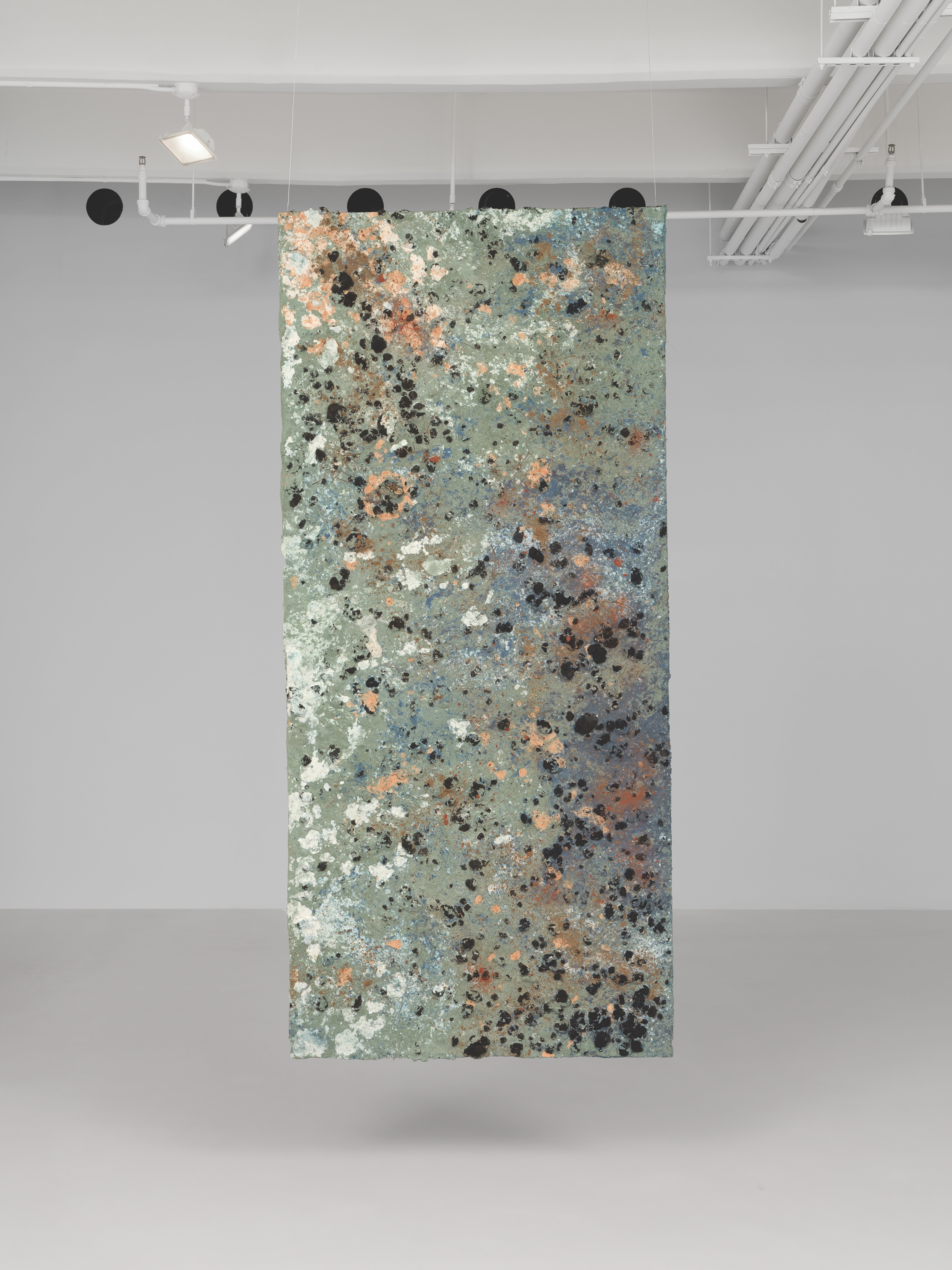
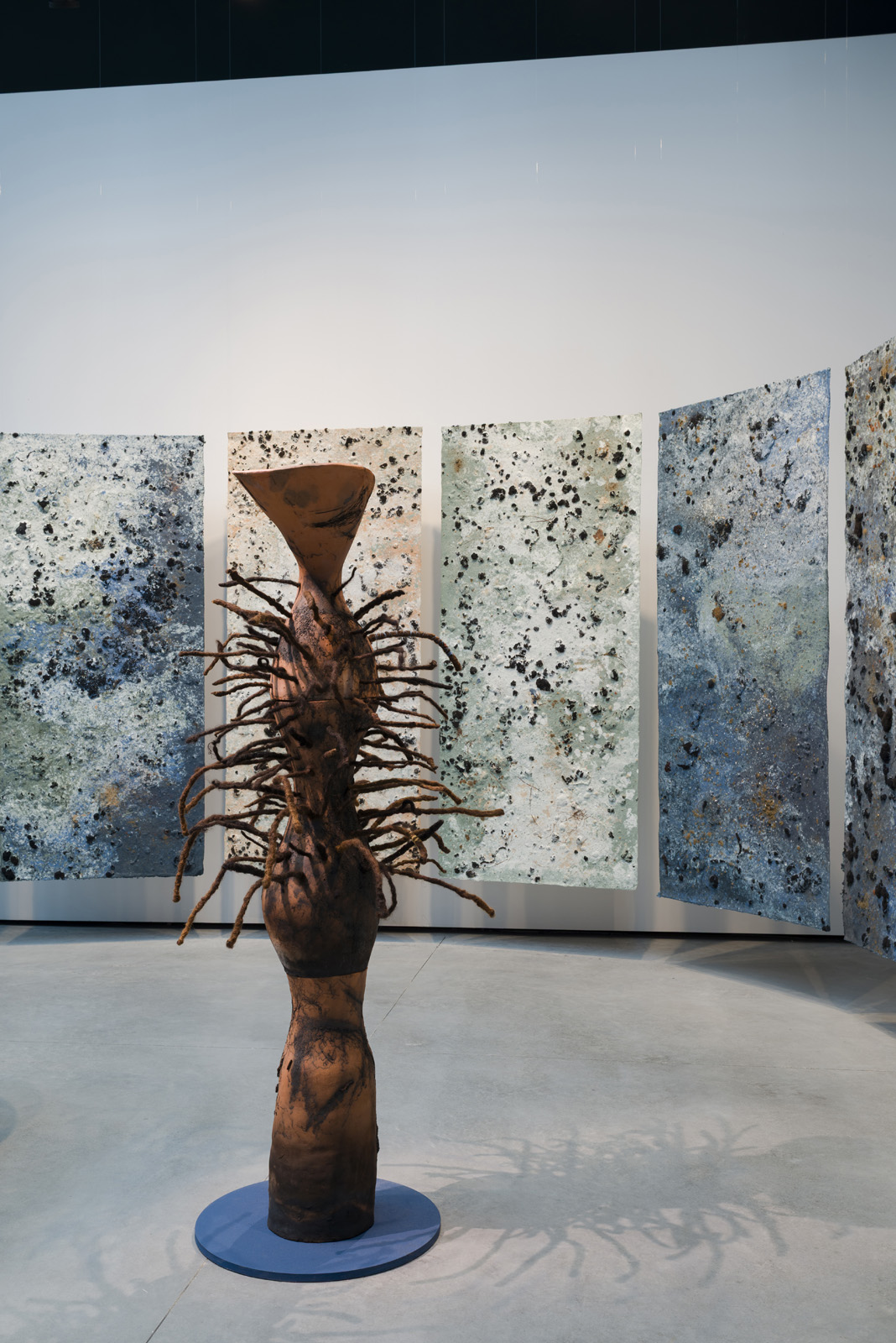
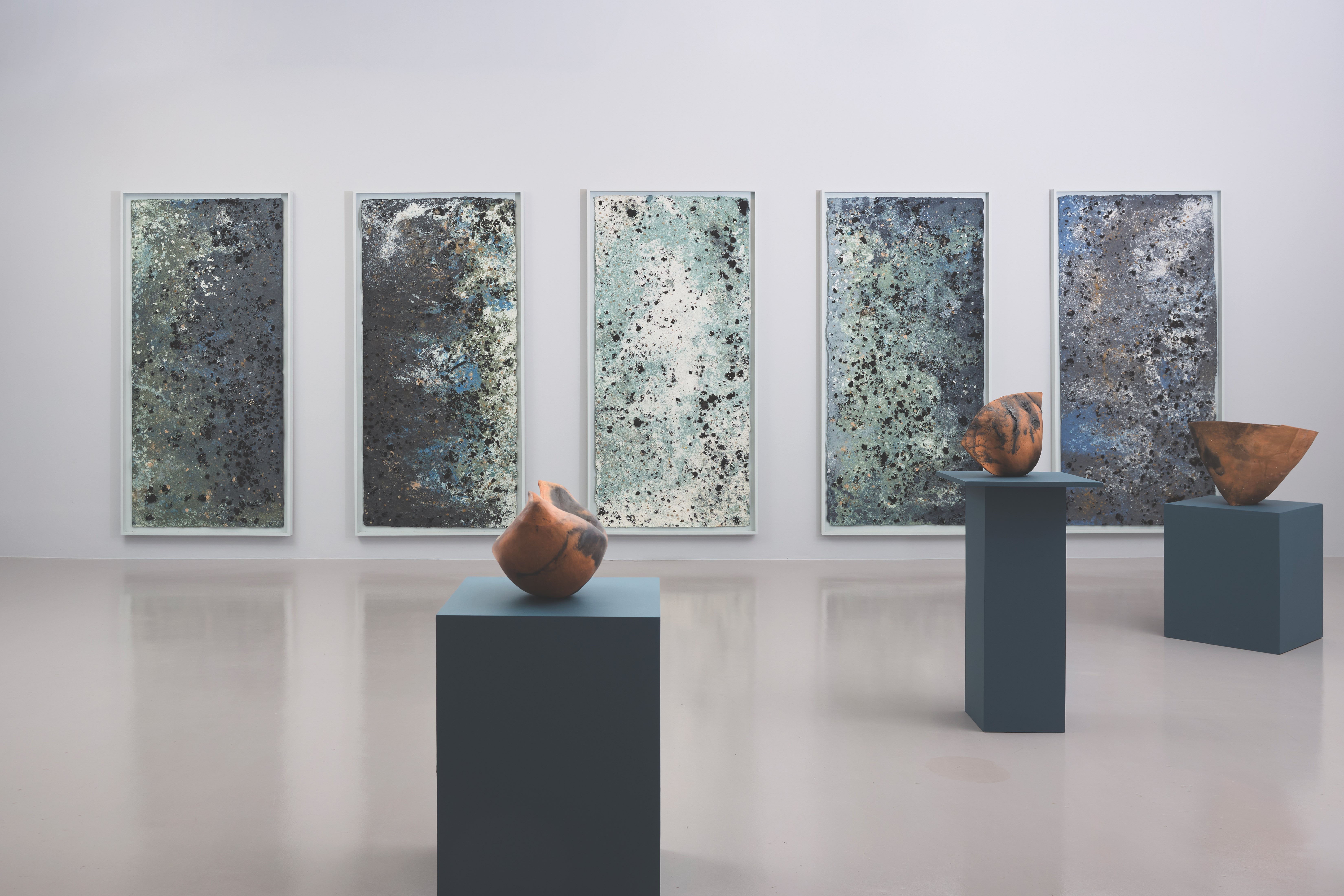
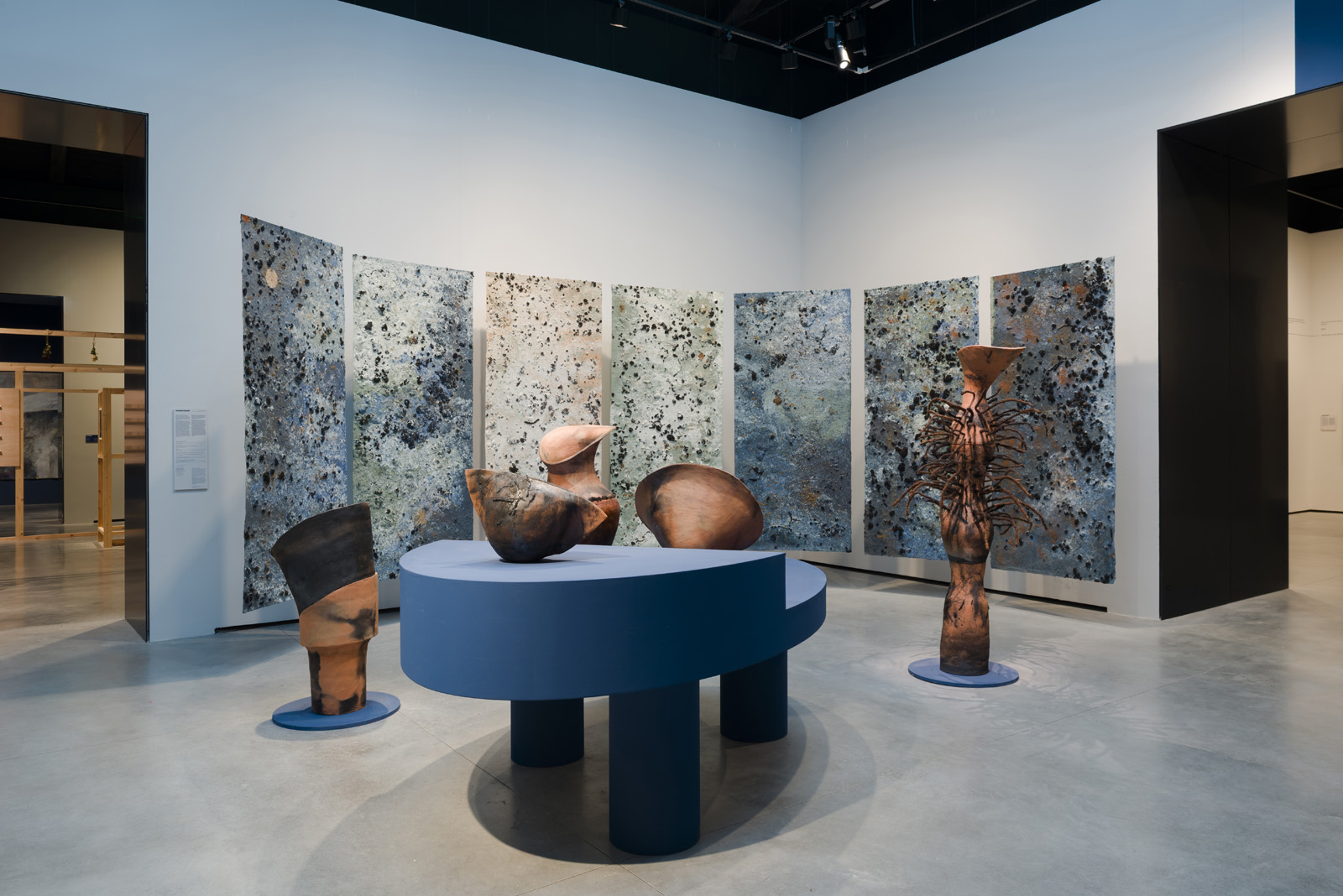
Though Gbadebo had been trained as a sculptor and painter, her approach to material took new dimensions at the School of Visual Arts in New York. There, she began collecting Black hair from barbershops, grinding it into fine powder and mixing it with indigo dye to create large sheets of handmade paper. “Black hair is an accessible material and comes in abundance,” she explains. “But it is also culturally specific; it is an extension of our Black selves, our Black bodies. It carries our DNA.” Another source of organic material is found in her series of globular ceramic sculptures, made with soil gathered by hand from True Blue Plantation in South Carolina, the site where enslaved people—among them, her maternal ancestors—were forced to cultivate indigo plant, later processed into blue dye. Through such works, Gbadebo unearths the histories of enslaved Africans whose lives have remained hidden in the official records of American history.
As her research into True Blue deepened, Gbadebo discovered a plethora of archival records documenting her matrilineal lineage through the perspective of enslavers. Among them were references to Julia Peterkin, author of the 1928 Pulitzer Prize-winning novel Scarlet Sister Mary, whose fictional characters were inspired by Gbadebo’s ancestors. Its 1930 stage adaptation in Broadway, performed by a cast of actors in blackface, further obscuring each character’s identity and transforming their lived experiences into a spectacle. “It’s enraging,” she says, “to see your ancestors only come up through history as a property.” Yet these discoveries ultimately reinforced her conviction that physical archives alone are insufficient. Instead of relying on written records as the definitive source of historical knowledge, she sees soil as an alternative achievement, one where traces of sweat, tears, and blood remain embedded in the land.
Her repeated visits to True Blue Plantation became the basis for Watch Out for the Ghosts (2026), a documentary directed by Yvonne Michelle Shirley that incorporates Gbadebo’s cell phone footage of local burial grounds and conversations with family members. Presented at the Black Star Film Festival in Philadelphia, the film offers audiences a broader context for her thinking process, as she notes: “It was nice to see the stories that were brewing, to investigate the underbelly of my trips.” Besides video, Gbadebo continues to expand her reach through collaborative projects. In tierra, an exhibition at the Craft Contemporary in Los Angeles, a handmade paper diptych is presented in dialogue with work by artists from Latinx and Indigenous communities, whose central focus address land displacement. Through this thematic overlap, earth-based materials become the unifying knot weaving together legacies shaped by colonialism and capitalist extraction.
Gbadebo’s recent participation in the 61st International Art Exhibition of La Biennale Di Venezia, In Minor Keys, curated by the late Koyo Kouoh, further expanded her conceptual framework. For Gbadebo, the invitation represented a significant moment in her career for two important reasons. First, Kouoh, who passed away weeks before announcing the Biennale’s title, was set to become the first African woman to curate the exhibition, and, secondly, her curatorial framework offered Gbadebo a new language through which to consider her heritage. Through the lens of “minor keys,” Gbadebo reflected on the landscapes that shaped her ancestors’ histories: the cemeteries where her ancestors are buried, the woodlands where enslaved people sought refuge, and the communities where maroon societies found freedom.
Gbadebo’s research has also strengthened her familial bonds. Relatives share stories over the phone, send her photographs, and connect her with distant family members grateful for her efforts. In this sense, Gbadebo’s multimedia practice becomes an act of cultivation, tending to a family tree with roots deep into the ground. Through organic material, she preserves the joy and pain of her ancestors, offering them a second chance at being heard.
What were some of the first life experiences that drew you into the arts?
My journey in the arts started at a very early age. My mom enrolled me into art courses at our local museum, the Newark Museum. When I was three at the time, they had a junior museum where they had free art classes for toddlers and kids.
And it was a free program. My mom took advantage of those programs and entered me into that. And I guess at a very early age, she recognized that I had an artistic inclination, and she really nurtured that. When I got to third grade, she had me start taking private art classes. In my neighborhood, there was a woman in my community who was a retired art teacher. She taught very advanced art courses out of her home studio. I took those classes from third grade to high school, almost every Wednesday.
I would go to her home studio and take private art courses in all mediums—such as ceramics, pastel, collage, painting, drawing. In addition to my K-12 art education in the community where I grew up in—which was Maplewood in South Orange, in New Jersey—I did these private art courses. I was engaged in museum education, educational activities. A lot of the work I made in those private art courses were exhibited in local galleries in our communities. Some of my first art shows happened at eight, nine, and ten years old. So, art making, exhibiting, and exploring were a part of my childhood.
That's really interesting, thanks for sharing. What I appreciate the most about your practice is your use of unconventional materials. In the past, you have mixed paper pulp with Black hair and clay with rice with soil to create many of your sculptures, prints, and paper works. Can you tell me a bit more about these materials?
Well, it's funny because I've been talking about this recently. One of my earliest art making experiences was with my mom in kindergarten, and we decided to make 54 flags representing each country on the continent of Africa. And I remember looking for art supplies in our kitchen, digging out coffee grinds and beans, rice, toothpicks and various kinds of unconventional materials for this art making project. I made the paper in kindergarten for the first time. I was in the local newspaper in East Orange, New Jersey, for what I had created.
Also, my mom was very Afrocentric and pro Black in the way she raised me. I recognized very early on through these private art classes or through my upbringing with my mom that much of Black creativity and Black cultural expression is through using what we have, making something beautiful out of the mundane, out of what is at arm's reach. So, by the time I got to the School of Visual Arts in New York, I already had a sort of artistic background, a philosophy that anything could be seen as material.
To me, Black hair is an accessible material and comes in abundance. But it was also very culturally specific, it was an extension of our Black selves, our Black bodies. It carried our DNA. Very early on as an art student, when you're being exposed to oil paint, acrylic, and more traditional materials in an institutional setting, you are not always encouraged to think of other materials.
The story you just shared about your mother is fascinating. In what other ways did your mom encourage your artistic explorations?
I went to a very Afrocentric kindergarten and preschool in New Jersey, it was called First Day Care Academy, and they had a school-wide project for students to just make any art project of their choosing. I am sure that mom had a bigger influence on how we landed on a project that was so specific geographically and culturally, but we landed on making flags representative of every single country in Africa. This gives you a pretty good insight into the type of mother I had. I was probably four years old.
Wow, that's incredible. This leads me to ask about your family lineage. So much of your work deals with the history of your ancestors, especially those ancestors who were enslaved at True Blue Plantation in Forte Motte, South Carolina. Much of the soil used in your sculptures has been excavated by hand from True Blue, where your ancestors cultivated indigo to later produce blue dye, relying on their labor and mastery over the land. How do you approach this kind of research?
I first learned about my maternal lineage and its connection to True Blue when we were planning a family reunion to return to the land. That was the first time I learned the name of this plantation, let alone that I could visit. Luckily for me, a lot of the enslavers connected to True Blue were very famous. I wanted to learn more about this former indigo and rice plantation in a very personal way, especially the relationship between the enslavement of my ancestors to the color blue.
Unfortunately for me, one of the slavers was Julie Peterkin. She was one of the first women to win a Pulitzer Prize for her book, Scarlet Sister Mary. All of the characters in her books are my cousins—my ancestors. Another major enslaver of True Blue Plantation was Louisa McCord. She was also an author and playwright, and a major funder of the Confederacy. So, a lot of what I was finding on my ancestors' records was nestled within these archives, within a different sector of American history.
Julie Peterkin's book, Scarlet Sister Mary, became a Broadway play, too. I even learned that Drew Barrymore's great-grandma played one of my ancestors on Broadway in blackface. In a weird way, the lives of my ancestors have been documented through the wrapped and racist imaginations of the people who owned them. I lean toward soil to move away from the enslaver's archives directly; to move away from the violence held within those archives and to deal with the very land in which my ancestors' bodies, flesh, and blood is buried.
I can only imagine how deeply emotionally charged this research has been for you. I'm curious how you've navigated your own emotions, and whether learning about these archives has changed your relationship to your family?
It's enraging to see your ancestors only come up through history as property, as less than human. Much of what motivates me is the ability to tell much more diverse, humane, and multidimensional stories than what racist archives say about my ancestors. I feel proud whenever my research leads me to a family member who can share oral histories, whenever I find the photograph of an ancestor, or whenever an elder in my family can identify an anonymous character in Julie Peterkin's archive. For example, I've learned that William Ravenel is my great-great uncle. He was born an enslaved man and died free. My family has been very supportive of my work, whether that's through encouragement or through the sharing of documentation. Every now and then I'll get a phone call from a family member that I barely know. They congratulate me and encourage me to tell our story. I think it's because Black people understand how cultural diversity is under attack and in danger of being erased, forgotten.
I love that. It feels as though your practice has become a way of nurturing your family tree, allowing its own roots to extend. How has this ongoing engagement with your family lineage informed recent exhibitions, such as Unbraid: Hair, Clay and Craft at the MFA Boston and Revelation: A Journey into Abstraction at National Museum of African American History and Culture?
Unbraid closed on June 27th, but it represented a great opportunity for me because I was able to exhibit the documentary film Watch Out for the Ghosts (2026), directed by Yvonne Michelle Shirley. Video is a new medium for me, but I thought it would be a good way to make my research more accessible and to document the history of my ancestors and their direct descendants.
Revelation opened a week or two ago. There, I am showing handmade paper and ceramics that address other spaces of enslavement within the South. One of them is Clemson University and the other is True Blue Plantation on Pawleys Island, currently used as a golf course. There's two True Blue Plantations, actually. I really like how my process allows me to dive into parallel stories.
Is Watch Out for the Ghosts part of the Black Star film festival in Philadelphia?
Yeah, it'll be my first film festival, but that'll be premiering under the short documentary category on August 6th at Black Star Film Festival. So many of the trips of me going to True Blue and collecting the soil to make my ceramics or gathering materials to embed in my sheets—I was documenting these trips through my life, through a camera or through my cell phone, in very impromptu, unofficial ways.
I was building a video archive without knowing what to do with it. At some point I was connected to the filmmaker, Yvonne Shirley, who was interested in creating a formal documentary, in formalizing all these years of my life. I think video is a very powerful medium in terms of archiving and documenting and formalizing stories. It's also very accessible. It was nice to see the stories that were brewing, to investigate the underbelly of my trips. All the stars aligned when I met Yvonne and received funding to produce the film. The film festival takes place in Philadelphia, but people can also purchase virtual tickets and watch the films from home.
Oh, that's wonderful to hear. It also seems that over the past few years you've not only expanded into new media but also reached increasingly global audiences. You recently participated in the 61st International Art Exhibition of Venice Biennale, In Minor Keys, curated by the late Koyo Kouoh. What was that experience like for you?
For any artist, participating in the Venice Biennale is the pinnacle of exhibiting work. This opportunity was extra special because of Koyo Kouoh's vision, with her being the first African woman to curate the Biennale. She passed away just before it opened, so it allowed me to steep deeper in grief. The soil that I use comes from burial grounds. In a spiritual way, I could feel how grief was guiding me, and all the artists, in her absence for this Biennale. Koyo's conceit of In Minor Keys gave me another anchor to think about. I thought about those minor keys that my ancestors claimed, the cemetery space as a minor key, as well as the woodlands that my ancestors escaped toward in search of refuge. I also thought about maroon communities—those that were able to escape from slavery—as minor keys in history. I'm just grateful for the language and additional dimension Koyo gave me to think through my practice.
One of Koyo's central concerns was the idea of "rest," a concept that she tied to plantations, colonialism, settlement, and environmental disasters. These are questions that deeply resonate with your own practice. From what you've shared, her curatorial vision shaped your thinking and opened new directions of thinking. As you look ahead, are there any upcoming projects you're especially excited about? What's next for you?
I just completed my first print edition with High Point Center for Printmaking in Minneapolis. This opportunity has been exciting because I challenged myself to do something that felt outside of my practice, such as printmaking a flower while still utilizing the same materials that I typically use, such as paper and ceramics. Aside from that, I am also participating in the exhibition Clay Has Memory: Creative Lineages from Africa at Princeton Art Museum, opening on July 19 and tierra at the Craft Contemporary in Los Angeles, closing on October 25.
Oh yes, I've been meaning to visit tierra.
It was nice to see how my work was framed in conversation with other artists from Latinx and Indigenous communities based in Los Angeles.
Could you tell us more about the ideas and lines of inquiry that shaped your project at the Contemporary Craft Museum?
In this exhibition, I wanted to return to my own artmaking process. In a diptych of two large-scale handmade papers, I incorporated human hair, archival documents, and dyed cotton with indigo dye from Bangladesh. However, these handmade paper sheets are made completely out of soil that I liquefied into pigments. All the colors and tonalities that you see in the sheets are soil that I've gathered throughout South Carolina at various locations connected to enslavement. One of them is Stony Bluff Plantation, where kaolin mines were used by enslaved potters in the nineteenth century.
What differentiates this work from other handmade sheets of paper that I've made in the past is that I am thinking beyond their density and dimensionality. I'm not just utilizing cotton and soil. In a way, I see this diptych as a study of land. This is a direction that I hope to push myself toward.
Stay up-to-date with exclusive events and content.


