F L A U N T


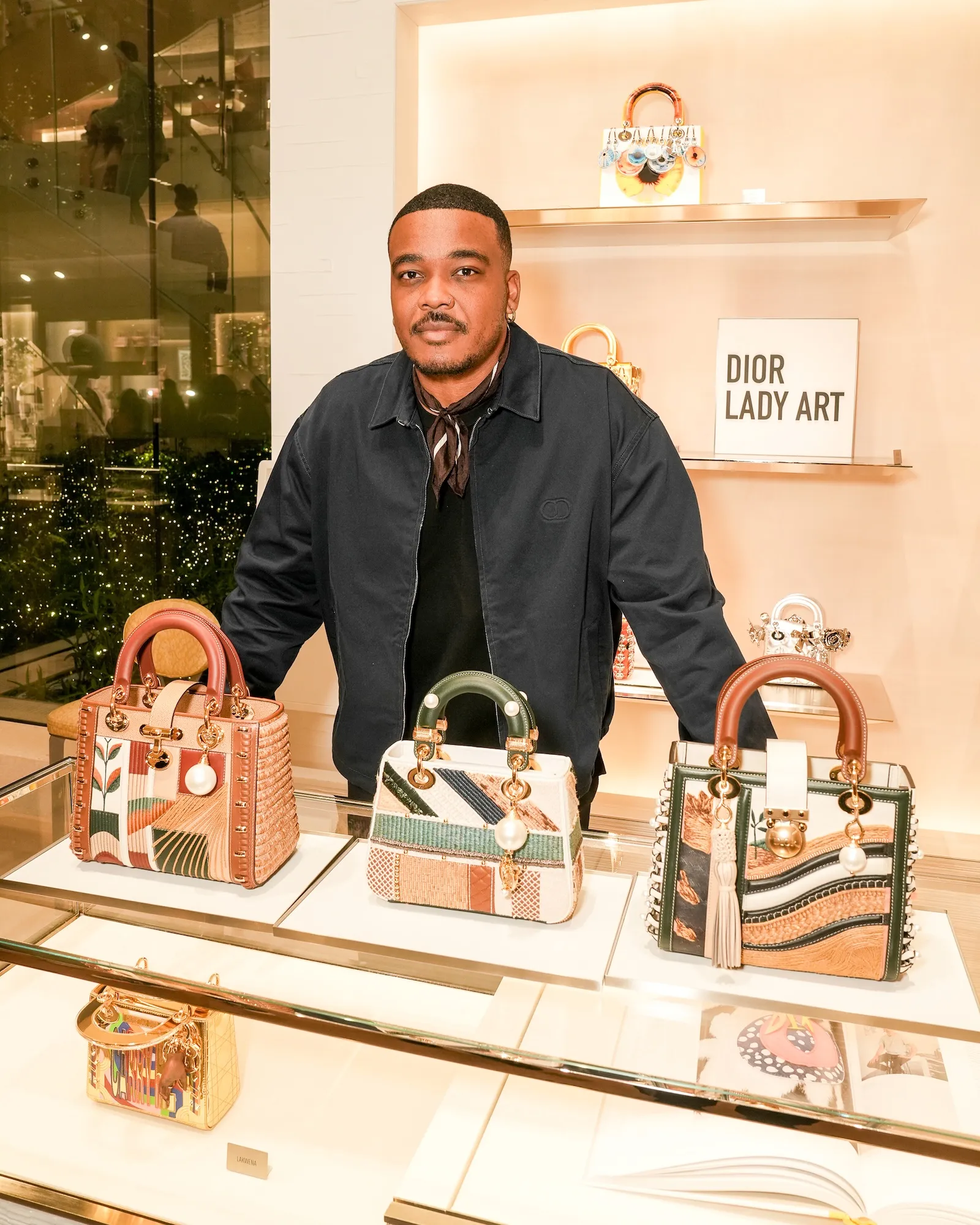
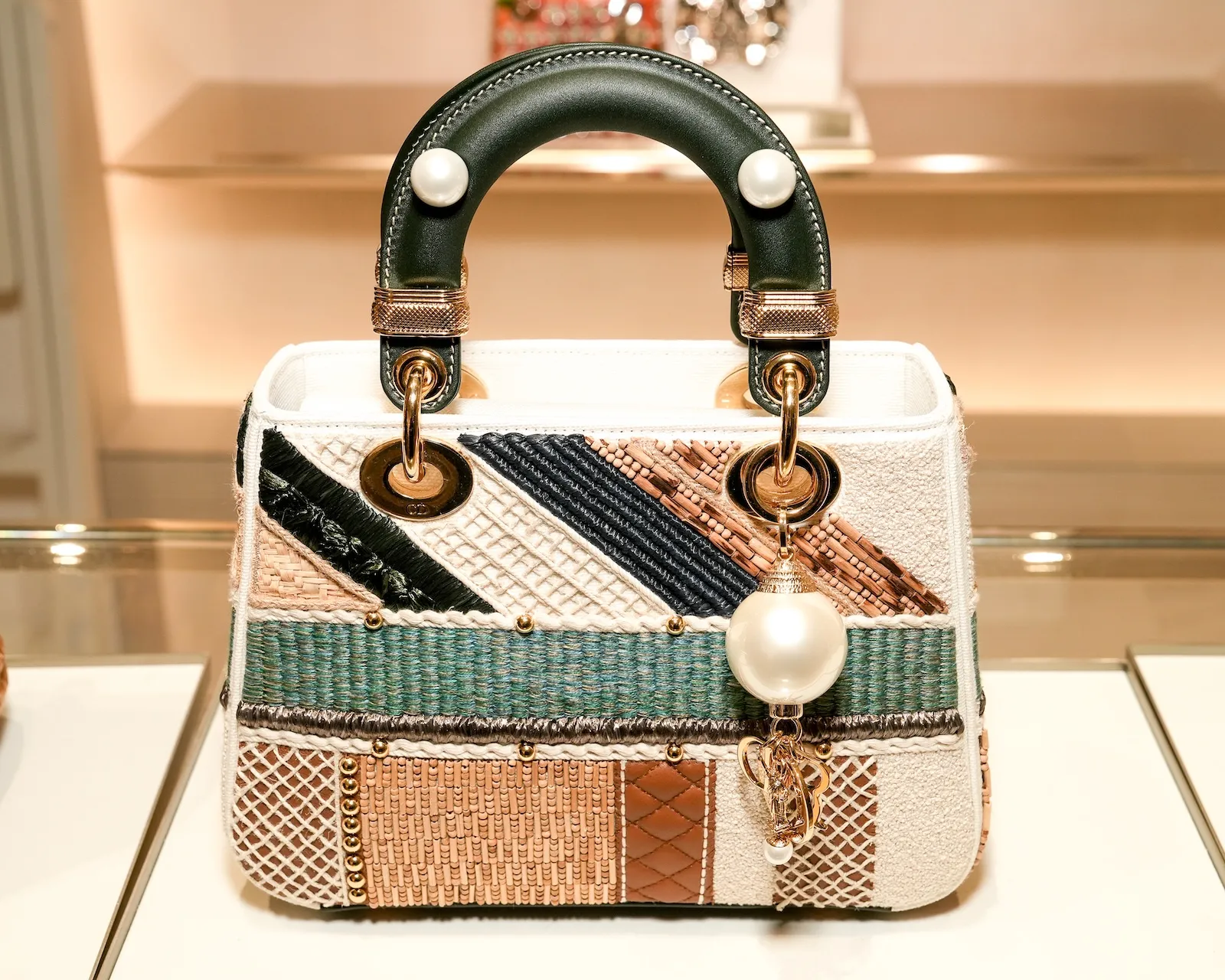
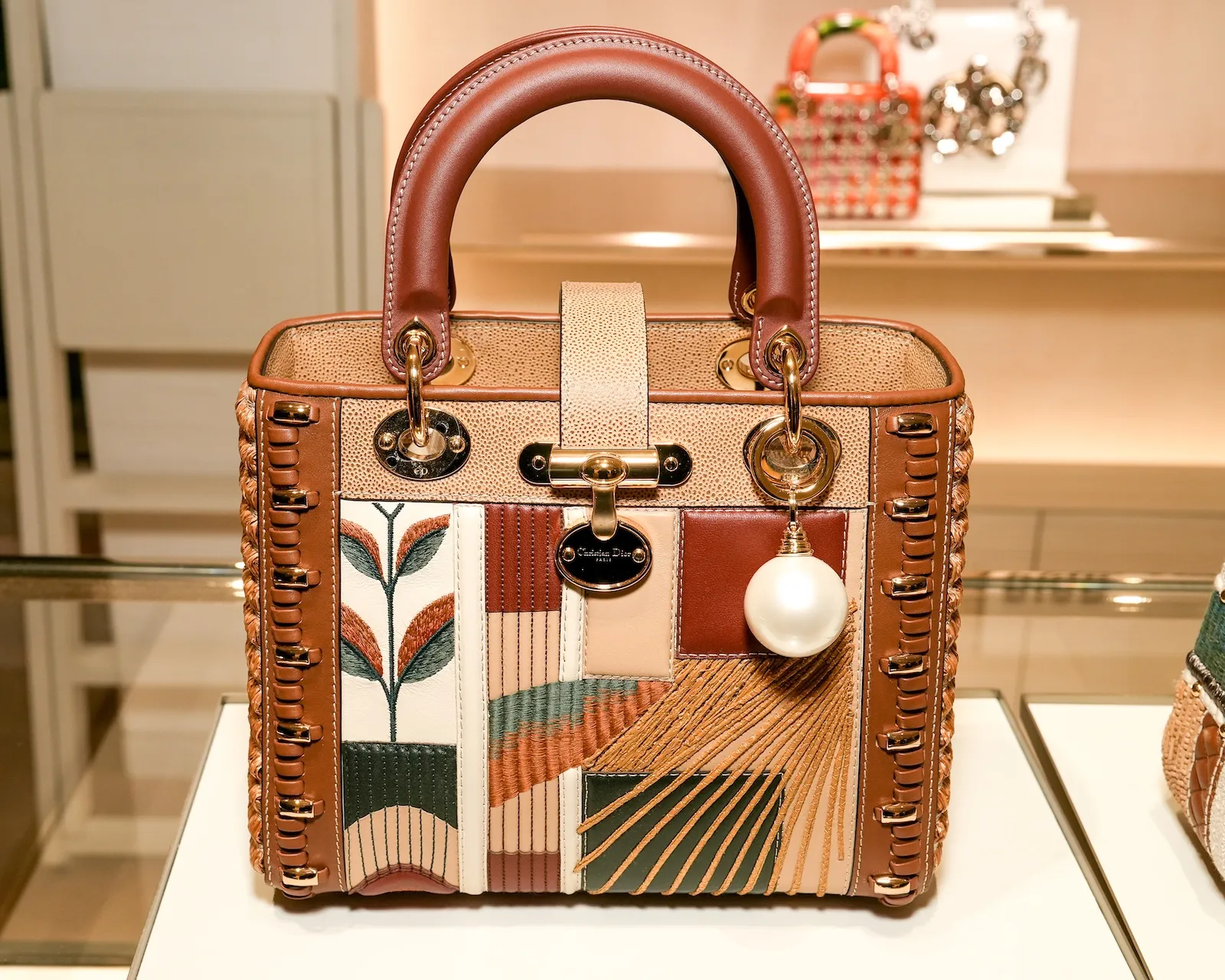
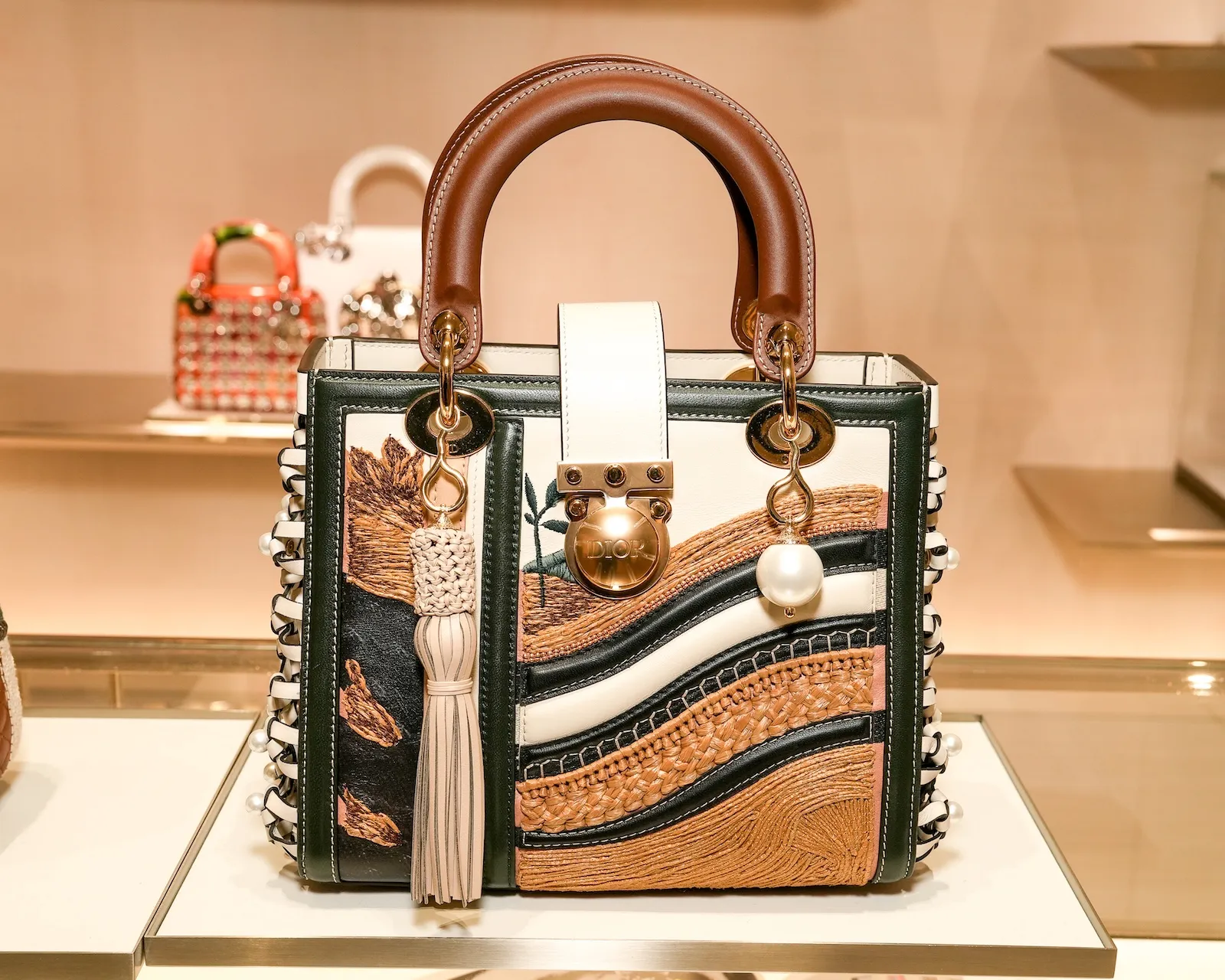
Each year, Dior invites revered artists from around the world to create their own Lady Dior bag, a project known as Dior Lady Art. On its 10th anniversary, Patrick Eugène of Mariane Ibrahim Gallery offers the "Pearl of the Antilles,” three Dior Lady Art bags made of raffa embroidery, macramé, woven straw, textile patchwork, and complemented with a large pearl.
Brooklyn-born and now based in Atlanta, Eugène is a Haitian American painter who began working in abstract expressionism. Through his self-teachings, his paintings have evolved into large-scale pieces that reflect a more figurative practice, always in reflection and honor of his Haitian heritage. His Dior Lady Art follows suit, not only in the name, the "Pearl of the Antilles”–a reference to Haiti’s nickname during French colonization, when the land and the people were exploited and enslaved in what would eventually lead to the Haitian Revolution–but also in the use of materials, colors used, and design implemented, which to Eugène, evoke the literal landscape of Haiti.
Eugène’s Dior Lady Art bag debuted at Art Basel Paris, followed by a celebration back in Los Angeles at Dior’s newly opened Rodeo flagship location. The bags then made their way to Art Basel Miami, where they were exhibited as part of Dior’s collection. After the flurry of activations and presentations, Eugène considers the bags’ future in “hoping that the people who wear the bag understand the narrative behind it, and can carry it with some type of pride to know that this is coming from someone who is reaching back into their history, into their family's history, and trying to shine light on the positive aspects of that.”
See below, FLAUNT in conversation with Eugène as he explains the ethos, process, and collaboration behind his Dior Lady Art creation.
I’m curious about the very, very beginnings of this collaboration. How did Dior approach you? What did that kind of conversation look like?
There are a couple of people at Dior who have been collecting my work for a couple of years, and the gallery I work with, Mariane Ibrahim Gallery—they're based in Chicago, Paris, and Mexico City–she's developed a really cool relationship with Dior personally, and they reached out to her to get to me and ask if I would want to do this collaboration.
I was kind of familiar with some of the people in the team already, just because they've acquired my work and, you know, revisited and acquired more, so their names would pop up often. I've gotten to meet a couple of them on my trips to Paris.
I made a bunch of sketches, not knowing how many bags this was gonna be. I thought it was just going to be one bag. Eventually, they actually chose three of the sketches to develop, which was really awesome. The process was just honestly seamless. It was really cool. In addition to the sketches, I sent over a write-up about why I thought it was important to approach it the way I did.
My family's from Haiti. I'm of Haitian descent. I was born here in the US, but Haiti was referred to as “The Pearl of the Antilles,” which is a really nice phrase, but they didn't benefit from that, right? It was more about what could be taken from the land. I want to reclaim that term, and do that within this collaboration—working for a French fashion house, I thought it was a cool opportunity to do so. So I wrote that up, I submitted my drawings, but I also had a cousin of mine make some digital renderings to try to make it look as real as possible. I submitted all of that, and they were very happy to just receive it and go “all right,” and they supported my vision, just completely. They didn't try to change anything. They flew out to Atlanta, where my studio is, and came with a couple of suitcases worth of materials, and we just sat there and started clipping materials to the Lady Dior bag and seeing what we could come up with based on the sketches and the ideas. They took that back to Paris and worked on it for a few months, and then flew my wife and myself over to Paris to double-check on that. We made slight adjustments then, and they made it happen. You never know with these collaborations—this is honestly my first collaboration, and for it to be Dior, it could be intimidating at first, but they were truly supportive of my vision. Whatever I came up with, they were down to try to make it happen.
We’ve started to see this more and more nowadays, this kind of marriage between the arts and fashion houses, institutions, and corporations. What does that relationship look like as an artist with a clear vision for your creation? Are there ever differences?
From my personal experience of what I've heard from other artists, I think [Dior] really just leans on artists to go with what they want to do. If you look back, there are some really experimental bags, right? Things that artists are just like, “This is exactly what my practice looks like, and it's exactly what the bag is going to look like.” It was said to me in one of these meetings, “Hey, listen, doing this your way allows us to experiment with things that we maybe would have never even tried before,” and so I think they see it as a mutually beneficial collaboration. They treat it as such. It's a little different than working in your studio, where whatever you create is whatever you create, and there's no input or anything like that. I did have to take that into consideration, because I'm not fully versed in creating a bag or fashion in that sense. I had to consider what limitations there were, when I was making sketches. But honestly, everything I presented was made, to my surprise. Raffia is a material that's used in the Caribbean quite often, and they're weaving baskets and making hats out of it. We did some really intricate things with this raffia on these bags. I was being ambitious with it, but they made it happen. And that was a super pleasant surprise. I couldn't believe it.
You typically work in the 2D, portraying human beings. But what did the creative process look like for you, to make something that will be held, and is a bit more physical? How did it differ from your typical creative approach?
Prior to working in figuration, the way I do right now, and representational work, I worked in the abstract for like 10 years, primarily. And so there was always this thing, how do you make an abstract piece evoke a feeling without something being, essentially, presented to you and told what it is, right? That's something I really, more so than figurative words, I've worked in my career for a longer period of time, and so when I got this opportunity, I thought it would have been an easy way out, just to kind of take an image of one of my works and put it on a bag—although that could have been beautiful too. I thought this was a project that allowed me to do something way bigger than myself, and kind of get the chance to work in abstraction again.
They’re kind of landscapes. Two of the bags kind of emulate the hills and the mountains of Haiti’s landscape, and so that's what I want to pull off. I pulled my color palette. I wanted to make sure my color palette was recognizable, and that was my main thing. There were a bunch of paintings that I referred to, that I drew colors from and made sure to stay consistent in that way. This allowed me to work with a different medium. I've always experimented in my practice, whether the pieces that you see out there in the galleries or museums, now, may be one way, but in my studio, there's constant experimentation. I'm trying 3D, I'm trying a little bit of sculpture, some assemblage, you know, just a little bit of everything. So when I got this opportunity, I was like, cool, like, let's make a sculpture out of this, you know. And it gave me that opportunity to do so, and then have, these experts that know the materials kind of finalize that and contribute to that was the cherry on top, you know.
I know you're obviously working with a lot of different materials, like the pearl, of course, and then the textiles, the leather. Can you talk about how you landed on those [textiles] and what they represent?
The pearl is the big one. That's the theme of the entire bag. So I wanted to go really big with it, and whatever material we had to use to make it feel like a big ass Pearl, that's what I wanted to do. We use that to represent the island, you know, the country of Haiti. And then the raffia, and there's a little bit of bamboo and things being used. That's all, you know. . . It's what I saw my parents having around the house. It's what I saw my grandparents having around the house when I visited Haiti. My first time going to Haiti was in 2010 after the earthquake, and I went every consecutive year afterwards. These are the materials you see being used. And so I wanted to make sure that I was honoring that. And then I also knew there were things like leather and gold that Dior masters and, they're really good at. And so I wanted to kind of make sure I stayed true to myself, but also understood the collaboration, and knew what they were good at. And so I wanted a little bit of both. And then just a way to elevate, you know, these other materials, which you know, it's all perception. What makes this more valuable than that, right? And so I think it was, in a way, to honor the craftsmanship of the people of the island, by laying it next to some of what we consider these luxury types of materials, right? And kind of elevate them all at the same time.
Also, working with so many, with so many different materials...I would imagine that it would be easy to make things look busy, but it flows very seamlessly.
It’s really like how you would approach a painting. It’s about where you place certain things that balance out the piece. So, as I'm painting, there's this intuition, because I don't use reference photos when I paint. So it's always this intuition. If I'm hanging out in one corner of a painting and I'm creating this going, “Oh, there's something that draws me to this particular spot on the other side of the canvas that makes it connect.” It may just be using that same color, or maybe a certain movement that works well, and is opposite to what is happening in that other corner of the canvas.
I think I've always been intuitive when it comes to design. Interior design, paintings, I just kind of know the balance when it comes to certain things. You don't want one of the materials to overpower the other. So I played around with it. It took a while to come up with these sketches and everything. You know, you guys saw the successful ones.
Do you think that kind of comes with being self-taught? You kind of just have to put it all out there and see what happens?
Yeah, you know, I mean, [being] self-taught is a blessing. All credit to everyone who's studied. I think it's important as well. But I think there's some freedom that I have where I'm not really thinking about so many of the written rules. I just follow my intuition, right? I’m just following my spirit. And I'm a very spiritual person. When I embark on these things, I do meditate and pray on things, and ask for guidance. I think that I've been put in a situation where I am able to channel some ancestors in a way, and speak to people and other artists that were in my family in previous generations, and just kind of open up that vessel. It’s all been from the gut. I'm a very observant person, so I'm watching everything all the time. Whether it's consciously or not, I'm always absorbing something. It's just how I've always been since I was a child. And so I think, you know, subconsciously, there were color variations or different materials that I've seen over the years that I just thought would be interesting in this.
Sounds kind of like a flow state.
Yeah, for sure. You just kind of go with it. When you're in the studio, there's less restriction, because you make the piece, and when it's ready to go out to the world, it goes out to the world. And that's all it is, right? You don't need approval from anyone. You don't need to send it to a second person to kind of check it out with. With [the Lady Dior Bag], it’s a little different. There was a little bit of anxiety with that part. It's like, okay, I created this, and this the way I wanted to be. Now, how do they receive it? Are they going to try to change things, or am I gonna have to go back and forth with this? It wasn't the case. And that was very surprising for me.
Your work is a homage to your Haitian heritage, which is kind of a personal thing, but also is something that can't exist without community. And your work has now traveled the world to Paris and Hong Kong and all around America. Has sharing your work with so many people impacted your own relationship to where you see its purpose at all?
I think just overall, being–this has happened very recently, just having conversations with the Haitian community specifically, right–they're very proud of this collaboration. I've been having meetings and sitting in front of people, you know, embassies and things like that, that I never thought would happen. I think what it does, it just kind of opens up another way to put things into context. Haiti is never really–there's never a light shown on the country. It's always negative media. And growing up, you know, you would be a little embarrassed about it, a little shy to tell people that you're Haitian. Because all you read in the news, when you turn on TV, you're seeing poverty and all that. I think I took it upon myself, I grew older, to really research and dive into the history of Haiti, a little bit more than my parents told me. You find that Haiti has such a rich, rich history. And history that's actually changed the entire Western world. Being this revolutionary country that beat Napoleon and went ahead and assisted other countries to defeat him and his army. It's something that I take so much pride in now. So I think just overall, besides specifically Haiti, I think art allows us a way to really look into history in a different way. For me to be able to communicate this, it can open up doors for more conversations, and for us to rewrite some of this history, and to shine light on the important things and the positive things that people have done, rather than just trying to put them in a box.
I don't want to get too political with it, but it really does fulfill me to be able to have these conversations in my own little way. And hopefully some of these other people that are cheering me on, can take it their way, and start a conversation in another way.
Especially in [art], a space that is historically so exclusive.
Of course. You know, I wouldn't even call it a risk. I'll just stay true to myself. With this, whether they liked it or not. I mean, with all respect to Dior. I just want to make sure I put my truth out more than anything. That's what artists are supposed to be for. I did understand that I could have just put something that was very noticeably my work on the bag, and it would have been great for my branding, maybe. That didn't matter to me at all. I thought this was just a good opportunity to do something really cool and impactful.

Stay up-to-date with exclusive events and content.


