F L A U N T


What does a young luxury watch company have in common with the world's most decorated pastry chef?
At first glance, and to the untrained eye, not much beyond status: the backing of LVMH on one side and the blessing of Michelin on the other. One is constructed to trace time, running smoothly and effortlessly, indefinitely. The other takes the fine dining stage each night to perform living art. Yet both depend on precision, measured in fractions of a second, on the wrist and on the pass.
They also share a relationship with age, from opposite directions. Hublot, founded in 1980, is young by watchmaking standards, and it is that youthfulness that gives it room to explore and play without compromising on materials. Chef Anne-Sophie Pic arrives from the other end of time. She is the fourth generation of a Valence family that has cooked at the highest level since 1889, and with 10 Michelin stars, she holds more than any other woman in the world. Between them stands Chef William Bradley, a San Diego native who built Addison into his hometown's first three-star restaurant and has held all three stars ever since. He doesn't call his watch a watch. He calls it a timepiece, the way collectors do. For two nights only, the three came together to assemble a dining experience fittingly named "A Timeless Collection."
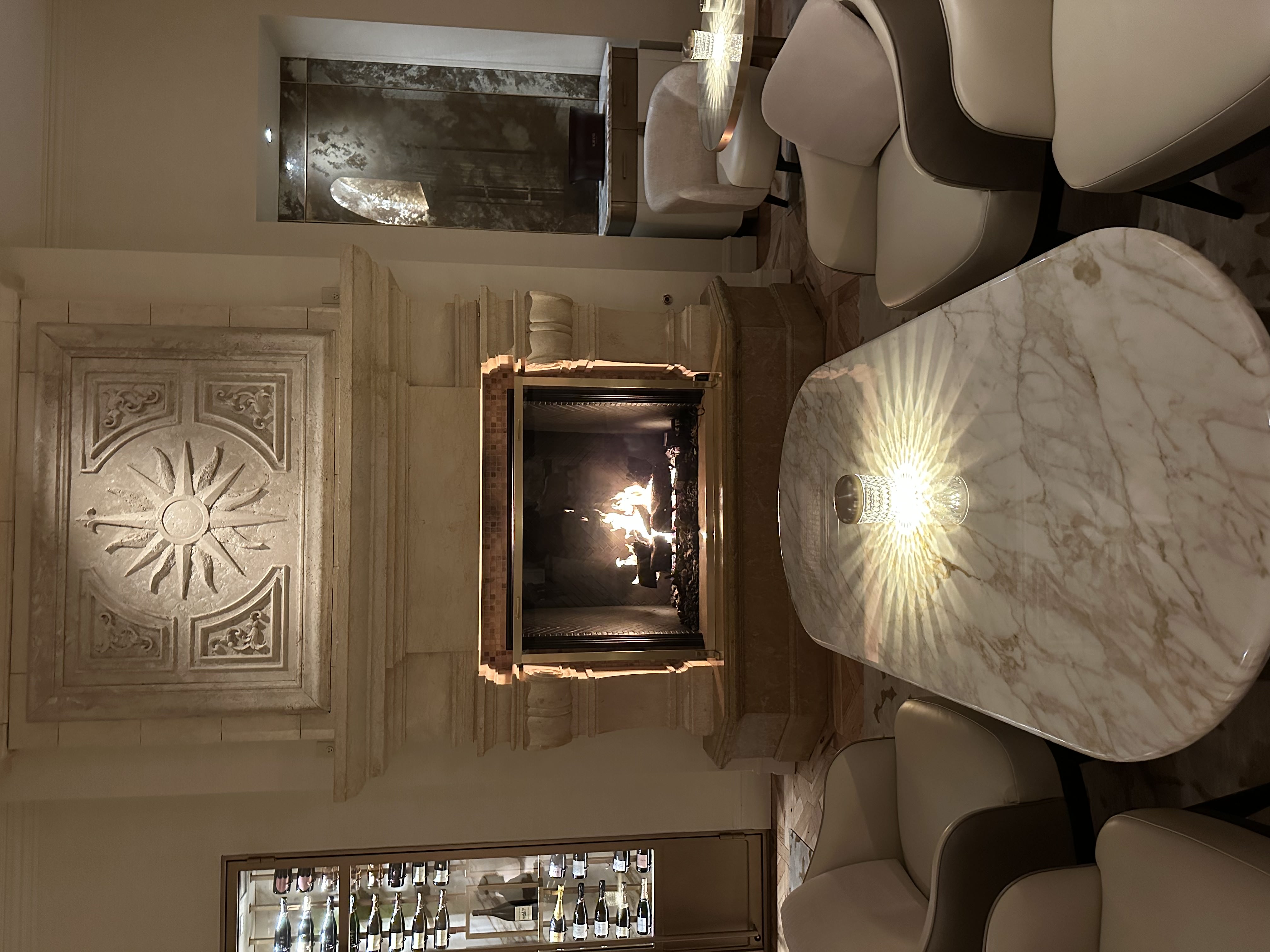
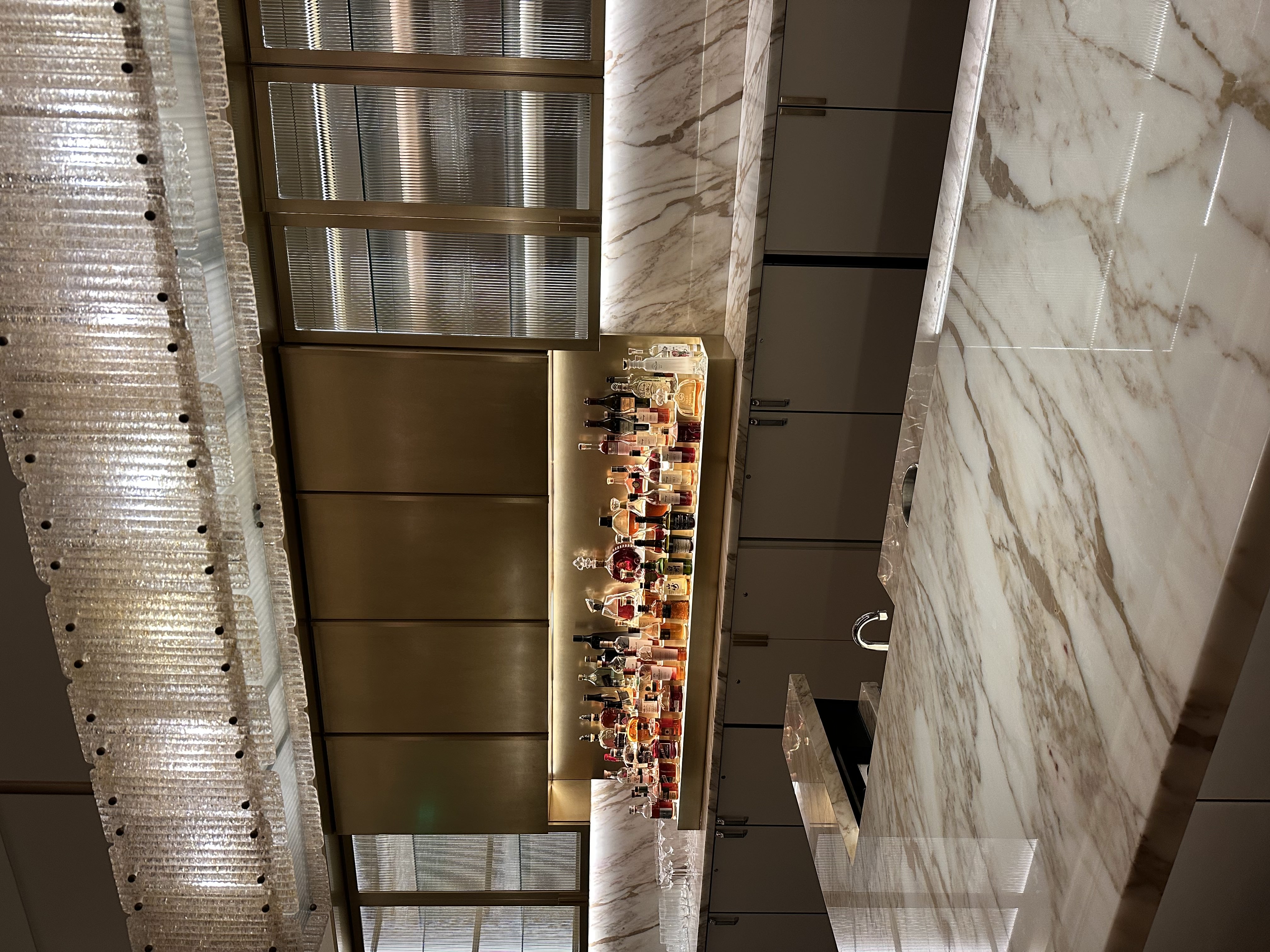
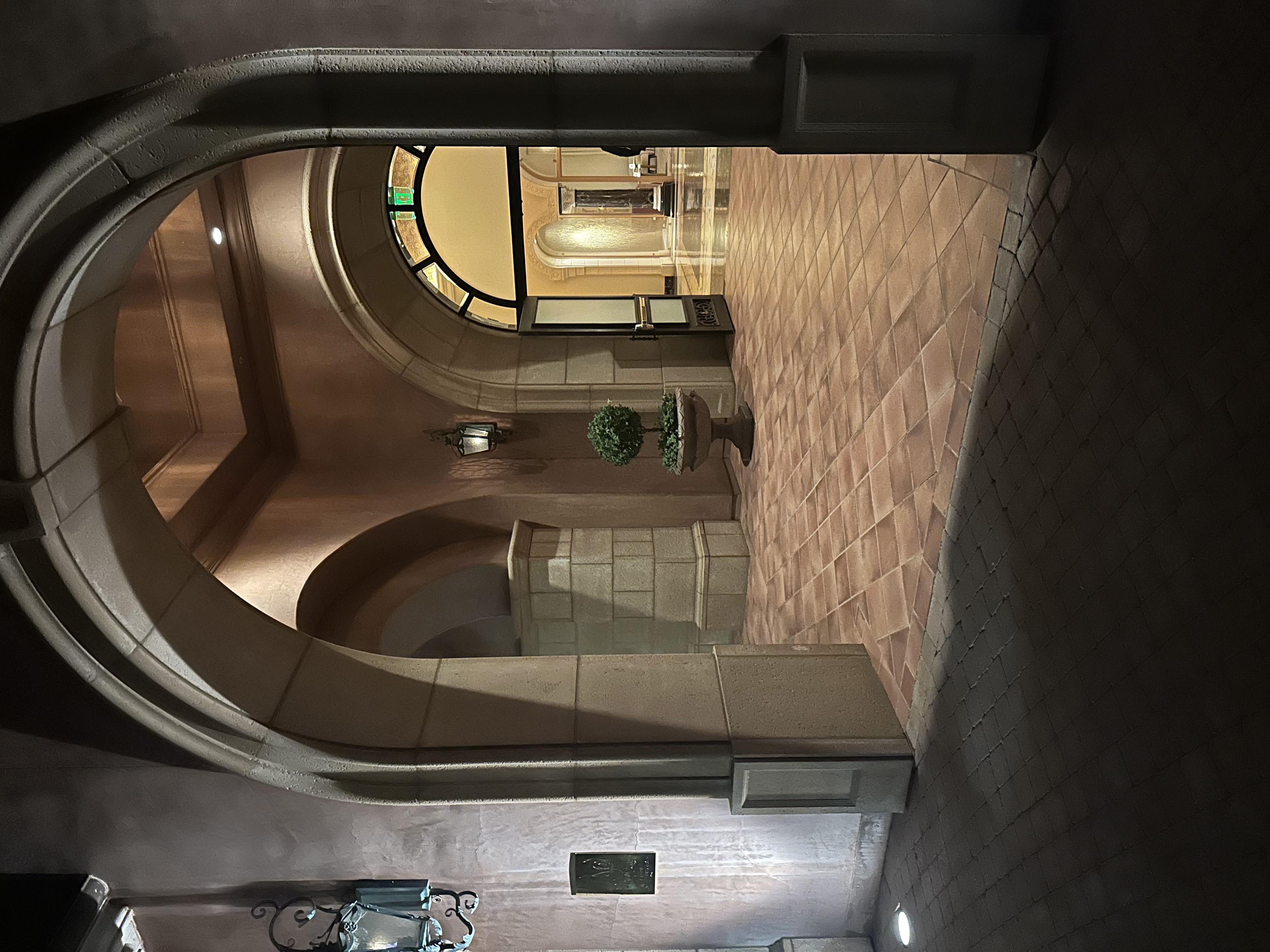
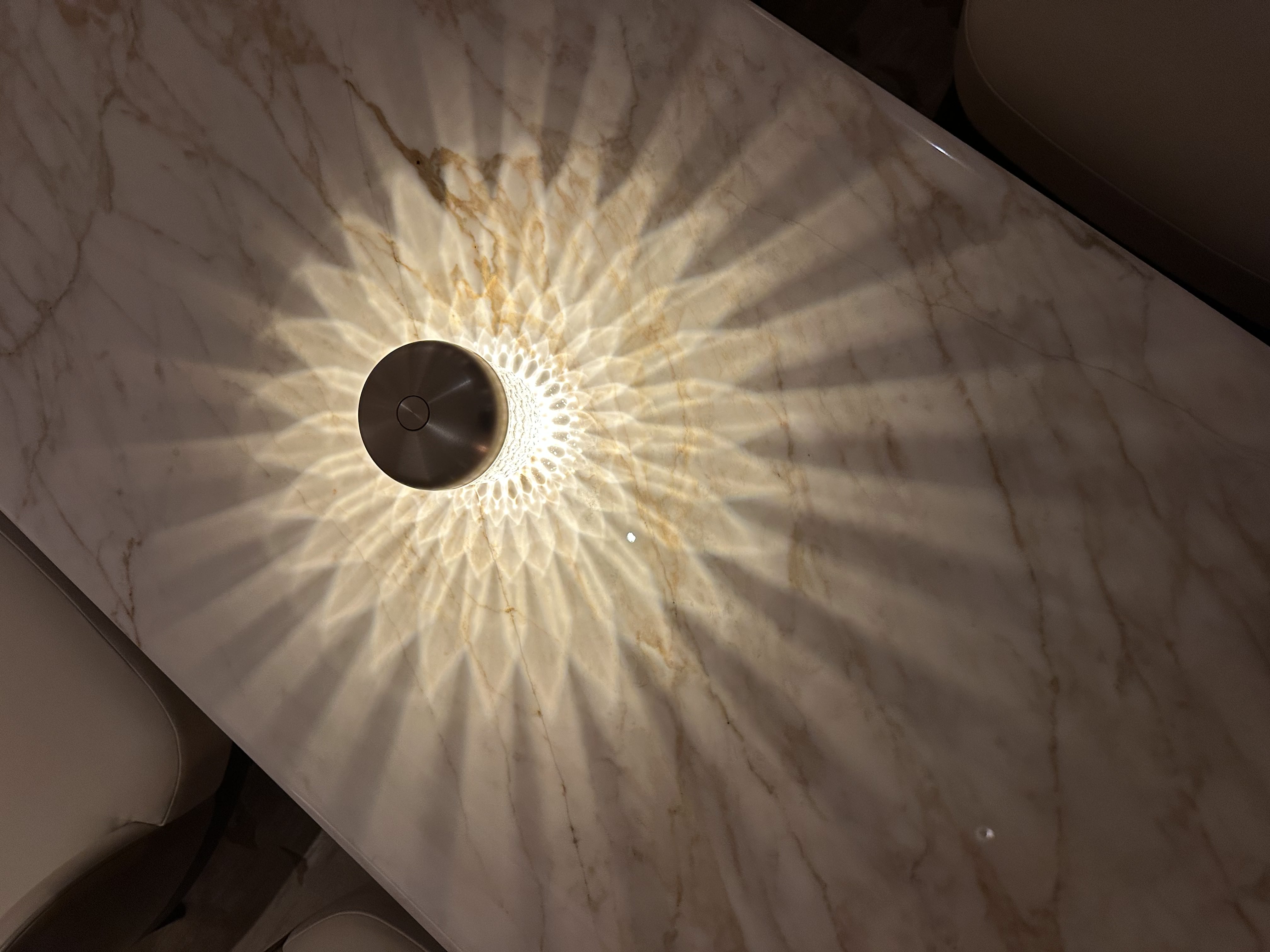
From the outside, Addison looks like the rest of the Fairmont Grand Del Mar: old-world and opulent, a Mediterranean reverie of arches, grand stone and meticulously manicured grounds. But step through the arched doors and you are immediately aware that you are no longer in the same place. What looks like a doorway is, in actuality, a portal. Inside Addison, your eyes are drawn to the white marble floors running beneath high vaulted ceilings. Colors of sand carry throughout, and a stone hearth greets you with a sun carved at its center. On the marble table before it, a small crystal lamp scatters rays of warm light in a circle, a second sun answering the one that watches from the hearth. To the right, a sleek, long bar glows amber, backlit by the bottles it holds.
At first, the dining room feels almost too open. Too big. Too bright. Too cold. And then, you sit down. Or rather, you are seated. A chair meets the backs of your knees at precisely the right moment, guided by someone you didn't see arrive. Like the movement inside a fine watch, the machinery is invisible. You only notice that everything is on time. And for the next few hours, time is the one thing you stop keeping.
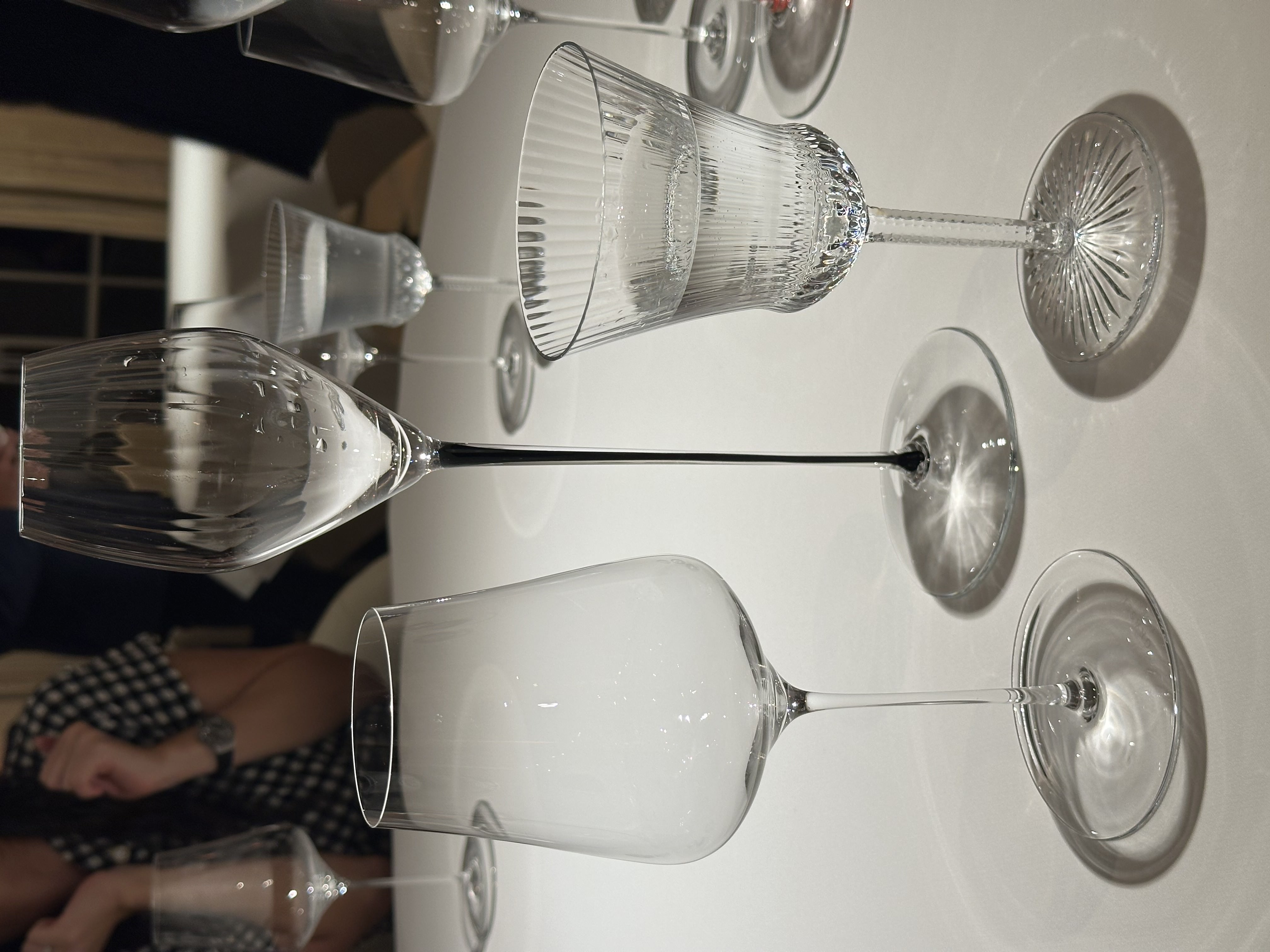
The room that felt too large contracts to a spotlit circle of white linen and six pieces of crystal stemware, each foot cut into a starburst, echoing the suns in the rooms before. Your table should, by all considerations, be loud with the clatter of other guests moving through the space. It isn't. It's tranquil, and the kitchen that is silent throughout service, plays its role.
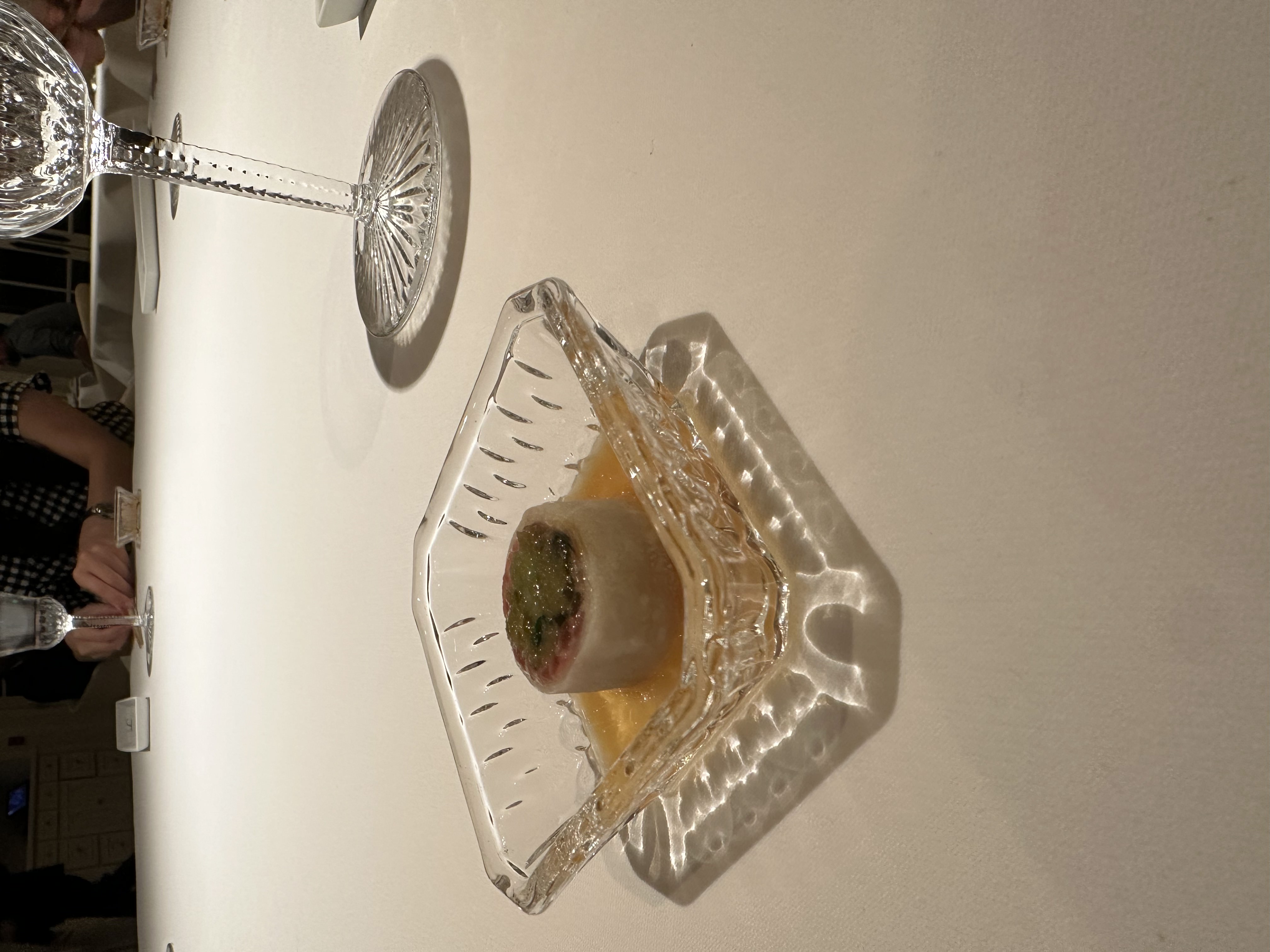
Over the next three and a half hours, the table fills and clears, then fills again, with the luxuries you'd expect at a three-star: caviar, Krug, wines older than the host Hublot itself. But the unexpected luxuries linger longer. A mint leaf hangs suspended in a lollipop of Chartreuse. Wild fennel, the same kind that springs up wild in San Diego, arrives beside a puff pastry shaped so delicately into a rose that it brings tears to your eyes to destroy such beauty in one bite.
There is something about a room like this that braces you for pretension. Maybe that's simply the effect of being among so many fine things and so many names that carry weight. But the meal itself is anything but cold. It is emotional, even tender. A nod to its creators. Every pause between courses feels intentional; an invitation to slow down and notice the moment you are in. Even the ludicrously long stemware is in on it: it makes rushing impossible. The people serving you seem to know exactly how rare this moment is, and they want you to know it too.
Bradley has admired the Pic name since he was a young cook, when Michelin was a European fantasy and The Great Chefs of France traced a lineage he would one day join. After Addison earned its third star, his eldest daughter looked at her father and his circle of three-star friends and asked, "Where's the females?" The answer was a family pilgrimage to Valence and to meet Chef Pic. When Addison's 20th anniversary approached, Bradley, a Hublot "friend of the brand," brought the idea to the watchmaker, which counts Pic among its ambassadors.
.jpg)
"I had the idea," he says. "They just had to say yes."
Bradley approaches a collaboration the way he approaches a concert. "If I go to a concert, it's because I want to hear this music, because I admire the composer or the band," he says. Some chefs visit other restaurants to compare. "I only go based on if I love the work."
So he gave his guest carte blanche. Pic chose her courses first, and Bradley’s team built the rest of the menu around them. The result is a rotation in which you can taste how closely the two chefs are intertwined and how distinctly each remains their own. If Pic's cooking is the movement, then Bradley and the Addison team are the case. Her cuisine is delicate and precise, refined down to the petal, with florals, teas and sour notes that nod to her love of Japanese ingredients, a passion the two chefs share. His team provides a structure sturdy and generous enough to let that delicacy shine, while still finding room for play, like caviar arriving on a lemon textured taco. Neither overpowers the other. They lift each other up, celebrating each other’s artistry along the way.
What makes this Addison x Anne-Sophie Pic collaboration a timeless collection is what it leaves behind: In Europe, Bradley says, chefs at the highest level champion one another rather than compete, and in America, "we're getting there." Nights like this are how American kitchens get there: two chefs setting competition aside and making room for inspiration and evolution. Hublot is building its legacy one partnership at a time. Pic is passing hers to a fifth generation. Bradley measures his by how many of his cooks will go on to earn what he has.
Before the second night of service, Flaunt sat down with Chef Anne-Sophie Pic and Chef William Bradley at Addison to talk about the meaning of luxury, what makes a craft timeless, and what keeps them inspired to continue to create at the highest level.
When people think of luxury ingredients, caviar or truffles are quick to come to mind. But you both have a talent for turning simple ingredients into a luxury. What’s something you love to work with that the average diner might not see that way?
PIC: It's a very good question in the sense that we always consider what our guests would like to have first, and it's quite similar to what we want to have also. I was very surprised by something Chef Bradley said to me: "I adapt my cuisine to the modernity of the time." We have all been working in this industry for years, and we have the feeling of adapting ourselves without leaving our soul. It's a very good sensation.
Like evolving with it.
PIC: Yes. People are looking for wonderful ingredients like truffle and caviar, and we source them very carefully. But simple ingredients sometimes demand more. I like to cook with vegetables. I am from a region with a lot of vegetables and fruits, and I like to cook very simply, with things like beetroot, because they enhance the main ingredient and make you think more about it. On the other side, I also need truffle and caviar, because people are looking for that. So it's a balance.
BRADLEY: We live in a world now, especially in the US, where the customer is very educated and very well traveled. This is a different time for us. At the end of the day, I think luxury means cooking within the seasons, which people did so long ago. As Americans, we're starting to understand that more. People wonder why things taste so amazing, and it's because we're using things within the season.
Alain Passard is a perfect example. At one time he only used the finest lamb, the finest caviar, the finest turbot, and now he only uses vegetables. His team had to adapt the way they handle a carrot, treating it just like they used to treat a kilo of caviar or truffles. If you take that mindset, and you're very intentional with how you handle a product and give it the right texture, that's very luxurious.
I think texture is a luxurious thing.
It's a real luxury now to know how to handle an ingredient in its peak form and season.
.jpg)
Do you have any favorites that are unique to San Diego's terroir?
BRADLEY: I love wild fennel. It grows everywhere around here. Everywhere you look on the side of the freeway, it's wild fennel. You'll try it tonight in one of our tarts. I love that licorice-y anise flavor, and it's very floral. Our tomatoes are great, too, and our seasons are longer here. But wild fennel is something I really love, and you can find it anywhere around here.
Timelessness is central to Hublot's identity. You've both dined at so many places, met so many incredible chefs, and come from such strong lineages. What do you think makes a restaurant or a chef timeless?
PIC: There's a difference between fashion and modernity. Modernity has a history, and fashion is like this [snaps fingers]. I think we both have a kind of modernity, as we have the capacity to evolve with the times. I'm from Vallée du Rhone, you know, its in my roots. And the soul of Valence, is something very precious for me because of the following generations. So I think modernity is much more interesting than fashion.
To be timeless, we have to think about modernity, and soul, and spirit.
BRADLEY: Hublot does a great job selecting its gastronomy partners, because what they've developed is just like their timepieces. If you go to the Maison in Switzerland and watch how everyone works, there's the precision of an old watchmaker, but they're modernizing through technique, innovation, and a certain aesthetic, feel, and texture. It's the same way with their chefs.
At this level, our foundation goes back to the lineage. We have a really good understanding of haute cuisine and where it comes from, but we've modernized it for the times we live in.
This timepiece here is completely different, but it's still classic with the bracelet look. It looks modern because of the color, the texture, and the feel. The parallels are very similar between haute cuisine, haute couture, and great watchmaking. It's a craft and an art. You have to understand the craft, and you have to have an artistic mindset to be different. Otherwise, you're just going to follow the path of someone else.
You're both at the highest level, and you've said this work takes obsession. What keeps you going? What inspires you to continue?
PIC: Obsession is a new dish: how to make it, and to really think. You know, I think its good to be here for one week because it gives energy also. When I come back to France, my mindset will be different. And my next obsession is my son. He just started in the kitchen.
He's very young, and he tells me things, not about the dishes but about the organization. It's very good to have him start from the beginning, because he's a new generation. He's beginning at the very first level in the kitchen, and he doesn't want another position. He doesn't want to be chef de partie, because he says he doesn't deserve it yet. He prefers to be a commis first. But it's a very difficult industry, and we can say that to our young people. So we pay a lot of attention to the energy and to what we build for the younger generation.
BRADLEY: That's been very important to me, and it was brought to my attention over the years by Thomas Keller, a mentor and a great friend for many years. He instilled in a lot of us American chefs that we need to make the next generation better than our own. The younger generation is very skilled, very smart, and very savvy with technology. They can get things done faster. So we have to adapt and change the way we do things, because they learn much faster than we did.
It's a very rigorous profession, and you have to be very dedicated and obsessed to reach the highest level. But you can do it in a different way, and it should happen quicker. It's what we call knowledge transfer. I take the knowledge I have and transfer it to you, so you can keep growing it. When I started, you worked garde-manger for four years and made terrines for two. It's so different now.
Did you have to adjust your teaching style for this younger generation?
BRADLEY: Yes. Your methodology has to change. They want to be led. You just have to change the way you lead them. My team today is better than it was 15 years ago, hands down. They're smarter, they're quicker, and they look at things differently. So I bring them in earlier in their careers and let them experiment sooner than I was allowed to, and you get results much quicker. The team here now, today in 2026 is better than it was in 2005. I think now is better than ever.
I can have all these stars and be ‘The Chef’ but I think the true testament is when I'm done, how many chefs who worked for me are doing what I did. That's what I feel is the most important. That's your legacy.
Thank you both so much for being here and being gracious with your time. I’m very excited for tonight.
BRADLEY: The way I look at dinners like this, and I said it today in our lineup: this will never happen again. This night, this time, this place, right now. Us sitting down will probably never happen again. We have to take time and really enjoy these moments, because they are very special and very unique.
Stay up-to-date with exclusive events and content.


