F L A U N T


.webp)
Halfway through watching a video of Friedrich Kunath’s studio, my attention zeroes in on something small and almost beside the point: a copy of Roland Barthes’s Image, Music, Text resting quietly above the studio bar. It’s not staged or emphasized—simply present, another object in a room of neon signs, polaroids, and foreign vinyl. These objects gesture toward the artist’s play between high and low, sincerity and humor.
That detail stays with me while walking through Aimless Love, Kunath’s newest exhibition, on view at Pace New York through December 20. The show resists immediacy and explanation, lingering instead in what Kunath describes as “a state of intentionlessness,” moments “where the less you aim the better you shoot.” Love, in this sense, is not clarity but “a half knowing,” shaped by uncertainty. “There’s an inevitable unknown to the experience,” Kunath says. “I find that state to be consoling.”
For Kunath, that consolation is inseparable from medium. He returns to music and film as models for emotional connection, balanced against painting, which he has described as more cerebral. “The naïveté in me is always looking for that conciliatory power of film or music,” he explains. “That’s what I’m seeking in my paintings.”
.webp)
The presence of Barthes’s book feels instructive here. In The Death of the Author, Barthes argues that biography often distracts more than it reveals. Meaning does not originate in the artist’s interior life, but emerges through a weave of gestures and references that precede the work itself. Unity belongs not to origin but to destination. Meaning lives with the viewer.
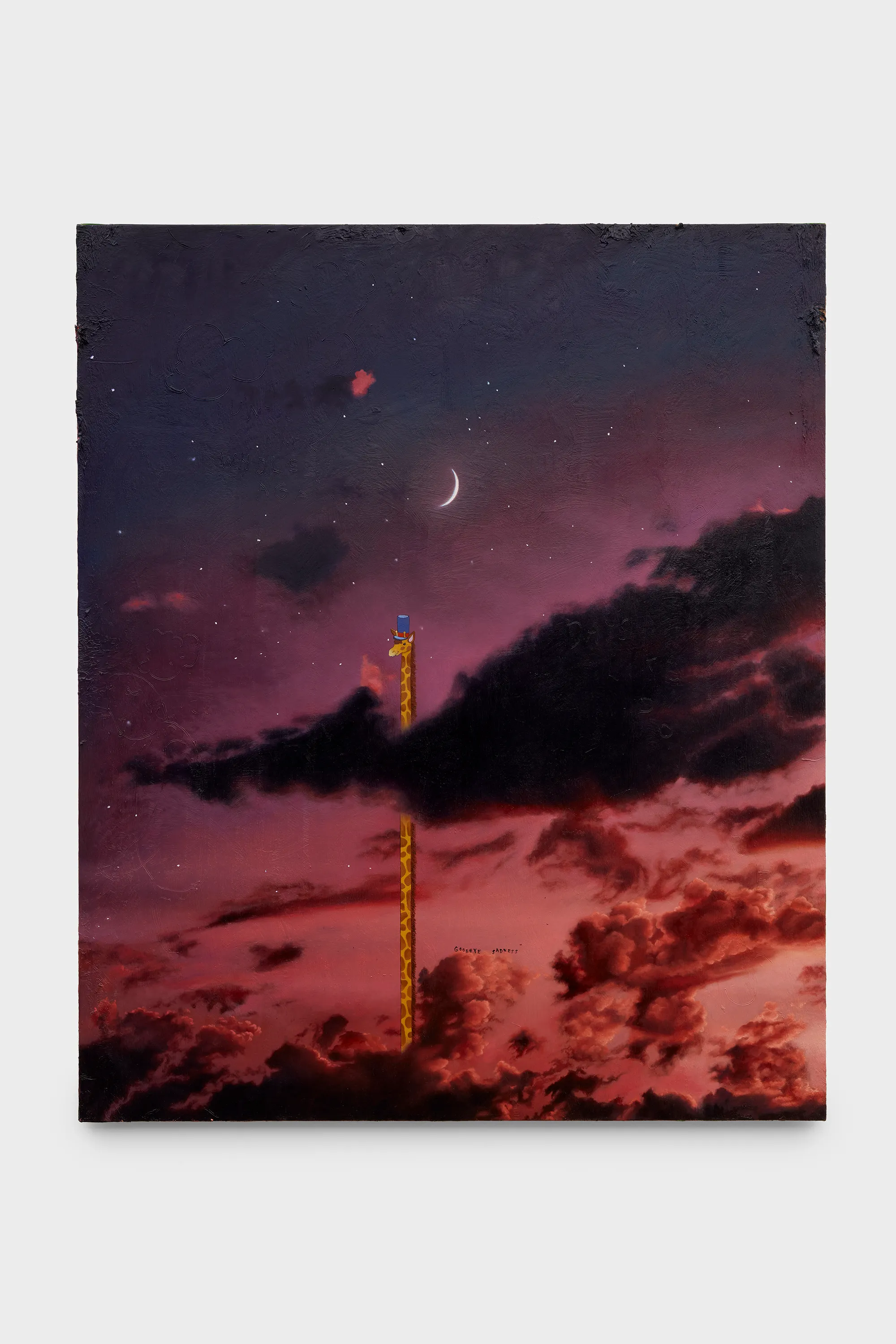
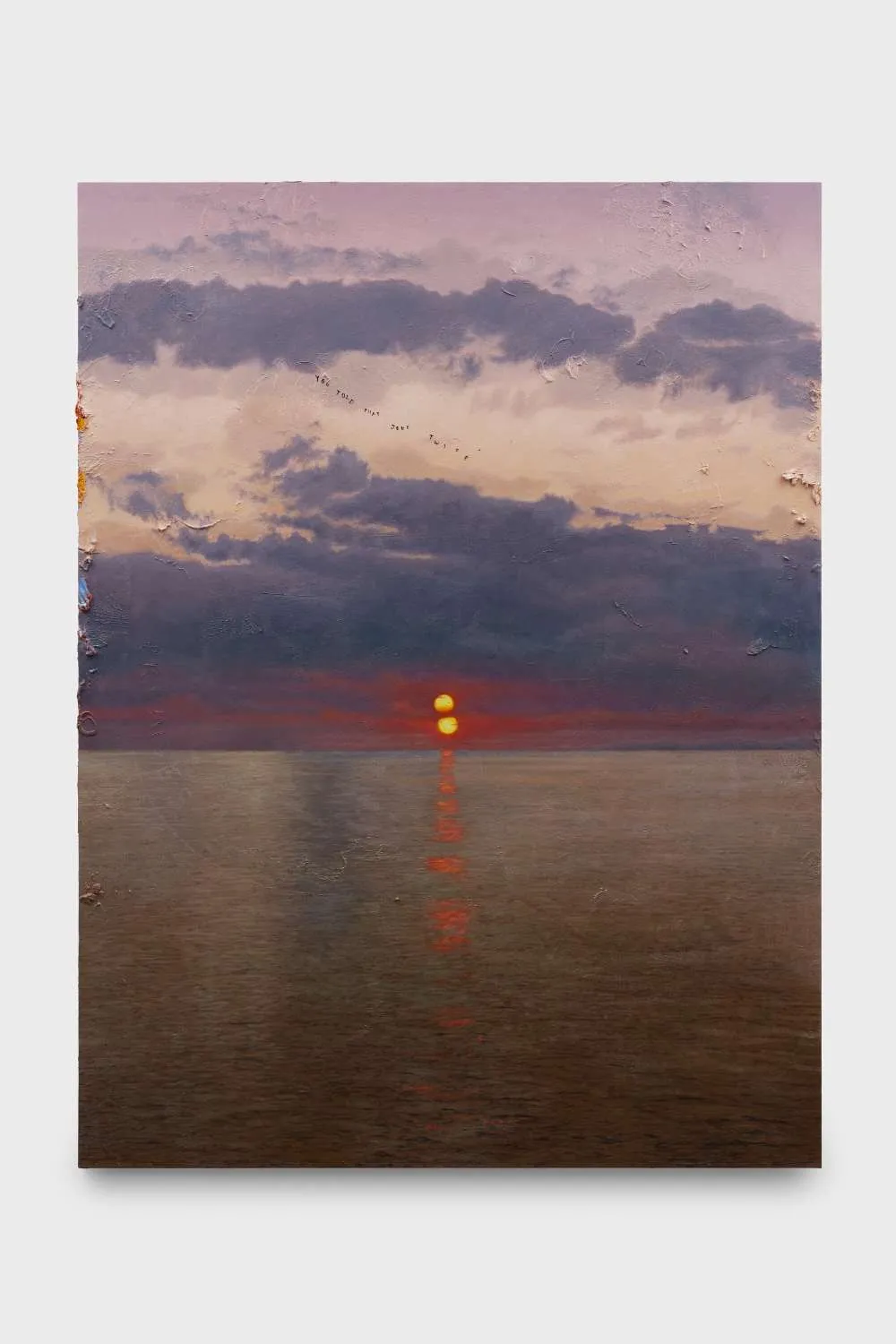
That framework resonates quietly throughout Aimless Love. Kunath’s paintings do not present themselves as confessions, even when they carry traces of private life beneath their surfaces. Handwriting embedded in wet impasto functions as gesture rather than revelation. Phone numbers and to-do lists sit beside abstraction without hierarchy. Over them, Kunath layers images that feel collectively familiar rather than personally owned. Meaning hovers, never defined by a single reference point.
One of the exhibition’s quiet anchors is “If It Comes Let It, If It Goes Let It,” a painting that embodies this suspension. Rendered in deep purples against a glowing orange sky, the work depicts a wave rising just before it crashes. The moment of impact never arrives. Particles hover above the water’s surface, softening the force of the wave. A small plane ascends in the distance, countering the gravity below. A split runs down the center of the painting, stretching the image across two canvases that hold opposing motions together without resolving them.
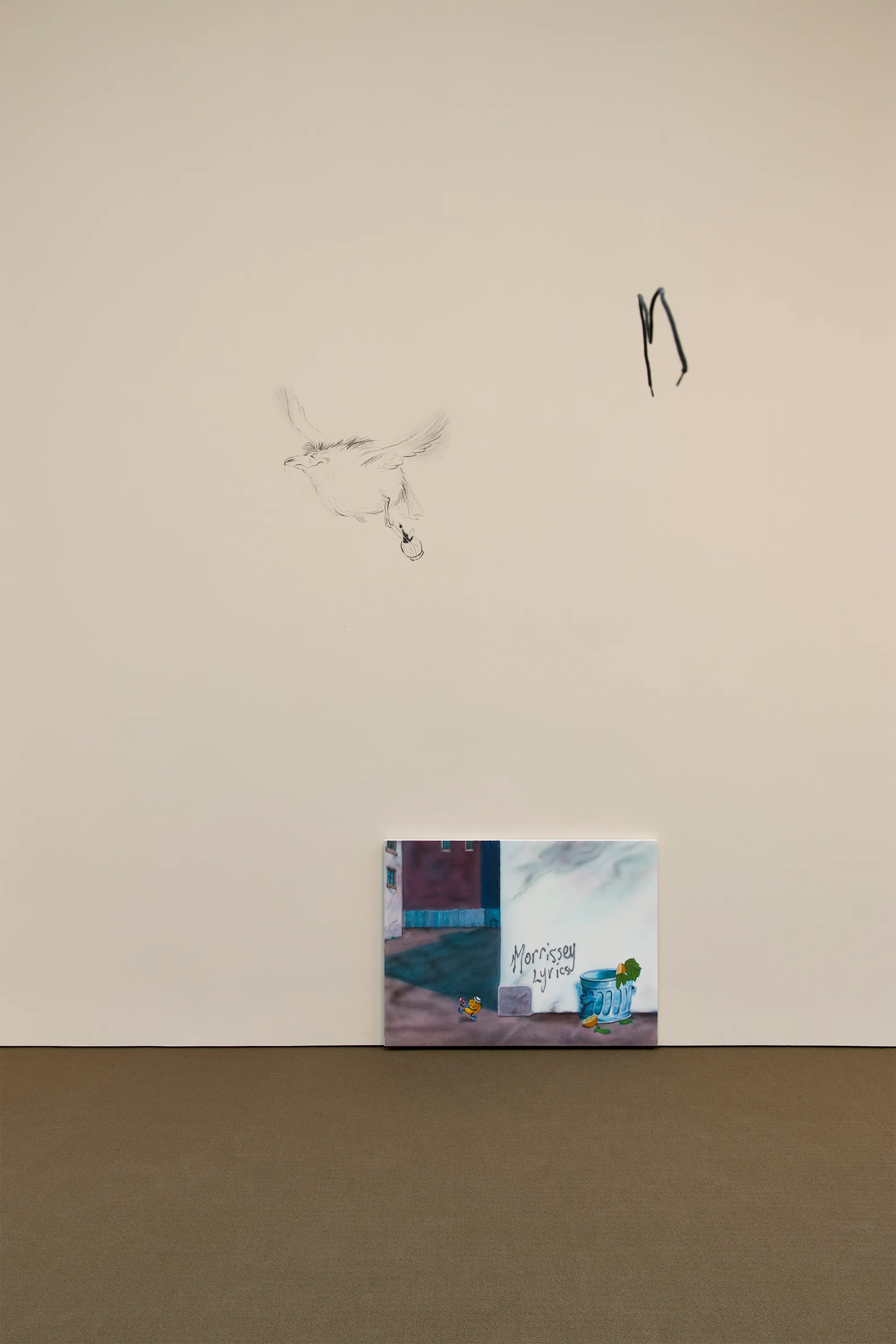
That sense of hovering extends beyond the paintings. Kunath’s “Bird Wall Drawing” executed in acrylic and charcoal directly on the gallery wall, depicts a single bird positioned above a tongue-in-cheek painting of graffiti and a trash can. Simple and wispy lines form a cartoon-like character, a wink towards viewers looking for symbolism in every brushstroke.
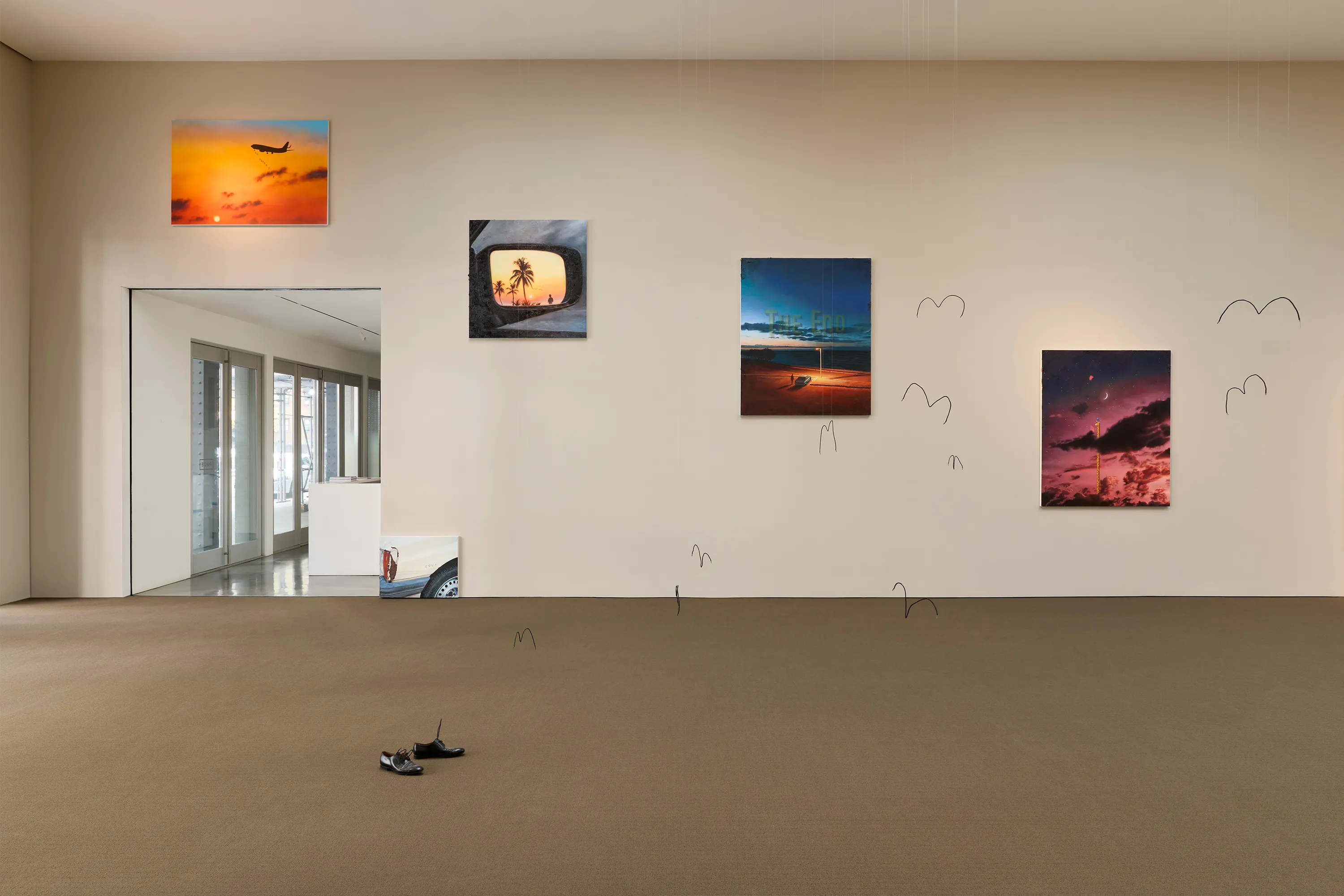
That activation becomes more pronounced in “Following the Feeling”, a sculpture constructed from a pair of dress shoes, shoelaces, wire, and nylon string. Bird-like forms emerge from the shoes and suspend mid-flight. Kunath describes the work as “a more somber, existential take” on an earlier version from 2010. The shift from sneakers to worn leather loafers, he noted, “expresses a kind of maturation process.” Despite those changes, the sensation remains the same. “Ultimately I hope to express with both versions this feeling of roaming,” Kunath says, “of aimlessness under changed conditions.”
Only after this visual language is established does Kunath’s life begin to register, not as explanation, but as continuation. Born in 1974 in what was then Karl Marx Stadt in East Germany, he grew up in a close-knit artistic community later revealed to be riddled with informants. In adulthood, he relocated to Los Angeles, drawn by American popular culture, music, and film. Movement, for Kunath, has never been cleanly liberating. It remains charged and provisional.
Kunath’s process mirrors the emotional openness he seeks in the finished work. “When I’m drawing into the wet impasto surfaces,” he offers, “I descend into a sort of unconscious level of creativity.” Once the paint dries, those impressions remain embedded beneath the image, forming what he describes as “a topography of my unconsciousness.” A recognizable scene arrives only later, resting over a more private interior. The painting holds both at once, never fully resolving the distance between them.
Looking back at Aimless Love, Kunath does not hope viewers leave having learned something about art. “It’s not about…presenting any intellectual discourse,” he said. Instead, his goal is recognition. “To be acknowledged or consoled.” He hopes viewers walk away feeling “like something within them has been expressed and seen.”
Like that unnoticed book in the studio, Aimless Love does not insist on interpretation. Meaning is not delivered, but allowed to arrive slowly, imperfectly, without being forced.
Stay up-to-date with exclusive events and content.


