F L A U N T



Perhaps, nowadays, the most outrageous statement is one that is completely normal. For 30 years, Scandinavian artistic duo Michael Elmgreen and Ingar Dragset have worked to blur the perceptive line between hypermodernity and satire, bloating the vocabularies of the mundane to communicate comedic distance between form and function.
Together, the Scandinavian duo has constructed a Prada store in the middle of the Texan desert. They’ve turned the Musee D’Orsay upside down. They’ve transformed the Whitechapel’s ground-floor gallery into a derelict municipal swimming pool. They’ve reshaped art venues into hyperreal vignettes of non-places in the shape of subway stations, airports, hospital wards and boiler rooms—and this fall, the duo will debut The Alice in Wonderland Syndrome at PACE Gallery in Los Angeles, an exhibition which seeks to exacerbate the perceptive discrepancies between the world at and the world of the mind.
Neither Elmgreen nor Dragset came from traditional artistic backgrounds—before the two met at a Copenhagen gay disco nightclub in the mid 90s, Elmgreen was a poet and Dragset lived in the theater realm. Much of the art they produce feels as such—there is a poetic scrupulousness in their sculptures, a clean matter-of-factness in their presence in a space—with, say, a pile of broken asphalt in a museum, or lifelike silicone man floating face down atop a shallow pool. “We call it dress[ing] up the white cube space in drag for just a little period. It changes its look, its appearance for the period we have the show,” Dragset explains.

Revered scholar Judith Butler has written about drag in its faculties to expose the process of imitation without original: “In imitating gender, drag implicitly reveals the imitative structure [of gender] itself.” The act of simulation, the act of hyperbole, reveals in itself the faults, or perhaps repetitions, inherent to the original structure itself. In Elmgreen & Dragset’s theatre of the Real, the observer is made to feel that the base material off of which they have been inspired (a road, a luxury store, an art gallery space) has only been constructed as an imitation of something else. A simulacrum, a performance of that simulacra.
Elmgreen & Dragset’s longstanding Powerless Structures series considers the idea that structures themselves do not exert power—the series questions the underlying rules and institutions that govern where power flows. One of their first works in this series, “Diving Board Powerless Structures, Fig. 11,” was shown in 1997 at the Louisiana Museum of Modern Art in Denmark, and saw a thick pane of glass extending out of the museum, overlooking a body of water: too high up to jump, but just close enough to the water for viewers to grasp function. The piece’s power hovered, traceably, just out of reach. The thought that was seeded when the artists looked at the lake beyond and how inviting the blue waters looked. Connecting the inside of the gallery to the outside world, the piece provided an exploration of space, its use, and how context forges meaning.
In the same year, Elmgreen & Dragset performed “2 Hours of White Paint / Powerless Structures, Fig. 15,” in which the duo repeatedly painted the walls of a standard exhibition space and hosed them down to start over again over the duration of two months, highlighting the oft-overlooked invisible labor in galleries and institutional spaces. Transforming the mechanics of the gallery into a meditation on process laid the foundation, or rather painted the walls of Elmgreen & Dragset’s universe for experimentation and commentary on the art world.
Dragset explains, “For us, it’s really important to include the people who are part of making the art world what it is, but are often not invited to the post dinner party or are present when you know the spotlight is on but, these people who install your shows that you have long technical discussions with or who are the person who is sitting welcoming people when you are not there in the gallery, or people who archive your documentations and do all the things that are so necessary for the artist and for the gallery, that we often forget.”
The pair’s latest installation, The Alice in Wonderland Syndrome, features a sleeping gallery assistant modeled after a real person Elmgreen & Dragset had witnessed in Geneva. “The front desk person is such an important position, because it’s a person who is supposed to welcome you to the gallery. But as we all know, many galleries in New York have front desks that are so high up you can’t even see the person, you can only see the top of their head,” the two laugh.
Dragset continues. “And if they look up at you when you come in and they can see that you’re just in normal clothing and you don’t look like you have extra 2 million in your Piggy Bank to buy works, they immediately just look down again and continue tapping on their computer. Other times, you come in and people are very welcoming and ask you if you have any questions, if they can help you with something. You feel very welcome in that environment.”

One might extrapolate from the work, gazing at the blonde slumped figure, that the sleeping desk receptionist is “Alice,” and that the surrounding exhibition—and, by proxy, the gallery itself—is the rabbit hole that one falls in the swath of a dream. Playing off of the neurological condition of dysmetropsia (the medical jargon for the colloquial “Alice in Wonderland Syndrome,”), the duo considers the realities of the condition, which is defined as a shift in perception affected by changes in distance and scale, triggered by fatigue. In a place and time in which we are always awake; psychological distortion affects all.
In the gallery, the artists have composed two rooms that look exactly the same—except that one room is exactly half the size of the other room. “From outside their window, so you can look into both spaces at the same time,” they share of the way the gallery behaves as a facet of the installation. “We wanted to have a space that would look identical to the bigger space, but just half the size in all dimensions. Even the spotlights will be half the size of the spotlight in the bigger space…When you go into the smaller room, you suddenly grow to be like a giant. And when you are in the bigger room, you are more kind of more normal size, but the space already has quite an overwhelming dimension. [The gallery] has quite overwhelming dimensions. You feel a bit small.”

Aside from the physical explorations of Wonderland, The Alice in Wonderland Syndrome will exhibit a faceless figure sculpture, wearing headphones—not only unaware of his own surroundings, but seemingly so absorbed in a world of his own invention that he’s not aware of his own lifelessness and blankness: a Humpty Dumpty; a Queen of Hearts, a figure enraptured by a presence undetectable to an outsider.
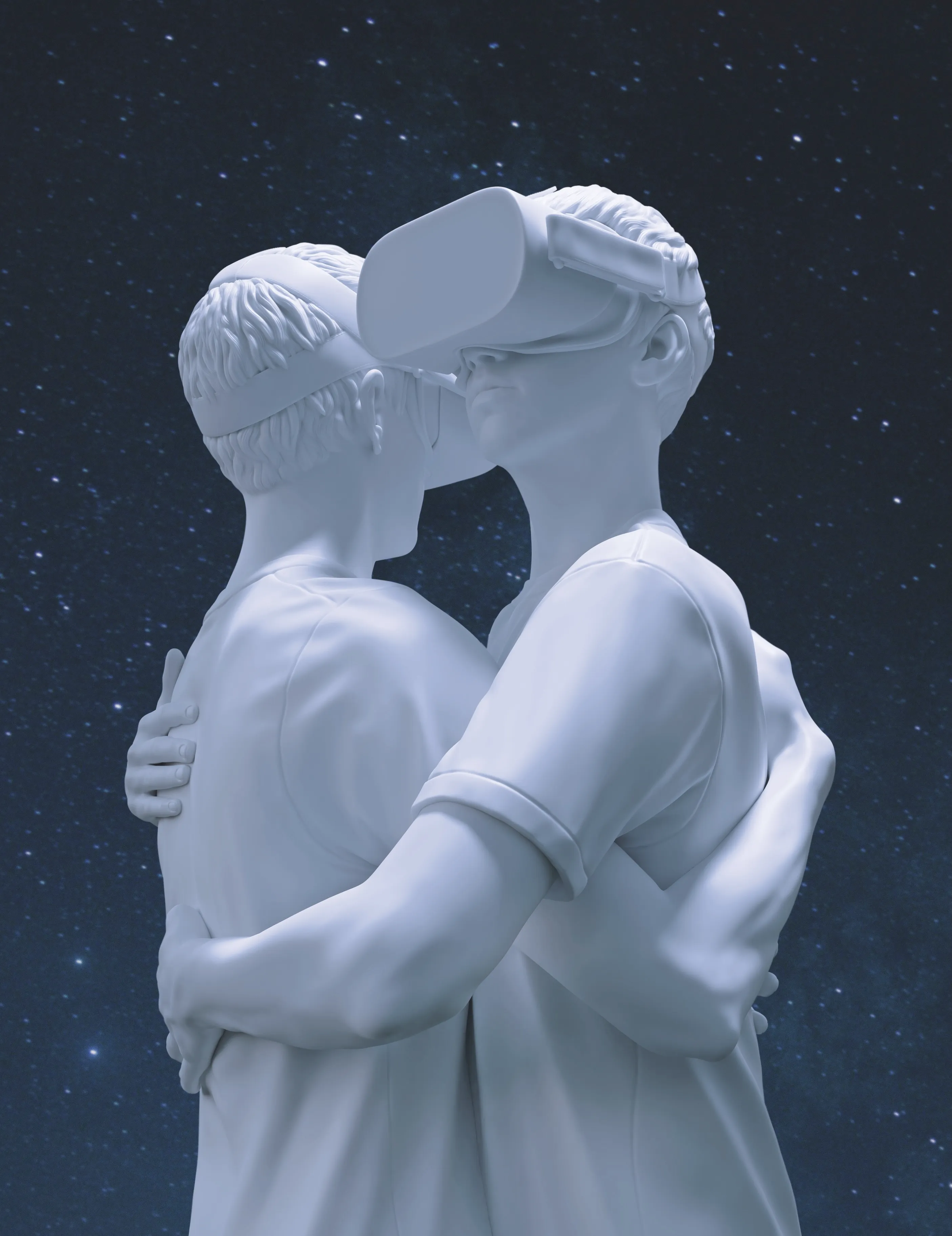
“It’s fun what social media and new technologies have done with our perception of intimacy,” Dragset says. “[We are never] excluding the other, no matter what. No matter where we are, we are in different spaces at the same time…that has influenced our perception of what it is to be intimate. What is it to be private? What is it to be close to each other?”
This very sense of intimacy—in both its overwhelming presence and utter meaninglessness due to its digital ubiquity—is one of the great challenges presented by the modern world. The online conundrum is perhaps an overwrought one, its impacts explored, in one way or another, by nearly every living artist or musician or creative putting out work today. The 350% increase in the average person’s information consumption since 2000 is inarguably unhealthy and unnatural and yet, unavoidable, though it presents the question: Can we make art that’s not about the hyperpresent? Must all art be about simulacra?

The most unique facet of Elmgreen & Dragset’s work is, it feels, their resistance to that artistic impulse—they’ve been exploring reality and hyperreality for longer than these problems have been present. Their subjects have never changed, but the teleological terms of their art have, with their work made all the more relevant as time has passed and technology has progressed. The duo does not issue warnings, or necessarily lament the loss of connection—one could make the argument that Elmgreen & Dragset have maintained longevity in the art world because of their work’s absurd, clinical timelessness; operating in a cerebral modality that exists because of, within, outside of, the information age. It is because of this that the two still want to keep going, to keep iterating new challenges, to confront new audiences.
“It’s a joy to keep on being surprised, surprised about how your artworks function when they’re realized and meet the audience,” says Elmgreen of his longtime artistic partnership with Dragset. “We have the joy of being surprised by each other.”
Stay up-to-date with exclusive events and content.


