F L A U N T


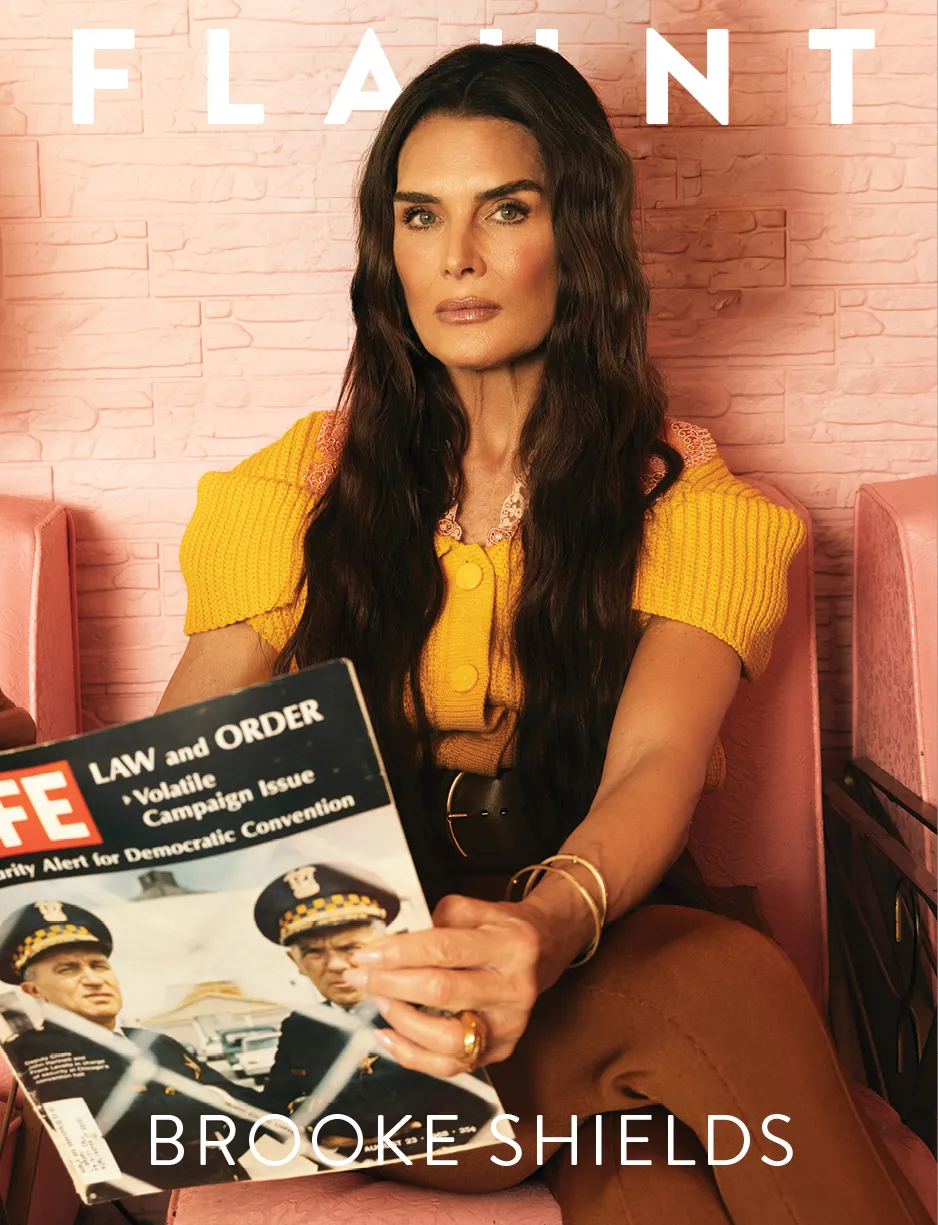
If you flashed Back to the Future and woke up somewhere in the early 1980s, there would be one face you’d see more than any other. There was always an irrepressible vitality to Brooke Shields. A Pre-Raphaelite on roller-skates, the desires of an epoch were projected upon her. Born in Manhattan in May 1965, she’d booked her first commercial campaign within the year. From there, Shields’ profile steadily rose. There was no one else like her. Cascading waves of dark-chestnut hair, crystalline blue eyes, glowing, downy skin, power brows, Bambi lashes, lithe-limbed and tall, she was poised, professional, and always polite. Her off-duty style was perfectly preppy, and there was a goofy, intractable sweetness to her demeanour. Massive early exposure of her winsome yet wholesome healthiness meant that images of the model and then actress blanketed all media formats of the time. “Brooke Shields” the image—and above and beyond, Brooke Shields, the teenage person—became a potent symbol, and a signifier of fresh, natural appeal forever immortalized in the collective imaginary.
What built this quintessential American beauty? She’s as cosmopolitan as her home city. On her paternal side is Italian nobility with French roots (replete with ancestral links to historic palazzi throughout Rome, including the Neo-Classical Villa Torlonia) and enterprising Scots-Irish immigrants who are the source of the ‘Shields’ surname. Lauded for their athleticism, her dashing grandfather Francis X. Shields, ranked No 1. in US tennis in 1933, and her father Frank excelled in rowing. More immediately useful to survive gritty, grimy Taxi Driver-era NYC were the Newark, New Jersey street-smarts of her mother and manager Teri, who had escaped grinding urban poverty and family tragedy through sheer moxie. And she wasn’t going back. It was Momager’s active ambition that set, and kept, her pretty baby on the path to fame.
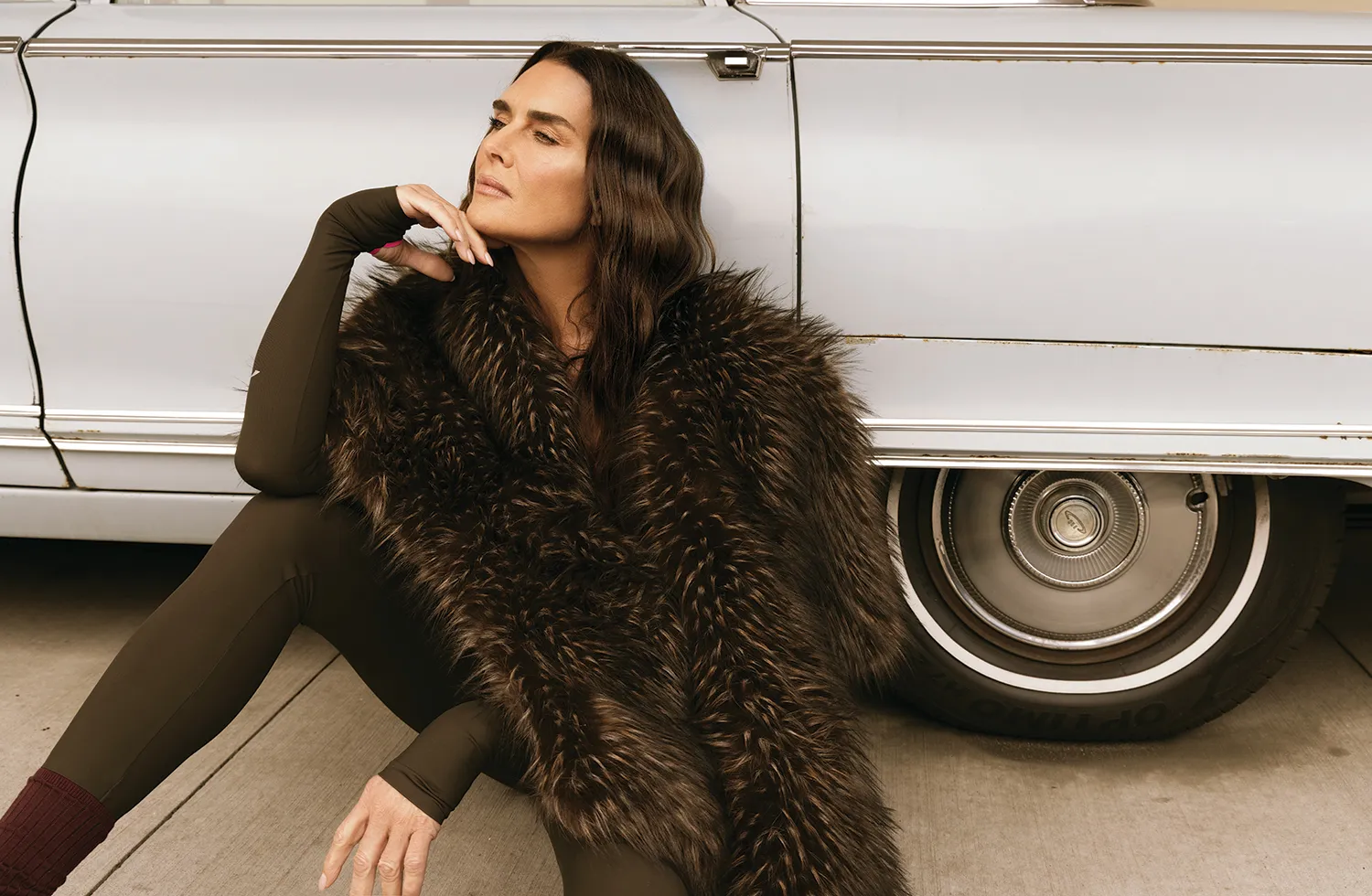
Brooke was always…the moment. She had the run of Studio 54, giggling with Andy Warhol as the party swirled around them. Booked both Calvin Klein and Versace campaigns with visionary photographer Richard Avedon in the same year. Was flown to Rome to star in Valentino’s spring show. Glowered over Gotham from Times Square billboards. Gambolled with Laird Hamilton on a Cabo beach for a LIFE photoshoot, in which she is featured on the cover, shot by Bruce Weber. Spent a summer in Fiji lensing The Blue Lagoon, a coming-of-age island adventure that outperformed both The Shining and Raging Bull at the box office; bronzed and sea salt-tousled, she carried the film and ignited a hormonal avalanche in an entire generation. And so much more. Agent Eileen Ford stated, in the February issue 1981 of TIME magazine (her client was on the cover, shot by Francesco Scavullo) “Brooke is the phenomenon.”
After being worked so hard for years at this hectic pace, smiling and selling every line thrown at her, it would have been understandable if her first instinct after gaining the age of majority would have been to escape the gaze—start an animal sanctuary in the South of France, sail solo around Antarctica, retreat to mountain ashram in the Himalayas, become a beekeeper in Spain. Leave it all behind forever. No more pictures. Brooke did take a break, studying Romance languages at Princeton in the mid 80s, but she came back to the entertainment industry on her own recognisance. She had no intention of cruising through life on remnants of her early exposure. Rather, she doubled down. As an all-grown-up actress, she fought to carve out her own path, on Broadway (Grease, Cabaret, Chicago) and with comedic turns on some of the biggest broadcast sitcoms of all time: Friends, Two and a Half Men, That ‘70s Show. Her own NBC network vehicle, Suddenly Susan ran for four seasons, earning Golden Globe nominations and a People’s Choice win. Brooke’s been booked steadily in every decade: Entourage, Nip/Tuck, Hannah Montana, she’s the current president of the Actors’ Equity Association.
In 2026 when we speak, Brooke Shields, the person, is 60 years old, just about to turn 61. She remains poised, professional and polite, a mature mega babe who steers her own ship, carefully selecting the productions and products she chooses to lend her aura to. We join her on the road, for a race through present, past, and future.
***
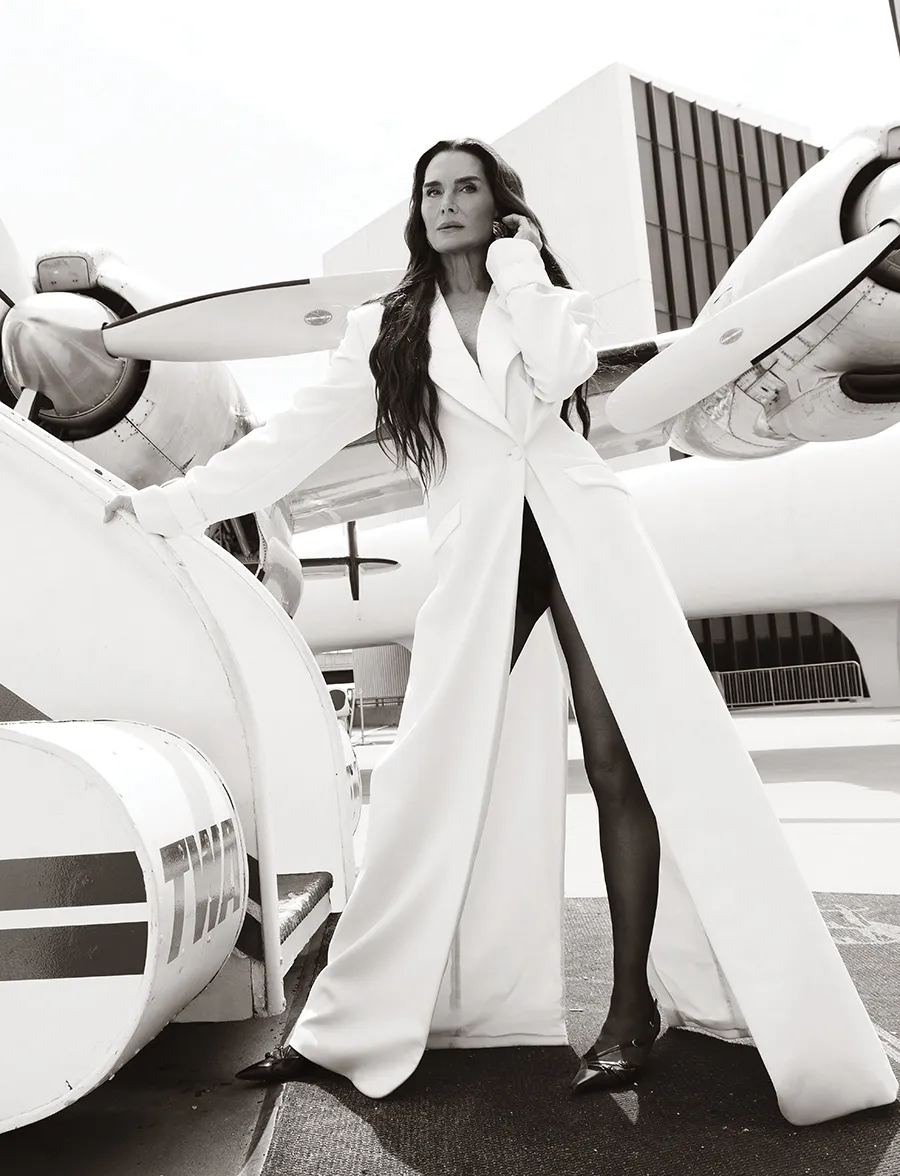
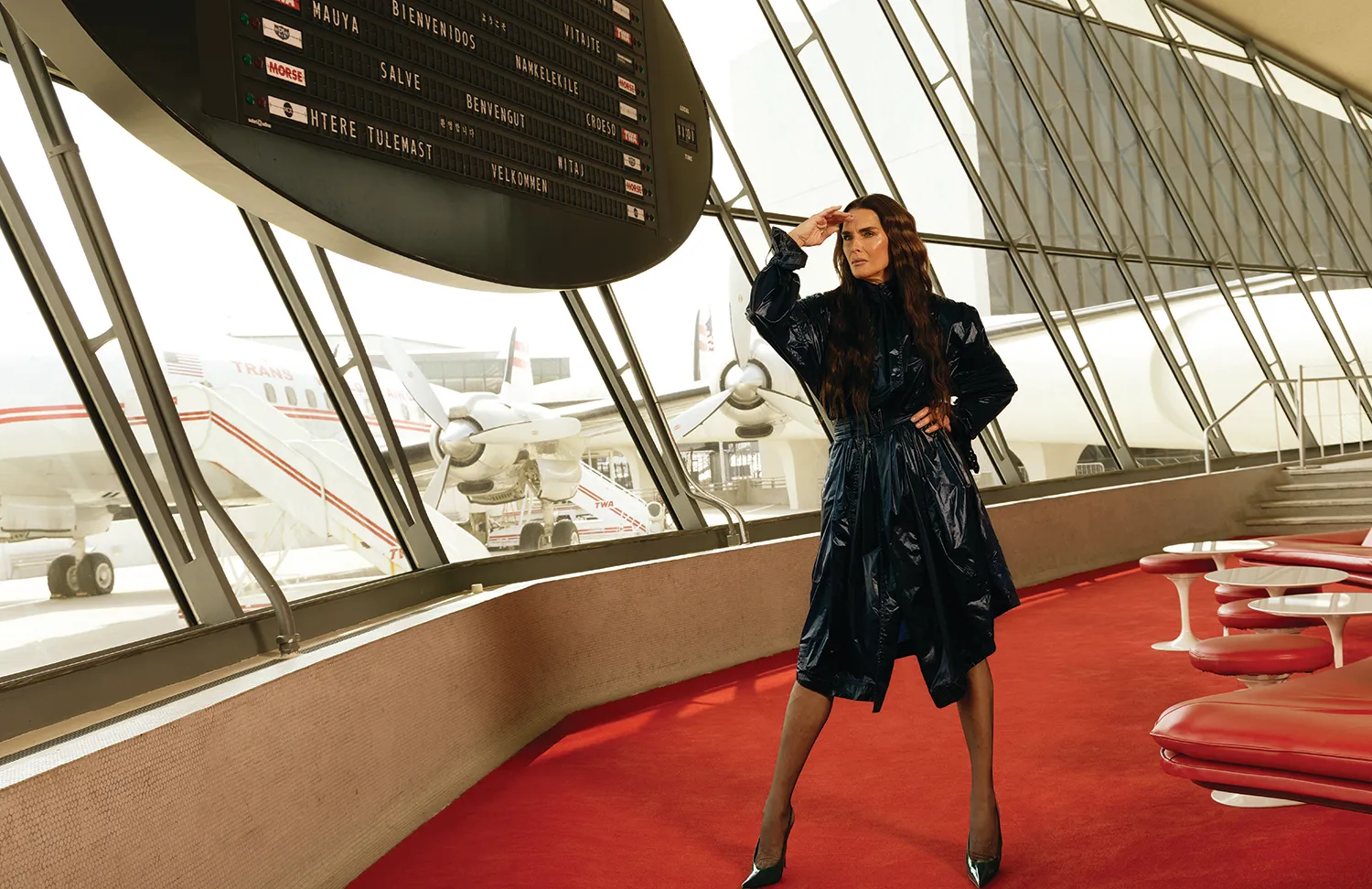
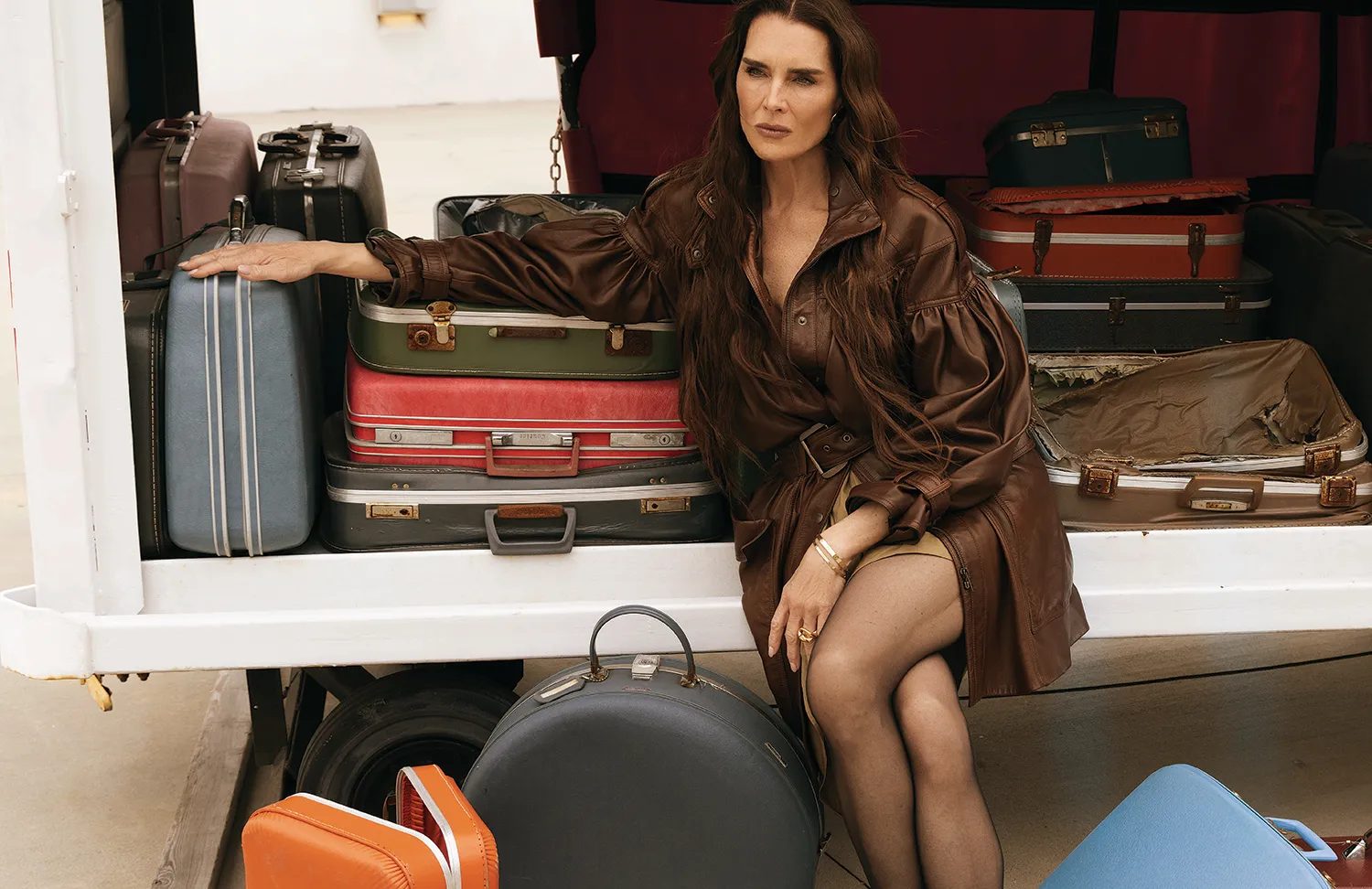
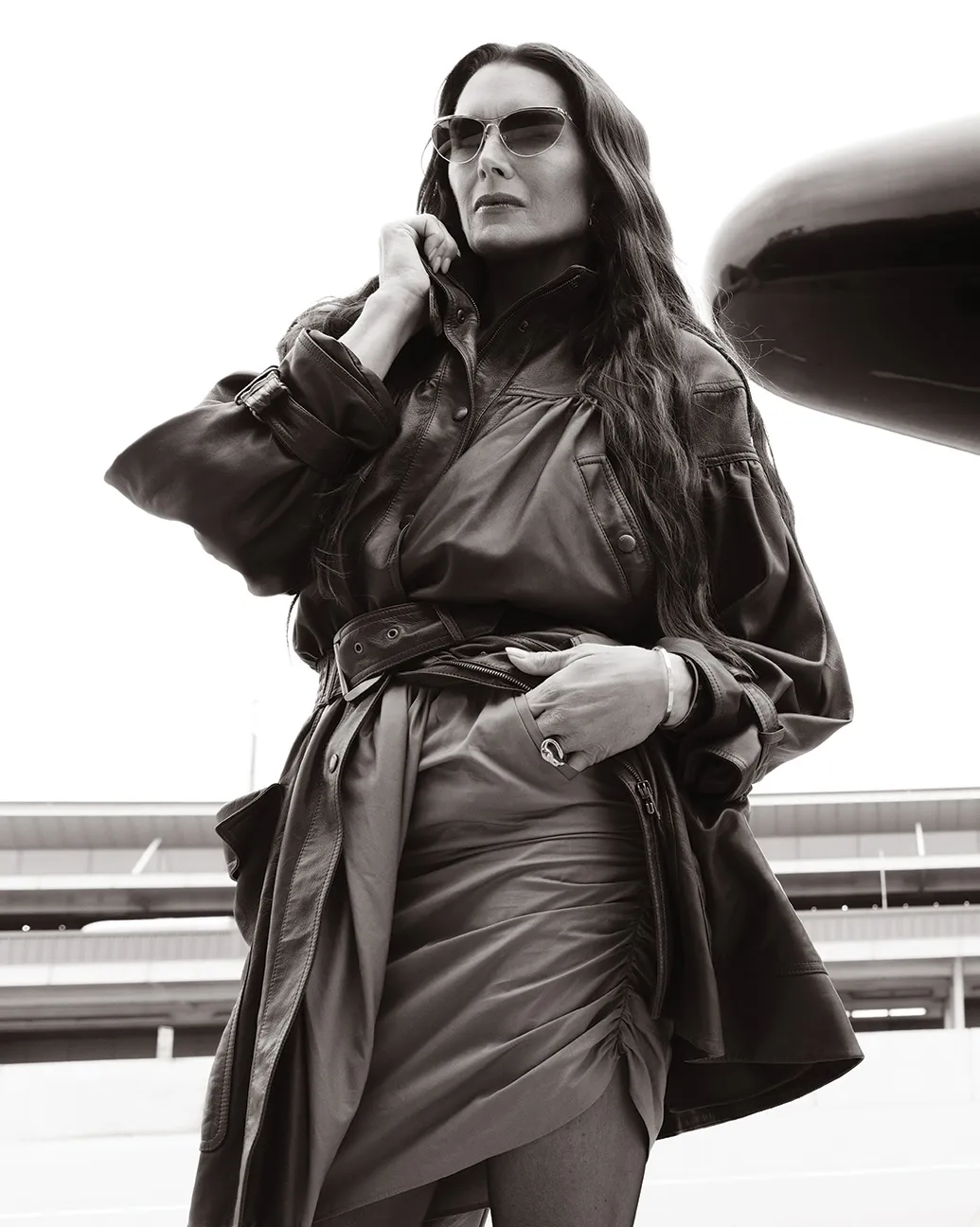
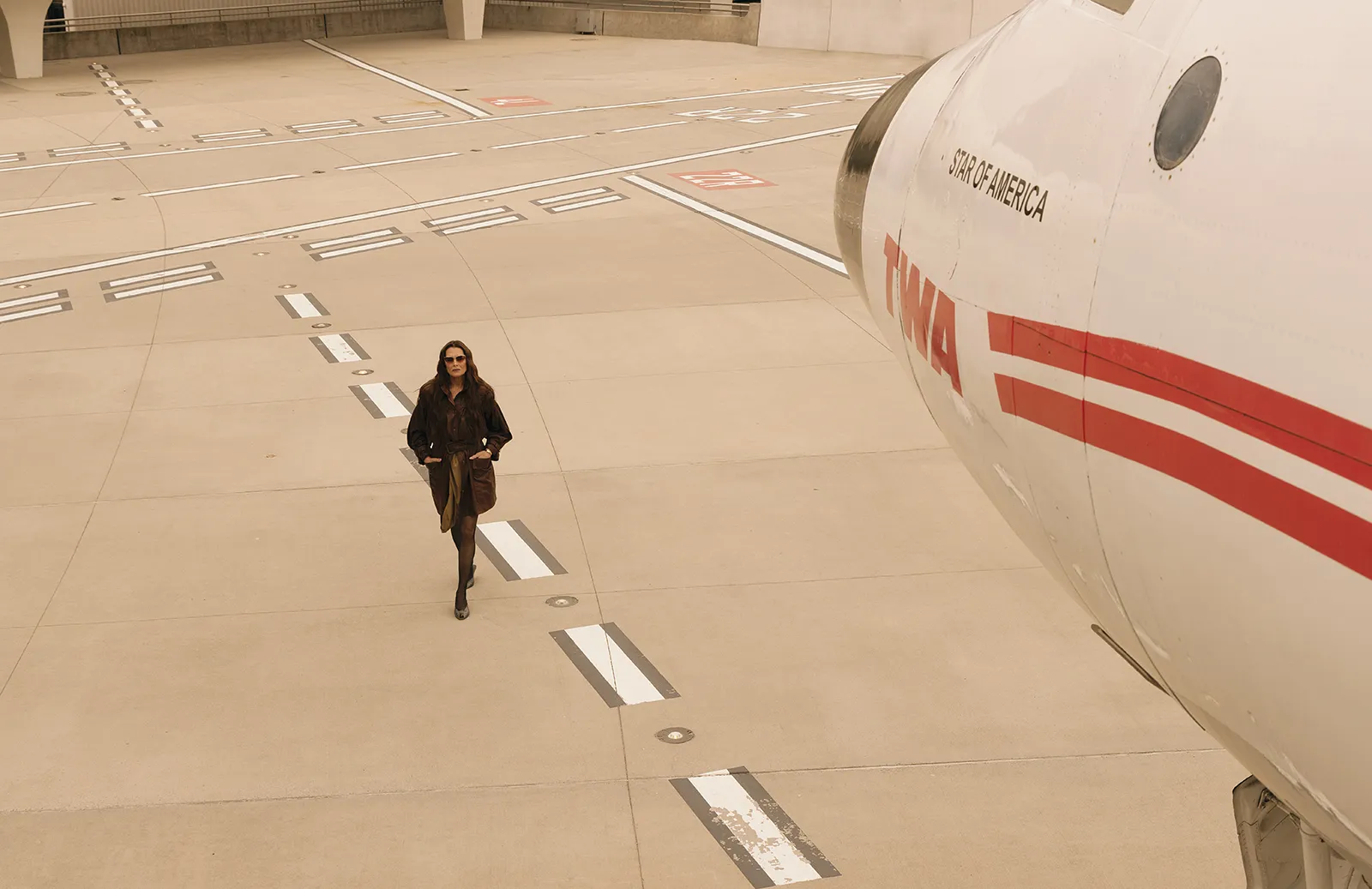
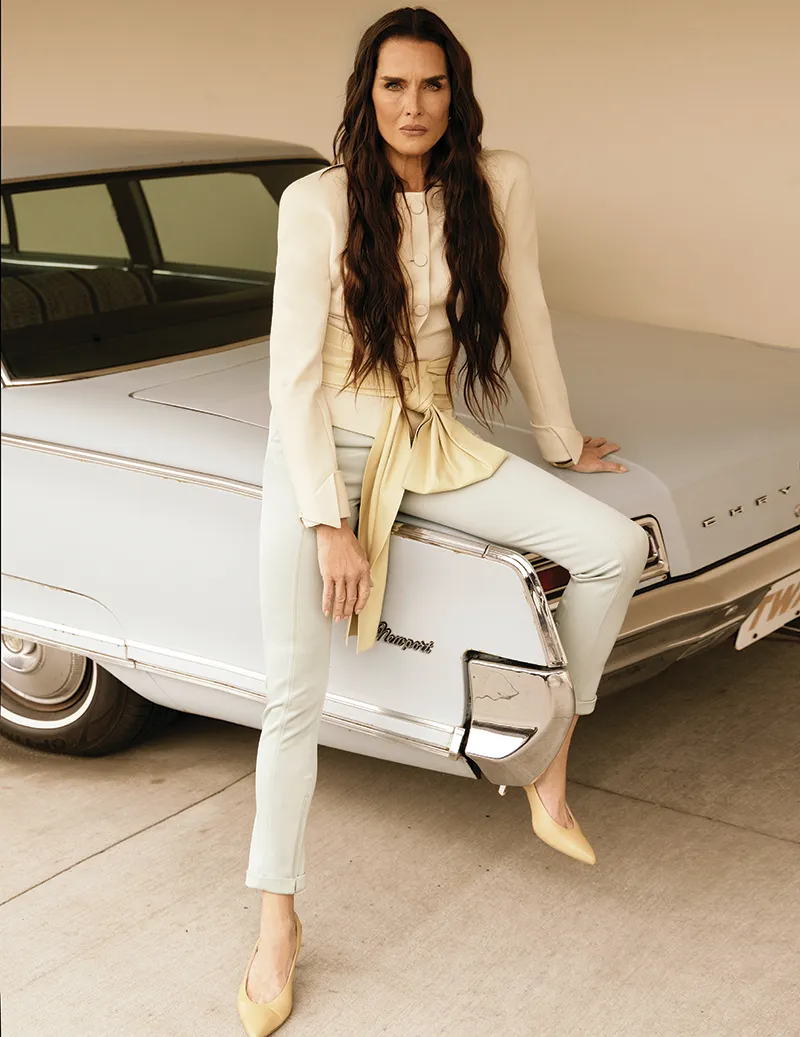
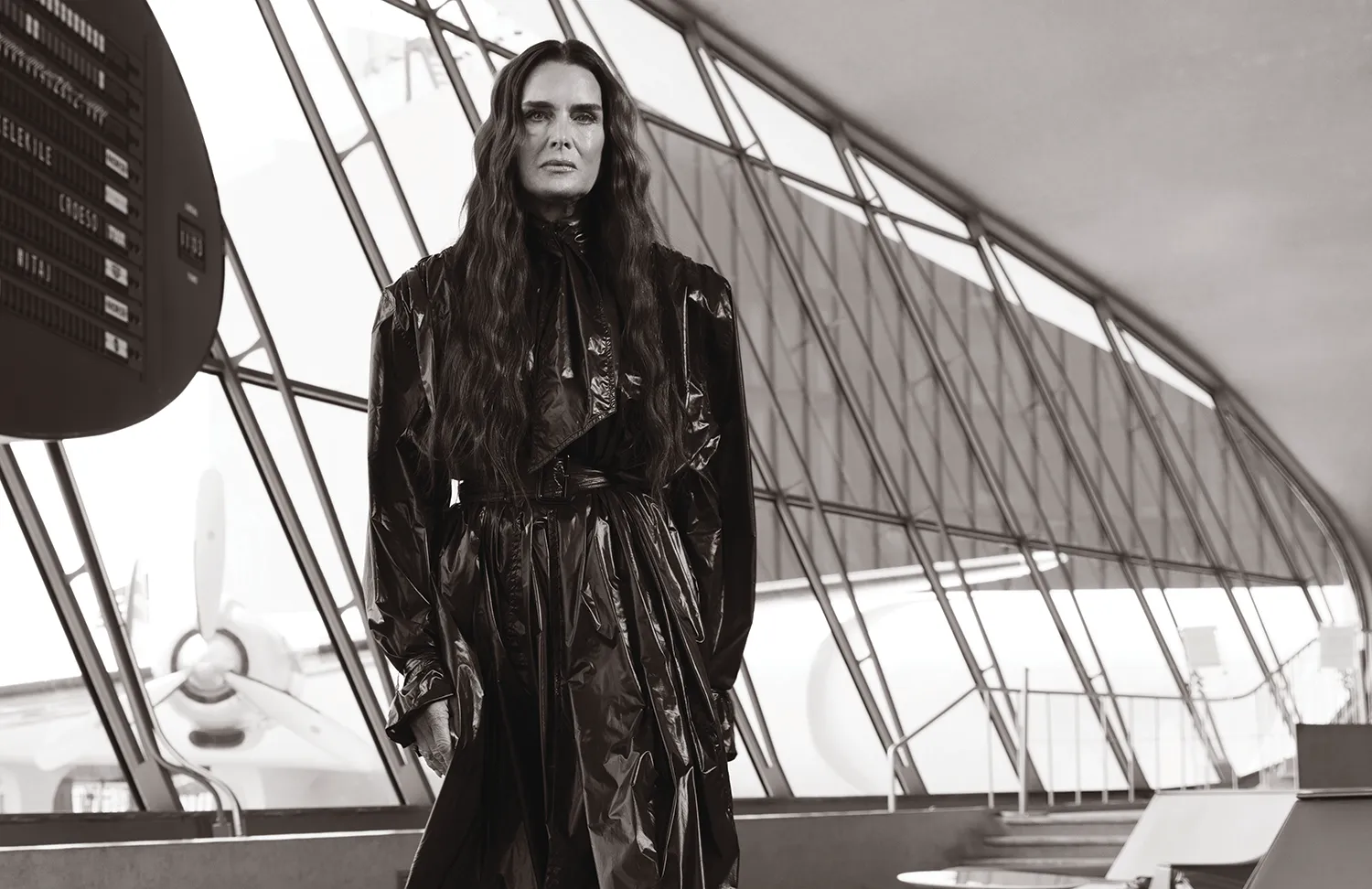
NEW YORK, 8am EDT: Brooke Shields is being driven through the misty morning city on the way to shoot for FLAUNT at the TWA Terminal at JFK Airport.
Good morning Brooke. I can see you’re in the car. How’s traffic?
Traffic? New Yorkers, we came out of the womb in traffic. [laughs]
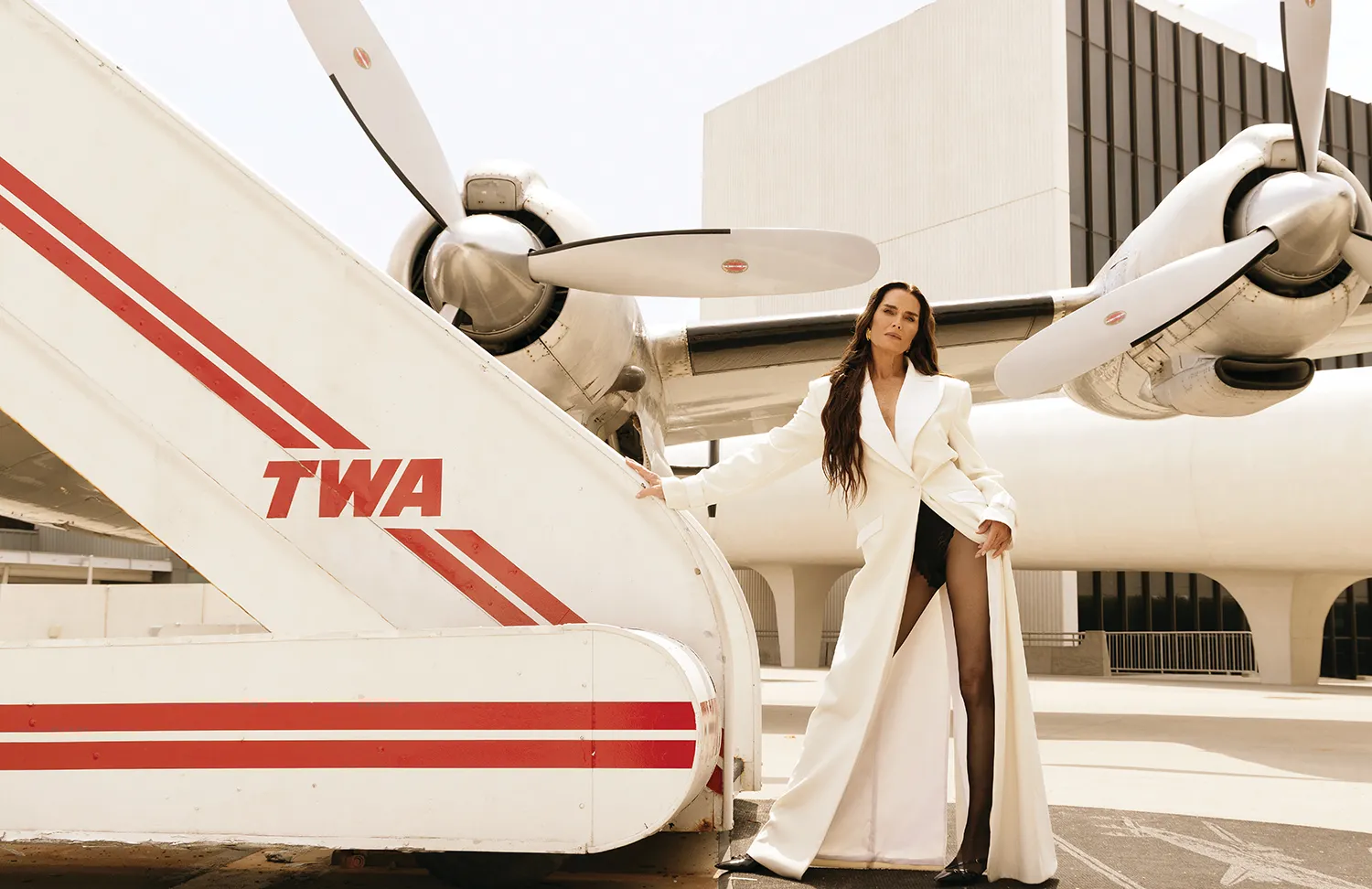
It’s so great to be able to work in the TWA terminal again. Which, you know, it was in Catch Me If You Can [Spielberg, 2002]. There’s such a nostalgia. It was “of its time,” but also has a modern element to it. No one’s really been able to replicate anything like it. Also, when Rowan, my now 22-year-old, was a baby, she took some of her first steps there. So when they said, “Do you wanna go back?” I was like, “Yes, I do wanna go back!”
[Shields is mother to two daughters, Rowan, pursuing a career in broadcasting, and Grier, 20, an IMG model, with husband of 25 years, comedy writer-producer-director Chris Henchy.]
It was an absolute pleasure to spend time in the gorgeous town of Founder’s Cove in your new murder mystery series, You’re Killing Me, which will be out May 18th on AMC’s Acorn TV. Your character, Allison “Allie” Chandler, star of the show, is the celebrated author of the Selena St.Cloud crime-romance books. She’s a cool, sexy Miss Marple for the modern era. Did you pull upon the tropes of yourself being a New York Times bestselling author for this role?
[Brooke’s books Down Came the Rain: My Journey through Postpartum Depression, (2005) and There Was a Little Girl: The Real Story of My Mother and Me, (2014) and Brooke Shields Is Not Allowed To Get Old, (2025) all made the esteemed literary list.]
Well, here’s the thing. What Allison does as a writer—she has original thought. She’s capable of building storylines; she’s been creating the Selena St. Cloud mysteries for 20 years. I have only ever written autobiographically—I feel that I can only write about what happened. I don’t have the ability to create a story that didn’t ever exist. I approached it more by just appreciating becoming a character who is able to birth these storylines in her head. What I found the most interesting was her relationship with her alter ego, Selena St. Cloud. That Allie legitimately aspires to be her own character is very self-absorbed, but kind of charming at the same time. That’s why we really fought for the dream sequences when Selena appears and talks to Allie. She’s the embodiment of her subconscious. It was something very fun for me to be able to play both of those characters.
The drama revolves around a series of murders which mimic storylines pulled from the pages of Allison’s novels. Attempting to solve the rapidly unfolding mysteries are the dynamic duo of Allie and Andrea Walker, aka “Andi,” [Amalia Williamson] a younger woman who comes on board as a writer’s assistant and ends up being so much more than that. Allison often pulls Andi up for her “Gen Z attitude,” Brooke Shields being, of course, a Generation X icon. Would you say something about the “generational clash” going on in the show?
I am a mother to two Gen Z daughters, so it was easy to pull from that because they get very frustrated with me all the time. They’ll send me these AI things and I’m like, “I can’t believe that happened!” They’re like, “Mom, it’s AI. It’s totally fake.”
Allison is at a kind of a crossroads. She’s no longer the hot, hip, “current” author. She’s divorced—a couple of times. With Andi, she gives it her best shot. Like when she says, “There will be no vaporizing in this household” for vaping, or “Are you on the Polly?” for Molly. She’s really trying to be cool, and she’s just not, but it’s okay.
What I love about Allie and Andi is their way of making fun of each other. But it’s never mean. The generational differences actually bring them together, because each learns from the other one…They actually end up being more competent at solving the murders than even Jack. Because somehow in this sleepy little town, there’s a murder every week. [laughs]
I just watched the Pretty Baby: Brooke Shields documentary, and I was absolutely blown away by how it was all put together. [Produced by ABC News Studios, and Hulu, the two-part docu-series premiered at the 2023 Sundance Film Festival and earned two Primetime Emmy nominations.] It’s a very personal piece of work. Can you describe the feelings you had after letting that out into the world?
I think that what is essential in a true “biography” of a person is that the subject doesn’t dictate the narrative. I didn’t produce it. I didn’t direct it. I didn’t have any input in the edit, and I think that that was very, very important, because that’s how a real documentary works. I didn’t try to make myself look better, or whatever.
I’ve been asked multiple times over the course of my life: “We wanna do a documentary on you!” I was always like, “No way.” Because in my mind, it was either gonna be a “True Hollywood Story,” or worse, a “Where Are They Now?” I wouldn’t endorse anything. Then my friend came to me and said, “Look, we’ve started a production company—and we would like your story to be our first story. I told her, “Okay. But pick a director, let me meet the director you’re working with.” That’s all I wanted.
So I met Lana Wilson. She’s been nominated for some serious awards, and her documentaries were beautiful. [Miss Americana, (2020)subject: Taylor Swift, won Critic’s Choice and National Board of Review Documentary Awards.]
I gave her my entire hard drive, all of my archives, that I had just had digitized. For what reason, I don’t know. I just wanted to have it for my kids, if they were ever interested. When I gave it to her, I said, “If you can find a way here to find a story that is bigger than just my life, my trajectory, please do that. If there’s a theme in there that you can find that’s bigger…don’t just reduce it to the lowest common denominator.
Every tabloid story that’s ever been written about me or my mother, it has always been reduced to that so quickly. Nobody has ever really been able to understand the nuance of surviving this life or this business.” And she came back to me, and said: “I think I’ve found it.” And when she told me that it was the overarching sexualization of young women in America, it had a cinematic quality to it.
Then, sitting down and watching it was pretty tough because I’d never really looked at my whole life that closely. I never looked back. I’m not a looking-back person. So, to see it all out there, to watch this young girl respond the way she did to people like Barbara Walters, and all of these critics, all these creepy interviewers…It was poignant; it was difficult.
Watching it with my daughters was really tough too, because I didn’t prep them ahead of time. They don’t know anything about my previous life, so I didn’t warn them. I guess that was my fault. They both took it very differently. My younger one was very upset, and very mad at me for not preparing her. My older daughter ended up saying, “Mom, this story needs to be told, and you can help. This will help people.” I was really appreciative that she thought that way about it. So it ended up being a really personally tough experience, but one that has been received really well, and has had a good outcome.
To me, what comes across is the incredible symbolic power of the way you looked, how that was used to sell things. Your symbolic power was so huge, but you yourself were a young girl learning about life as she went along [and] who couldn’t fathom how big that symbolic power was. We can now look back and say, “That’s insane.” What I got out of it was that the vast currency your image had for other people—it was not personal currency. You always had other priorities that didn’t align to what society had decided was your most important function.
Yes. What was currency for other people was not personal currency. I think that saved me a great deal, because I didn’t value what “they”—the public, the press, whatever their perception was—it didn’t equate with how I thought of myself. My high school cheerleading was more important to me than being on the cover of TIME Magazine. It’s like, “Really? Who gives a shit?” I didn’t value it the way other people did, and I think that that saved me. Because it felt separate.
Let’s talk some more about this “world of culture” you found yourself a part of. You’re 15, 16 at that time, you’re participating in creating these works, in creating culture. You’re already working with great artists, auteurs, the French Louis Malle [Pretty Baby, 1978], then later, Italian maestro Franco Zeffirelli [Endless Love, 1981]. There’s also a part in the documentary where you talk about going to see all the 70s art house movies in New York, which are now the seminal works you get shown in Film Studies 101.
The 70s were this incredible period. Seeing those films, that was all my mom. There was no reason why she would know about Fellini or anyone like that, because she was from Newark, New Jersey. But she knew that there was “more” somehow, and she immersed herself in that type of artistic culture. She took me to see Amarcord when it came out. [When Fellini’s oneiric, evocative vision of his ribald Rimini adolescence premiered in September 1974 at NYC’s art house, The Plaza Theatre on East 58th Street, Brooke would have been nine years old.] Who goes to see that movie with their kid? I think she exposed me to that in a way that was not conventional. The irony, if that’s the right word, is I started off there, and then became so commercialized. The juxtaposition was between Louis Malle, Zeffirelli, all these influences and experiences that I had at the beginning of my career, then in the 80s, becoming, like, “this thing.” There were dolls made of me.
And then you decided to go to Princeton, an incredibly strong-willed move on your part. You began a four year Bachelor of Arts in Romance Languages in 1983, which makes sense with your European heritage, but at the time, confounded “the industry.”
That’s why going to college was so important to me. Because I thought, “I’m losing this sensibility.” Not to sound obnoxious, but “sensibilité” in French is a very different word. We had this big conversation about that word. But in essence, I was perceived as “pop culture.” Yuck. I’m not pop culture. I knew I needed to step out of it, and at least try to nurture my psyche and my brain a little bit. So that’s why I was very lucky to be able to go to university.
You also used this as an opportunity to reflect on what you had participated in, culturally. I love your senior thesis title, The Initiation: From Innocence to Experience: The Pre-Adolescent/Adolescent Journey in the Films of Louis Malle, Pretty Baby and Lacombe, Lucien. Can you just flashback a little to that moment, and the spark you had of knowing “I can write about this, I can write about my own experience.”
I was so hurt and upset by the reaction to Pretty Baby when I was younger. It was Louie Malle’s first American film. It was a true story, beautifully depicted.
[Pretty Baby was released in April 1978, making Brooke 12-turning-13 during the movie’s promotional circuit. She had filmed her role as Violet, a winsome waif living in a Louisiana brothel with her prostitute mother (Susan Sarandon), the previous year, at 11 years old. The narrative was inspired by Storyville, New Orleans: Being an Authentic, Illustrated Account of the Notorious Red-Light District, a book which showcased the intimate early 20th century photography of E.J. Bellocq alongside testimony from his subjects.]
I was just texting with Keith Carradine [who plays a photographer based on Bellocq in Pretty Baby] last week—a picture popped up and I sent it to him. I wasn’t scarred by it. I’m not scarred. But they wanted me to be scarred. They wanted it to be about degradation. They couldn’t understand the artistic power of it. And then to have America kind of shit on it, and again, reduce it to a lowest common denominator take…I mean, it just was so insulting to me. I was 12, almost 13 when it came out. The press was attacking me and attacking my mother. They were so afraid of it. People would fight [with us about it], and my mother would say, “Have you seen the film?” And they’d go, “No, we won’t see that, we’re Christian.” I shut it all off, just let the vitriol attack me. It wasn’t until I got to college that I thought, “You know what? Excuse me, but fuck all of you. This is my perspective. This is what I know to be true. I’m gonna study this director’s films. I’m going to look at them from a cinematic, an artistic, a literary, a historical angle. And you can’t take that away from me.”
At Princeton at that point, you couldn’t declare a major in Film or Cinema in Liberal Arts, so I was a French Lit major. When I presented the idea for my thesis in front of the board, they were like, “Oh… so you’re just gonna write about a movie you were in?” I was like, “God, you guys, you’re not getting it.” But I went ahead with it anyway. I did all my research in French, even though they wouldn’t let me write it in French, which was interesting: “No, you have to write it in English, but you have to do all your research in French because that will prove you have a knowledge of the actual language.” I was like, “Okay, wow, you’re gonna make it even harder on me.”
Obviously, there’s no one more qualified to write on the subject you chose than yourself. So it was at 21, 22 years old, that you recovered your ability to reflect on the thing that had been created.
Because then you’re not a victim to it. Do you know what I mean? If you allow whatever the narrative is to dictate what’s “out there [about you” you’re allowing it to bother you. Obviously if it doesn’t bother you, it doesn’t matter. But I was like, “No, I’m not gonna be a victim to this. This is not my story.”
I also wanted to touch upon how you got your revenge, with artist Richard Prince, regarding the Garry Gross situation.
[Staged by photographer Gross of the prepubescent child model in 1975, the (nude) images resurfaced in 1981 at the height of her CK fame. In March 1983, after a highly publicized lawsuit and countersuit, the New York Court of Appeals affirmed that Brooke’s mother had irretrievably signed away any rights to control reproduction of the shots of the minor, originally receiving $450. Later that same year, Richard Prince “rephotographed” one of the most controversial captures; placing a small color print in a gilt frame, he titled the appropriated work “Spiritual America.” Artforum made note of what happened next: “On November 13, 2003, one version of “Spiritual America,” from an edition of ten dated 1983, sold at auction in New York for $372,500. (“Now that’s Spiritual America!” Prince exclaimed, according to the San Francisco columnist.) Less than a year later, the “original” Spiritual America sold in Basel for just under $1 million.”]
You worked with Prince on pictures that echoed the poses of those early shots—but here, you’re 40 years old, fully present, physically and psychologically powerful. There’s a motorcycle behind you. Like, boom. Props to you to even consider doing something so cool. [Prince titled this echo-chamber meta-image “Spiritual America IV.”]
Yeah, well, the story ended well in my opinion, because the guy, you know, [photographer Garry Gross] died broke and a dog walker, after trying to capitalize on me. Then in 2005, Richard Prince asked me to go to his studio. He was all nervous; he was like, “I just hope you forgive me.” I said, “Forgive you? You did it! I don’t care who got the million dollars. If you got the million dollars, good for you.” [laughs] This was justice in an artistic way, in a way that I thought would close the circle. I do wish he’d had one left, and would’ve given it to me, which he didn’t. He just gave me a Polaroid picture.
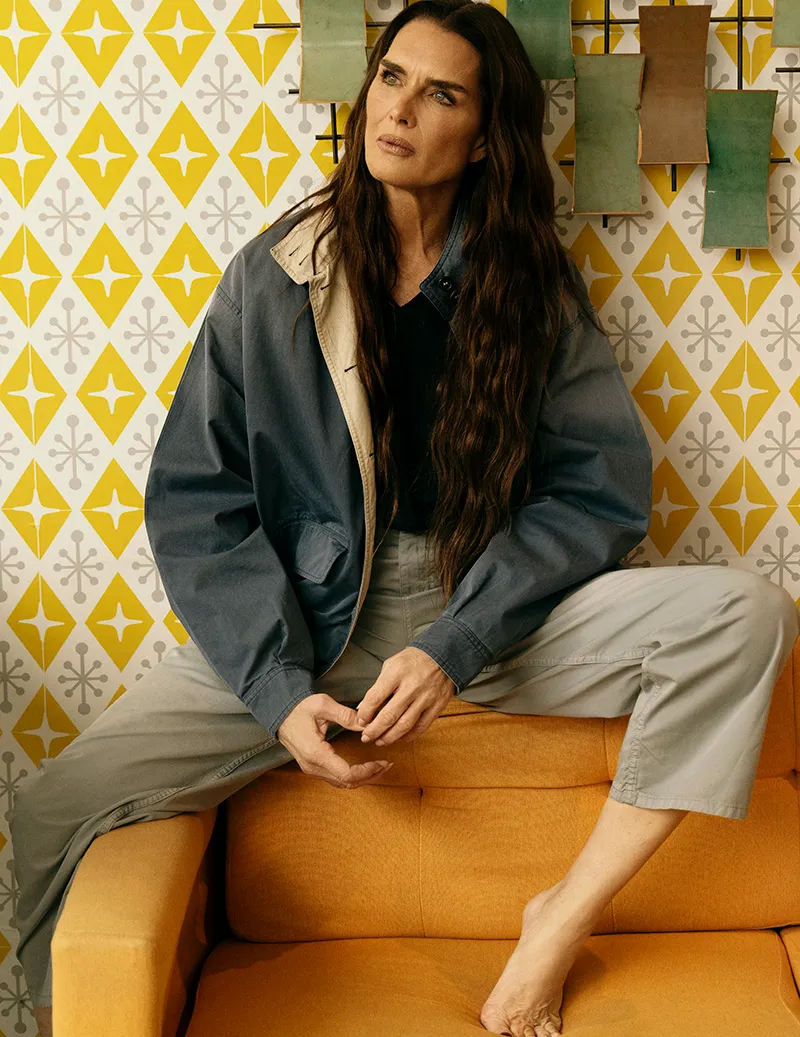
So let’s bring the circle around to where you’re focusing your energies today. Your Commence brand offers a new range of haircare products specifically formulated for the 40+ market. You’re applying that kind of molecular science to haircare.
The Commence product lines and platform has taken us years to develop. Being a part of a start-up is no joke. I’ve invested my own money into it, and we’re not backed by a huge company. But it really started with some research I did into the skin of the over-40 scalp. I dug deep, just like I do with everything. The ‘student’ in me came out again.
One essential for me was an amazing instant shampoo—if I get a good blowout, I don’t like ruining it by washing my hair, but I do want to clean my scalp. When you age, the pores change, on your head just as much as your face. We forget that. It’s harder to hold onto the moisture delivered by hyaluronic acid. So I went to the lab and I said, “Can you make hyaluronic acid smaller?” And they were like, “What?” I go, “It’s too big. Can you cut it up? Isn’t this what you guys do in the lab?” Two weeks later, the lab came back and said, “We’ve quaternized it, and we’ve found a way, but it’s still a liquid form—we don’t know how to put it into a rice powder.” Which is what we needed. I said, “This is something that I use—we’re going to get the right one.” The ones on the market all contain benzene and aerosol, which are bad for your lungs, bad for the environment. So the end result of me geeking out in the lab is that we came up with six products that are geared towards the over-40 scalp, packed with components to address these different needs.
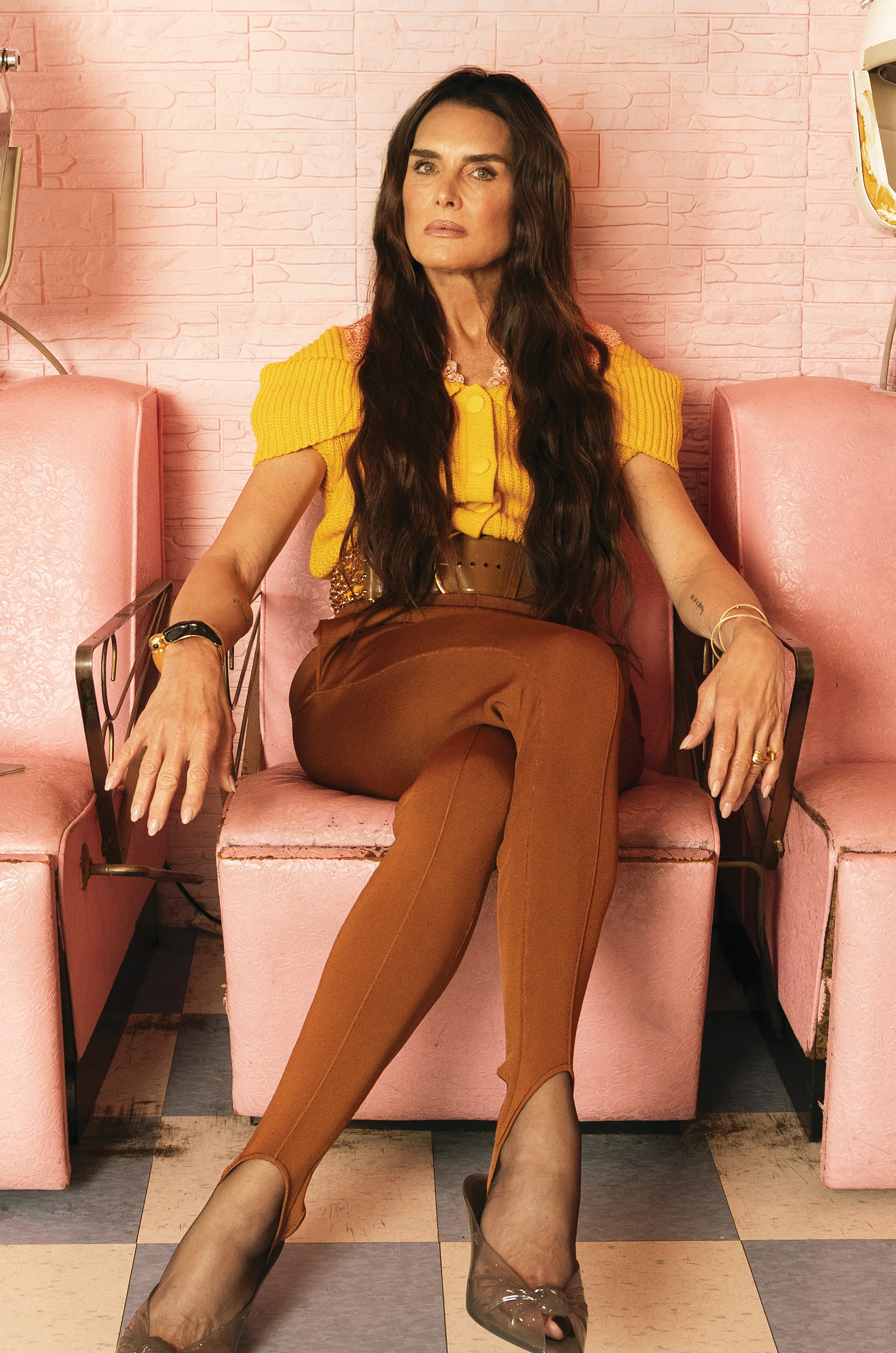
To return to the symbolic “Brooke Shields, Icon” your hair has always been such a major feature of that persona, and so this is perfect. Who wouldn’t want to have hair like Brooke Shields?
I just felt that nobody was marketing to women who are in this era of their lives. There’s a truly powerful demographic of women there. So that’s why I came up with Commence. I always say, it’s like you’re either “that hot girl at the bar” or you’re in Depends, peeing your pants. But we’re right in the middle. Which was also the narrative in You’re Killing Me.” Yeah, we’re not 30, but we’re also not 80, so let’s address the needs that are specific to us.
We’re almost at Kennedy. Hold on. Look:
[Shields turns her phone to show me her POV—through the windscreen, the car sliding under the green-glowing roadsigns bold over the damp highway and against the gray sky. And after goodbyes and thanks, our exchange ends and Shields continues to her morning’s destination. ]
****
Many child stars barely make it out. Sustaining an always-on-display public persona and retaining sanity into adulthood is a success in itself. Brooke Shields, the original, made it out, and then some.
I think I have some idea why. For many other starlets, negotiating the snakes-and-ladders nature of the entertainment industry was like walking on broken glass. After speaking with Shields, I go on a completist mission to see as much as I can of her profound impact on popular culture. One of the more disturbing artefacts I uncover is live televised footage of Brooke literally walking over broken glass, with a smile on her face.
This is a real stunt from the Circus of the Stars 1984 special; I look further and find her talents were featured over several seasons of the CBS TV show. Completing incredible aerial feats with no safety net, dazzling in feathers and rhinestone spangles, she trained to accomplish these as flawlessly as an acrobat born to the big top. Brooke was made of steel. Soft flesh forced to become superhuman, emotions and pain responses repressed, the mental disassociation she describes in the Pretty Baby documentary encouraged. This was the entertainment industry, a brutal endurance sport.
I watch not only her greatest hits but also check out her roles in low budget Indie cinema—Alice Sweet Alice, (1976) (innocent girl gets strangled and burned alive by her psycho-brat younger sister on her first communion day!), King of the Gypsies, (1978) (a young girl about to be wedded underage after her father sold her to another family, dies horrifically in car chase after being kidnapped by her brother, played by Eric Roberts!), Tilt, (1979) (she plays a hitchhiking, lewd-mouthed underage runaway who scams older men for money on the bar-room pinball circuit!) Her age means that much of the material and the lines she had to say were highly questionable, even at the time. The language being bandied around her is ripe and raw; these are exploitation movies, and this is exploitation. But these are the dues she paid, and they can’t be refunded. Shields learned more with each crazy inappropriate role. And later, with her more legitimate art house movies, she refused to be bullied into feeling shame for being chosen to express auteurs’ visual poetry. The criticism, the misunderstanding, the confusion, made her go deeper, adding “questing student” to her character traits.
And that’s how Brooke broke free of her conditioning. Smiling on the outside, glamorous, gowned, inside, psychologically, she was making a crucial, self-reflective flip. “I would like to express my gratitude to Professor Karl D. Uitti for helping me have faith in my own hypotheses,” wrote Brooke Christa Shields, on the Acknowledgements page to her Princeton University B.A. Senior Thesis, submitted in May 1987. That push towards the confidence to trust her own agency and intuition led to the strong woman she is today. From functioning as the screen unto which the desires of a nation were projected, today Shields is the one calling the shots, booking the crew, producing the show, knowing what’s inside the shampoo bottle she’s holding up, because it’s her formulation.
Shields was a model mirror held up to millions before she even went through her own Lacanian mirror stage. Brooke was not only her own “Other,” but the imago of an entire era, a disco ball’s worth of mirrors flashing out meaning to an international eye. But through regaining power over her image, how she spent her time, who she gave her energy to, the mirror has one face, now. An integrated being, Shields’ inner worlds and outer surfaces are now united. The formerly fractured self is now “whole.”
The actress weathered a massive media storm and faced fierce moral outrage over the casting choices of her early career, but look around now—there’s more sex and obscenity in one minute of Euphoria or TikTok short than in the entire oeuvre of Brooke Shields. Times have changed. While “image is currency” more than ever, the owners of the image are also its subjects and distributors, self-publishing, rather than exploitative industry systems being the only way to achieve the dream of “fame” and “celebrity.” Our easily accessible digital environments collapse the model of elitism that restricted widespread media access only to the corporate budget. For her part, Shields has embraced the socially-mediated age. Her account on TikTok has 1.4M followers and 26M likes. Fans admire and acknowledge her struggle for her own autonomy, posting edit compilations titled “what Brooke Shields went through.”
Brooke’s own words at the start of this interview echo back to me, at its end: “of its time,” but it also has a modern element to it. No one’s really been able to replicate anything like it.” She might be talking about the architecture of mid-century master Eero Saarinen, but the phrase also readily applies to the phenomenon that is Brooke Shields. There’s nothing like her. As vital as ever, if not even more so in her maturity; young, she was put through so many challenges, that ageing is one she takes on just as fearlessly. For a woman who holds herself to such superhuman standards, who never stops setting new goals, the finish line will always be far ahead. The truly beautiful thing is that she’s spurring others on to find and their own versions of “wholeness,” right alongside her.
Photographed by William Lords
Styled by Anna Katsanis
Written by Hannah Bhuiya
Hair: Sky Kim at The Only Agency
Makeup: Mark De Los Reyes at Paradis NYC
Flaunt Film: Mynxii White
Location: TWA Hotel
Stay up-to-date with exclusive events and content.


