F L A U N T


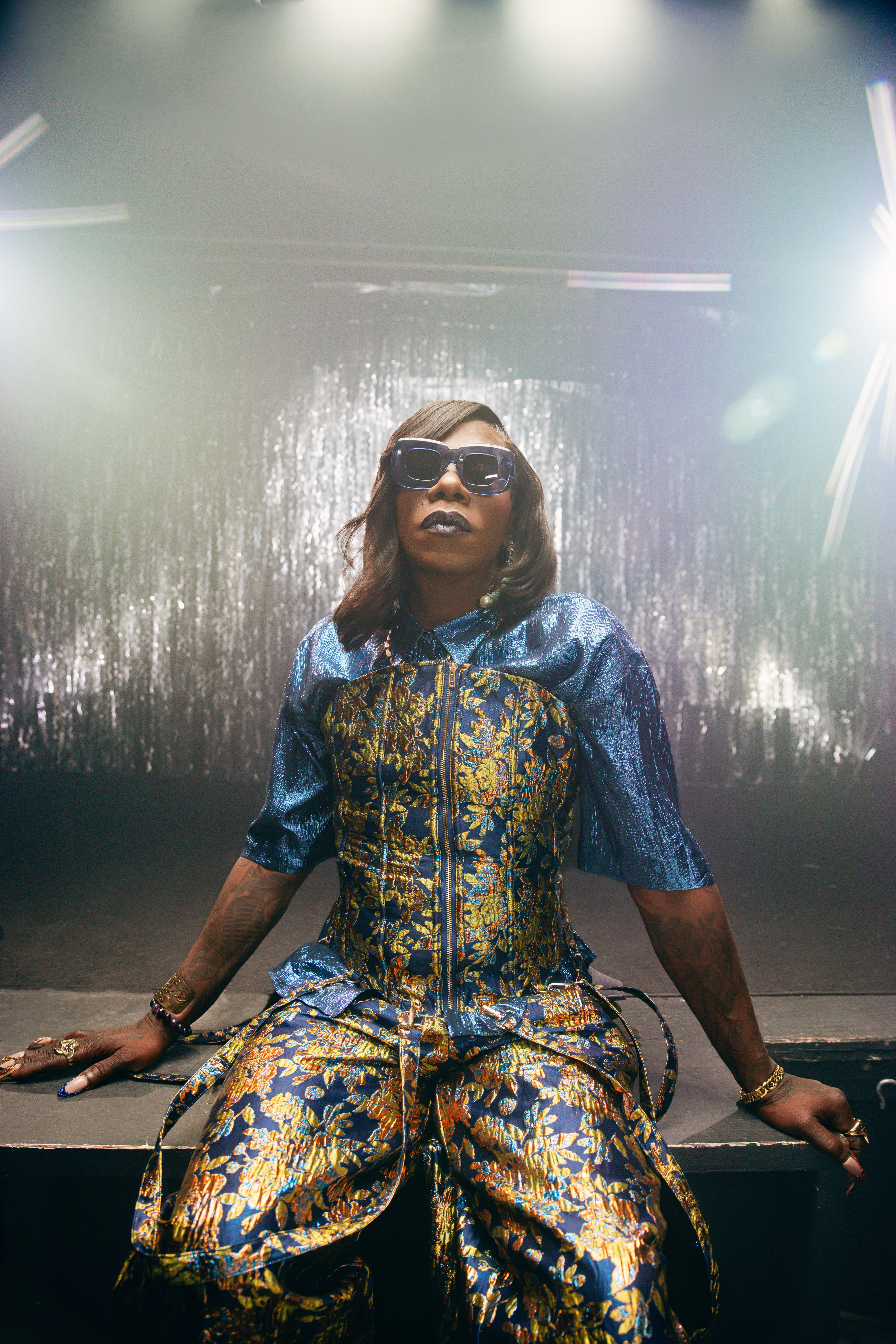
I speak with Big Freedia thee Queen Diva while sitting on a riverbank somewhere in the Hudson Valley. My phone service is spotty until she hops on the line—word to divine timing. Her voice, strong and measured, comes through the line from New Orleans, the city she has always called home. Our conversation anticipates her new EP, Released at Last, a three-song project that she recorded ten years ago with the late SOPHIE, who passed away in 2021.
Big Freedia is a bounce music icon who has introduced the once-lowkey, hyperlocal scene to mainstream audiences. Bounce is essential to NOLA; the slick-mouthed, uninhibited, and vulgar daughter of hip-hop originated in the early 90s. Freedia joined the game towards the end of the decade. In 1998 she went to a show by Katey Red, a drag queen and one of (if not the first) trans bounce rappers, who grew up in the same housing projects as Freedia. She soon began performing as Red’s backup dancer and in 1999 released her first single as Big Freedia: “An Ha, Oh Yeah.”
“Music is timeless. And so, my hope is that this EP continues to grow and to give SOPHIE’s fans an appreciation of her life and her legacy––that her music and her spirit live on with us for years to come and remind us a little bit of piece of her every step of the way,” Freedia reflects.
SOPHIE was a trailblazing musician, songwriter, DJ, and performance artist whose singular approach to sound design continues to inspire. She was able to fluidly exist at electronic music’s more obscure fringes and also at the center of pop music’s mind simultaneously. She produced for Madonna, Charlie XCX, Caroline Polachek, Vince Staples, and Arca in the 6 short years of her solo production career (her first release as SOPHIE was in 2015, but she had been active as a musician since 2008). Her discography is intensely textured and animated by a bright, molten, nucleus—the experience of a SOPHIE album or DJ set is akin to being on a roller coaster or in a mad scientist’s lab, witnessing an almost frightening command over the elements of speed, noise, intensity, and ecstasy.
In a 2013 interview, SOPHIE likened the scientific nature of her production ethos to molecular gastronomy, “It’s about getting to the molecular level of a particular sound—realizing what that sound actually is made of, and why it behaves a certain way when processed or cooked. Then you use those molecules to build new forms, mixing and reappropriating those raw materials, and of course, it should be bloody delicious.”
Transcending simple definitions, both Freedia and SOPHIE have made indelible marks on music history. The collaboration between the two artists makes so much sense. They both carved out their own niches and maintained themselves within a flattening music industry, while always experimenting with new sounds and holding collaboration close to their personal practice. Big Freedia and SOPHIE’s legacies are testament to how transformative our art can be when we step into ourselves and our power as Queer and trans people.
“If SOPHIE was here today, we definitely would continue to collaborate,” Freedia intones. “If she was able to see the reaction that these songs are doing in the club right now…I know she’s smiling down and looking at all of us.”
The lead single from Released at Last, “Blaze That Ass” has been a cult favorite deep cut for years due to online leaks and SOPHIE herself mixing it into DJ sets for dancefloors throughout the world. Freedia remembers the day it was created: “The day that I recorded these songs with Sophie was really special,” she remembers. “If you got a chance to meet Sophie up close and in person, you would have known what type of loving and kind spirit she was, and what she stood up for…She fought for her music, and her legacy will live on and on forever.”
While recording, Freedia’s voice was rough from an intense performance the night before, which adds a raw and unique texture to her voice. She did not have anything prepared or any expectations of what their session would be like, but “knew that some magic was going to happen regardless of not being prepared with any track, any wording or whatever. I kind of just freestyled everything right off the dome.” “Blaze that Ass” was a hit.
While Freedia got her professional start in Bounce, she grew up singing and performing in the choirs at her Baptist church and school. She even simultaneously directed both choirs, “choir was my life and I started there,” she says. Big Freedia’s latest full-length, the gospel album Pressing Onward, dropped in August 2025. She dedicated the project to her partner Devon Hurst, who passed away only three months before its official release date. I can sense Freedia’s reverence for this project through the phone. “I’m finally able to pay homage to God and the culture I grew up in. It feels like my best album yet,” she shares. “You feel the spirit in both bounce and gospel… both have that power and energy. This music makes you happy; it lifts and lights up everybody up in the room.”
Bounce remained a local treasure until the mass devastation caused by Hurricane Katrina in ’05 displaced about half of the city’s population (over 250,000 people). As the scene’s creators and torchbearers were forcibly spread throughout the region, so did the presence and infectious rhythm of bounce. That these artists continued to make and perform music in the traumatic wake of Katrina is a testament to how we must create in order to survive, both spiritually and economically––it absolutely is that serious.
Freedia and some of her family were forced to relocate several times in the ensuing weeks: first to an emergency shelter in a local convention center, then via plane to a military campground in Arkansas, and finally to Houston where they were able to settle for a little bit longer. Freedia was determined to move home as soon as possible and, about a year later, as one of few Bounce artists in the city at the time she began organizing a weekly party called FEMA Fridays at a club called Caeser’s in the city’s West Bank.
“[Caeser’s] was the only club that was open in New Orleans at the time, so the lines were down the street, and the people were all around the corner,” she said in a 2020 interview. “They had FEMA money and Red Cross money, and they were popping bottles and shaking ass. It was just an amazing feeling.” New Orleans was still devastated but at this point had begun to rebuild. Freedia’s call-and-response style of performance is reminiscent of the church community in which she found her first musical inspiration. Communal catharsis to song and dance is especially potent medicine, knowledge shared by both club and Baptist church regulars.
She hustled hard to get there in the post-Katrina years and did not find national recognition until 2010 after a performance at Hoodstock in Bedford-Stuyvesant, Brooklyn that caught the attention of journalists at the Village Voice and the New York Times. Freedia began to tour across the region, and then the country, often playing 7-10 shows in a week. She was nominated for a GLAAD media award in 2011, received a TV deal for her own reality show in 2013, released her first major-label studio album Just Be Free in 2014, and then really blew up after her vocals were featured in Beyonce’s Formation music video. Freedia tells me the process of clearing her sample for Break My Soul was actually quite simple, “She called me directly and said she wanted to use [the sample] from 'Explode', and I said: ‘Bitch! Whatever you want girl…’”
Only 3 decades after its origins Bounce has become the city’s pulse–– completely integral to NOLA’s sonic blueprint, and Big Freedia its biggest international ambassador. She has performed at Manchester Pride, Ottawa Bluesfest, and even visited Havana, Cuba for a cultural exchange program in November 2023. The program consisted of meetings and creative sessions with Queer and trans community members, entrepreneurs, musicians, and a massive show.
She implores that, “entrepreneurs continue creating ventures, that the LGTBIQ+ community continue fighting for a greater space in society, that artists continue developing culture; that is important. Even when the government is in control, the power is always in the people.” However, the situation has gotten much worse in the past 2 and a half years. US sanctions have gotten incredibly strict since November 2024 and the price of gas and other commodities has skyrocketed. As such, the legendary music venue and third space where Freedia hosted her a concert and twerking competition, La Fabrica de Musica (Music Factory), closed just two weeks ago. It is unclear if the venue will be able to reopen in the future.
Music connects people across geography and cultures, of course, but it becomes an even more powerful tool when wielded as a platform for organizing resources and cultural diplomacy like Freedia has exhibited throughout her personal life and professional career. This is so important in the context of our country today. Freedia shares that June is usually her busiest and most profitable month, but the Pride bookings aren’t coming through this year as they usually do. “We can’t celebrate [Pride] without these corporations being there and supplying the funds,” she laments. Further, domestic inflation caused by senseless and grotesquely high military and police budgets, as well as the resurgence of the anti-rights movement and its collusion with US mass media are all doing their big one to contribute to this dire situation.
But we must persist and continue to create. Those who came before us have weathered much worse storms with less resources at their disposal. It feels fitting that this EP is released on Juneteenth; liberation music extends beyond genre. Let Big Freedia help you get free.
Released at Last is out now on all streaming services
Stay up-to-date with exclusive events and content.


