F L A U N T


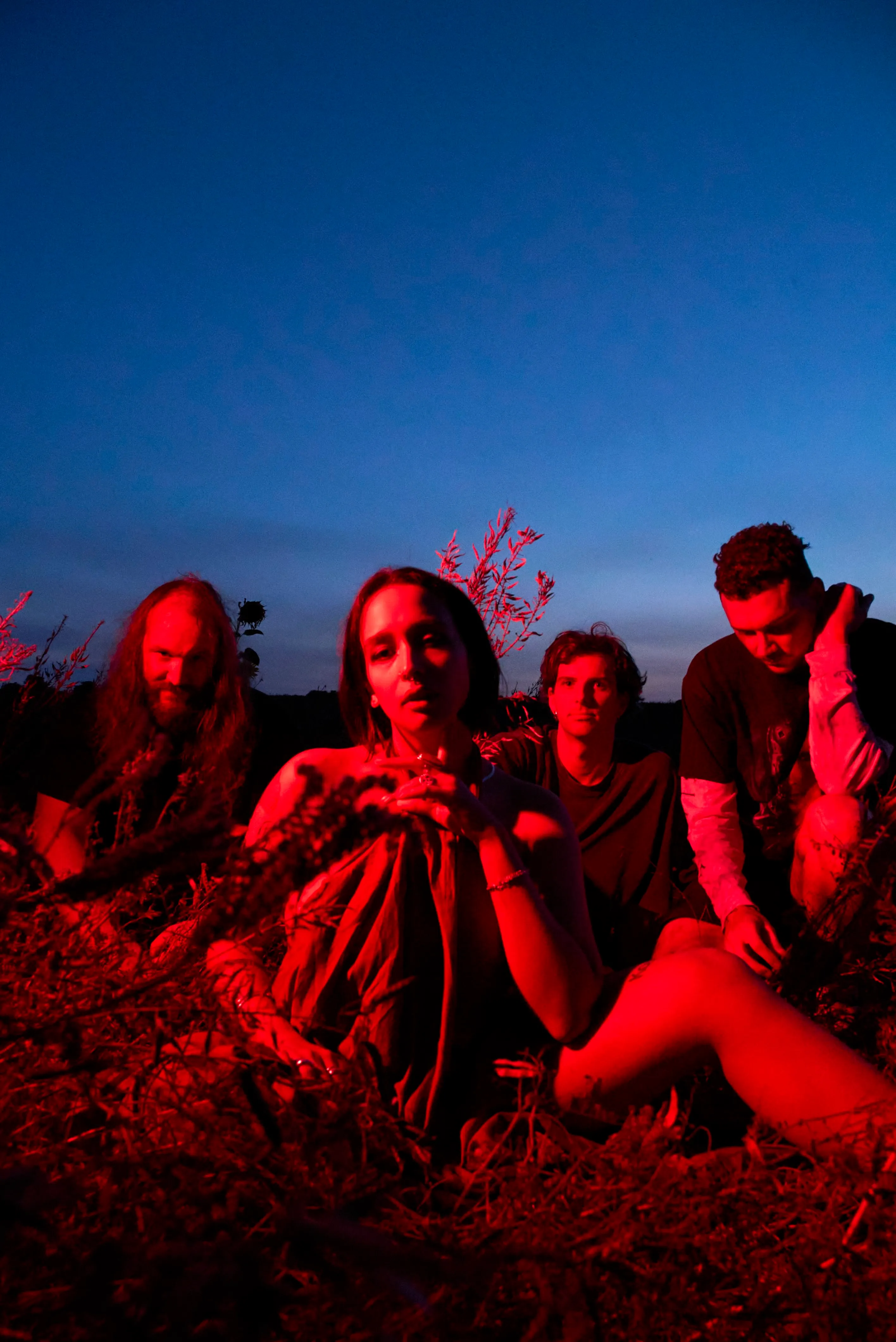
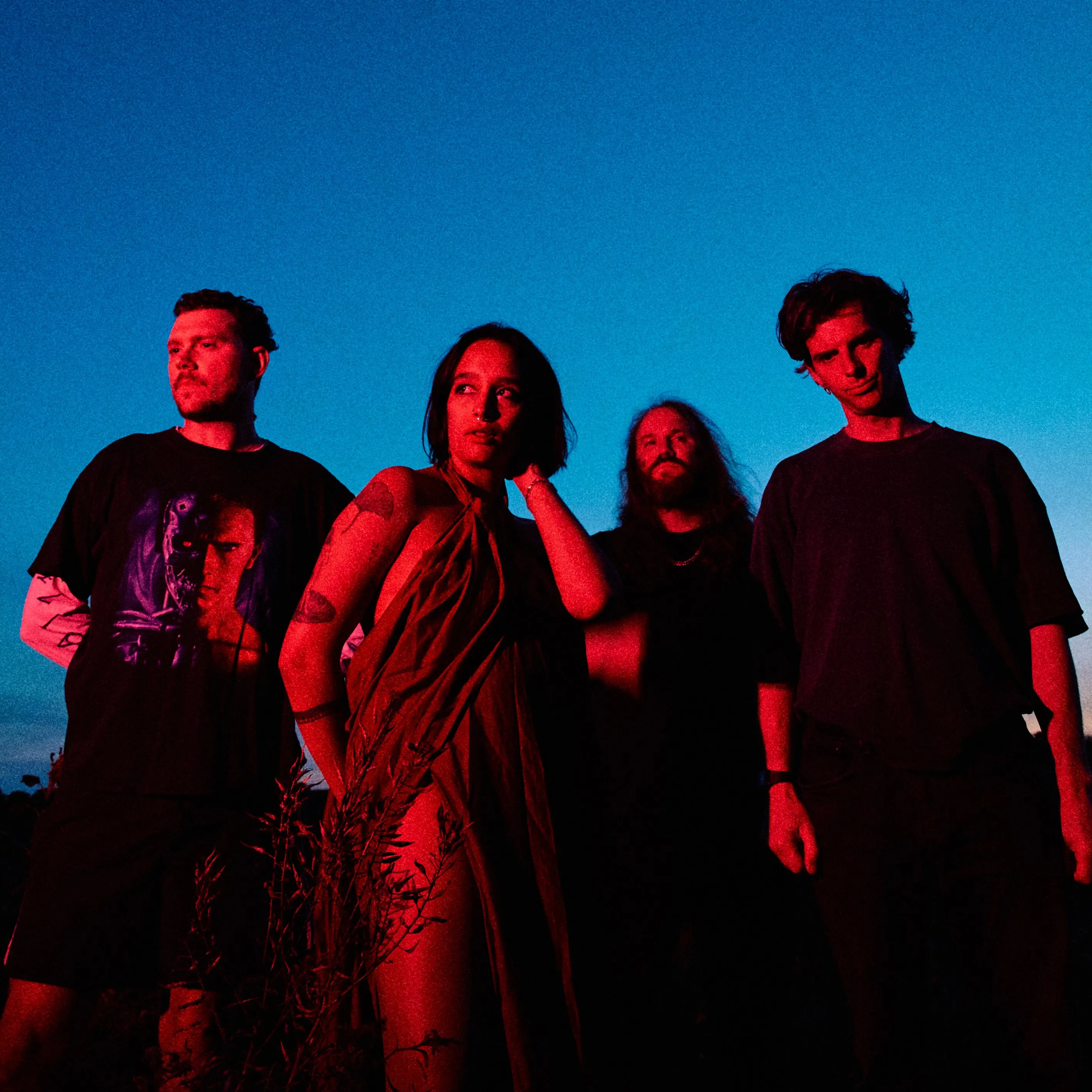
Industrial EBM band, Mandy, Indiana’s newest offering, URGH, via Sacred Bones, traces the sharp edge where sound becomes pure sensation. Consisting of vocalist Valentine Caulfield, guitarist and producer Scott Fair, synth player Simon Catling, and drummer Alex Macdougall, the Manchester/Berlin quartet seems to know how to mangle, slice, and torque noise, intention, and power just enough to locate pleasure inside the fury. Where their 2023 debut, i’ve seen a way, leaned toward observation, URGH is far more carnal.
Here, body music is not so metaphorical, leaning into a brutally literal understanding of sound as impact, rhythm as pulse, and distortion as something that courses through muscle and bone rather than just ear and mind. “It genuinely feels like we all bled all over this album,” Caulfield confesses, as much of the record was written and recorded while Caulfield and Macdougall were both undergoing multiple surgeries. At the time, she was grappling with a rare eye disorder that severely impaired vision in one eye, while the relentless pace of recording pushed Macdougall into a state of pure survival after the removal of a hernia and half of his thyroid. But what emerged was a type of endurance sewn into every frequency.
Mandy, Indiana places you immediately inside the noise, testing your willingness to stay. The first release, “Magazine,” is a track that treats distortion like a language that you can only learn by immersion. Nearly the entire album is performed in French (Caulfield’s native language), and while you may not understand every word, the intent cuts through regardless. Meaning here is carried by texture, repetition, and pressure rather than translation. Songs like “Cursive” pulse with hypnotic insistence, blurring the line between club propulsion and emotional overload. But URGH isn’t heavy for heaviness’ sake, though there is pleasure in its force. Instead, it filters the constant, low-grade noise of everyday life, the murmurs and signals we’ve learned to tune out. In that act of listening, they expose the societal indifference that's embedded in our silence, even when reality presses insistently at our doors.
.webp)
“I think it’s really tough, and I’ve especially felt it in my professional life, because as a journalist, I can’t turn it off,” Caulfield says. By day, she works at a German data services company in Berlin, producing daily infographics on global news. Demos arrive from Fair in Manchester, and she texturizes them with her sharp, confessional lyrics, cutting feeling into sound and ready to draw blood. But music (professionally at least), is not the center of her daily life. “I absolutely could not be a full-time musician. I don't want to be,” she tells me. “It’s a fantastic outlet for a very specific energy I have. We care deeply about it and feel fully committed, but it isn’t the main thing in any of our lives…and I think that’s actually quite healthy.”
That distance also keeps the music uncommodified by resisting extraction. In that sense, Mandy, Indiana’s relationship to music feels more honest as the band reserves music as a space that isn't governed by the same logics as everything else. This way, it remains necessary rather than productive. For Caulfield, this boundary is essential, especially when her day job makes disengagement almost impossible since she is required to look directly at the world as it is. There was a point, she explains, when the sight of that constant witnessing became unbearable.
“Up until October of 2024, I was much more plugged into traditional news media,” she says. “But the execution of Marcellus Williams in the US just really broke me completely.” After a year of watching the genocide in Gaza unfold, of grappling with what she describes as appalling coverage and the active complicity of Western governments, that moment marked a limit. She turned off her news notifications, not because of indifference but more for survival.
While Caulfield still keeps up with the day-to-day, this is where music enters as a parallel practice for her. But Caulfield is careful not to frame URGH as a document of world events. “I don’t want to dwell on it on the album,” she says. “A lot of it is more personal than that.” And yet, the record is shaped by the confrontation with reality, with exhaustion, with the toll of constant awareness. “It’s good for me to keep music as a way to maybe bring attention to things I wish there was more focus on,” she explains, “but it is also a form of escapism, for sure.” Here, sound transcends to a space to release anger, to process sensation, to exist briefly outside the machinery.
“I genuinely think that if I didn't have this ability to be vulnerable about it, and not necessarily in music, but also like in my personal life and stuff, I would be absolutely fucked." She confesses, “I think the only way for me to kind of get better was always to be vulnerable and to kind of allow myself to like share this with people and like to let them kind of come and comfort me. Like I couldn't have done that without being vulnerable.” This openness crystallizes most sharply when Caulfield turns inward, confronting her rapist saying, "Yes you had me / Last time / But tonight / I’m coming for you,” on “Magazine,” while also calling out the systems that shield wrongdoing on “I’ll Ask Her” with “And anyway, you stand by your boys, ’cause they’re your boys and that’s just how it is.”
URGH finds pleasure in saying exactly it means, in trusting that feeling doesn't need to be softened to be shared. But this openness isn’t framed as catharsis alone, it’s a way of staying tethered to the world rather than retreating from it.“We live in a time period where we have to hold onto what's good. I think it's a strength to be able to look at something that seems pretty dark and find the little cracks of light in it.” And this philosophy runs through the record. “We're not gonna dance our way to a better world,” she explains. “But it's definitely good to be able to congregate with people and feel that energy and remember that there is still some good in the world. I think it's important that we have this outlet, like us as a band and also us as a species, you know.”
Even in its most severe moments, the album never fully collapses inward. It hums beneath the skin. It reminds you that feeling, however overwhelming, is still a form of being alive. There is still that rush. “This is an album that even in its darkest moments, you can feel it rattle your bones.” Caulfield concludes, “And that just feels really good.”
Stay up-to-date with exclusive events and content.


