F L A U N T


To watch is to already commit the act of trespassing.It is to hover at the membrane between what is happening and whatever meaning will calcify in its wake. Children understand this trespass with cunning: They pretend to sleep long after their bedtime, they siphon knowledge from half-shut doors. Long before the world demands them to perform, they learn how to surveil it. Mia McKenna-Bruce has yet to outgrow this instinct. Observation is the first tool she employs when a scene, a character, or a life refuses to hand her the easy answers.
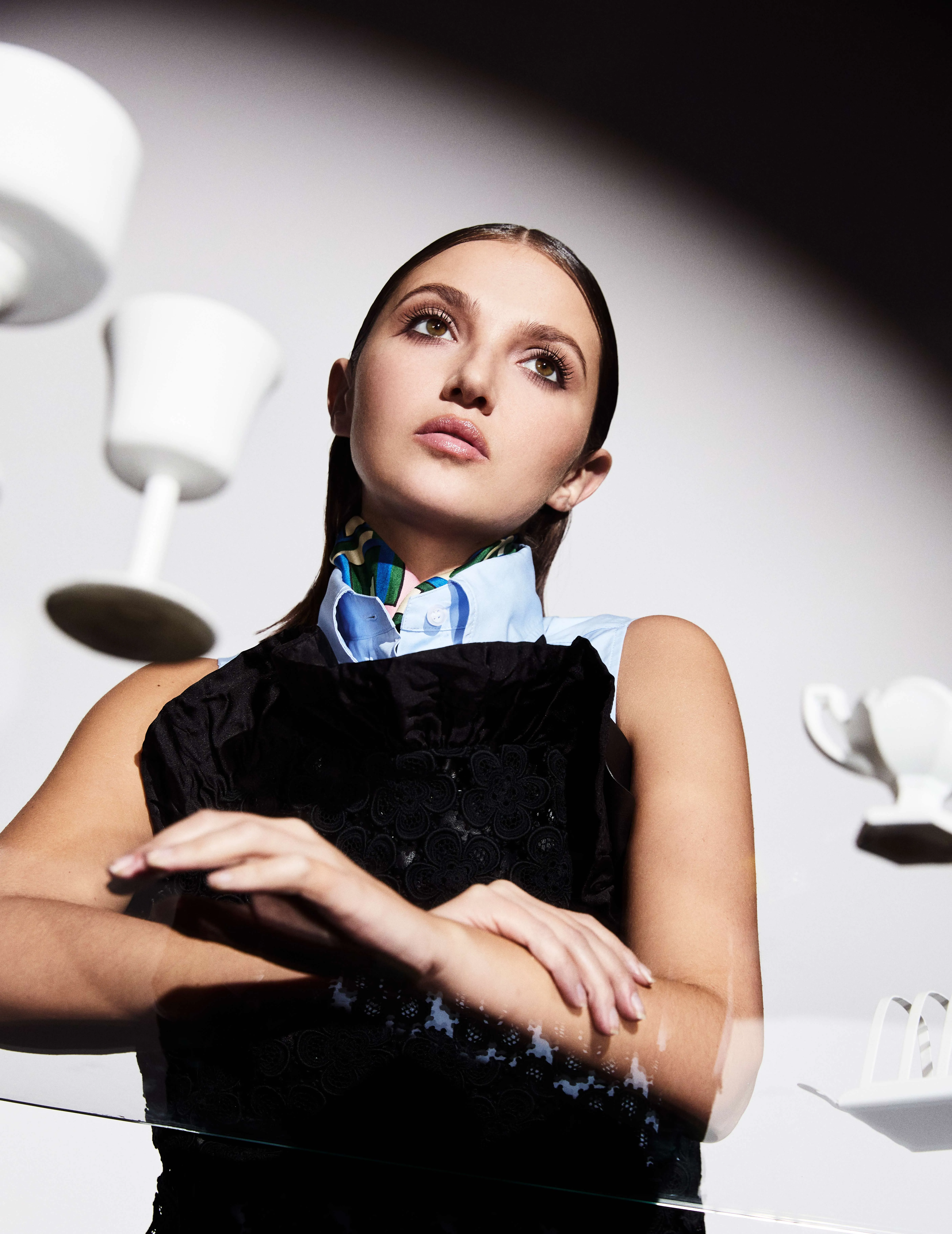
Which is why our arrangement—McKenna-Bruce is my object of observation today—feels like a rare and mildly destabilizing inversion of her natural state. At the forefront of our conversation, she clocks the absurdity of the Zoom delay and micro-glitches inflicted by the interface—relieving us both of the obligation to pretend this is seamless. It’s a small acknowledgment, but under digital surveillance, she is ahead of the moment. “I feel very much at a hinge point,” she says early on, reporting on herself from a slight altitude as she describes a year that has flung her between Senegalese deserts, Agatha Christie drawing rooms, and the airless chaos of Beatlemania. “But with that comes more eyes on those roles.” She instinctively checks her footing: “But you know what? I bloody love a challenge.” The space between the sentences informs me where her truth lives—in that infinitesimal pause where she can listen back to herself.
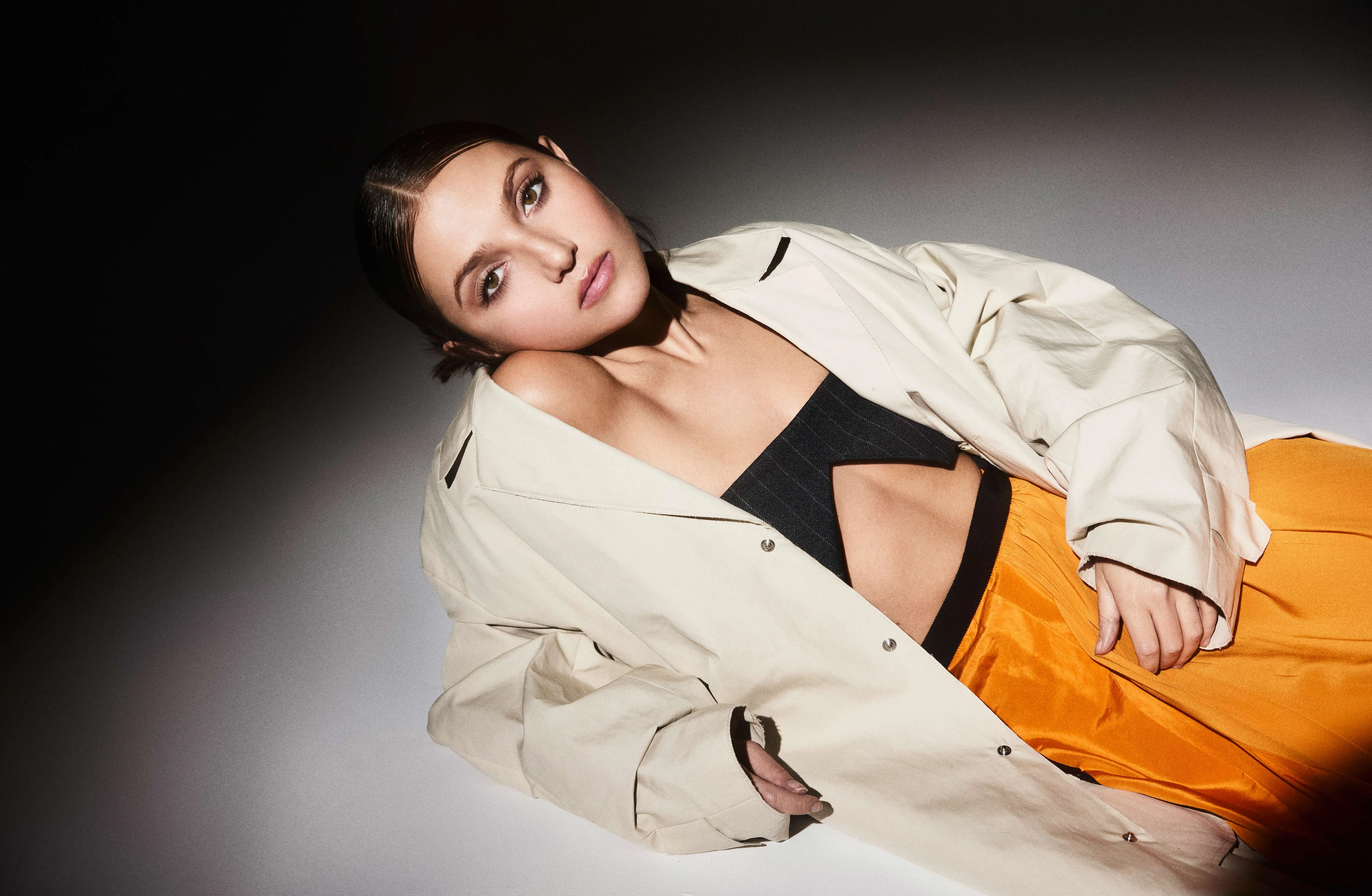
Mia McKenna-Bruce, more than anything, is in the business of reception. She wants to watch you. This is quite seismic, given that her career increasingly positions her as someone the rest of us are meant to look at. Cinema has archetypes in order for this particular sort of woman, though she is rarely (or is yet to) be named. She isn’t the ingénue, nor the final girl, nor the mastermind stockpiling a monologue in her throat. She is the woman who arrives early and intact, and does her best to exit just as she came. If the scream is cinema’s most fetishized release, then watching is its most undervalued weapon.

Her body of work operates accordingly, positioning McKenna-Bruce as one of the most rapt performers of our contemporary landscape. Having cut her teeth in British television and early independent films, McKenna-Bruce’s breakout arrived with How To Have Sex (2023), Molly Manning Walker’s BAFTA-winning debut, in which her performance as Tara—a teenage girl navigating the slow, suffocating erosion of consent—announced a startling new screen presence. The film’s critical reception thrust McKenna-Bruce into international focus, earning her the EE Rising Star BAFTA and queueing her workload for the foreseeable future. She followed with The Fence, filmed in Senegal, a physically and psychologically demanding drama that displaced her into viewership of a necrosed ecosystem.
This year, she controls our consciousness through a different register entirely as she undertakes Sam Mendes’ four-part biopic resurrection of Beatlemania, before turning inward again in The Lady, portraying Jane Andrews and the dangerous misrecognitions that accompany proximity to power. She then pivots into classic British intrigue with Netflix’s forthcoming adaptation of Agatha Christie’s The Seven Dials Mystery. The project, a priority for the streamer, places her alongside Helena Bonham Carter, Martin Freeman, and Edward Bluemel—if this sounds like a dense mouthful of accolades, credits, and increasingly serious nouns, it’s because it undeniably is. McKenna-Bruce is, by any reasonable measures, on a roll.
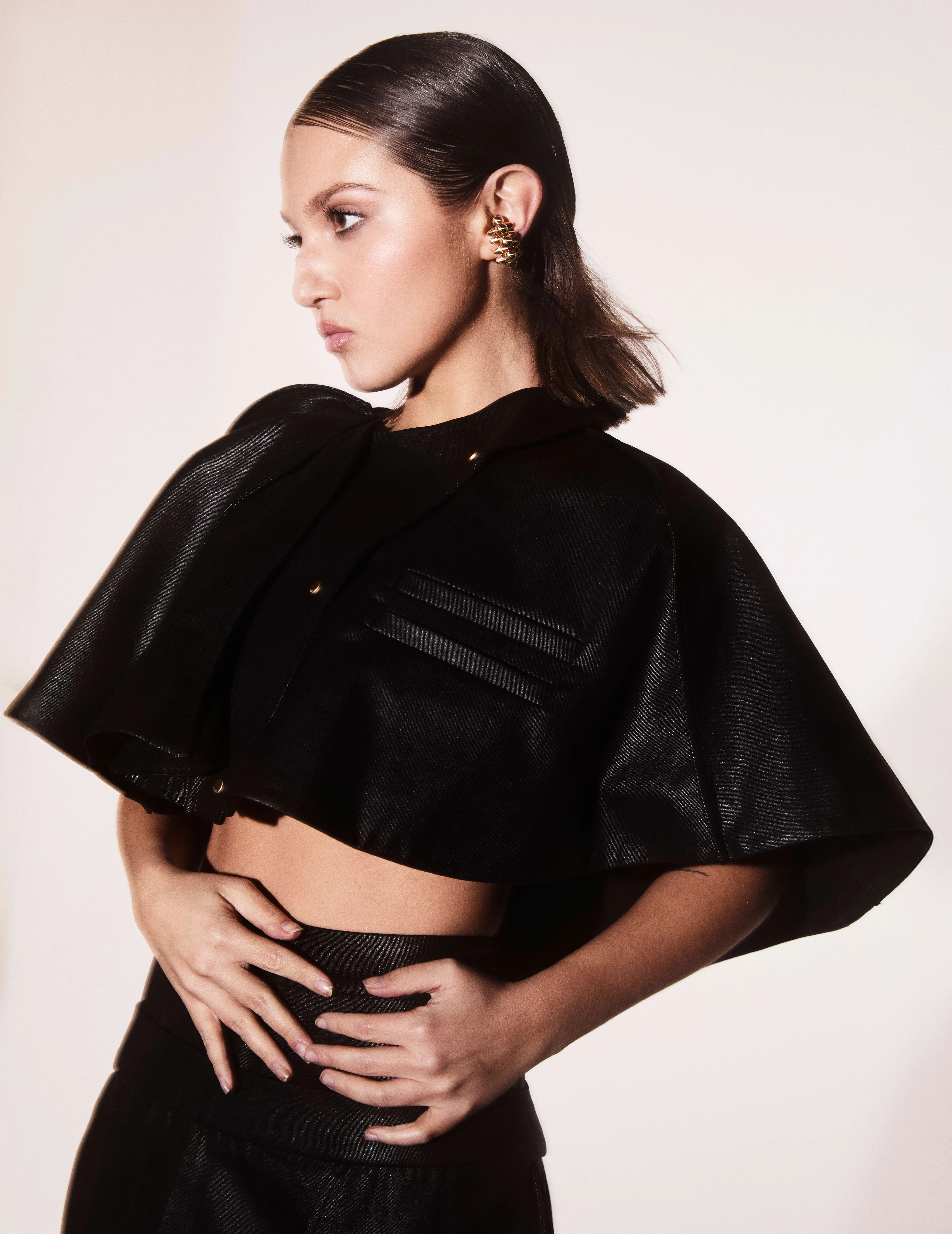
When I suggest that she so often functions as a witness before she is an actor, McKenna-Bruce considers the idea as if it has only just been introduced to her. “I’ve always been an observer of people,” she admits. “Even as a kid. I think I learned more from watching than from doing.” She laughs, softly, surprised. “Humans are so fascinating. I don’t think I’ve ever said that out loud.”
That instinct extends directly into her mechanics. She is openly suspicious of over-rehearsal amidst contemporary worship of “The Method Actor,” vis-à-vis an era in which Hollywood’s most visible men are irreparably damaging their eyesight, shedding a staggering amount of weight, or adopting accents that will, for the worse of society, never quite fade. She is also suspicious of anything that prematurely congeals, of certainty that arrives before the body has caught up. “I don’t want to come in knowing everything,” she says. “I think I’m probably the furthest thing from method. I really trust instinct. I need to be Mia again at some point.”
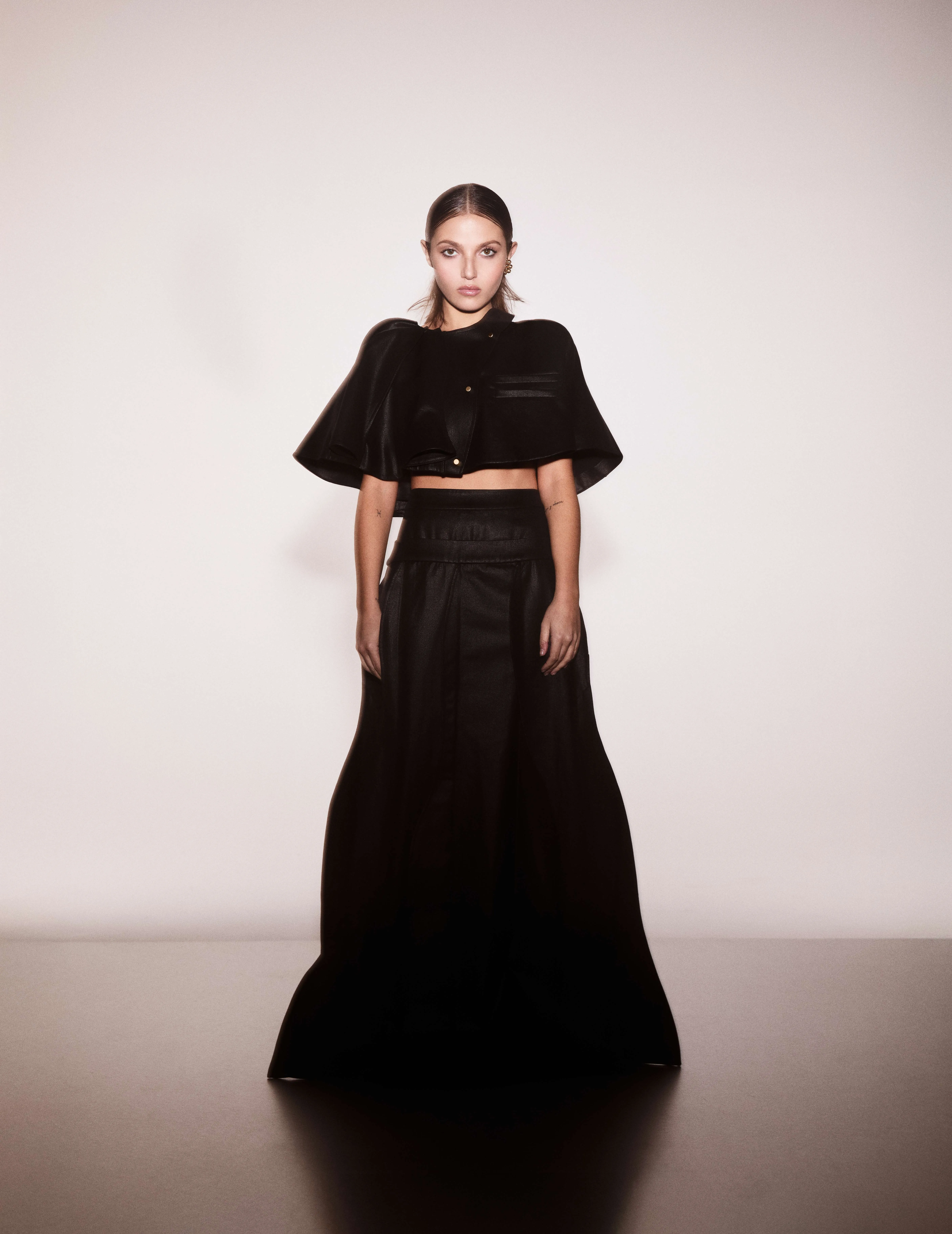
First takes speak. Working with filmmakers like Claire Denis and Molly Manning Walker has bestowed a great secret about the meaning of meaning upon McKenna-Bruce. Sometimes meaning shows up late, drunk, mid-mistake, if you resist the urge to dominate the moment before assemblage is complete.
She tells me about briefly experimenting with writing diaries through the lens of her characters—a much more tame method acting exercise, when we again consider that there are men forfeiting their eyesight for the sake of The Craft—before abandoning it entirely. “Most of the characters I play are quite traumatized,” she says, dryly. “Sitting at night writing as them? I was like, ‘No. This is weird.’ I don’t need to take the work home.” For her, less is more. Over-thinking is the enemy. “I’d rather get it wrong,” she says. “And know that it’s okay to get it wrong.”
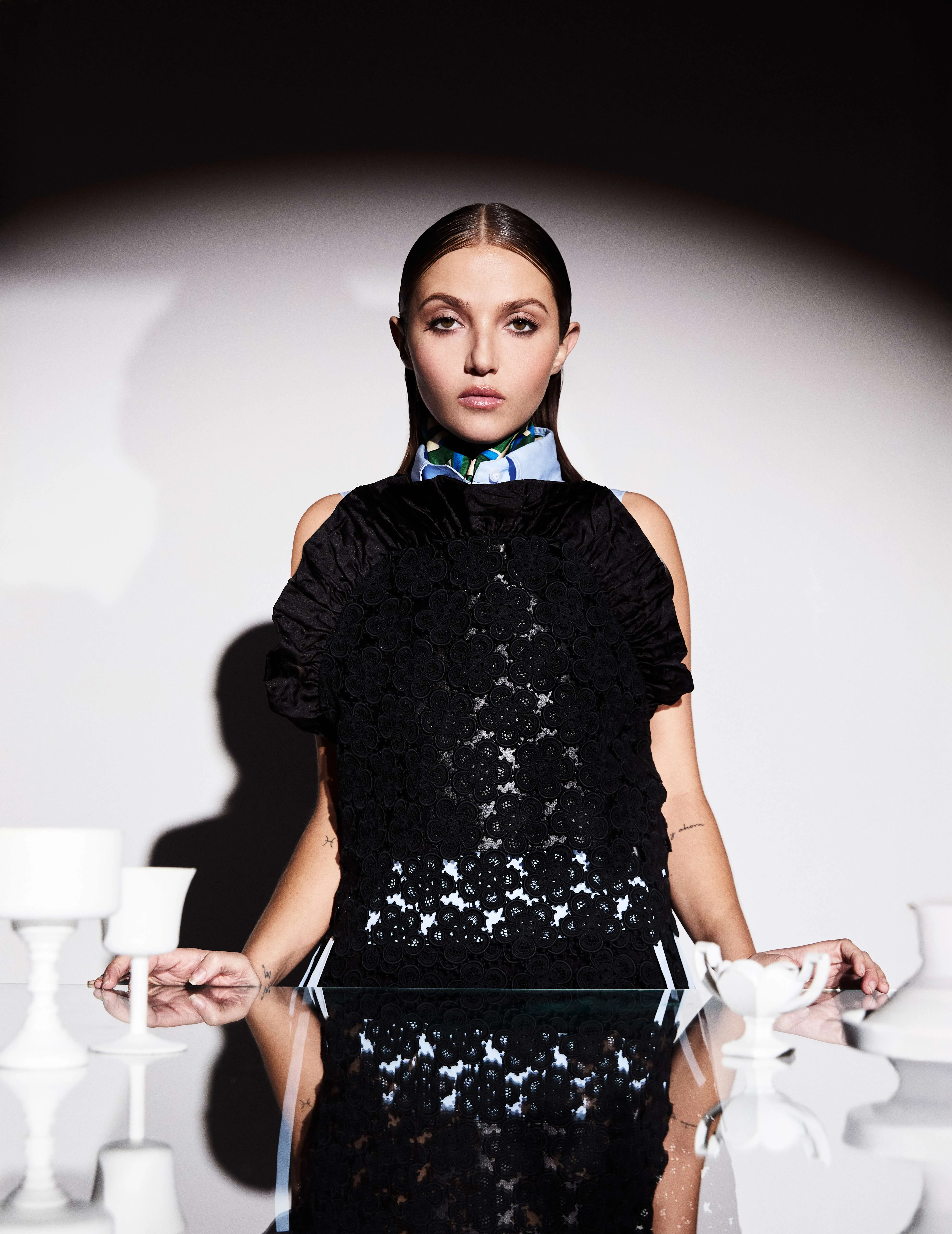
McKenna-Bruce admits that she absorbs the energy of others, which is a gift when she is working and an exhaustion when she is not. Mothering her son, Leo, has only sharpened that reckoning—the act of watching begins to carry stakes beyond the self, beyond ambition, beyond the aesthetic pleasures of understanding. “You become much more aware of what you’re willing to give yourself to,” she says. “It completely changes how you see everything. There are moments where I’m like, ‘Am I working too much?’” she admits. “But then I think—my son gets to see his mum following her dreams.”
Then choice follows, the seductive little word that vows freedom and delivers vertigo. With success comes agency, and with agency, terror. “Saying no [to a role] feels very scary,” McKenna-Bruce admits. “You don’t know what you’re turning down, or what you might not get again.” Scarcity once imposed its own brutal logic; control, by contrast, feels theological. Visibility complicates this further. Actors consent to being seen—this is the foundational pact—but McKenna-Bruce questions how much agency survives once momentum takes hold. “I don’t know if you can fully control how visible you become,” she says, circling the thought before she bites.
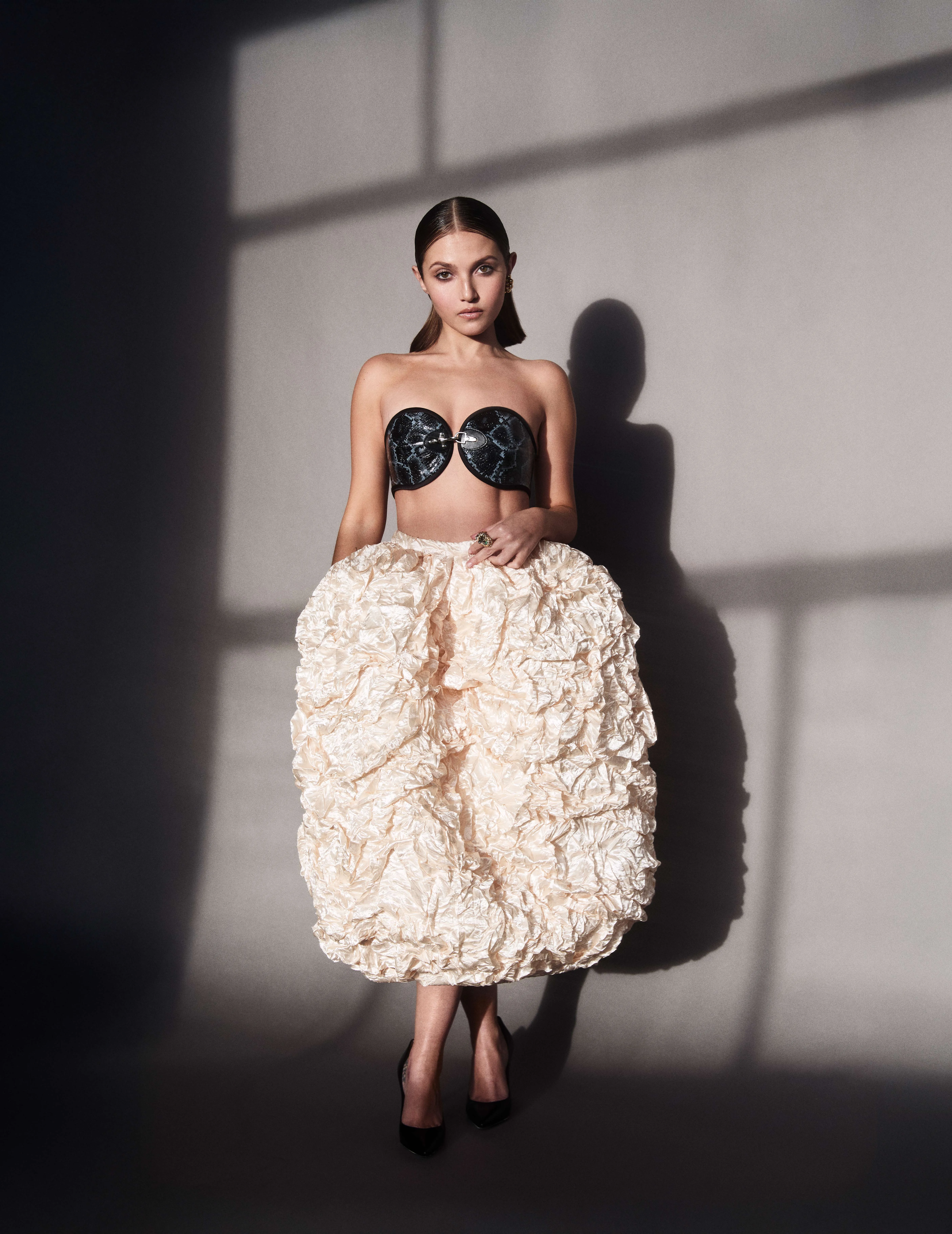
“It has to be about success. It’s about getting to do acting as my job and not have to have another job alongside it, and at this moment, I’m getting to do that. So choice feels really scary, because it feels like you actually have a bit of control over something, and I want to make it last as long as possible.”
McKenna-Bruce is acutely aware of how attentiveness—particularly in women—is rarely read as neutrality. “If a woman is quieter on set, or just a bit more internal, it’s like, ‘Oh, what’s wrong with her?’” she says. “You’re instantly marked as difficult.” A man, she notes, is granted mystique for the same behavior. “He’s fascinating. He’s deep. His process is interesting.” Watching, then, becomes a minor act of defiance—a refusal to perform accessibility on demand. In this sense, McKenna-Bruce’s restraint feels almost political: an insistence that not every interiority be flattened into legibility.
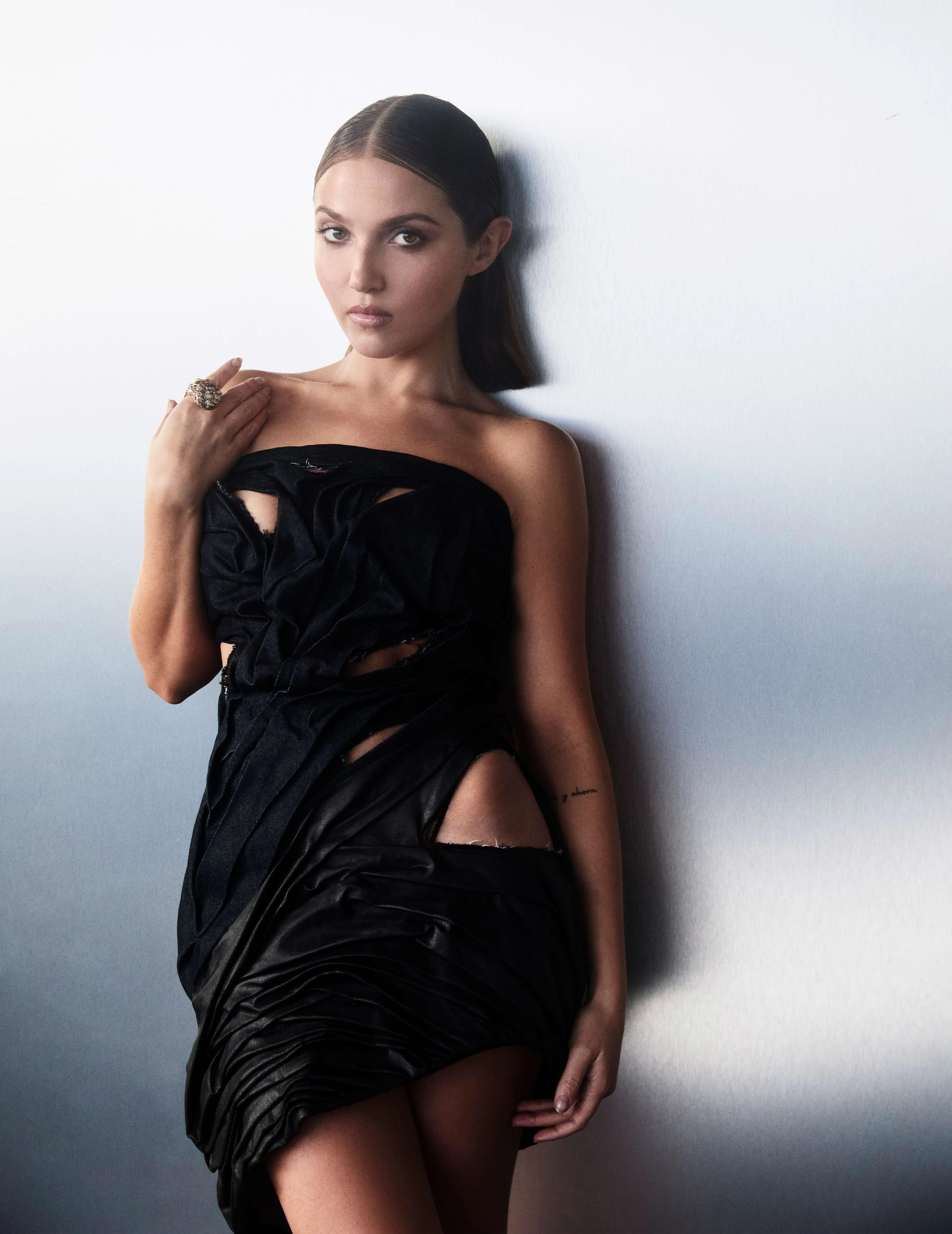
And so my final question to Mia McKenna-Bruce becomes: what is a woman to do when she has spent a lifetime watching the world, and the world finally returns its gaze? McKenna-Bruce does not have the blueprint, but offers something stranger, riskier, and a hell of a lot more compelling: an insatiable appetite. “I just want to keep playing all kinds of characters,” she tells me. “I really feel connected to these females trying to break some kind of mold, or stay true to who they are in a world that’s trying to tell them to be something else.”
If to watch is to trespass, then Mia McKenna-Bruce has built a career out of crossing that membrane, again and again, gathering the courage for the next threshold—standing at the edge of action and meaning, forbearing as ever. The future is approaching. She’s already looking it in the eye, ready to break its mold.
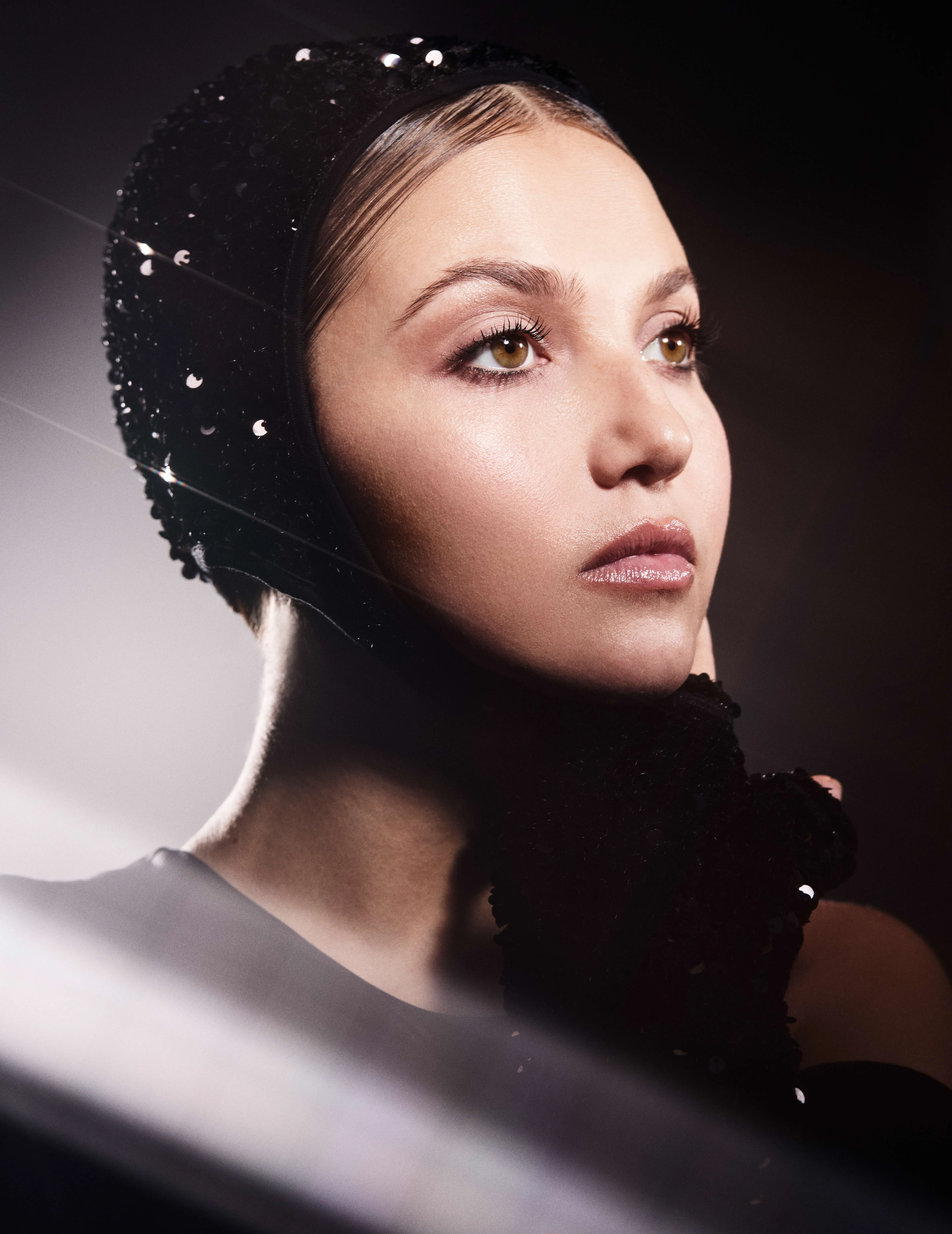
Photographed by David Reiss
Styled by Aartthie Sashi Mahakuperan
Written by Melanie Perez
Hair: Davide Barbieri at A-Frame Agency
Makeup: Emma White Turle at The Wall Group
Styling Assistant: Tilly Hopcraf
Stay up-to-date with exclusive events and content.


