F L A U N T


Repetition has a curious way laundering intent. Rinse and repeat long enough, and all of our menial daily tasks are no longer symptomatic of choice: life simply becomes expected. We swipe cards, trawl ourselves to work, and tell ourselves again and again that this latency of a life is progress. The extraordinary becomes ordinary, the dangerous becomes procedural, and even war—perhaps especially war—is rendered administrative.
Atropia is concerned with exactly this erosion. Written and directed by Hailey Benton Gates and produced by Luca Guadagnino, the Sundance Grand Jury Prize-winning film unfolds inside a simulated warzone—a fictitious Middle East designed to prepare soldiers for deployment. Based on simulated villages that actually exist across the US, actors populate the configuration as civilians, insurgents, mayors, grieving parents. Grief is scripted. Violence is rehearsed. Fear is modular. The premise is so audacious it skirts surrealism—until you realize it isn’t abstraction in the slightest. Real people live in what’s referred to as The Box. They leave The Box with residue intact.
The film is anchored by Alia Shawkat’s equally hilarious and devastating performance as Fayruz, an actress who has spent some time inside The Box, clings to fantasy as someone who understands that reality offers less mercy. Shawkat’s performance is a study in what happens when selfhood becomes porous after prolonged performance—when Fayruz’s self-serving ticket to stardom is indistinguishable from her means of survival. Across from Fayruz is Callum Turner’s Abu Dice: a man afforded mobility, exit, and authorship over his narrative. Where Fayruz must metabolize the simulation to endure it, Abu Dice is permitted distance. The question raised, then, is not who performs best. Atropia asks—who gets to step out of the simulation unchanged?
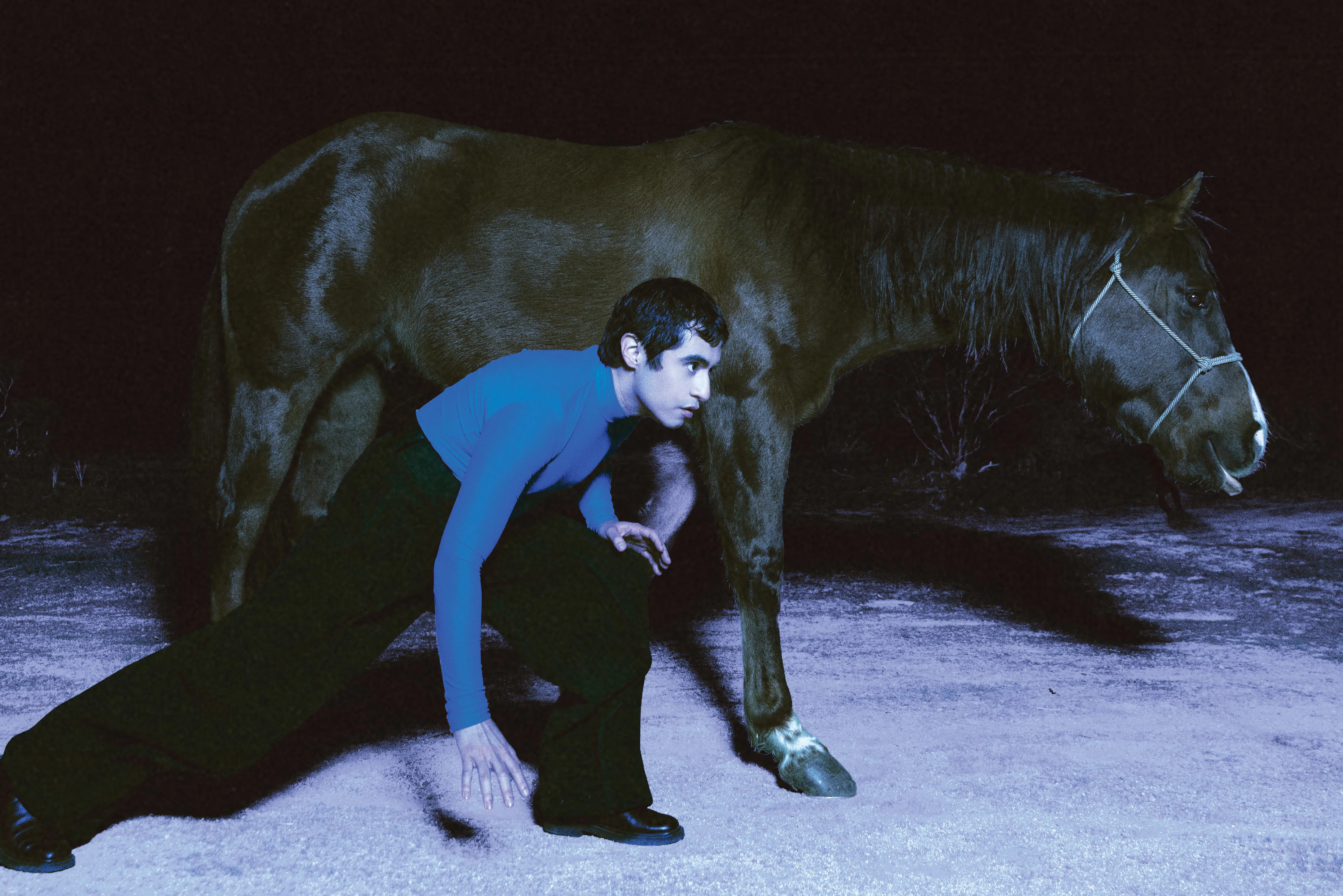
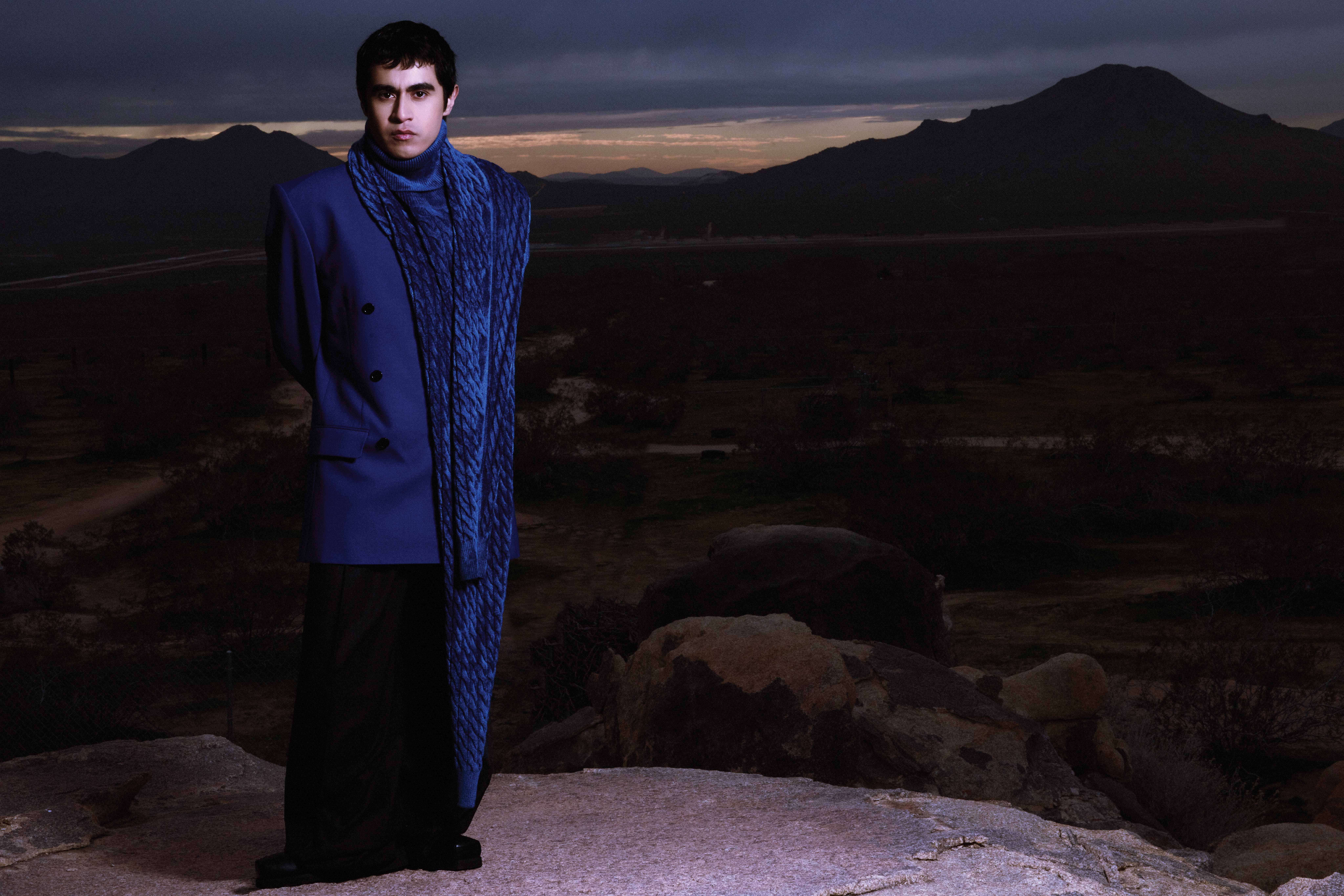
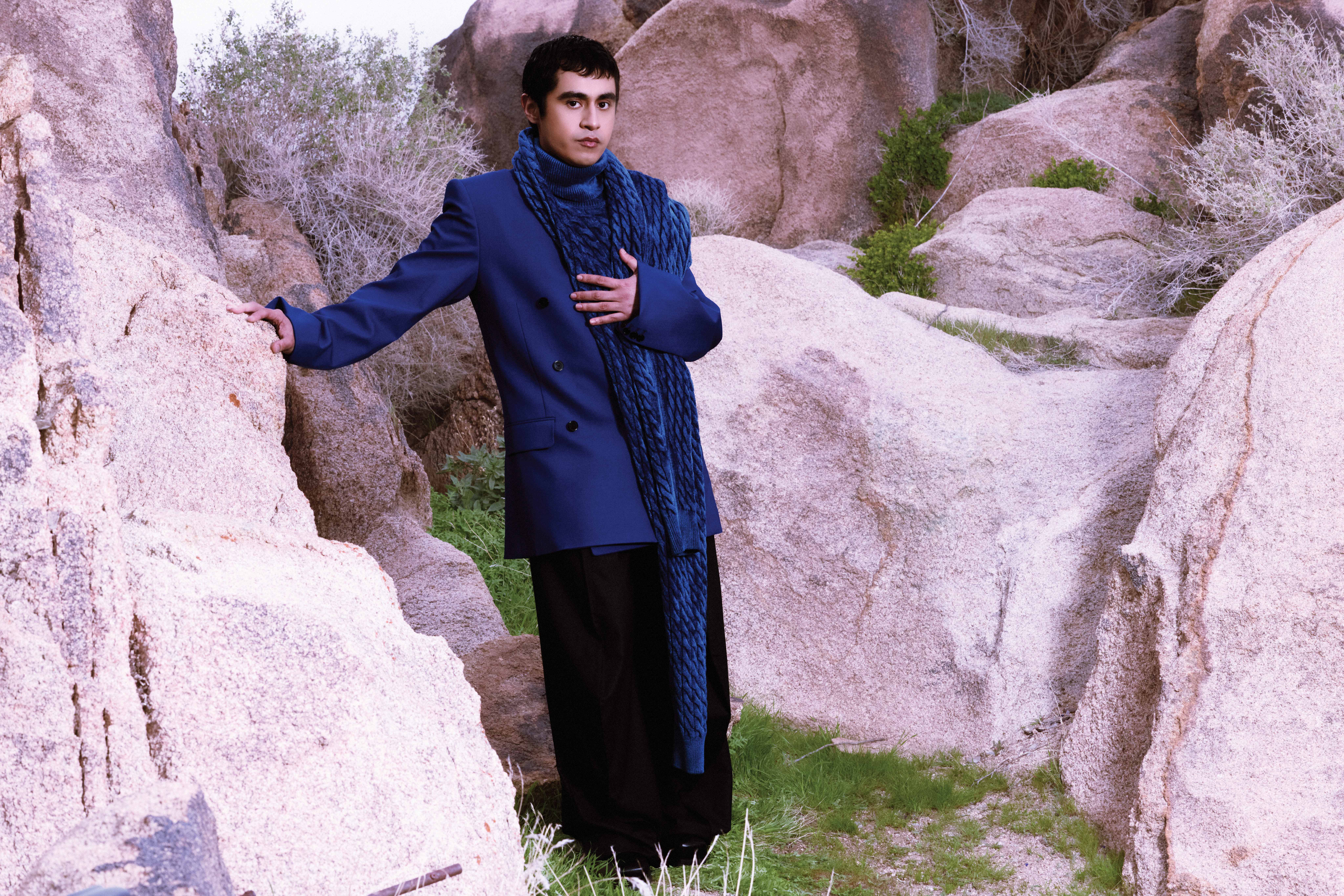
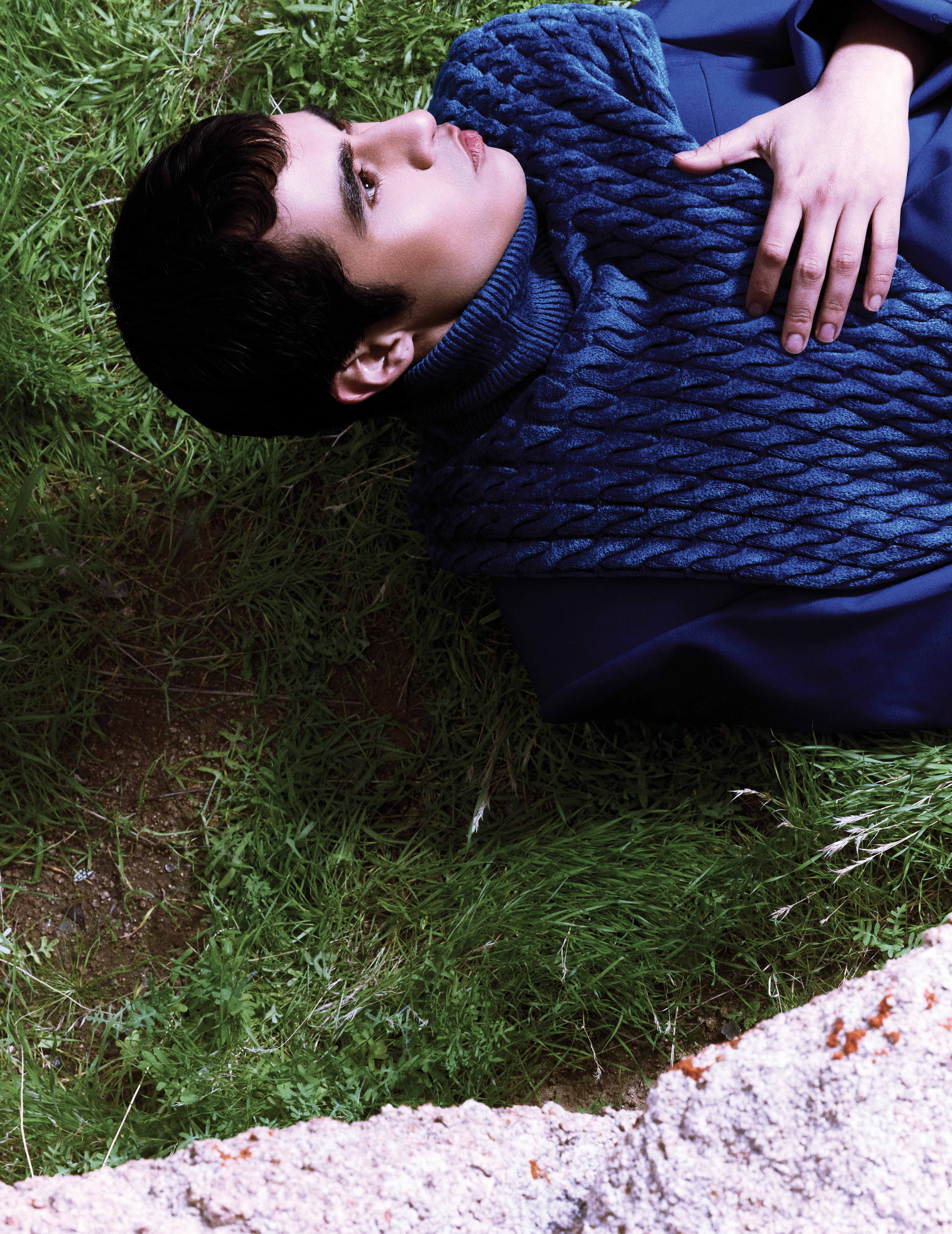
Within this aphorism exists Private iPod, played by Gilberto Ortiz. Young, earnest, and openly curious, iPod represents a familiar American archetype: the believer. He is animated by the promise that service will amount to something—sacrifice will suffice to unlock education, stability, and pride. Within the mechanics of the simulation, iPod serves to function as realism’s proof. Raised in a working-class, Latino household with close ties to the military, Ortiz understands the stakes of enlistment as a lived reality rather than sheer abstraction—a means to healthcare, education, and stability that is framed as opportunity despite its immense personal risk. He is utterly and beautifully unembarrassed by hope.
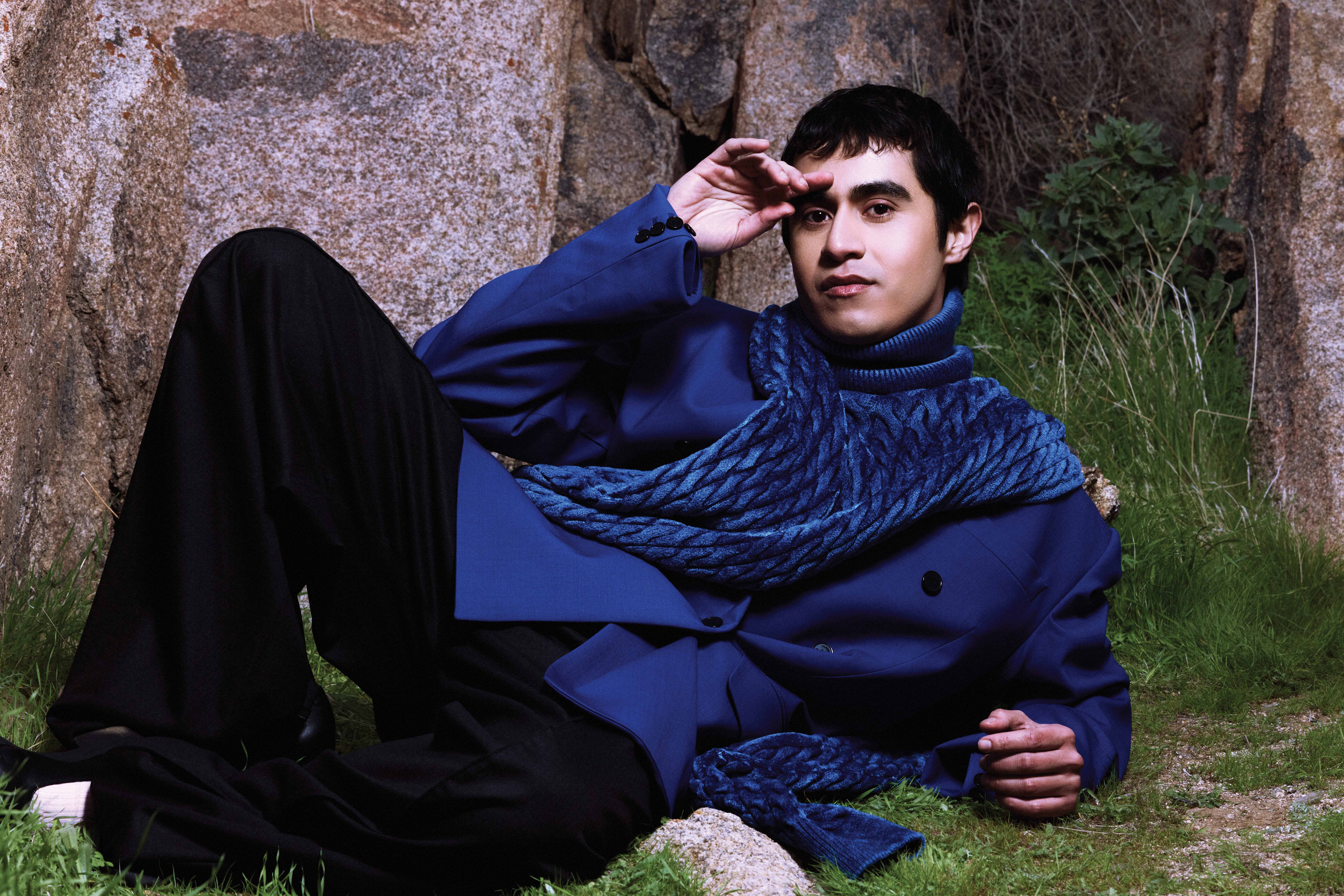
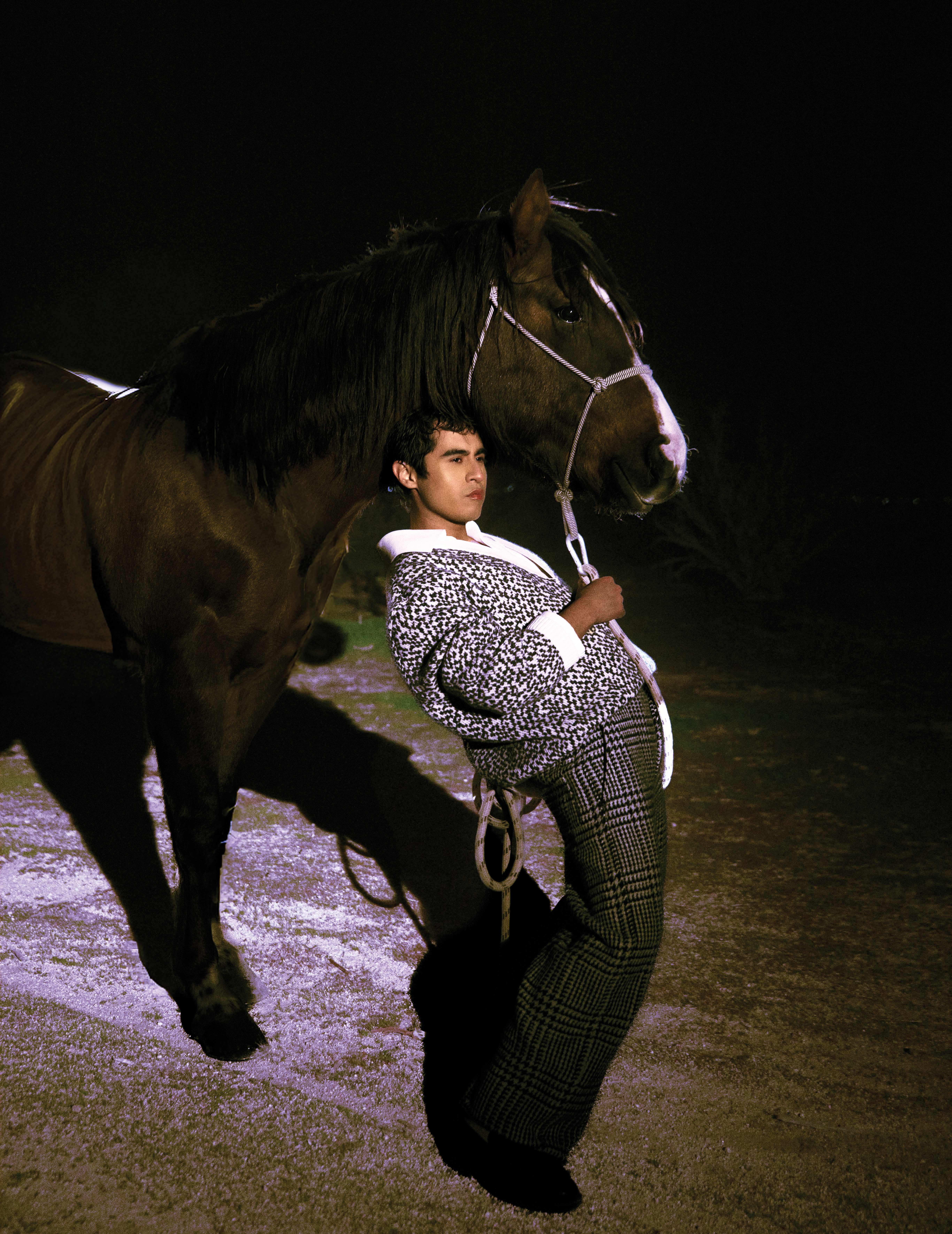
In conversation with FLAUNT, Ortiz speaks with the same openness that defines his performance—about guilt and ambition, masculinity and softness, fantasy and survival. What emerges is an artist interrogating the systems that beckon us to give more than we are ever guaranteed to receive. Atropia may be a film about perpetual staging, but Ortiz is most interested in what remains unsimulated: dignity, connection, and the insistence on being human inside structures designed to flatten us.
What drew you to the Atropia script in the first place?
Once I started reading it and got to the second page, I just had to go back and reread it. I was like, “What the fuck?” The veil was lifted and it wasn’t what I was originally reading. I was like, “Oh, okay, so this movie is going to be [surprising], and I’m not gonna really know what I’m getting myself into.” At each page, I discovered new jokes and moments that were so smart and sharp. It’s just the most insane premise. And I did some research, and it turns out that this is a real place that does exist, which blew my mind—that this actually does happen.
I kind of went down a rabbit hole after finding out this is a real thing. In Atropia, I found that Private iPod is basically cast in the box as a prop of realism, as everyone else is. What did it feel like to be cast in a role that serves as a prop of reality?
What’s funny is that I was brought in for a different character initially. They brought me in for Private Freeburn. But I read the script a couple times, and I did my tape for Freeburn, but I wanted to take a stab at iPod. I saw elements of myself and my cousin; there was just this sense of naïveté with him and in curiosity and not really understanding the gravity of what he signed up for. That really drew me to him, because young women and men who are doing this don’t really understand what they’re getting themselves into. I want to think that there were some elements of heart and innocence that I hope shone through the character.

These people are essentially being trained to go to war. There are no expectations that meet the reality of war.
What’s crazy is that a lot of the people who went through Atropia and did The Box for 25 days surprisingly found The Box to be more traumatizing than actually going to Iraq. Which is wild, because I think it was just something about them, not comprehending that it was a simulation. None of it was real, but there were real landmines. It was a real mind fuck. People were really traumatized from The Box, injuring themselves to get out. In some of the earlier Atropia scripts, we’d see people getting killed in the box.
How else have you found similarities to iPod?
I wasn’t sheltered growing up, but I never was able to see the bad side of things. I navigated the world thinking that everyone was nice and kind and open to me, and I still feel as though I am that way.
You should be that way. That’s a good outlook to have.
I try to give people the benefit of the doubt. If my initial meeting with someone wasn’t the most positive, I’ll think, “Well, maybe they’re having a bad day.” I saw parts of that in iPod, and parts of my cousin Marco in him as well. He’s just so curious and wants to know what it’s like out there. Like when he’s asking Abu Dice, “So what’s it gonna be like for me?” I’m not saying he doesn’t understand what he’s getting himself into, but there’s naivete there. What is war gonna be like? Is it going to be cool? Is it going to be everything I dreamed of? Is it going to be camaraderie? Am I going to be proud of being an American? He’s going off and trying to fight for something that maybe doesn’t need to be fought for, you know?
It’s such a commitment to something that’s larger than yourself, but you never know what that commitment fully entails at the same time. There are a lot of people who have the same experience that iPod had. A dream of grandeur, in a way.
His long-term goal is to go to college and he feels like this is the only outlet for him to be able to afford college or even get an education, enlisting in the military. I have family members of mine that are still active in the military, and they really did it to help their families get a green card and just to be able to have health care and access to things that most of us already had growing up.
It’s almost an unfortunate trade-off, because you can’t guarantee that you will receive these things at the end of this stretch of commitment. When you consider how everything in a situation like Atropia is staged—language, gestures, danger—what do you think is the most honest thing that remains in a staging like that?
Maybe your dignity. We see how far Fayruz goes to put on a persona to Abu Dice, but also a persona to herself. I suppose in that way, then it’s about preserving your identity. I remember one of my first insights into the real life of an actor was getting booked as a lead for my first film, and I was working at Vons as a courtesy clerk, and I was also doing interior plant maintenance. I held three jobs at once. One day I’d be filming the movie, and the following day I’d be pushing carts and bagging groceries, and then I’d be watering plants that evening. There was the sense of, “Oh, okay, this is what it is to be an artist.” The journey is not everything that a lot of people think it is. I don’t want to say that it was humbling, because I didn’t have any expectations with it. When I booked that role, I was like, “Okay, this is just my life,” and it just kind of became it. I think being grounded and centered in who I am was really important to me, because filming a movie felt amazing, but that’s not the entirety of it. The reality is that I was a struggling actor who was just trying to break into this business, doing what I could just to survive.
In Atropia, iPod has a lot of moments where he is indignified. I think this indignity is especially prevalent in our hustle culture, especially in these creative fields.
In these moments, I think other people’s thoughts and opinions of yourself sway who you are and what your mission is, but I don’t think iPod ever allowed himself to be truly embarrassed by being singled out in front of his compatriots. He was so sure of himself and sure of his end goal and journey, which was to go on this tour and come back and go to college. And I feel like I’m kind of on that same path.
Where do you see yourself wanting to go after this film? What kind of stories do you want to tell?
I write, and I have a feature that I’ve been working on as well. I think this is written in my wheelhouse of characters that I want to play. I really want to write and produce and create my own stuff, and I feel as though I’ve been really afforded the privilege to be in rooms with people with this film, [Atropia] whose brains I’m able to pick at. For so long, I kind of just did the job and went home and didn’t really make an effort to connect with other people in the industry, outside of just acting. I recently made it a goal to really connect with producers and other people—even just painters or artists in different mediums... It’s been so interesting just seeing that side of the industry. I just want to be able to tell real fucked up, raw stories of people who are complicated and nuanced. Fayruz is someone who is so deeply messy, but I feel for her. She just really wants to connect and be taken seriously. And, yeah, maybe she’s pregnant and likes doing, you know…
Smoking cigarettes?
Smoking cigarettes, hooking up with this dude that maybe she doesn’t actually like. It’s life. People like that exist in my life. There’s characters who are so innately good, and you’re rooting for them, and then they go ahead and do something that makes you say “Why would you do that!?” I also grew up in a really macho, traditional household, and I think all of that is just BS. I really want to tell stories from the other side of that—women can be the opposite of what they were taught they were supposed to be. Men can be sensitive, and men can cry. Women can also be independent and tough. I grew up with a really, really tough single mom, and she was always like, “I’m your mom and your dad.”
It’s such a fortified generational concept that Latino parents have, and they don’t know any different from that. It really is up to us to fully break that mold.
I think sometimes things like that can be so messed up, and can kind of mess you up a little bit. But I want to believe that I can turn that around and maybe make something really interesting. Projects that maybe could resonate with people—or they don’t, and they think it sounds dumb. They might think that I’m stupid—great, let’s create that dialog. I feel like art should be divisive. I want to believe that maybe I could do that and maybe be of service.
Is the goal to write and star in these stories?
Definitely. I’m working on a short that I’ll be the lead in. And then there’s the feature as well. It’s a little out there, but I kind of want to challenge myself in playing characters that are so outside of me. I want to understand the human psyche as much as I can—of people who maybe grew up differently than I did. I also want to play characters that are closer to me and who I understand.
At the end of the day, we’re human. We are so complicated. So many people are fighting themselves...They needed to be understood. They live with a lot of guilt. As I get older, it makes me sad to think that they hold on to that guilt, but it can also be really hard to let go.
Guilt is a parasite. It’s hard to keep it from seeping through every facet—informing how you go about life, how you treat your kids, how your kids treat their kids…
I’m living with guilt as we speak. I feel guilty for not giving my dog enough attention or giving her dinner too late.
Look at us and this generational affair.
I’m really trying to understand my own power—like, I can say no to my mom and it’s not the end of the world. I try not to be too hard on myself. If you can’t do something, someone else will.
How do you stay grounded at times like these? When the guilt is so consuming, or when life throws us three jobs at once?
I think my family is a huge, huge part of it. I’m home a lot, and I live a very chill domestic life. My cousins and mom will come over for dinner. And I like that. I also like connecting with people and hearing their stories. I hope that doesn’t make me nosy… but I really crave connection with people. I love going out into the world and having a conversation with a random stranger and never seeing them again. That’s cool.
Atropia is anchored in finding connection, which is crucial in such a demanding environment. How should we find connection in such dire situations?
Recently, I was talking to a barber as I got my hair cut during the filming of Atropia. Ironically, he took part in Atropia when he was based in Fort Irwin, and we just got to talking. He was telling me that they didn’t shower and rarely used the bathroom. They would sleep under tanks. There was such a sense of camaraderie because they were all in this fucked up environment, and they had no choice but to bond and connect. No one was phased by others not showering or the generally gross things of the world—there was a bigger sense of having to protect one another. He told me about how difficult it was at times for some of them to be away from their families, so having each other was very meaningful.
You have nothing but connection. How do you think you’d fare in a staging like that? Earlier you said you identified with iPod—do you think you’d approach Atropia similarly to him?
I think I would have fully embraced it. I want to believe that I’m somebody who can navigate any situation, and I’m fully just gonna have to deal with it, or else, I’m gonna fight with myself. I’m the youngest of six, and so I grew up with a huge family where there was no sense of privacy ever in my home. I think that would have prepared me for something like that. I’m the youngest, so I grew up with thick skin after getting teased a lot.
What do you hope viewers take away from Atropia?
Atropia has such great social commentary and so many great smart jokes that every time I would reread the script, I just kept discovering new moments that went over my head in the first or second passes. I’ve watched the movie a lot, but this last time, I watched it with my dad, and I still found so much beauty in it, and a lot of moments and jokes that somehow hit me harder. When I watched it at Sundance—you know, that scene with Fayruz, when she’s in the truck after she injured herself, and she’s with the mayor—that man who plays the mayor is actually Alia’s dad. I started to cry, because Fayruz was hit with the reality of becoming a mom, and she wouldn’t get to live in the fantasy she’s lived in for two years. God knows how many times she’s done this thing with Abu Dice with other people in the box. I have people in my life who suffer from mania. I’m not saying that she’s manic, but she’s stuck in a false reality. I’ve seen people in my life have to navigate that, and I want these people to know that you’re gonna be okay. Everything’s gonna work out. Creating this fantasy in your head of what life could be—and seeing it shatter—would hurt my heart too.
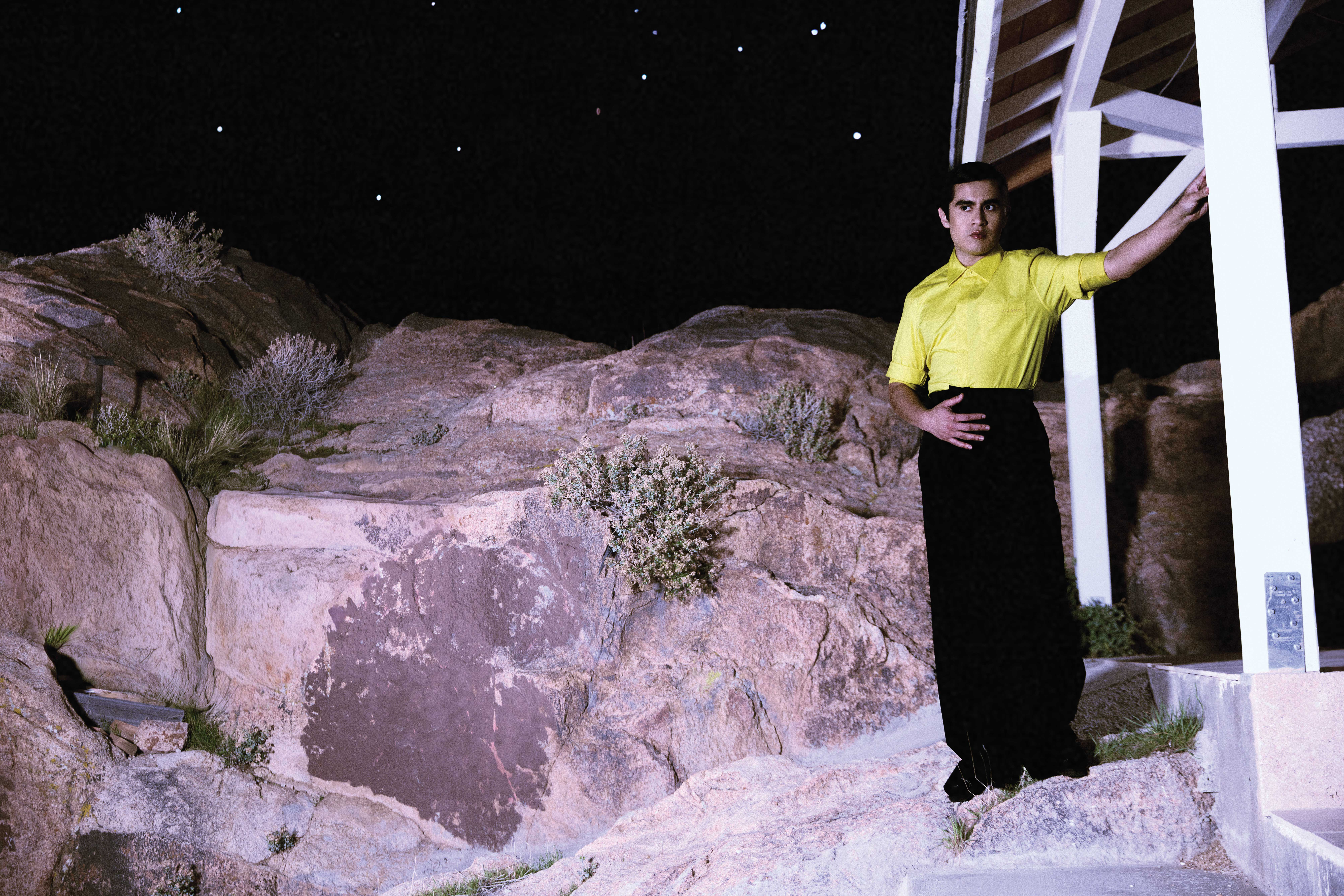
Photographed by Exavier Castro
Styled by Jai Simmons
Written by Melanie Perez
Makeup: Cristal Barrera
Hair: Marissa Garcia
Flaunt Film: Cristian Castillo
Styling Assistant: Amiah Joyner
Location: Dreamers Ranch
Stay up-to-date with exclusive events and content.


