F L A U N T



Cartier, as the watchmaker of shapes, stars at this year's edition of Watches and Wonders Week in Geneva, once again reinterpreting its most iconic forms. Known for their French poise, Cartier draws on their design language rooted in geometry–oval, rectangle, square, and the Maison’s signature curved shape–to reinvent their most recent releases.
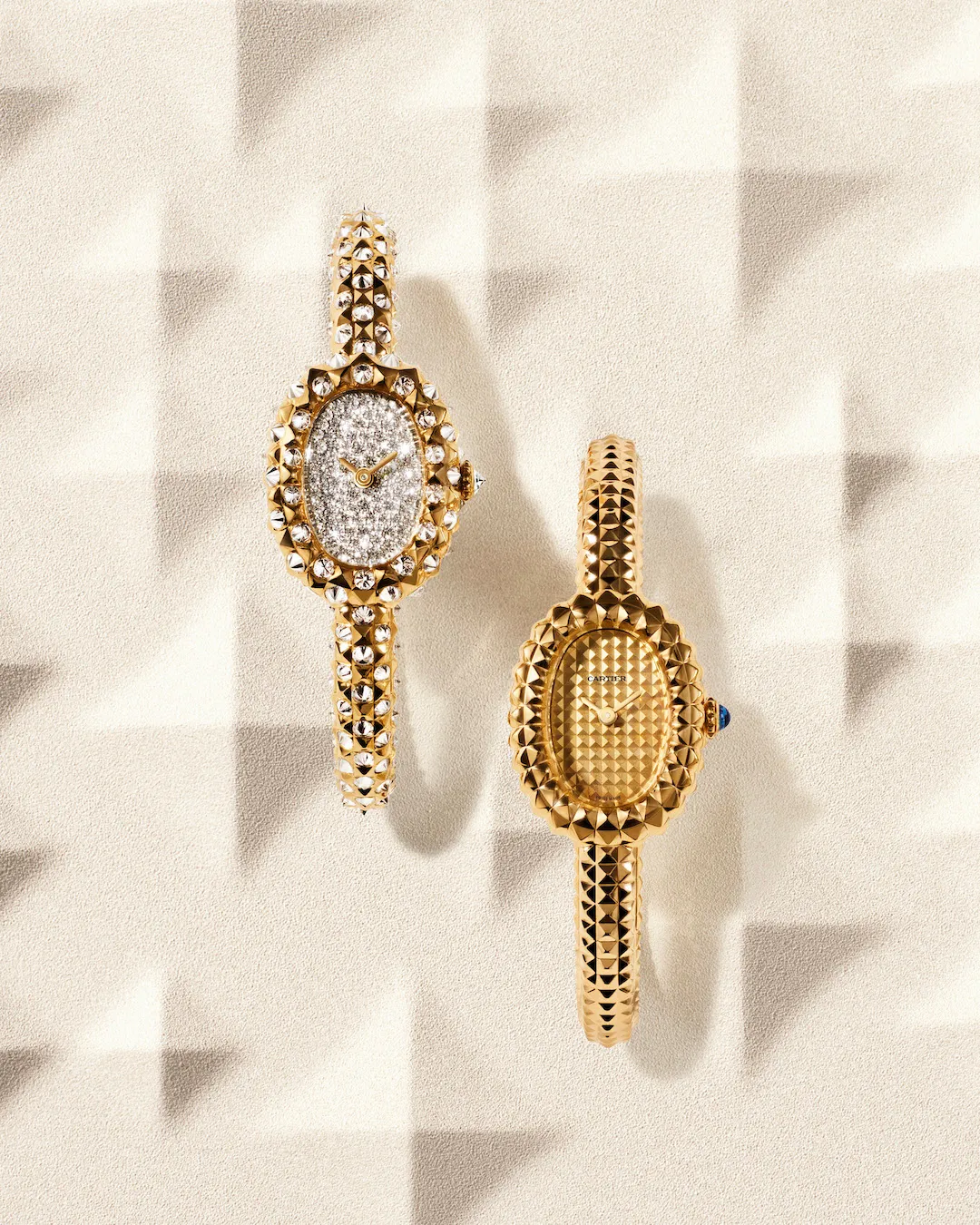
The newly imagined Baignoire watch is an oval watch now studded with their Clous de Paris motif across the case, dial, and bracelet—a hobnail-esque design uniquely integrated for this specific collection.
Equally sculptural, the Myst bracelet watch, with its claspless design, presents a seamless wear with its flexible band. Available in yellow gold with hand-painted black lacquer sections and a monochromatic white gold variation, this piece is reserved as a high-jewlery edition due the 112 hours of gem-setting required for each piece. The gold variation stands out as an Art-Deco inspired style with its undulating black lacquer stripes surrounding its curved silhouette and geometric pavé dial.
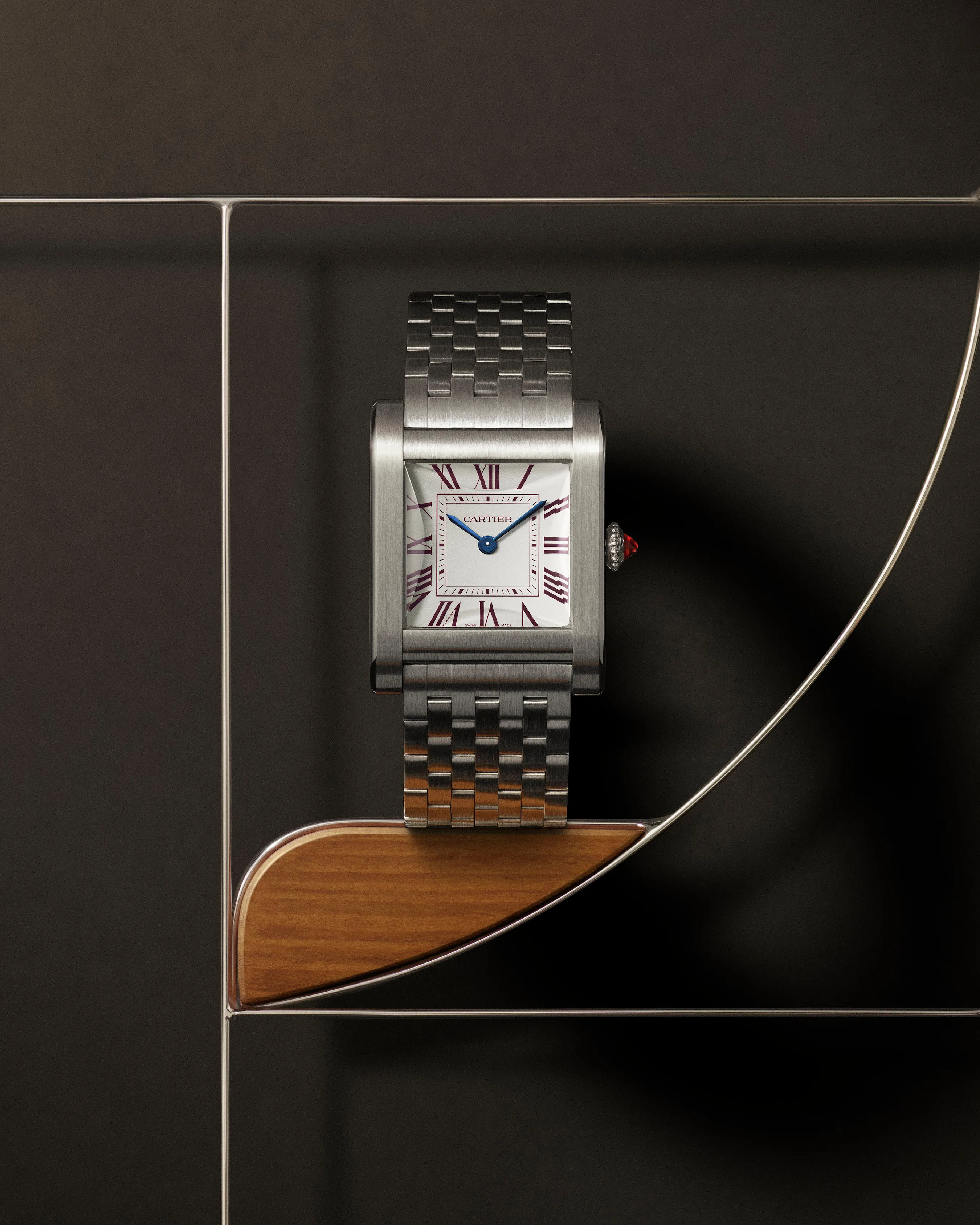
Cartier revisits heritage with the Santos-Dumont watch, introducing vintage-inflected details, such as a gilded obsidian dial, mesh band, and pointed ruby cabochon, offered in gold or silver metal. The result is a restrained yet expressive update to one of its most enduring unisex designs.

The return of the Roadster watch too marks a significant revival, reintroduced for the first time since its debut in 2002. Drawing from automotive ergonomics, the watch features a streamlined case, a crystal headlight-shaped magnifier, and even a speedometer-inspired dial. This classic watch offers two self-winding mechanical movements—the 1847 MC and the 1899 MC—a direct nod to the sporty design.
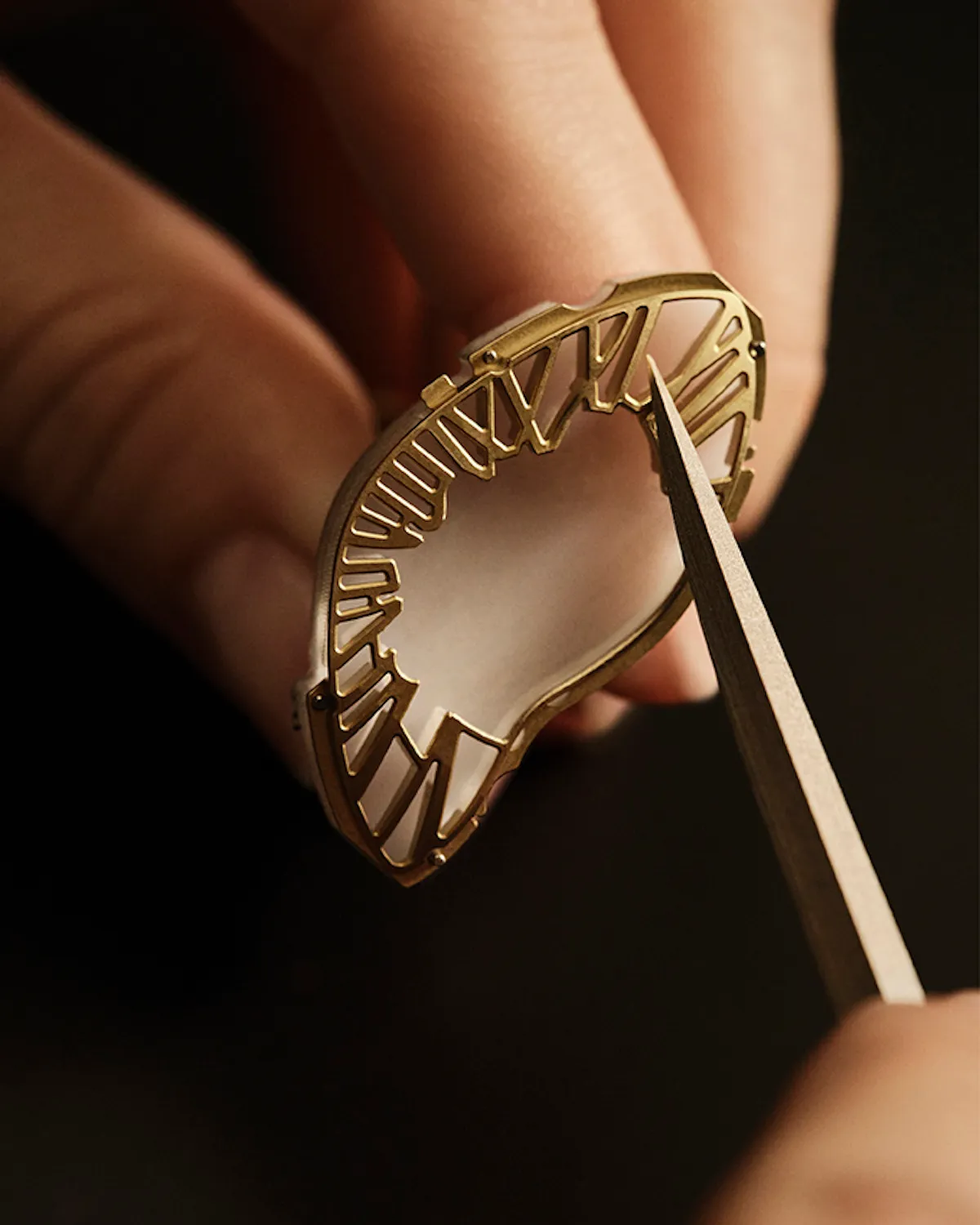
At the center of this year’s presentation is the Cartier Privé Crash Skeleton, part of the 2026 Opus trilogy and a marker of the Privé collection’s tenth anniversary. This iteration features a 1967 MC “Skeleton” movement, not as a decorative layer, but as the primary architecture. The Skeleton caliber is a manual-winding movement made of 142 components, all encased neatly into their signature curved case. The dial melts into the hand-hammered Roman numeral bridges, blending into the platinum case and distinct ruby cabochon crown. A retrofuturistic aesthetic, Cartier has managed to combine both form and function in order to present a mechanical masterpiece.
In Geneva, Cartier assumes the position of the watchmaker of shapes with an aire of savoir-faire—proving that shape, when mastered, becomes a language entirely its own.
Stay up-to-date with exclusive events and content.


