F L A U N T


Before a meeting is booked, a search has almost always happened, and a company or its founder is represented by a scattering of interviews or a knowledge panel summary. A musician or artist’s career highlight becomes a single collaboration with another artist. An actor or model’s body of work is turned into a sentence. So in a time when a computer program assembles fragments it finds into an introduction, and this very introduction is becoming the reason a person or company is considered first, shortlisted, or let into the room at all, the biggest problem becomes how to take control of that introduction.
That’s exactly where GAEA Agency, a Los Angeles practice founded in 2026 by Gina Chung and Rhiyen Sharp, comes in. The strategic agency works across brand positioning, communications, reputation, partnerships and representation, with particular attention to how a person or business appears in search and AI-generated answers. The question is familiar to anyone whose work has outgrown an old biography: does the story available to a stranger reflect what is actually true now?
The pressure to answer has intensified. A Pew Research Center survey conducted in February 2026 found that 60 percent of U.S. adults say they read AI summaries at the top of search results. In an earlier analysis of browsing data, Pew found that people clicked a traditional Google result in 8 percent of visits when an AI summary appeared, against 15 percent of visits without one.
“There is no page two of an AI search answer,” Sharp says. “You are either in the answer, or you are defined by your absence from it.”
The agency’s founders bring different forms of experience to navigating this new landscape for their clients.
Chung headed global and digital brand marketing at Forever 21, overseeing communications, music partnerships, brand collaborations, strategic planning and marketing campaigns during an era in which the retailer operated nearly 800 stores worldwide and recorded more than $4 billion in annual sales. She joined Gen.G Esports, which Forbes has ranked among the world’s most valuable esports companies, in 2019 as vice president of brand, activation and apparel, and became its chief marketing officer in 2021.
Sharp’s work has moved from talent representation at major agencies like IMG/WME and New York Model Management into media partnerships and digital and social media strategy, and includes one of the earliest examples of a large-scale strategic business partnership built around social media as the primary platform: the 2015 collaboration he created between Teen Vogue and the Billboard Music Awards. That same year he created another between Models.com and the American Music Awards, and in 2016 teamed up with Teen Vogue again for a social media partnership covering the BET Awards, experience he now brings to Flaunt as its director of digital and strategy.
The collaborations between Chung and Sharp began in 2015, long before they formed GAEA.
Selected projects from the founders’ collective careers include campaigns and partnerships across fashion, beauty, luxury, consumer brands and entertainment, among them Johnson & Johnson, Chloé, Versace, Burberry, Benefit Cosmetics, Alo Yoga, Puma, BMW, Coca-Cola, Pepsi, Disney, Netflix’s Stranger Things, Sony Music Entertainment, Republic Records and Riot Games.
Their selected media work gives GAEA’s approach a more distinctive shape, with executive production credits on projects for Vogue, Harper’s Bazaar, Elle, L’Officiel, Nylon and Rolling Stone.
The common thread is an understanding of how one association can change the way another is read, and of the interconnectivity between them that creates influence.
“I spent years on the brand side being pitched by agencies that talked about reach,” Chung says. “What I actually needed was for the right people to already understand what we were before the meeting started. That is still the job. The difference now is simply that people ask systems for recommendations before they ask someone else.”
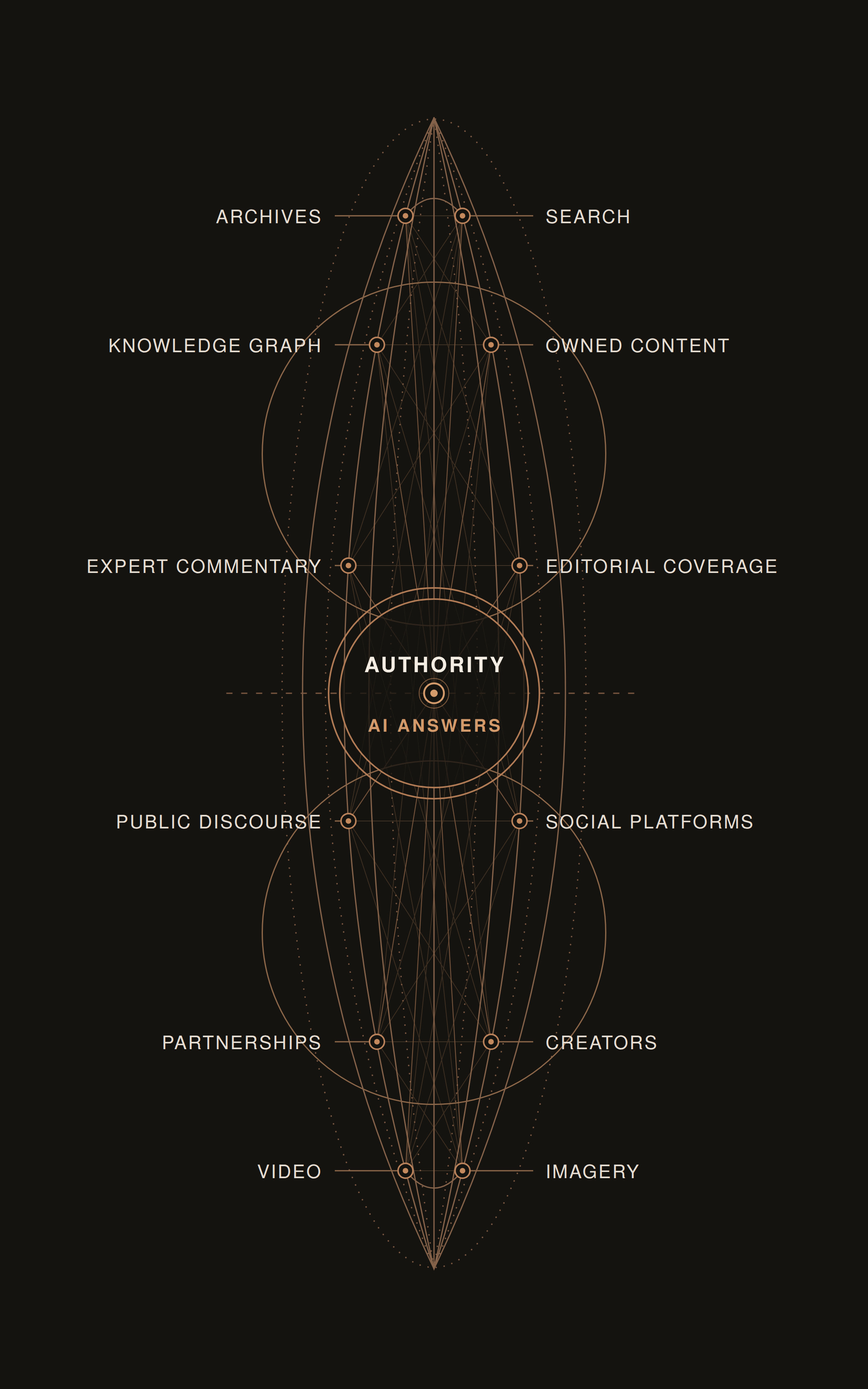
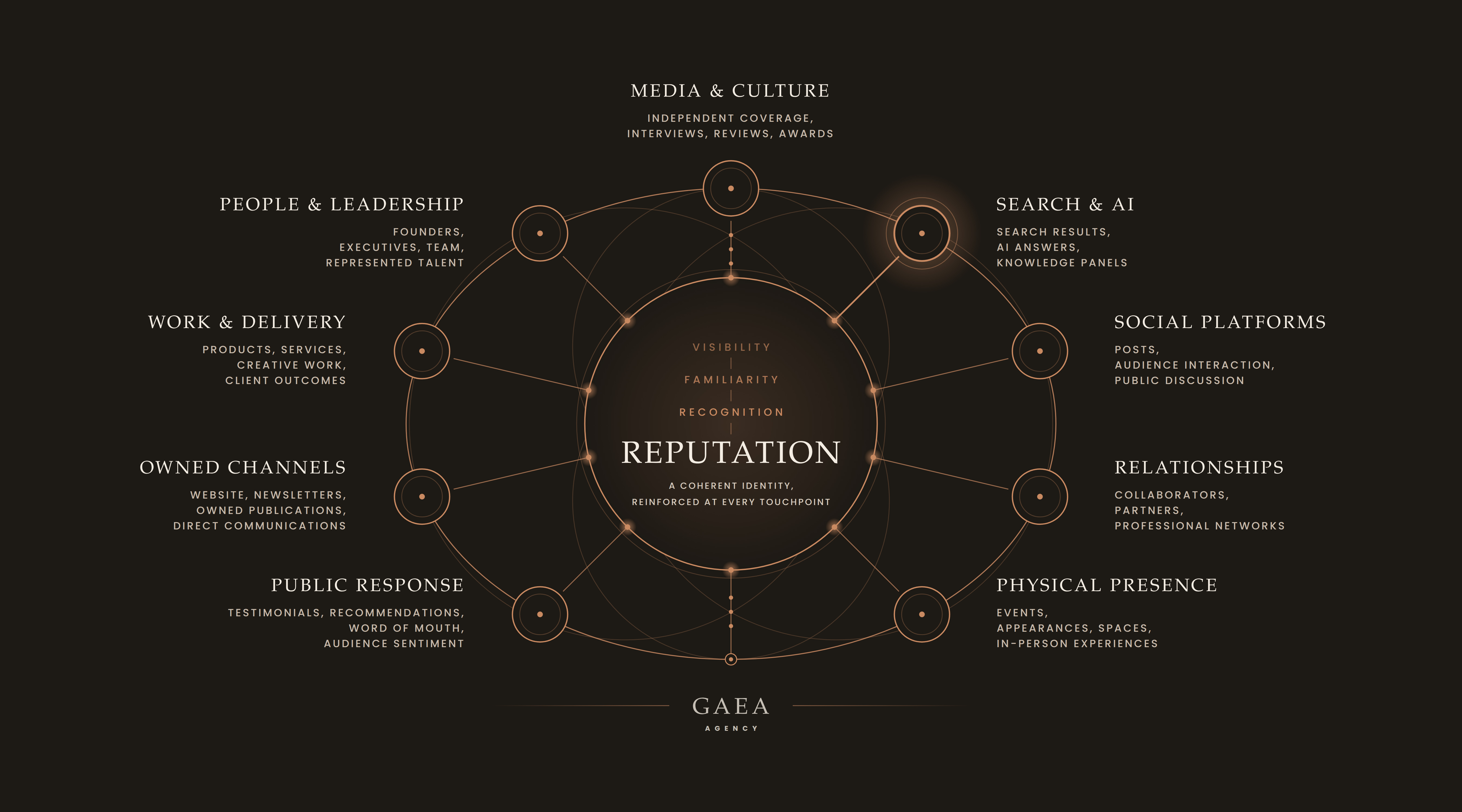
At GAEA, their expertise extends beyond press coverage. The agency’s method, which it calls Authority Through Osmosis, starts with positioning and carries it through communications, cultural partnerships, reputation work and discovery. GAEA organizes these as five territories: Position, Communicate, Amplify, Protect and Represent. A campaign can build attention; a profile and press coverage can supply context and depth; a carefully chosen collaborator can place a person in a new conversation. The value depends on whether those signals make sense together over time.
“No single channel has ever created relevance at scale, and none ever will,” Sharp says. “People, brands and businesses come to matter by being seen, cited and talked about everywhere: in media and culture, in search and social, and in real-world conversations. A coherent idea, repeated across every channel, is what turns visibility into familiarity, familiarity into recognition and then recognition into fandom. That is how culture has always decided what matters.”
“The people and companies we work with are always going to be searched, summarized and compared,” Sharp says. “Our job is to make sure that what comes back is true, and that it is the best version of true.”
There is a less visible side to that work. GAEA keeps a private record for each client, mapped against its Authority Graph, covering verified facts, source links, language, imagery, coverage and relationships, and its internal Authority Index tracks clarity, coherence, evidence, opportunity and discovery. Neither is presented as an independent industry standard, but both speak to an old editorial discipline with a new urgency: know what can be substantiated, and keep the record current.
“Reputation has always worked by association,” Chung says. “Who you are seen with, where you show up, who vouches for you, AI did not invent that, it just started reading it at scale, and it reads everything, including the things you forgot or didn’t realize were out there.”
A substantial profile remains valuable in this view because it gives future readers more than a slogan to find. “A good profile is still doing work for you three years after it runs,” Chung says. “That is the asset. Not the clip, not the screenshot for the deck. The thing that gets read when someone is deciding whether to call you.”
The terms generative engine optimization (GEO), answer engine optimization (AEO) and AI search visibility have grown around this shift, and they can suggest a degree of control that the technology does not offer. Google’s guidance on AI features in Search says that established SEO principles still apply and that there is no special shortcut to inclusion. Accurate, accessible pages and original material written for people are a sounder starting point than a promise of placement in an answer, and the same principle applies to an agency pitching authority: the proof has to exist beyond the pitch.
For Sharp, it all comes back to ownership and management of one’s image. “If you want to be in a room, you’re going to be introduced in some way,” he says. “The only real question is whether you want to be involved in how that introduction goes.”
Stay up-to-date with exclusive events and content.


