F L A U N T


In a fashion market obsessed with novelty, London- based designer Xinyu Hou is doing something more provocative. Instead of chasing the new, she is redeeming what fashion has long deemed undesirable - the functional, the corrective, the visually awkward. She is recalibrating the relationship between the urban environment and the human form, approaching fashion as an adaptive system.
Fashion has long maintained a polite distance from physical function. We are conditioned to believe that certain needs belong in the pharmacy or the sports field, while style belongs on the runway. Xinyu Hou works to dissolve this divide. Her practice is driven by a transformative conviction: that physical comfort does not always require the sacrifice of aesthetic value, and that the most "unfashionable" needs actually offer fertile ground for contemporary fashion.
Hou treats clothing as soft infrastructure that supports the body in the way everyday systems support urban life. She looks at what is usually hidden, obsolete, or clinically awkward and identifies unrealized potential. Acting as an alchemist of function, she transforms physical and psychological necessities into garments for those who value wellbeing without compromising visual sophistication.
This philosophy is realized in Soft Armor, a collection that rethinks protection through softness. While armor is typically associated with rigid defense, Hou’s soft armor responds to the aggression of urban life - noise, proximity, and constant sensory intrusion. Through padded volumes, rounded silhouettes, and plush, insulating surfaces, she constructs garments that act as a buffer zone between the wearer and the external world. They offer the wearer a sense of spatial permission: an embodied boundary that acknowledges vulnerability without surrendering to it, turning defense into an expression of softness.
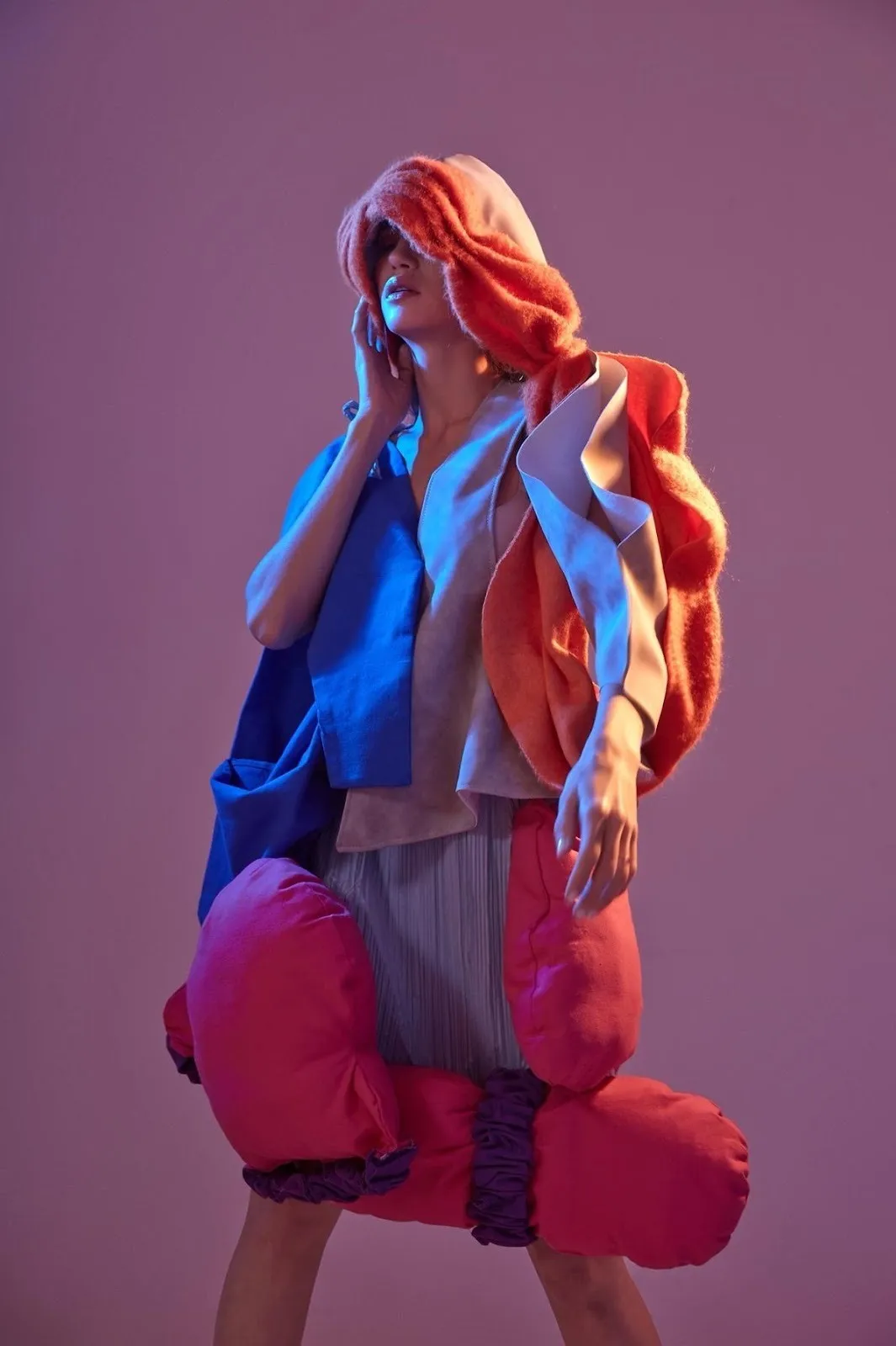
If Soft Armor considers psychological boundaries, Backup tackles a more physical erosion: the gradual collapse of posture under modern routines. Hou elevates the posture corrector - an object usually hidden or confined to private spaces - into a visible design language. Drawing from the mechanics of historical corsetry, she transforms restriction into support.
"I am interested in transformation," Hou explains. "I want the body to feel held without the garment announcing its function".

Using body scanning and Clo3D, Hou develops an internal support system that subtly guides the spine into alignment. The traditionally ornamental embroidery is placed along the spinal column, becoming a visual and structural reminder. She strips away the clinical awkwardness of the brace and the oppressive history of the corset, arriving at a new equilibrium: a "backup" system for the exhausted urban body that disciplines gently, almost imperceptibly, like an embrace.
Technology follows the same logic in Hou's design, which is shaped around the needs of the body and deeply rooted in empathy for the human condition. This is evident in her work with cooling garments, where she challenges the assumption that thermal regulation belongs solely to performance wear. By reinterpreting traditional weaving structures through digital modelling, Hou creates textiles and garments that improve airflow and comfort in contemporary fashion. She builds digital representations of fiber and yarn systems that mirror real-world physics, ensuring that her digital innovations translate into physical comfort.

In a crowded fashion landscape, Xinyu stands apart through a rigorous design language that is closely attuned to the realities of the body. Technology and function are handled with restraint, empathy, and clear intent, embedded into garments in ways that feel natural. She is answering a question the industry has often sidestepped: how wellbeing can become an integral part of how clothing is worn, inhabited, and experienced on a daily basis.
Hou's vision points toward a more deliberate evolution within fashion - one in which innovation is assessed through structural intelligence and cultural sensitivity. Form, cultural memory, and body are brought into alignment, so that function and elegance are experienced as one. In doing so, she gestures toward a future for fashion in which style, care, and lived experience are inseparable.
Stay up-to-date with exclusive events and content.


