F L A U N T


The contemporary smart-glasses market often treats the face as unfinished hardware. Temples grow bulkier, components remain exposed, and notifications compete for space within the wearer’s field of vision. Technology becomes the protagonist, while the person behind it risks being reduced to a walking terminal.
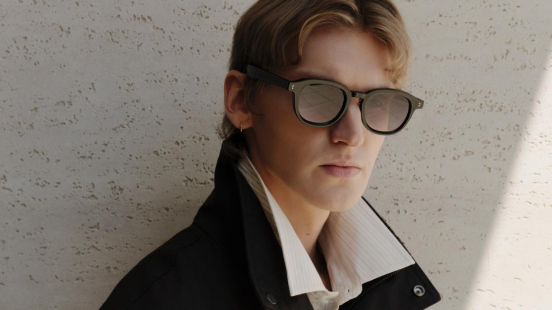
< Sutyo > proposes subtraction instead. The independent eyewear brand rejects both the screen-on-your-face aesthetic and the passive logic of automatic light adjustment. Its electrochromic lenses are controlled manually through ONE SLIDE, a gesture that allows the wearer to adjust tint with a finger rather than surrendering the decision to an ambient light sensor.
The < Sutyo > philosophy, “Light as Form,” begins with a different question: What if technology could shape an experience without announcing its presence? Beneath the lines of a minimalist Wellington frame, the brand conceals the microcurrent system powering its ColorShift and LightShift lenses. No exposed electronic components interrupt the silhouette. Until the wearer slides a finger along the temple and the lenses begin to change, the technology remains hidden.
This disappearance is central to < Sutyo >’s interpretation of quiet luxury. Restraint is expressed not only through materials and form, but through the decision to let sophisticated technology recede into the background. The eyewear resembles a premium acetate frame rather than a wearable device, allowing the wearer’s identity to remain more visible than the mechanism.
ColorShift enables the lenses to move between two hues, allowing the wearer to alter their visual tone in relation to a mood, outfit, or setting. LightShift offers stepless manual control of the tint depth. Both operate across the Cat.1–Cat.3 range, with LightShift adjusting light transmittance smoothly across changing conditions.
Unlike conventional photochromic lenses, which respond automatically to sunlight, < Sutyo >’s electrochromic lenses react to a microcurrent directed by the wearer. ONE SLIDE is built into the frame, removing the need for apps, buttons, or additional accessories. The gesture is deliberately simple, but its philosophy is more pointed: the environment does not decide how the wearer sees it.
Where other smart eyewear attempts to place more information in front of the eye, < Sutyo > focuses on controlling what already reaches it: light. A bright street-style photography scene can give way to the subdued atmosphere of a front-row show, or an office can transition into an evening event, without requiring the wearer to exchange frames or wait for a sensor to interpret the setting.
The shift changes more than light transmission. Color and darkness influence how a space is perceived, and the manual gesture allows the wearer to choose the filter through which that space is encountered. Here, technology does not attempt to predict a person’s needs. It waits for instruction.
This rejection of “sensor dictatorship” places agency back at the center of the design. The wearer is not asked to adapt to a device or accept an automated decision. Instead, the lenses become responsive to intention, making the hand, the eye, and the surrounding light part of the same exchange.
The brand’s emphasis on concealment extends to its materials. The frames are made from 100% bio-based nylon derived from castor seed oil sourced from Pragati Farms in Gujarat, India. According to < Sutyo >, the oil is extracted through a cold-pressed mechanical process without petrochemical solvents, while the frame material can be recovered and regenerated through the Virtucycle® program.
Rounded edges and a full-rim Wellington silhouette keep the design familiar, creating a deliberate contrast with the technology hidden inside it. The frame does not perform futurism through an exaggerated shape. Its innovation is revealed only in use.
< Sutyo > also offers prescription lens services for different vision needs. According to the brand, each prescription lens is precision-cut and hand-assembled in its dedicated optical laboratory before being shipped directly to the wearer. This allows the electrochromic system to function as everyday eyewear rather than as a separate technological accessory.
Even with its technology concealed, the frame does not compromise on everyday function: full UV400 protection, IPX4 waterproof, magnetic charging, up to 10 days of standby power, and Rx-ready support, all crafted for all-day comfort in a sustainable bio-based frame.
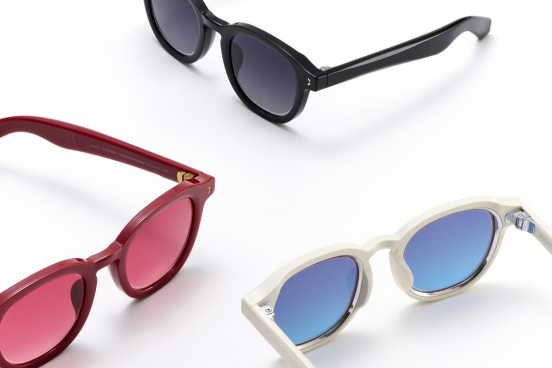
The brand’s four styles, Prism Veil, Aurora Fade, Pitch, and Oxide, interpret the same concealed technology through distinct visual languages.
Prism Veil draws on the gradients of natural light, using pale tones and softly luminous finishes. Aurora Fade takes its cues from the changing colors of opal, bringing a more expressive surface treatment to the frame and lenses. Pitch approaches the Wellington form through cleaner lines and a more restrained, formal sensibility. Oxide introduces sharper geometry and a more architectural profile.
Across the collections, the technology remains deliberately quiet. That may be < Sutyo >’s more forward-looking proposition: not that eyewear needs to do everything, but that it can perform one transformation precisely and then disappear again. In an era of feature overload, the most human-centered device may be the one that knows when to step out of view.
Stay up-to-date with exclusive events and content.


