F L A U N T


As digital products become more powerful, they also become harder to understand. Enterprise platforms, AI-enabled tools, complex systems, and technical software often ask users to move through layered information, permissions, settings, and decisions. In these spaces, design is not only about how a product looks. It is about how people understand what they are seeing, what they can do, and why their next step matters.
Lingjie Guo, a Los Angeles-based UX designer, works in this space between complexity and comprehension. Her practice focuses on complex digital products, accessibility, information architecture, design systems, and human-centered technology. Rather than treating user experience as a surface layer, Guo approaches design as a structural discipline. Her work asks how digital systems can become clearer, more accessible, and more trustworthy for the people who rely on them.
Guo’s professional experience includes work across technical product environments where users must complete complex tasks with accuracy and confidence. The direction of her practice is clear. She designs for systems where hierarchy, guidance, consistency, and accessibility directly affect how users move through information.
“For me, clarity is not the same as simplification,” Guo says. “Many technical products are complex because the work behind them is complex. The goal is not to erase that complexity. The goal is to organize it so users can understand the system, make decisions, and move forward with confidence.”
This point of view has shaped Guo’s work on enterprise and technical product experiences. In these environments, a weak interface can create more than aesthetic problems. It can increase cognitive load, slow down decision-making, and make important actions harder to identify. Guo’s design approach begins with structure: understanding user roles, task paths, information relationships, and reusable patterns. From there, she creates experiences that help users interpret complex systems without being overwhelmed by them.
A central part of Guo’s practice is accessibility. She sees accessibility not as a final compliance step, but as a core design principle. Contrast, hierarchy, navigation, language, spacing, interaction states, and content structure all shape whether a product can be used and understood by a wider range of people. In technical products, accessibility is also connected to trust. When users can clearly read, scan, compare, and act, the system becomes more usable and more reliable.
Guo’s work with design systems extends this thinking beyond individual screens. A strong design system can help teams build with greater consistency, reduce repeated work, and support more accessible product decisions over time. For Guo, this kind of system-level work is one of the most meaningful parts of UX design. It turns design principles into repeatable standards. It also helps product teams create clearer experiences at scale.
Beyond her work on enterprise products and complex systems, Lingjie Guo has increasingly focused on a broader question within user experience design. Instead of concentrating only on functionality and efficiency, she is interested in how technology influences the way people understand each other. As digital tools become more advanced, communication becomes faster and more convenient—but does that necessarily mean people are connecting on a deeper level?
This question inspired the creation of EmpaSee, a platform that combines VR and AI to help people develop empathy.
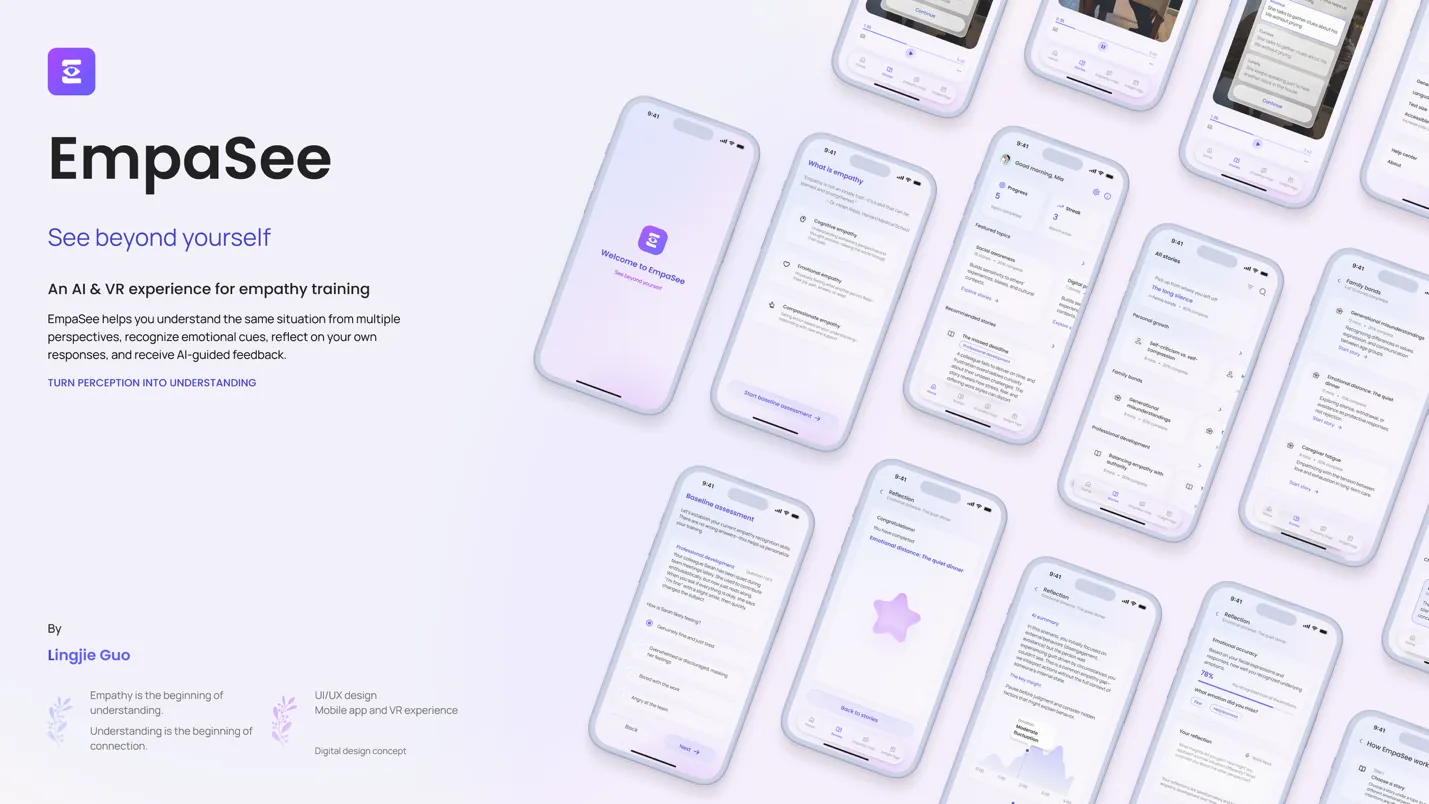
Unlike traditional empathy training, which often relies on reading materials, case studies, or classroom discussions, EmpaSee allows users to learn through direct experience. Using immersive VR simulations, users can step into someone else’s perspective and navigate emotionally challenging situations in settings such as family relationships, schools, healthcare environments, and workplaces. After each experience, AI-powered reflection tools help users review their responses, identify emotions they may have overlooked, and recognize possible biases in their thinking. The goal is to help people better understand both themselves and others.
The project was developed in response to a growing challenge in today’s digital world. While technology has become remarkably effective at processing information, genuine human understanding remains difficult to achieve. As remote work, online communication, and AI-assisted collaboration continue to expand, empathy and emotional intelligence are becoming increasingly important in education, healthcare, business management, and social services. Through immersive training and guided reflection, EmpaSee offers a new way to approach these challenges and highlights the role experience design can play in supporting emotional learning and social awareness.
Because of its innovation in human-centered technology and interaction design, EmpaSee received recognition from both the Indigo Design Award and the UX Design Awards. More importantly, the project demonstrates that artificial intelligence can do more than improve efficiency—it can also help people connect, communicate, and understand one another more effectively.
While EmpaSee focuses on understanding others, Guo’s second notable project, Recollect, explores a different but equally important topic: understanding ourselves.
Today, people have more tools than ever to record their lives. Photos, messages, notes, and digital archives continue to accumulate every day. Yet having more records does not necessarily mean having a better understanding of our experiences. Guo noticed that many digital products are designed to help users remember information, but very few are designed to help them make sense of it.
Recollect was created to address this gap.
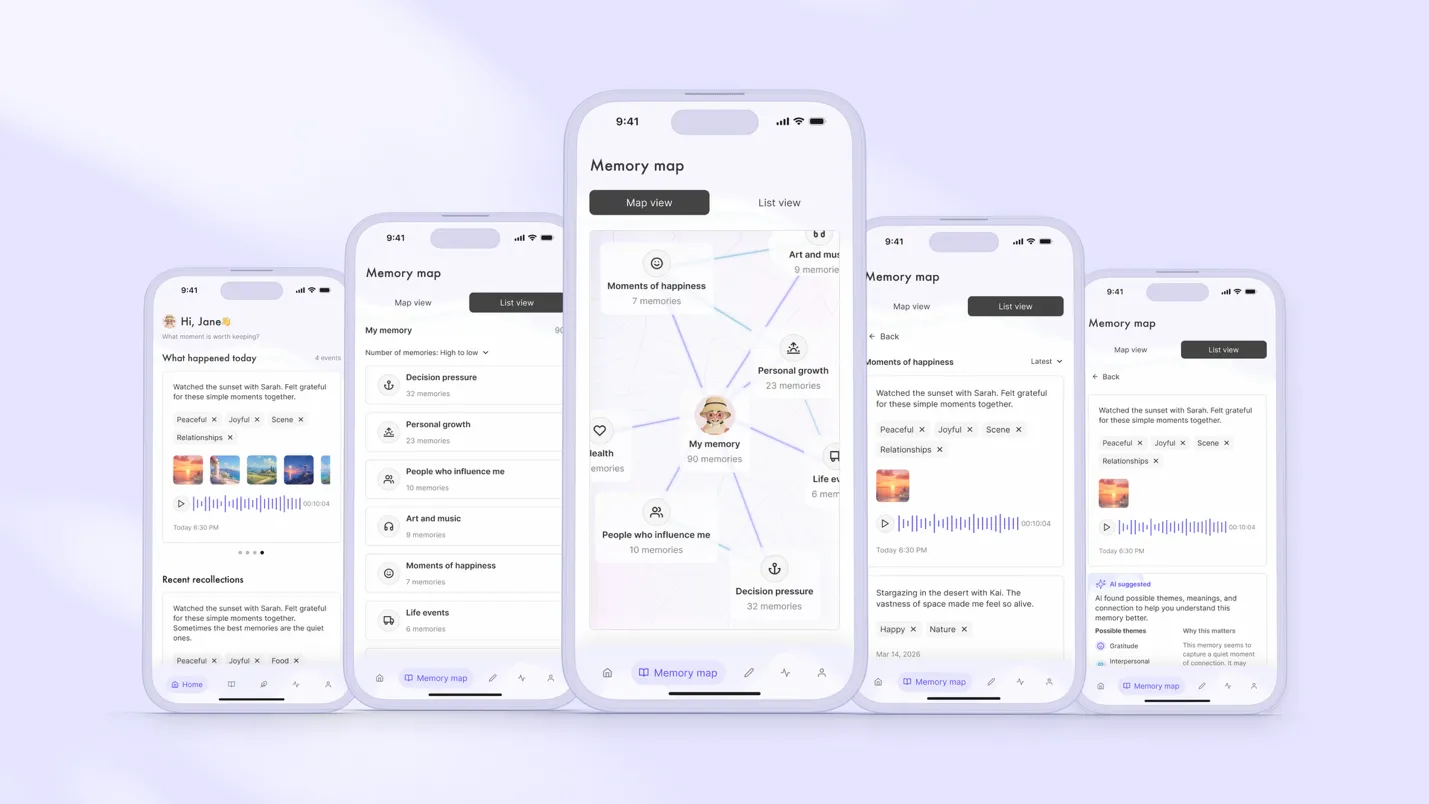
Rather than serving as another storage platform, Recollect encourages users to reflect on their experiences. Through features such as memory cards, emotional tags, and dynamic relationship mapping, the platform transforms fragmented memories into visual networks that reveal patterns, emotional trends, and personal growth over time. In this way, design becomes more than a tool for displaying information—it becomes a tool for self-discovery.
This perspective closely aligns with emerging conversations around digital well-being, cognitive experience design, and meaningful technology. For Guo, design is not simply about creating attractive interfaces or improving product features. It is about helping people better understand the world around them and gain deeper insight into themselves. Reflecting this vision, Recollect was selected for exhibition with CICA in the upcoming Humanity exhibition.
Although EmpaSee and Recollect focus on different challenges, both projects are built around the same core belief:
The greatest value of technology is not making systems more powerful—it is helping people become more aware, more thoughtful, and more capable of understanding.
This philosophy has gradually pushed Guo’s work beyond the traditional boundaries of user experience design. Rather than focusing only on task completion and usability, she explores how people process information, relate to others, and build self-awareness. As artificial intelligence continues to reshape everyday life, this human-centered approach to cognition and emotion is becoming an increasingly important direction for the future of experience design.
For the industry, Guo’s contribution goes beyond creating award-winning projects. Her work represents an alternative vision for the role of technology. At a time when many innovations aim to replace human abilities, she continues to explore how technology can strengthen them instead.
Stay up-to-date with exclusive events and content.


