F L A U N T


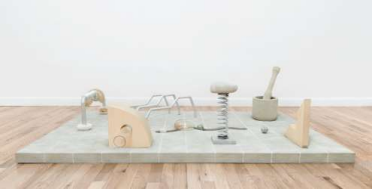
At first, “without knowing” looks almost approachable. There are pipes, tiles, a mortar and pestle, soft edges, small objects that might be pushed, pulled, sorted, touched. The work seems to borrow from places we already know: a playground, a kitchen, a therapy room, a care facility, the corner of a home where useful objects quietly collect.
Then the familiarity starts to slip.
.png)
In the collaborative project by Hyoju Cheon and Yixuan Wu unveiled at Fragment Gallery in New York, ordinary forms are not allowed to remain ordinary for long. Steel bends into something playful but not quite usable. A mortar and pestle become too large, too present, too strange. Hand-blown glass, glazed stoneware, wood, faux fur, straw, aquarium pebbles, and sand sit together on a tiled platform as if they belong to a system whose purpose has been partly remembered and partly forgotten.
Wu has been here before. The domestic objects, the care environments, the familiar thing that slowly stops making sense—these have moved through her work for years. What's new is Cheon beside her.
That in-between state is where the work lives. “without knowing,” presented as part of Hard Play at Fragment Gallery recently, marks Cheon and Wu’s first collaboration. At the center of the exhibition is the fidget board, an object that appears in more than one world. It can be a learning tool for children, a therapeutic device for elderly people, a sensory object, a memory aid, a toy, or an instrument of care. Cheon and Wu are interested in that overlap, especially in the way touch can become a method of learning.
.png)
There is also a quiet sense of unease running through the installation. Nothing looks threatening, exactly. The objects are too soft, too pale, too familiar for that. But they also refuse to behave like the things they resemble. A pipe becomes something to handle, but not quite a tool. A tiled surface recalls both a playground and an institution. A mortar and pestle suggest care, labor, medicine, and domestic routine all at once. Cheon and Wu let these associations overlap without resolving them. The viewer is left in a small delay between recognition and use, which is where the work becomes most interesting.
Flaunt sat down with Cheon and Wu to talk about spoons in fish tanks, steel pipes that don't quite function, and what the body knows before the mind catches up.
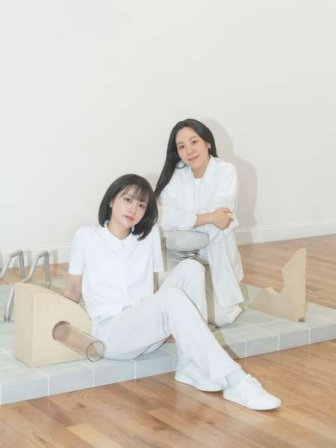
The project moves between two very different states: the child learning through play and the elderly person navigating memory loss. How do you think about that overlap between early learning and forgetting later in life?
Hyoju & Yixuan: Our collaboration began with examining the overlap between these two stages of life, since both are central to our individual fields of research. We look at objects of care and play, objects that become stranger through simple, daily use. The project came from our thoughts around the fidget board, a dual-purpose instrument that exists in both contexts: used by children
as a tool for learning and exploration, and by elderly individuals as an aid for memory support and cognitive exercise.
For a child, play is a way to make sense of the world through feeling, touching, observing, and small bodily movements. For an elderly person facing cognitive decline, a similar process can become necessary as a way to recall or retain information that has become less accessible. We
see these two stages as connected experiences. Both involve uncertainty, trial and error, repetition, and the body’s relationship to memory.
The installation uses materials such as steel, aluminum, hand-blown glass, glazed stoneware, wood, faux fur, straw, aquarium pebbles, and sand. How did you decide which materials belonged together, especially when some feel industrial and others feel bodily, fragile, or sensory?
Hyoju: The installation came out of an ongoing dialogue between our practices. We come from different sculptural backgrounds, so we brought different material instincts and different ways of making. For me, the project grew out of observations of playgrounds and public spaces. Materials such as steel pipes and sand refer to the structures and surfaces that shape some of our earliest experiences of play.
Yixuan: The tension between the “industrial” and the “fragile” is exactly what we wanted to work with. We are drawn to materials that seem contradictory. That comes from our shared interest in objects and instruments that support sensory learning and care. There is often a very specific logic behind those instruments: a rigid support system, then buffers, surface treatments, silicone grips that soften contact with the body, or sensory elements that invite interaction. We carried that kind of material tension into the project.
Because this is our first collaboration, the process also changed how we each think about material. Our individual approaches expanded the range of what the other person would normally consider. The current version of the work feels like a starting point, a way for us to begin building a shared vocabulary.
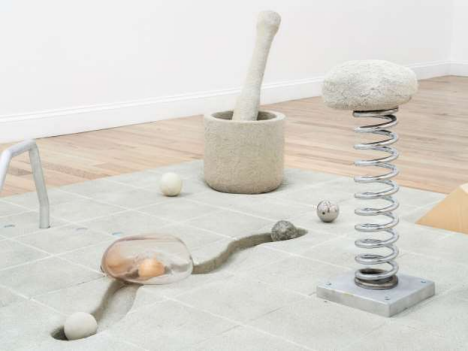
Hyoju Cheon & Yixuan Wu, “without knowing”, 2025-2026, aluminum, steel, hand-blown glass, glazed stoneware, wood, faux fur, straw, aquarium pebble, sand, 32 x 96 x 64 inches (81.3 × 243.8 × 162.6 cm) Courtesy of the artist and Fragment Gallery, Photo: Christopher Stach
Your practice has been described as reconstructing vignettes of domesticity into substructures. What does “domesticity” mean to you now? Is it a place, a memory, a behavior, a system, or a kind of emotional architecture?
Yixuan: “Domesticity” is less about a physical house than a structure of care, dependency, routine, and emotional maintenance. “Home” is where relationships are constantly negotiated through ordinary objects and repeated gestures. I think of home as an ecology of ordinary things that depend on one another: things we have acquired, used, lived with, and rearranged in pursuit of comfort and well-being. I am especially interested in what I call “care infrastructures”: assistive objects that support daily routines and are often overlooked until a need appears. A grab bar, a stepping stool, a padded edge, sensory toys. These objects can exist in both a home and an institutional care setting, but they mean different things depending on where they are and who is using them.
Through my work, I investigate the idea of “questioned comforts,” and how care itself can be designed, managed, and sometimes made strange.
Many of the objects in without knowing seem playful but also slightly difficult to understand. Is confusion important to the work? What do you think happens when viewers cannot immediately identify how an object should be used?
Yixuan: For me, confusion is just as important as clarity. I do not think objects should have fixed meanings. Their identities are contingent and relational: who gets to use them, and under what conditions?
My works often draw from past experiences caring for a family member with cognitive and memory difficulties. They are informed by moments when objects become dissociated, such as seeing someone drop a spoon into a fish tank. Objects are never defined entirely by the purposes they were manufactured for. They can become something else through use, confusion, memory, or need.
In without knowing, many of the objects are intentionally rendered somewhat equal, anonymous, and even institutional. That makes sense to me, since my personal works often revolve around environments of elderly care facilities. We try to remove obvious cues that suggest function or emotional association, while still leaving enough familiarity for the viewer to recognize something. We wanted to get at those moments of frustration when familiar objects become estranged, and when memory starts to fail.
.png)
Performance documentation on June 4 2026, Courtesy of the artist and Fragment Gallery, Video by Kai Miedendorp
.png)
Performance documentation on June 4 2026, Courtesy of the artist and Fragment Gallery, Video by Kai Miedendorp
The project deals with learning, memory, touch, and forgetting, but it does so through objects rather than direct narrative. Why is indirectness important to you?
Hyoju: Indirectness is important to us because memory, learning, and forgetting are rarely experienced as clear narratives. They appear through fragments, repetitions, gestures, and sensory experiences rather than direct explanation.
For Yixuan, indirectness also reflects the way memory often returns in fragments instead of complete stories. Objects become carriers of association, allowing personal and collective histories to emerge gradually rather than being explained all at once.
Although the installation is object-based, performance plays a crucial role in how the work is interpreted. We think of language itself as a material within the work. While developing the performance, we spoke with a friend who works in caregiving through art therapy, and many of the verbal prompts that appeared in the performance were inspired by those conversations. The phrases are mostly fragmented and recurring. They echo exercises commonly used in learning environments as well as care settings.
The narrative in the work exists in a nonlinear way. It takes shape through the performers’ engagement with the objects, their repeated actions, and the sporadic spoken words that become woven into the movements.
The title without knowing suggests uncertainty, intuition, and perhaps a kind of pre-verbal understanding. What does the title mean to you?
Yixuan: The title is intentionally direct. It points to the experience of moving through care, play, and memory without complete certainty. Both childhood learning and caregiving require forms of trust and improvisation that often happen before understanding arrives.
Hyoju: Both processes operate through uncertainty. In those disorienting circumstances, we begin to rely heavily on improvisation, which disrupts our usual relationships with space and the things around us. This idea of engaging with the unknown is then opened up further through the performative activities incorporated in the work.
The questions Wu has been asking for years have not changed. What without knowing offers is a new person to ask them with.
Stay up-to-date with exclusive events and content.


